
Indonesia’s Just Transition policy is ambitious, linking decarbonisation with jobs, equity, and growth, but its implementation reveals structural cracks. Governance instability, weak social financing, and fragmented policy execution threaten delivery.
For African and emerging markets, the lesson is clear: transition frameworks must move beyond energy targets to institutional coherence, social investment, and local ownership, before global capital dictates the terms of “green” development.
Balancing Climate Ambition With Social Reality
Indonesia’s Just Transition (JT) agenda is increasingly positioned as a flagship model for aligning climate ambition with economic development.
Anchored in the Just Energy Transition Partnership (JETP), the country has mobilised over $20 billion in initial commitments while targeting peak power-sector emissions by 2030 and net-zero by 2050.
However, beneath this progress lies a more complex reality. The transition is no longer about securing pledges; it is about execution. And execution, as Indonesia’s experience shows, is where most emerging markets will either succeed or fail.
At its core, Indonesia’s approach is built on a compelling premise: decarbonisation must not come at the expense of workers, communities, or economic stability.
However, translating that principle into policy coherence, financing structures, and institutional delivery remains uneven.
The Transition Risk No One Is Pricing
Indonesia’s Just Transition reveals a critical truth: climate ambition without institutional readiness creates systemic risk.
Despite strong policy articulation, implementation remains politically sensitive and operationally fragmented. Cabinet restructuring in 2024 disrupted governance continuity, forcing institutional realignment and knowledge transfer challenges across ministries.
More importantly, the transition remains narrowly framed. In practice, “Just Transition” is often reduced to an energy-sector agenda—leaving agriculture, industry, and transport largely outside its scope.
This creates a dangerous asymmetry: emissions reduction pathways are accelerating, but social and economic systems are not evolving at the same pace.
For investors and policymakers, this is the real risk—not whether transition happens, but whether it happens unevenly.
Interest: A System Under Strain
Indonesia’s transition architecture is sophisticated on paper but fragmented in execution.
Key Structural Realities
Area | Current Status | Implication |
|---|---|---|
Governance | Multiple task forces, evolving mandates | Coordination gaps and delays |
Financing | $20 billion committed vs >$97 billion needed by 2030 | Significant funding shortfall |
Social Investment | 0.2 billion allocated to social components | Underfunded equity dimension |
Data Systems | Fragmented and inconsistent | Weak evidence-based planning |
Subnational Capacity | Low awareness and alignment | Implementation bottlenecks |
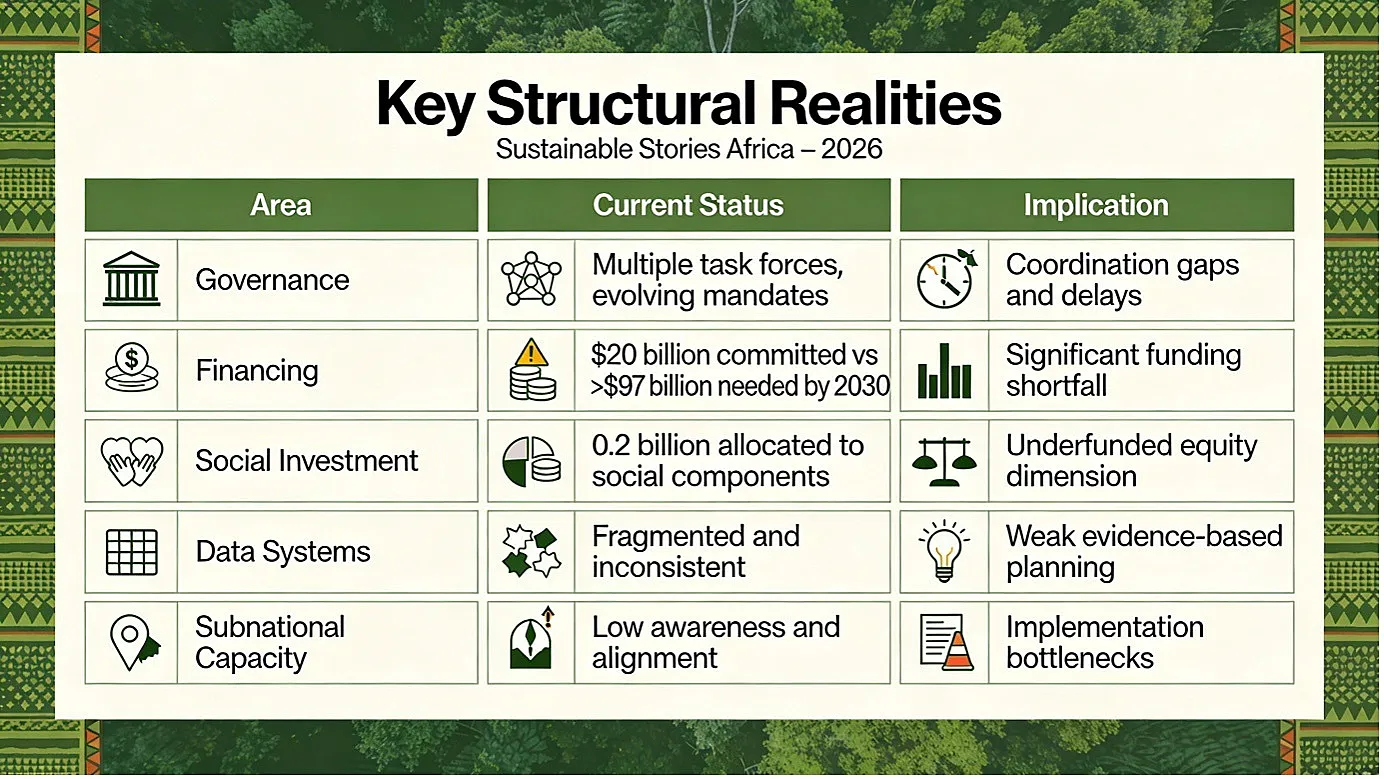
The numbers are revealing. While Indonesia requires approximately $97.1 billion in investment by 2030, current commitments cover only a fraction of that need.
Even more striking is the imbalance within financing itself. Social components, including reskilling, community protection, and labour transition, receive only marginal funding, despite being central to the “just” in Just Transition.
This imbalance reflects a broader global pattern: capital flows easily into infrastructure, but not into people.
What a Functional Just Transition Could Deliver
If Indonesia succeeds in closing these gaps, the upside becomes transformative, not just for the country but for emerging markets globally.
A fully operational Just Transition framework would:
- Stabilise labour markets through structured reskilling and green job creation
- Unlock inclusive growth by aligning climate policy with industrialisation strategies
- Strengthen investor confidence through predictable governance and policy clarity
- Reduce inequality by embedding social protection into climate action
Indonesia’s framework already hints at this potential. Its integration of climate targets with economic development, labour policies, and social safeguards represents a shift from “green growth” rhetoric to systems-level economic redesign.
However, the contrast is equally clear: without these reforms, transition risks reinforcing inequality, particularly in sectors such as critical minerals, where local communities bear environmental costs while global markets capture value.
From Policy Commitments To Delivery Systems
Indonesia’s experience points to a clear agenda for policymakers across emerging markets.
- Build Integrated National Frameworks – Transition policies must move beyond sector silos. Energy, labour, climate, and social protection systems need unified governance structures.
- Rebalance Financing Toward Social Outcomes – Grant-based and blended finance must prioritise:
- Workforce transition
- Community resilience
- Social protection systems
- Strengthen Subnational Capacity – Local governments are the frontline of transition, but remain under-resourced and under-informed.
- Institutionalise Social Dialogue – Worker representation and community participation must be embedded, not treated as optional.
- Fix Data Infrastructure – Without reliable, integrated data, transition planning becomes speculative rather than strategic.
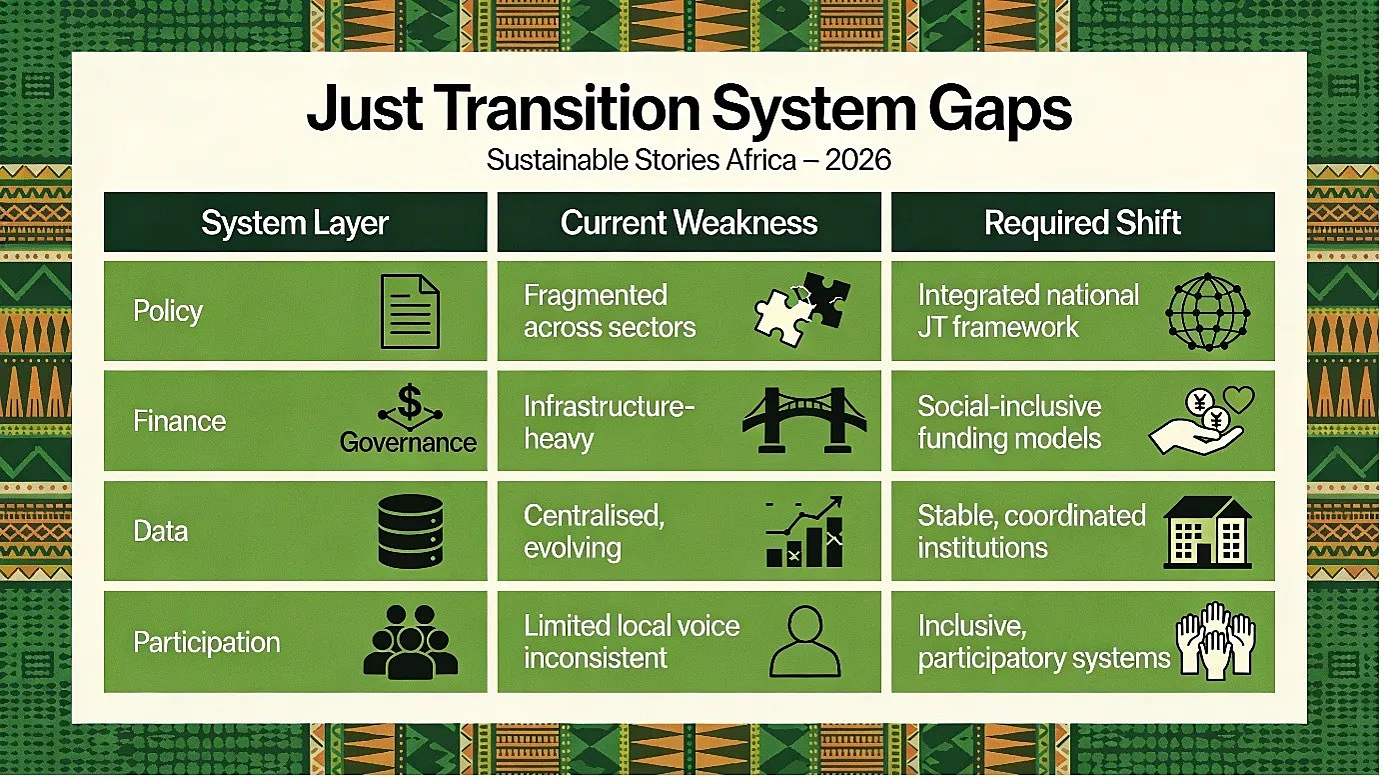
Just Transition System Gaps
System Layer | Current Weakness | Required Shift |
|---|---|---|
Policy | Fragmented across sectors | Integrated national JT framework |
Finance | Infrastructure-heavy | Social-inclusive funding models |
Governance | Centralised, evolving | Stable, coordinated institutions |
Data | Incomplete, inconsistent | Real-time, integrated platforms |
Participation | Limited local voice | Inclusive, participatory systems |
Path Forward – Align Systems, Not Just Targets
Indonesia’s experience shows that climate transition is no longer a technical challenge; it is an institutional one. Countries must align governance, finance, and social systems before scaling ambition.
For emerging markets, the priority is clear: build transition architectures that are locally owned, socially grounded, and financially balanced. Without this, climate ambition risks becoming another form of external dependency.
SSA Editorial Comment: Lessons For Africa
Indonesia’s Just Transition underscores a critical lesson for Africa: transition frameworks must be domestically anchored, rather than externally driven.
While global partnerships can mobilise capital, they often prioritise emissions outcomes over social equity.
African economies must design transition strategies that integrate labour markets, industrial policy, and social protection from the outset.
Equally, the Indonesian case highlights the risk of resource-driven transition pathways.
Africa’s critical minerals boom could replicate these patterns, in which global decarbonisation is achieved at the expense of local environmental and social costs.
Avoiding this requires stronger governance, equitable value chains, and deliberate policy choices that ensure communities benefit from the transition, rather than just endure it.