Unused medicines are quietly accumulating in households, farms, and hospitals, creating an invisible but escalating environmental threat.
A new UNEP report warns that without systemic disposal frameworks, pharmaceutical pollution could deepen antimicrobial resistance, contaminate food systems, and undermine global health gains.
Medicines, Waste, and System Failure
Medicines are designed to heal, but when mismanaged, they can harm.
Across the world, unused pharmaceuticals, whether expired, overprescribed, or improperly discarded, are increasingly entering ecosystems through landfills, wastewater, and open-space burning.
The consequences are far-reaching: environmental contamination, rising antimicrobial resistance (AMR), and growing public health risks.
The United Nations Environment Programme’s report, Safe Disposal of Unused Medicines: A One Health Approach for National Systems, reframes the issue as a systemic governance challenge, rather than a technical waste problem.
For Africa and other emerging markets, where healthcare access is expanding, but waste systems remain fragmented, the risks are magnified.
Pharmaceuticals are becoming a new class of persistent, complex, and largely unregulated pollutants.
The core question is no longer whether medicines are essential, but whether systems exist to manage them safely after use.
A Health Solution Becoming an Environmental Risk
Up to 50% of household medicines globally end up as waste, a staggering inefficiency that directly contributes to environmental exposure.
At the same time, global consumption of medicines continues to rise, driven by population growth, ageing societies, and expanding healthcare access, thereby intensifying the volume of unused pharmaceuticals entering the environment.
The consequences are already visible:
- Pharmaceutical residues detected in water, soil, and food systems
- Increased risk of endocrine disruption and toxicity
- Acceleration of antimicrobial resistance, linked to 1.27 million deaths annually
Improper disposal practices, such as flushing medicines into drains, dumping them in landfills, or burning them in low-temperature facilities, are central drivers of this crisis.
This is not just waste mismanagement. It is a systemic leakage of chemicals into the biosphere.
Mapping the Pharmaceutical Pollution Pathway
The UNEP report identifies three primary sectors driving unused medicine accumulation:
- Households and municipal systems
Healthcare facilities and pharmacies
- Agriculture and veterinary use
These sectors feed into a complex environmental pathway.
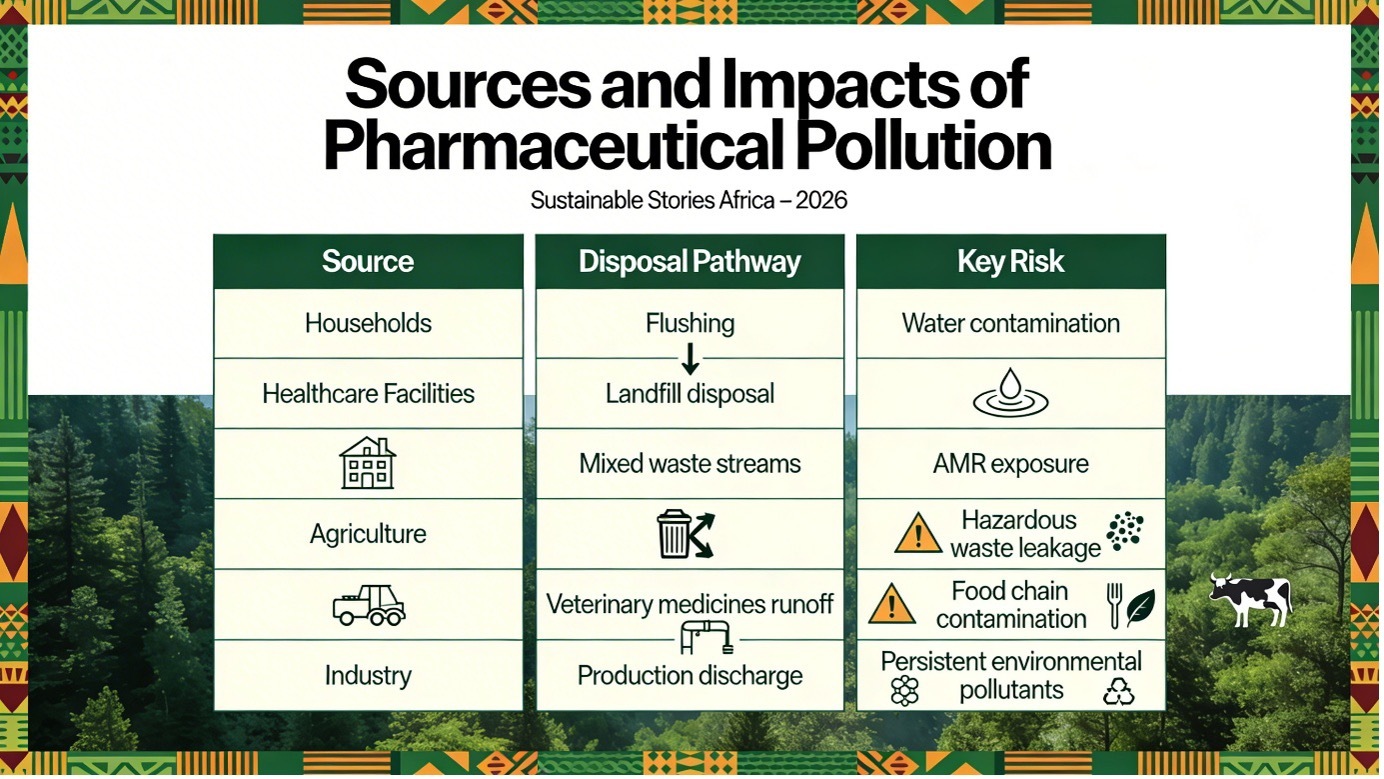
As illustrated in the diagram on page 4, pharmaceuticals move from production and consumption into wastewater systems, landfills, and incineration processes, ultimately contaminating surface water, groundwater, and soil.
Sources and Impacts of Pharmaceutical Pollution
Source | Disposal Pathway | Key Risk |
|---|---|---|
Households | Flushing, landfill disposal | Water contamination, AMR exposure |
Healthcare Facilities | Mixed waste streams | Hazardous waste leakage |
Agriculture | Veterinary medicines runoff | Food chain contamination |
Industry | Production discharge | Persistent environmental pollutants |
Beyond environmental risks, the economic costs are also significant. Discarded medicines represent millions of dollars in lost value annually, while disposal costs can range from $600 to $790 per tonne in developed markets.
In lower-income countries, the burden is even heavier, combining financial loss with weak infrastructure and regulatory gaps.
A System That Protects Health and the Environment Together
The UNEP report proposes a “One Health” approach, recognising the interconnectedness of human, animal, and environmental health.
At its core is a shift from reactive disposal to preventive system design.
If implemented effectively, this approach could:
- Reduce pharmaceutical pollution at source
- Lower AMR risks and healthcare costs
- Improve public safety and food system integrity
- Create new markets in waste management and circular health systems
There are already signals of success. Countries with structured take-back systems and Extended Producer Responsibility (EPR) models have reduced public costs while improving environmental outcomes.
For Africa, this presents a dual opportunity:
- Strengthen health systems alongside environmental governance
- Build new industries around pharmaceutical waste management
The transition is not just about compliance; it is about redesigning how medicines move through the economy.
Building National Systems That Work
The UNEP framework identifies four core pillars for effective management, as outlined in the infographic on page 9:
Four Pillars of Safe Medicine Disposal
Pillar | Core Focus | Strategic Outcome |
|---|---|---|
Waste Prevention | Reduce overuse, improve prescribing | Lower waste generation |
Take-Back Systems | Structured collection and disposal | Safe recovery of unused medicines |
Legal & Policy Frameworks | Regulation, accountability, EPR systems | System-wide governance |
Awareness Raising | Public education and stakeholder engagement | Behavioural change |
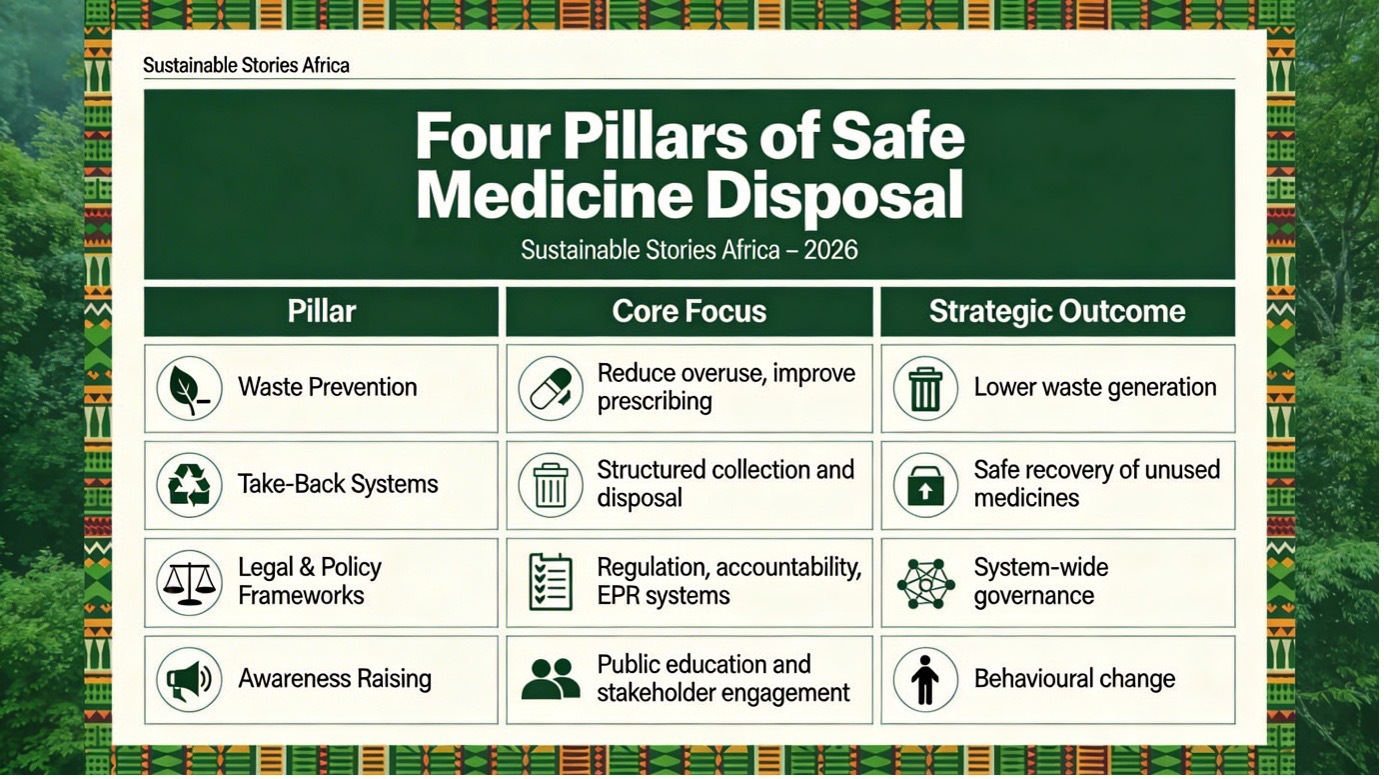
Each pillar is interdependent, and failure in one weakens the entire system.
Key actions include:
- Establishing national take-back schemes across households, farms, and healthcare facilities
- Integrating veterinary medicines into disposal frameworks to prevent cross-sector contamination
- Implementing Extended Producer Responsibility (EPR) to shift costs from governments to manufacturers
- Strengthening regulation and enforcement, particularly in waste classification and treatment
- Leveraging digital tools to track medicine use and disposal patterns
Crucially, prevention remains the most cost-effective strategy. Measures such as better prescribing practices, improved diagnostics, and smaller packaging sizes can significantly reduce waste generation at source.
Path Forward – Design Systems, Not Just Disposal
Safe medicine disposal must move from fragmented interventions to integrated national systems. Governments, producers, and healthcare providers must align incentives, regulations, and infrastructure to close the pharmaceutical lifecycle loop.
For Africa, the priority is clear: build systems that prevent waste, capture unused medicines, and protect ecosystems. Done right, this is not just an environmental fix; it is a public health safeguard and an economic opportunity.