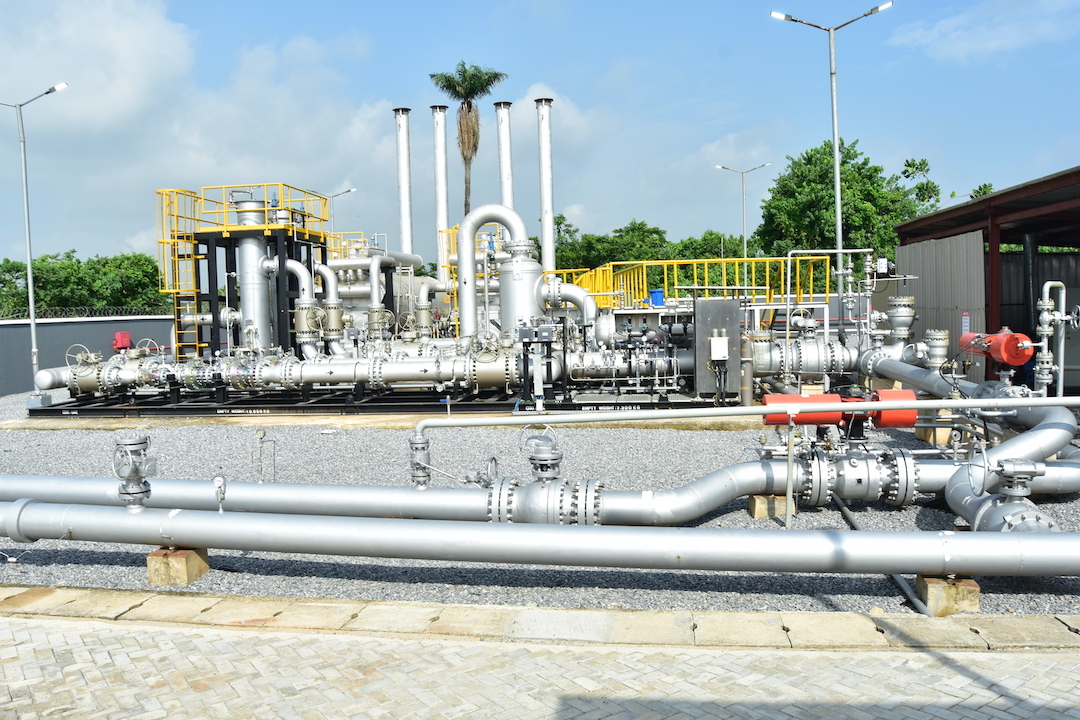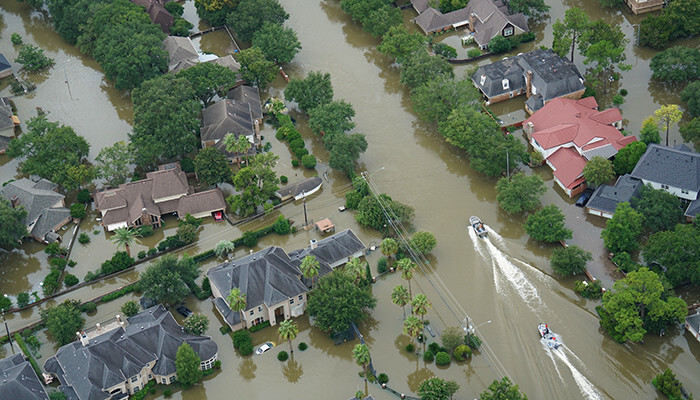
Climate risk is no longer a sustainability footnote; it is now a core financial variable shaping corporate decision-making.
Across African markets, CFOs should be embedding climate scenarios into risk, governance, and capital allocation models.
The shift signals a deeper transition: from ESG compliance to financial materiality.
The question is no longer whether climate risk matters, but how it is quantified, priced, and acted upon.
Finance Meets Climate Reality Shift
Across boardrooms in Lagos, Nairobi, and Johannesburg, a quiet but consequential shift is underway. Climate risk, once treated as a corporate social responsibility concern, is becoming a core of financial modelling, forcing chief financial officers (CFOs) to rethink how value is created, preserved, and measured.
The implications are structural. For African markets already navigating currency volatility, infrastructure gaps, and energy transitions, climate risk introduces a new layer of uncertainty, one that directly affects revenue stability, cost structures, asset valuations, and access to capital.
What is emerging is a new financial architecture. Governance, risk management, scenario analysis, and capital allocation are no longer siloed processes; they are becoming interconnected levers through which climate risk is translated into financial outcomes.
This evolution, reflected in frameworks outlined in the linked infographic, signals a turning point for corporate finance across emerging markets.
Climate Risk Becomes a Financial Variable
A growing body of evidence suggests that climate risk is already reshaping corporate financial performance.
Extreme weather events, regulatory shifts, and transition risks are translating into measurable financial impacts, higher operating costs, stranded assets, and rising cost of capital.
For CFOs, the shift is immediate and material. Climate risk is now being embedded into four core financial pillars:
- Governance – Board-level oversight of climate-related financial risks
- Risk Management – Identification, assessment, and quantification of climate exposure
- Scenario Analysis – Stress-testing business models under different climate futures
- Capital Allocation – Redirecting investments toward resilience and low-carbon opportunities
The outcome is a direct link to financial metrics, revenue, costs, assets, cost of capital, and enterprise value, transforming climate risk from a qualitative disclosure into a quantitative driver of corporate performance.
From ESG Reporting to Financial Modelling
The integration of climate risk into CFO models reflects a broader regulatory and market shift.
Frameworks such as IFRS Sustainability Disclosure Standards (S1 and S2), alongside evolving national guidelines, are pushing companies toward decision-useful, financially material disclosures.
For African corporates, this transition is unfolding against a complex backdrop:
- Energy transition pressures – With over 80 million Nigerians lacking reliable electricity, investments in gas, solar, and mini-grids are accelerating.
- Capital constraints – Africa requires an estimated $410 billion to meet net-zero ambitions by 2060, intensifying the need for efficient capital allocation.
- Regulatory evolution – Markets are moving from voluntary ESG reporting toward phased mandatory disclosure regimes.
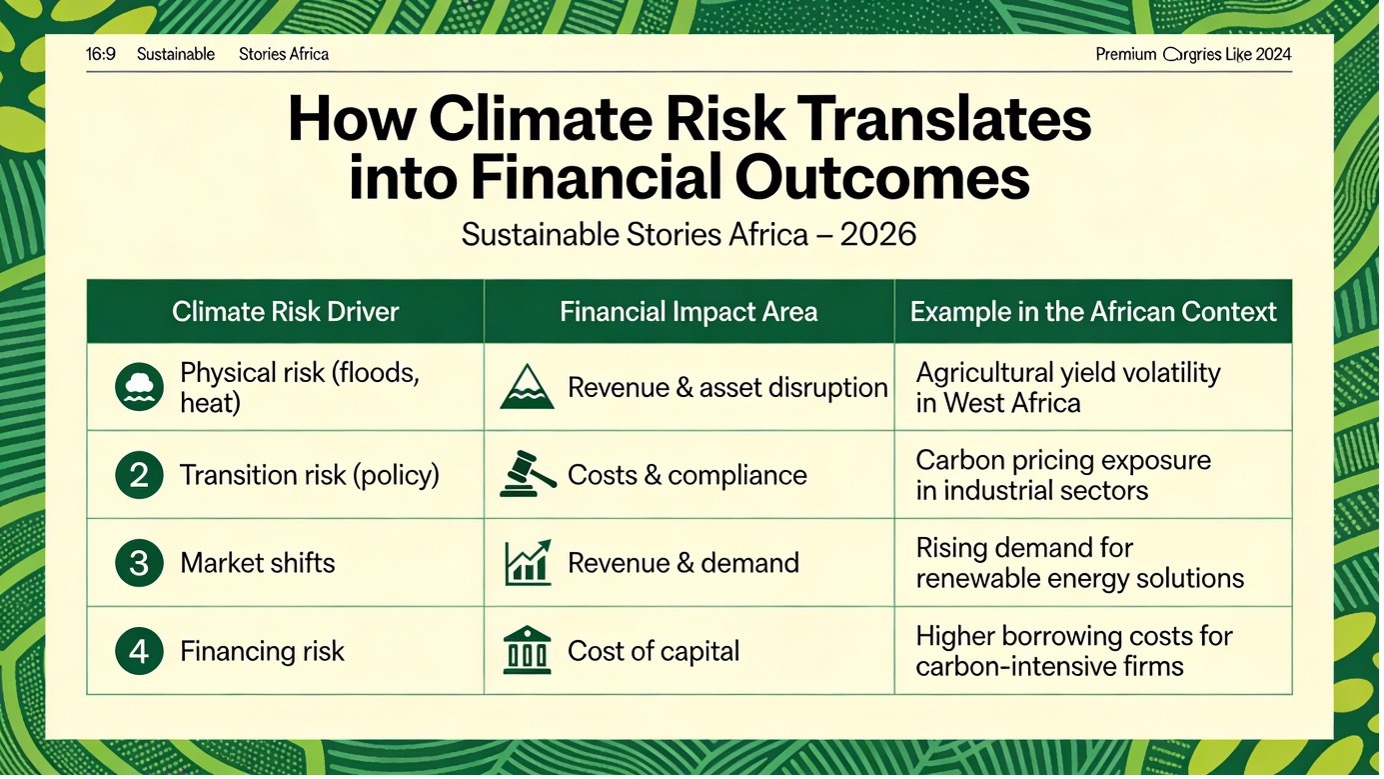
How Climate Risk Translates into Financial Outcomes
Climate Risk Driver | Financial Impact Area | Example in the African Context |
|---|---|---|
Physical risk (floods, heat) | Revenue & asset disruption | Agricultural yield volatility in West Africa |
Transition risk (policy) | Costs & compliance | Carbon pricing exposure in industrial sectors |
Market shifts | Revenue & demand | Rising demand for renewable energy solutions |
Financing risk | Cost of capital | Higher borrowing costs for carbon-intensive firms |
At the firm level, scenario analysis is becoming a critical tool. CFOs are increasingly modelling outcomes from different climate pathways, ranging from orderly transitions to delayed or disorderly scenarios, to test the resilience of their business models.
This is particularly relevant for sectors such as energy, banking, agriculture, and infrastructure, where climate exposure is both direct and systemic.
Unlocking Strategic and Financial Advantage
While climate risk introduces new uncertainties, it also creates strategic opportunities. Companies that integrate climate considerations early into financial models are better positioned to:
- Access cheaper capital – Investors are increasingly rewarding firms with credible climate strategies
- Enhance resilience – Climate-informed planning reduces exposure to shocks
- Capture new markets – Renewable energy, green finance, and circular economy sectors are expanding rapidly
- Strengthen enterprise value – Long-term valuation improves with reduced risk premiums
In African markets, this opportunity is particularly pronounced. The continent’s relatively low historical emissions, combined with high growth potential, position it as a frontier for climate-aligned investment.
Consider the financial implications:
- Firms adopting climate-informed capital allocation are more likely to attract development finance and ESG-linked funding
- Banks integrating climate risk into lending models can reduce portfolio-level default risk
- Infrastructure investors can unlock long-term value through climate-resilient assets
The shift, therefore, is not just defensive; it is fundamentally about value creation.
What CFOs, Regulators, and Markets Must Do Next
The transition from ESG reporting to climate-integrated financial modelling requires coordinated action across multiple stakeholders.
- For CFOs and Corporations
- Embed climate risk into enterprise risk management frameworks
- Develop internal carbon pricing mechanisms to guide investment decisions
- Invest in data systems and analytics for climate scenario modelling
- Align disclosures with IFRS S1 and S2 standards
- For Regulators
- Accelerate the transition from voluntary to mandatory climate disclosures
- Provide clear taxonomies and reporting guidance
- Support capacity building for companies transitioning to new standards
- For Financial Institutions
- Integrate climate risk into credit risk assessment models
- Expand green finance products and sustainability-linked instruments
- Strengthen stress-testing frameworks for climate-related shocks
- For Investors
- Demand decision-useful climate disclosures
- Price climate risk into valuation and portfolio allocation decisions
- Support companies transitioning toward low-carbon business models
CFO Climate Risk Integration Framework
Pillar | Key Action | Financial Outcome Impacted |
|---|---|---|
Governance | Board oversight on climate risk | Enterprise value stability |
Risk Management | Climate risk quantification | Cost control, asset protection |
Scenario Analysis | Climate stress-testing | Revenue and resilience forecasting |
Capital Allocation | Climate-informed investment | Cost of capital, growth potential |
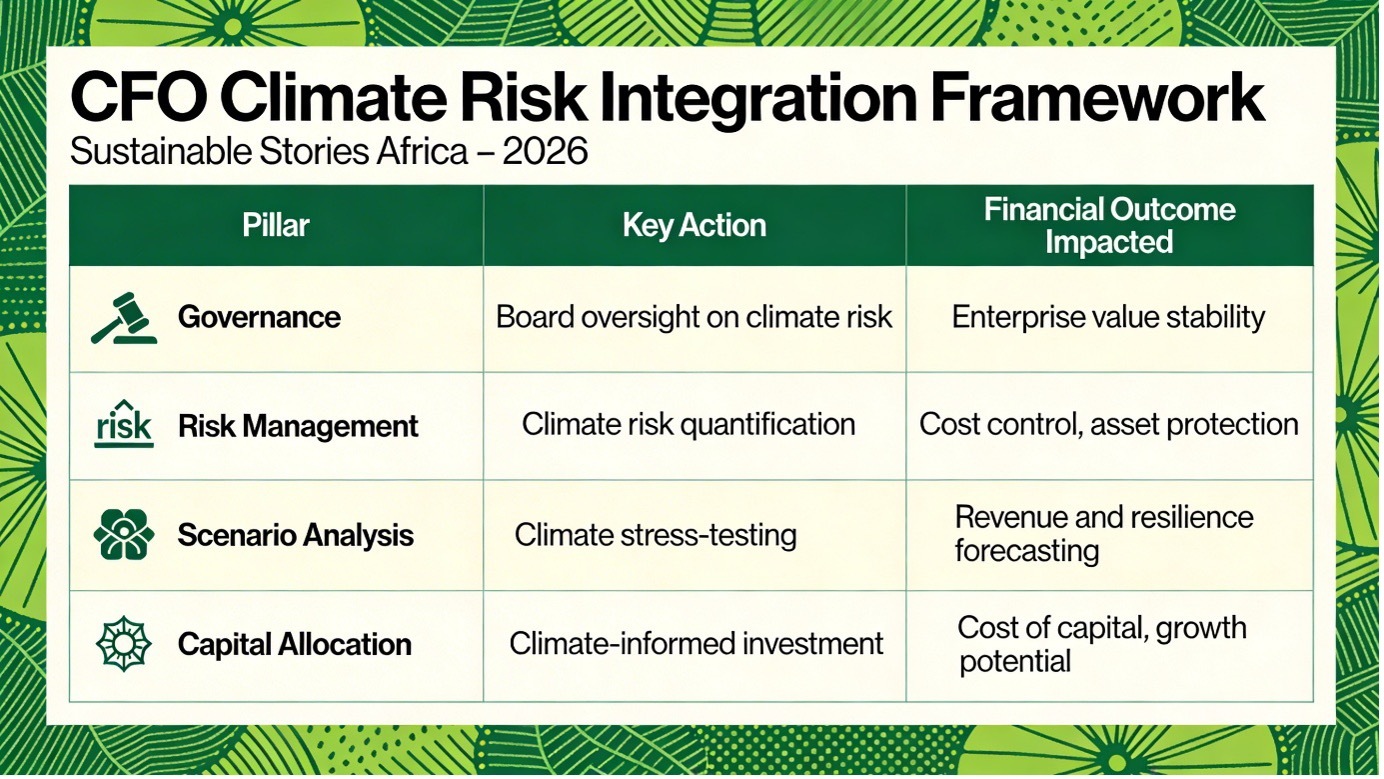
The message is clear: climate risk integration is no longer optional; it is a financial imperative.
Path Forward – Finance Meets Climate Discipline
Climate risk is becoming embedded in the DNA of corporate finance. CFOs who integrate it into governance, risk, and capital allocation will shape more resilient and competitive businesses.
For African markets, the priority is clear: build capacity, standardise disclosures, and align capital flows with climate realities, turning risk into a lever for sustainable growth and long-term value creation.