Across African markets, ESG is shifting from a reporting obligation to a strategic decision-making framework.
Five core decisions, including spanning capital, supply chains, governance, innovation, and transparency, are emerging as the true test of whether sustainability is embedded in business models or remains surface-level compliance.
Five Decisions, One Strategic Imperative
Sustainability is no longer measured by what companies say, but by the decisions they make.
Across Africa’s rapidly evolving corporate landscape, ESG is moving beyond disclosures into the heart of strategy, shaping how firms allocate capital, design products, manage risks, and communicate performance.
This significance is shaped by a convergence of forces, including tightening global standards, rising investor expectations, and growing exposure to climate and social risks.
For African businesses, the stakes are particularly high, as ESG alignment increasingly determines access to capital, trade competitiveness, and long-term resilience.
At the centre of this transformation are five critical ESG decisions that every serious organisation must confront. Together, they define whether sustainability becomes an operational reality or remains an aspirational narrative.
ESG Becomes Real at Decision Level
“ESG becomes real when it influences business decisions.”
This principle is fast becoming a defining benchmark across global and African markets.
While over 80% of large firms now publish sustainability reports, far fewer integrate ESG into core decision-making processes such as capital allocation or product design.
The result is a widening gap between ESG disclosure and ESG performance.
The five ESG decisions framework provides a practical lens to assess this gap:
Decision Area | Core Question | Strategic Implication |
|---|---|---|
Capital Allocation | Are ESG risks priced into investments? | Determines long-term financial resilience |
Supply Chain Standards | Are suppliers aligned with ESG values? | Impacts operational and reputational risk |
Product & Service Design | Does sustainability shape innovation? | Drives competitiveness and new markets |
Governance Accountability | Who owns ESG outcomes? | Defines execution credibility |
Transparency | How openly are risks disclosed? | Builds trust and investor confidence |
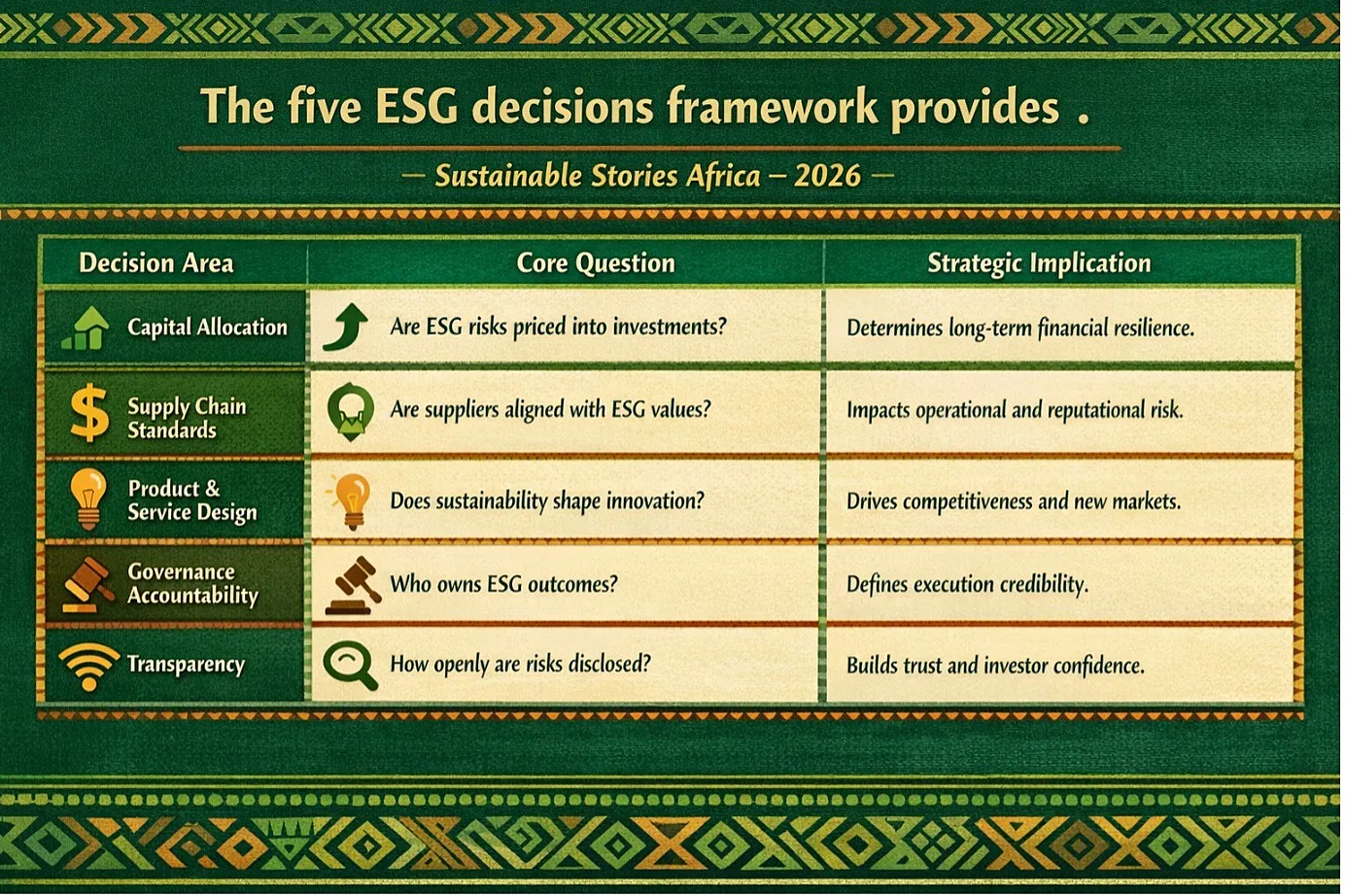
What is happening now is a decisive shift: ESG is moving from reporting frameworks to decision frameworks.
The Five ESG Decisions Explained
Capital Allocation – Pricing Sustainability into Investment Decisions
The most fundamental ESG decision lies in how organisations allocate capital.
Forward-looking firms are embedding sustainability into investment appraisals, factoring in carbon costs, climate risks, and social impact. This includes:
- Redirecting capital toward renewable energy and green infrastructure
- Integrating climate scenario analysis into project evaluation
- Prioritising long-term resilience over short-term returns
African signal: Development finance institutions and commercial banks are increasingly linking financing terms to ESG performance, including sustainability-linked loans.
Supply Chain Standards – Balancing Cost and Responsibility
Supply chains are emerging as one of the most complex ESG battlegrounds.
Companies must decide whether to prioritise cost efficiency or sustainability standards, particularly around labour practices, environmental compliance, and sourcing transparency.
Key challenges in Africa:
- Informal supply chains with limited traceability
- Weak enforcement of labour and environmental standards
- Pressure from global buyers to meet ESG benchmarks
Leading firms are responding by:
- Implementing supplier ESG audits
- Investing in supplier capacity building
- Digitising supply chain tracking
Product and Service Design – Embedding Sustainability into Innovation
This decision reflects whether sustainability drives innovation or remains peripheral.
Organisations with advanced ESG strategies are redesigning products and services to reduce environmental impact and meet emerging market demands.
Examples:
- Renewable energy solutions tailored to off-grid communities
- Financial products supporting climate resilience
- Circular economy models reducing waste
This is where ESG transitions from cost management to revenue generation.
Governance Accountability – Defining Ownership of ESG
Without clear accountability, ESG strategies fail in execution.
This decision centres on who is responsible for sustainability outcomes—and whether governance structures support delivery.
Best practices include:
- Board-level ESG committees
- Linking executive compensation to ESG performance
- Integrating ESG into enterprise risk management
African trend: Regulators and investors are increasingly scrutinising governance structures in ESG assessments.
Transparency – Communicating Risks and Trade-offs
Transparency is no longer optional; it is a strategic necessity.
Organisations must decide how openly they communicate:
- Sustainability risks
- Trade-offs between profit and impact
- Progress against ESG targets
Emerging reality:
- Global standards (e.g., IFRS S1 and S2) are raising disclosure expectations
- Investors are demanding decision-useful data, not narrative reports
Transparency builds trust, but also exposes weaknesses, making it a critical and often difficult decision.
Unlocking Value Through ESG Decisions
When these five decisions are aligned, the benefits extend across the entire economic system.
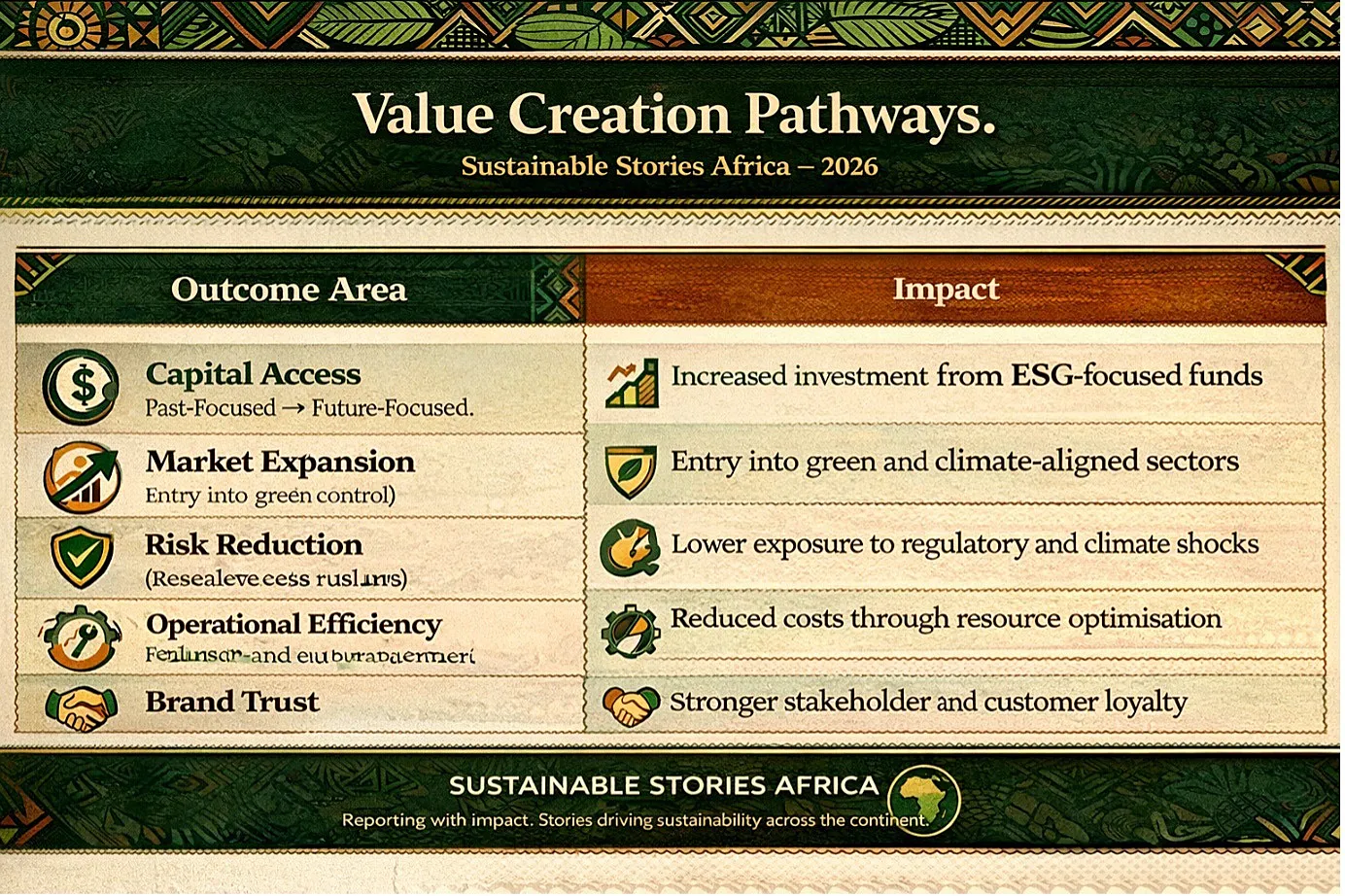
Value Creation Pathways
Outcome Area | Impact |
|---|---|
Capital Access | Increased investment from ESG-focused funds |
Market Expansion | Entry into green and climate-aligned sectors |
Risk Reduction | Lower exposure to regulatory and climate shocks |
Operational Efficiency | Reduced costs through resource optimisation |
Brand Trust | Stronger stakeholder and customer loyalty |
For Africa, the opportunity is transformative.
The continent’s renewable energy potential, young population, and growing digital infrastructure position it uniquely to leapfrog into sustainable growth models—if ESG decisions are made strategically.
Failure to act, however, risks:
- Capital flight
- Trade barriers (e.g., carbon border taxes)
- Increased vulnerability to climate shocks
Turning ESG into Strategic Execution
To operationalise these decisions, stakeholders must move from intent to execution:
- For Corporate Leaders
- Integrate ESG into capital allocation frameworks
- Establish clear governance accountability structures
- Invest in data systems for ESG measurement and reporting
- For Policymakers
- Develop clear ESG taxonomies and disclosure requirements
- Align regulations with global standards
- Incentivise sustainable investments
- For Financial Institutions
- Embed ESG into credit risk assessments
- Expand green financing instruments
- Support SMEs in sustainability transitions
- For Businesses Across Value Chains
- Strengthen supplier ESG compliance
- Collaborate on industry-wide sustainability standards
- Invest in innovation-driven sustainability
- For Citizens and Consumers
- Demand transparency and accountability
- Support sustainable products and services
Path Forward – Decisions That Define Futures
Africa’s ESG future must focus more on decision-making rather than reporting.
Organisations that align capital, governance, innovation, and transparency with sustainability will define the continent’s next phase of growth, while those that delay risk structural decline in an increasingly ESG-driven global economy.