The European Union’s Corporate Sustainability Due Diligence Directive (CSDDD), effective March 2026, is reshaping how companies manage human rights and environmental risks across global value chains.
For African and other non-EU stakeholders, the directive introduces both compliance pressures and strategic opportunities, raising a critical question: can emerging markets turn regulation into competitiveness?
Global Rules, Local Supply Chain Reality
The European Union has drawn a new line in global business conduct. With the Corporate Sustainability Due Diligence Directive (CSDDD) entering force in March 2026, large companies are now required to identify, prevent, and address adverse human rights and environmental impacts across their operations and value chains.
For African economies, deeply embedded in global supply chains spanning agriculture, mining, manufacturing, and services, the implications are immediate and structural.
This is not just a compliance story. It is a recalibration of how value is created, distributed, and governed across borders, where data, transparency, and accountability increasingly define market access.
A Directive That Travels Beyond Borders
The CSDDD may be an EU law, but its reach is global.
According to the briefing document, the directive creates binding obligations for large companies to conduct risk-based due diligence across their entire value chains, including suppliers and partners outside the EU.
This means African exporters, contractors, and SMEs, even if not directly regulated, are indirectly affected through their relationships with EU firms.
The stakes are high:
- Companies that fail to meet due diligence expectations risk losing contracts with EU buyers
- Supply chains must now demonstrate traceability, labour compliance, and environmental safeguards
- ESG performance is shifting from voluntary reporting to enforceable market access criteria
In effect, ESG is no longer reputational; it is transactional.
Four Stakeholders, Four Pathways of Impact
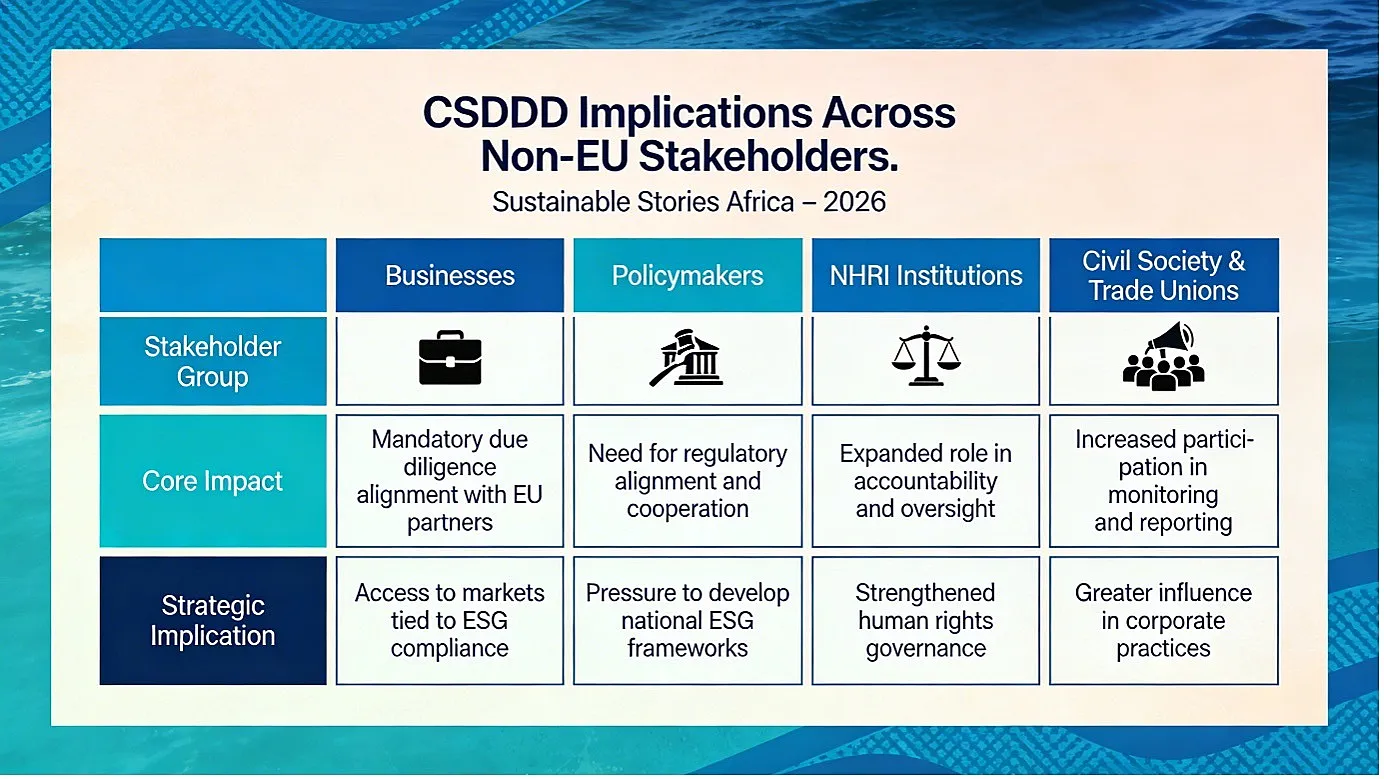
The directive’s implications are not uniform. As highlighted in the briefing (page 3), four non-EU stakeholder groups will be most affected:
CSDDD Implications Across Non-EU Stakeholders
Stakeholder Group | Core Impact | Strategic Implication |
|---|---|---|
Businesses | Mandatory due diligence alignment with EU partners | Access to markets tied to ESG compliance |
Policymakers | Need for regulatory alignment and cooperation | Pressure to develop national ESG frameworks |
NHRI Institutions | Expanded role in accountability and oversight | Strengthened human rights governance |
Civil Society & Trade Unions | Increased participation in monitoring and reporting | Greater influence in corporate practices |
- Businesses – From Compliance Burden to Competitive Advantage – For African businesses, the directive introduces both friction and leverage.
The briefing (page 4) notes that non-EU companies can use the CSDDD to strengthen their own due diligence systems, improve labour standards, and become more attractive to EU partners.
More importantly:
- Firms that demonstrate compliance gain preferred supplier status
- ESG alignment improves access to responsible investment capital
- Transparent operations can unlock better contract terms and pricing
This marks a shift from “cost of compliance” to currency of competitiveness.
- Civil Society and Trade Unions: From Observers to Co-Architects – The directive explicitly requires companies to consult employees and their representatives when developing due diligence policies (page 5).
This elevates civil society and labour groups into active governance roles:
- Facilitating engagement with affected communities
- Highlighting risks faced by marginalised or excluded groups
- Informing context-specific solutions to ESG challenges
In African markets, this could strengthen bottom-up accountability systems, which are seen as a gap in ESG implementation.
- National Human Rights Institutions (NHRIs): Scaling Accountability – NHRIs are positioned as regional catalysts for corporate accountability.
As outlined on page 6:
- They can collaborate across jurisdictions to harmonise enforcement approaches
- Share knowledge on due diligence frameworks and best practices
- Support the development of mandatory human rights and environmental laws
This creates a pathway for African regulatory ecosystems to align with global ESG expectations without external imposition.
- Policymakers: Aligning Domestic Systems with Global Standards – Perhaps the most strategic implication lies with governments.
The directive encourages the EU and its member states to provide trade agreements, development cooperation, and international partnerships to support implementation in non-EU countries (page 7).
This opens opportunities for:
- Technical assistance in ESG regulatory frameworks
- Integration of ESG into national industrial policies
- Alignment with global standards such as the UN Guiding Principles on Business and Human Rights (UNGPs)
In essence, the directive acts as a soft export of regulatory norms.
A New Competitive Frontier for African Markets
If leveraged strategically, the CSDDD could accelerate a transformation already underway across Africa.
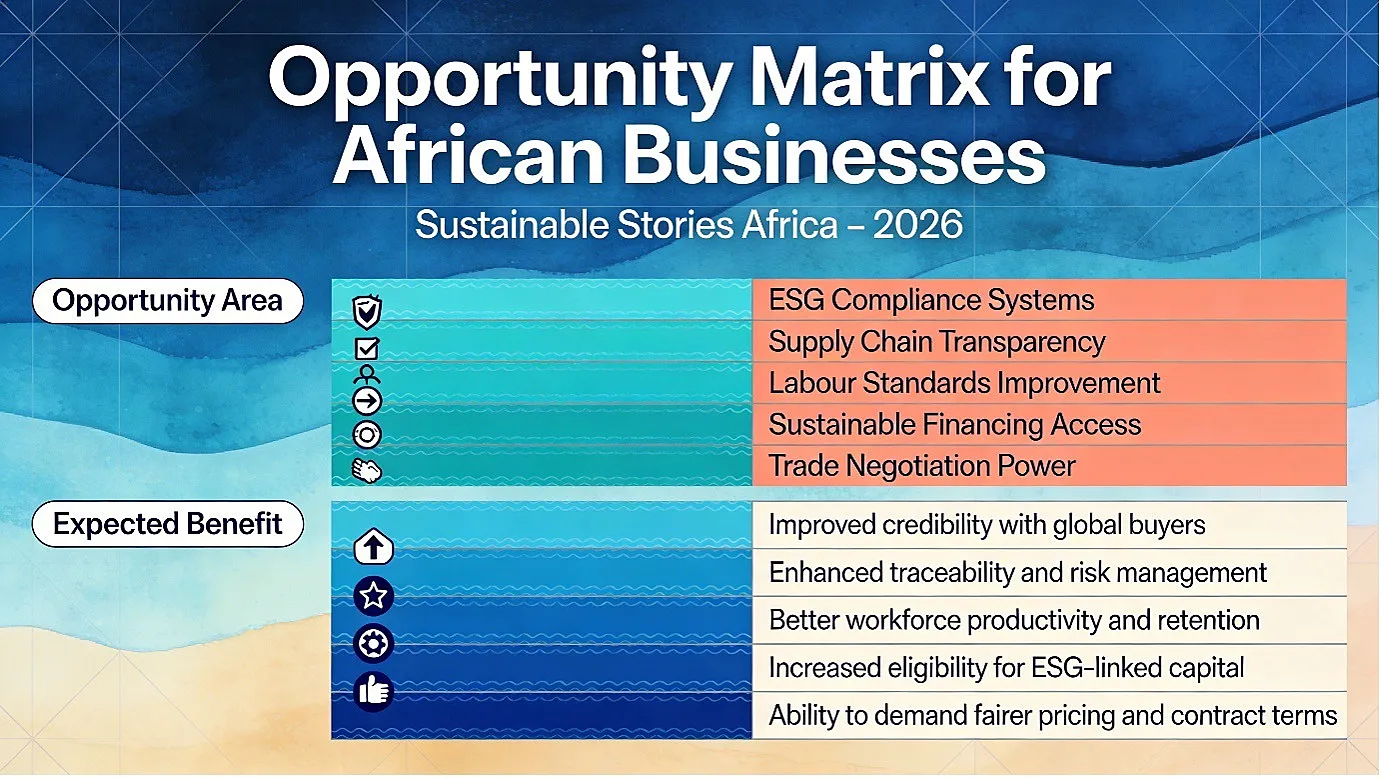
Opportunity Matrix for African Businesses
Opportunity Area | Expected Benefit |
|---|---|
ESG Compliance Systems | Improved credibility with global buyers |
Supply Chain Transparency | Enhanced traceability and risk management |
Labour Standards Improvement | Better workforce productivity and retention |
Sustainable Financing Access | Increased eligibility for ESG-linked capital |
Trade Negotiation Power | Ability to demand fairer pricing and contract terms |
Beyond compliance, the directive could catalyse:
- Formalisation of informal sectors
- Expansion of green and ethical exports
- Strengthening of corporate governance frameworks
For countries such as Nigeria, Kenya, and South Africa, this represents an opportunity to position themselves as ESG-aligned supply chain hubs.
What Needs to Happen Next
The transition will not be automatic. It requires coordinated action across multiple actors.
- For Businesses
- Conduct value chain mapping and risk assessments
- Embed ESG into core business strategy, not just reporting
- Invest in supplier capacity building and traceability systems
- For Governments
- Develop national due diligence legislation aligned with global standards
- Integrate ESG into trade and industrial policies
- Strengthen enforcement institutions and regulatory clarity
- For Financial Institutions
- Expand ESG-linked financing instruments
- Incentivise compliance through lower cost of capital
- For Civil Society
- Build capacity to monitor, report, and engage effectively
- Act as intermediaries between communities and corporations
The directive’s success will depend less on legal text and more on execution ecosystems.
Path Forward – Turning Compliance into Capability
The CSDDD is not just a European regulatory instrument; it is a global signal that ESG compliance is becoming foundational to economic participation. African stakeholders must move from reactive adaptation to proactive alignment.
By embedding due diligence into systems, strengthening institutions, and leveraging partnerships, emerging markets can transform compliance into a competitive edge, ensuring that global rules translate into local resilience and shared value creation.