
Chile has emerged as a leading case study in expanding just transition beyond energy, embedding social, ecological, and economic justice into national climate policy.
However, beneath the ambition lies a critical tension: fragmented governance, weak monitoring systems, and declining budgets threaten to undermine long-term implementation and global replicability.
Beyond Energy: A Broader Transition Agenda
Chile’s climate transition story is no longer confined to decarbonising energy systems; it has evolved into a broader socioecological transformation agenda.
Over the past decade, the country has integrated “Just Socioecological Transition” (JSET) principles across national climate commitments, institutional frameworks, and sectoral policies.
This expansion reflects a deeper recognition: climate action must address not only emissions, but also inequality, labour transitions, ecosystem restoration, and social justice.
For emerging markets, including across Africa, Chile’s model offers both inspiration and caution. It demonstrates how climate policy can be mainstreamed across government systems but also reveals the complexities of aligning ambition with execution.
A Decade of Transition, A System Under Strain
Chile’s just transition journey began in 2014, but the last decade has marked a decisive shift, from energy-focused policies to a multi-dimensional socioecological transition agenda.
The country is now among a small group globally that explicitly integrates just transition principles into both its Nationally Determined Contributions (NDCs) and long-term climate strategy.
However, despite this leadership, the system is under strain.
Key risks include:
- Weak monitoring and impact measurement systems
- Fragmented definitions across policy frameworks
- Declining budgets for implementation
- Limited legislative alignment
The question is no longer whether Chile has a vision, but whether it can sustain it.
Inside Chile’s Socioecological Transition Architecture
Chile’s Just Socioecological Transition (JSET) is built on a layered institutional and policy framework.
Chile’s JSET Governance Architecture
Component | Role |
|---|---|
Interministerial Committee (IC-JSET) | Coordinates cross-government policy alignment |
JSET Technical Office | Oversees implementation and strategy development |
Local Governance Bodies (CRAS) | Drive community-level planning and accountability |
National Strategy (2025–2035) | Defines long-term transition roadmap |
NDC Integration | Embeds social justice into climate commitments |
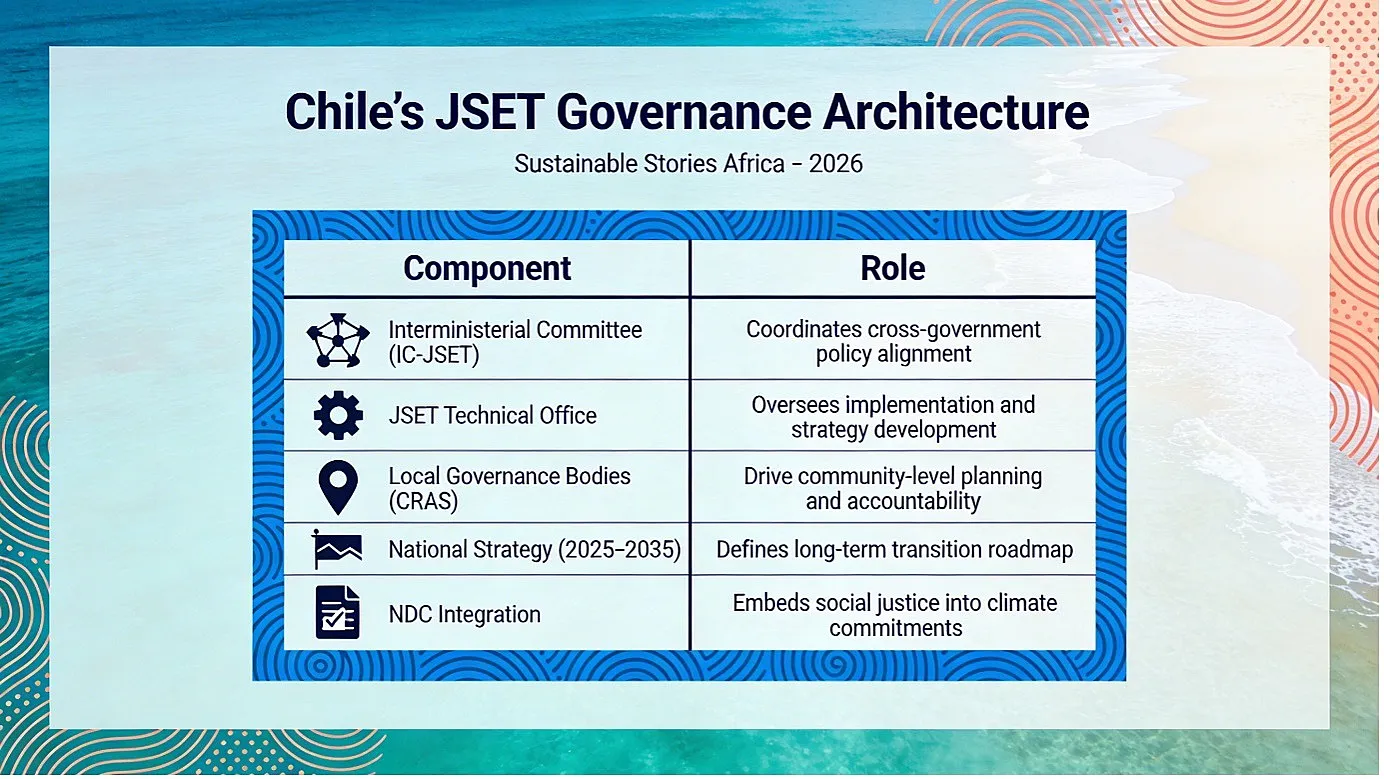
This architecture reflects a whole-of-government approach, with participation from up to 18 ministries and institutions and more than 100 policy measures embedded in national and local action plans.
From Coal Regions to National Strategy
Chile’s transition is grounded in real-world experience.
The Program of Social and Environmental Recuperation (PRAS), launched between 2014 and 2015, targeted “transition territories” affected by industrial pollution and coal-based energy systems.
These territories became laboratories for:
- Multi-stakeholder governance
- Local action planning
- Community engagement
Over time, PRAS was integrated into the broader JSET agenda, creating continuity while scaling ambition.
Participation at Scale
Chile’s transition process has emphasised public engagement:
- 16 regional workshops conducted nationwide
- Over 700 participants engaged
- Over 300 stakeholder submissions incorporated
This participatory approach strengthens legitimacy but also introduces complexity in aligning diverse stakeholder interests.
The Structural Constraints
Despite progress, implementation challenges are significant.
Key Barriers to Chile’s JSET Implementation
Barrier | Impact |
|---|---|
Weak indicators and data systems | Limits accountability and performance tracking |
Budget cuts (75% reduction, 2019 –2024) | Constrains programme scale and continuity |
Institutional fragmentation | Reduces coordination efficiency |
Limited legislative integration | Risks policy reversals |
Capacity gaps at the subnational level | Weakens local implementation |
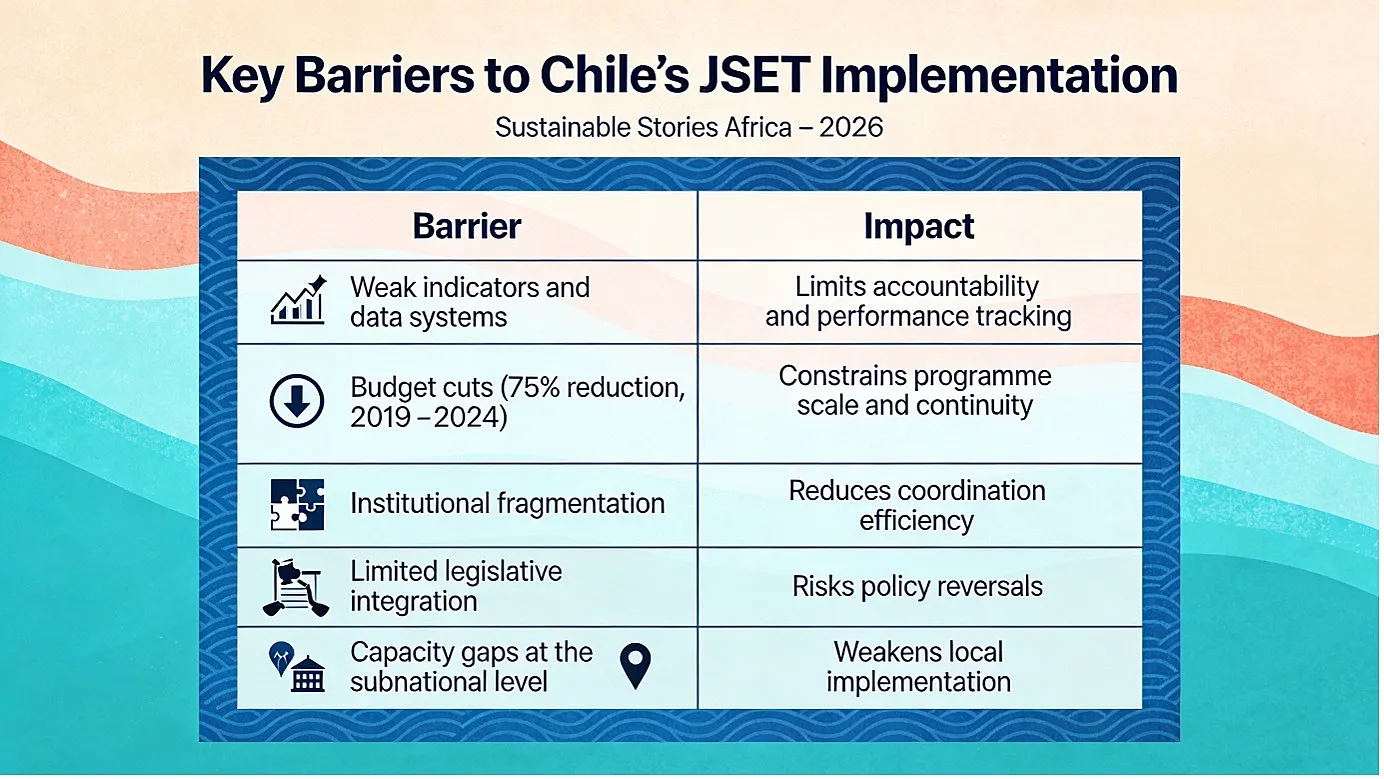
One of the most striking figures: JSET-related budgets declined from nearly $1 million to $250,000 annually between 2019 and 2024, a 75% reduction during a period of expanding policy ambition.
The Measurement Problem
A core weakness lies in monitoring systems.
- Indicators were developed years after implementation began
- Many metrics track activities, not outcomes
- Social impact and beneficiary data remain limited
This creates a fundamental gap: policy ambition without validation of measurable impact.
A Model for Inclusive Climate Transformation
Despite these challenges, Chile’s approach offers a compelling vision for emerging markets:
- Beyond Carbon: A Holistic Framework – By integrating labour, ecosystems, and social justice, Chile expands the definition of climate transition.
- Institutional Continuity – Embedding JSET in NDCs ensures resilience across political cycles.
- Multi-Stakeholder Governance – Local and national coordination mechanisms create shared ownership of transition outcomes.
- Replicability for the Global South – Chile’s model demonstrates how countries can align:
- Climate goals
- Social equity
- Economic transformation
For Africa, where transitions intersect deeply with livelihoods, this integrated approach is particularly relevant.
Closing the Implementation Gap
To sustain momentum, Chile and similar economies must address critical priorities:
- Build Robust Monitoring Systems – Develop:
- Outcome-based indicators
- Impact measurement frameworks
- Real-time data systems
- Restore and Scale Financing – Stabilise budgets and leverage international finance, particularly through mechanisms like the Green Climate Fund.
- Align Legislative and Executive Agendas – Bridging the gap between policy design and legal frameworks is essential for long-term continuity.
- Strengthen Subnational Capacity – Local governments require:
- Technical expertise
- Financial resources
- Institutional authority
- Integrate International Support – Better alignment with global initiatives, such as Just Energy Transition Partnerships, can unlock financing and technical assistance.
Path Forward – From Ambition to Execution
Chile’s just transition journey demonstrates that policy innovation alone is not enough; execution systems must evolve in parallel. Strengthening governance, financing, and measurement frameworks will determine long-term success.
For emerging markets, the lesson is clear: the future of climate policy lies not only in ambition, but in the ability to translate vision into measurable, inclusive, and sustained outcomes.