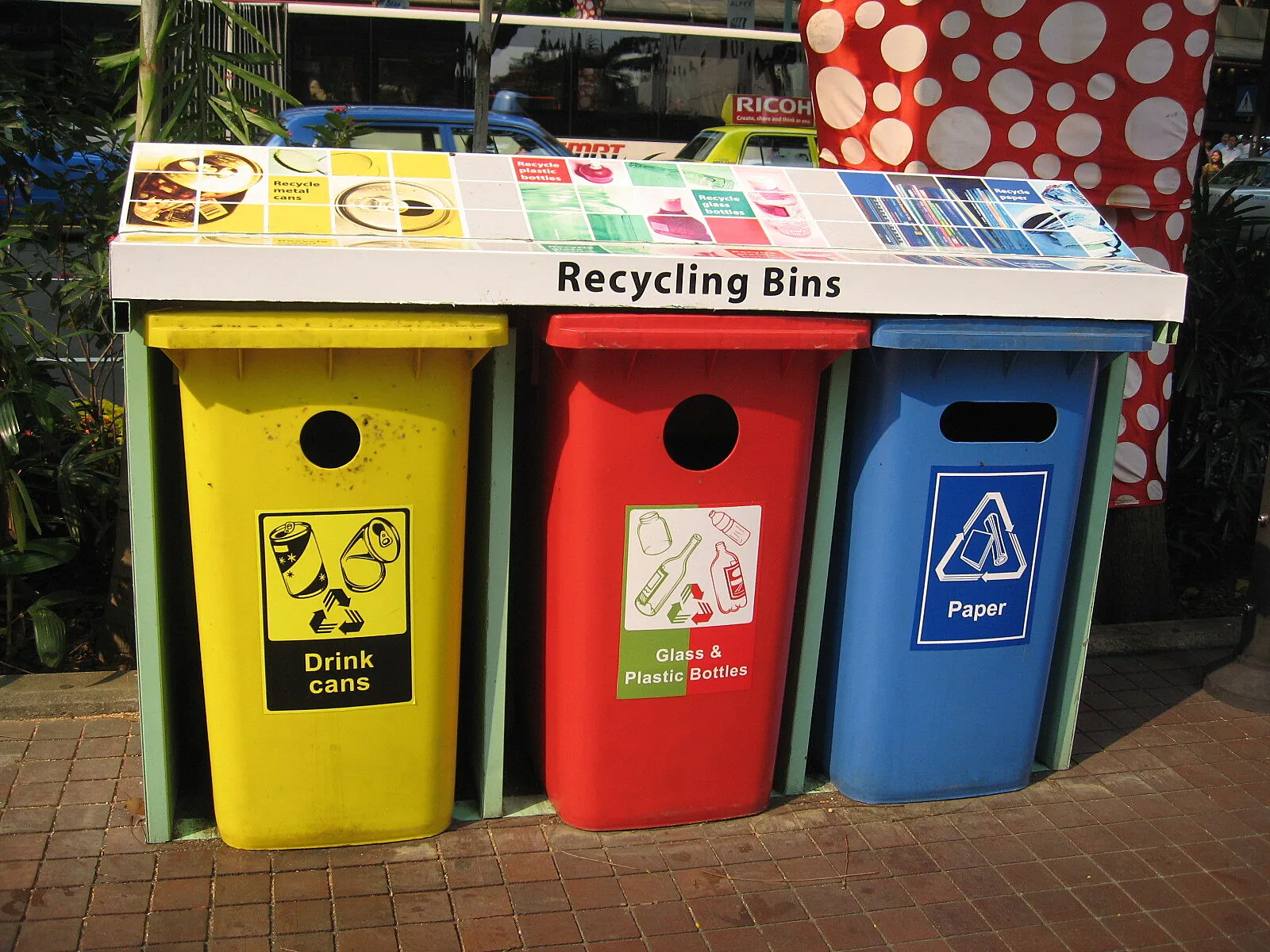
Across Africa’s rapidly expanding cities, waste is growing faster than the systems designed to manage it.
Landfills are expanding, pollution is rising, and valuable materials are being lost to inefficient disposal systems.
However, a new perspective is emerging. Instead of treating waste as an environmental burden, policymakers and entrepreneurs are beginning to view it as a powerful economic opportunity, one capable of generating jobs, energy and sustainable growth across the continent.
Waste As Africa’s Untapped Resource
Africa’s cities are expanding at an unprecedented pace. Urban populations are projected to double by 2050, bringing rising consumption, increased infrastructure needs and an inevitable surge in municipal waste.
For decades, waste management has largely been treated as a public health challenge. Many cities struggle with overflowing landfills, informal dumping sites and limited recycling infrastructure.
But a different narrative is beginning to take shape.
Across Africa, governments, entrepreneurs and environmental organisations are exploring the concept of a waste economy, a system in which discarded materials become inputs for new industries, energy generation and agricultural solutions.
From recycling plastics into construction materials to converting organic waste into fertiliser and biogas, the waste economy is emerging as a cornerstone of the continent’s transition to a circular economy.
For African economies seeking sustainable development pathways, transforming waste into wealth may become one of the most powerful opportunities of the coming decade.
Africa’s Waste Problem Is Growing Fast
Africa currently generates hundreds of millions of tonnes of waste annually, and that figure is expected to rise sharply as urbanisation accelerates.
Without intervention, much of this waste ends up in landfills or informal dumping sites, contributing to environmental pollution, health risks and greenhouse gas emissions.
However, the same waste streams contain valuable materials.
The linked infographic “The Waste Economy: Transforming Waste into Wealth in Africa” illustrates how waste can support new industries, including recycling, waste-to-energy technologies and organic fertiliser production.
The concept reframes waste not as an environmental liability but as an economic asset.
Key pillars of the emerging waste economy include:
- investment in waste infrastructure
- empowerment of informal waste workers
- innovation in recycling and energy technologies
Together, these pillars could transform waste management from a cost centre into a driver of economic development.
The Three Engines Of The Waste Economy
The waste economy relies on several interconnected industries that convert discarded materials into valuable resources.
According to the framework illustrated in the infographic, three major sectors are emerging as central pillars of the system.
Recycling Industries
Recycling remains one of the most established components of the waste economy.
Materials such as plastics, metals, paper and glass can be recovered from waste streams and transformed into new products.
Across Africa, recycling initiatives are expanding rapidly.
Plastic waste is increasingly being converted into:
- construction materials
- packaging products
- industrial raw materials
These recycling industries not only reduce environmental pollution but also create significant employment opportunities.
Informal waste pickers, who already recover a large share of recyclable materials in many African cities, play a crucial role in this ecosystem.
Waste-to-Energy Systems
Waste-to-energy technologies represent another important pathway.
Instead of sending waste to landfills, these systems convert waste materials into electricity or heat.
Examples include:
- burning municipal waste to generate power
- converting landfill gas into electricity
- transforming scrap tyres into fuel
These technologies can help address two challenges simultaneously:
- waste disposal
- energy shortages
For countries facing chronic electricity deficits, waste-to-energy infrastructure offers an additional energy source while reducing landfill pressure.
Organic Waste Solutions
A significant portion of urban waste consists of organic materials such as food waste and agricultural residues.
Instead of decomposing in landfills, where they release methane, these materials can be converted into:
- organic fertilisers
- animal feed
- compost for agriculture
Organic waste solutions create a powerful link between urban waste systems and rural agricultural productivity.
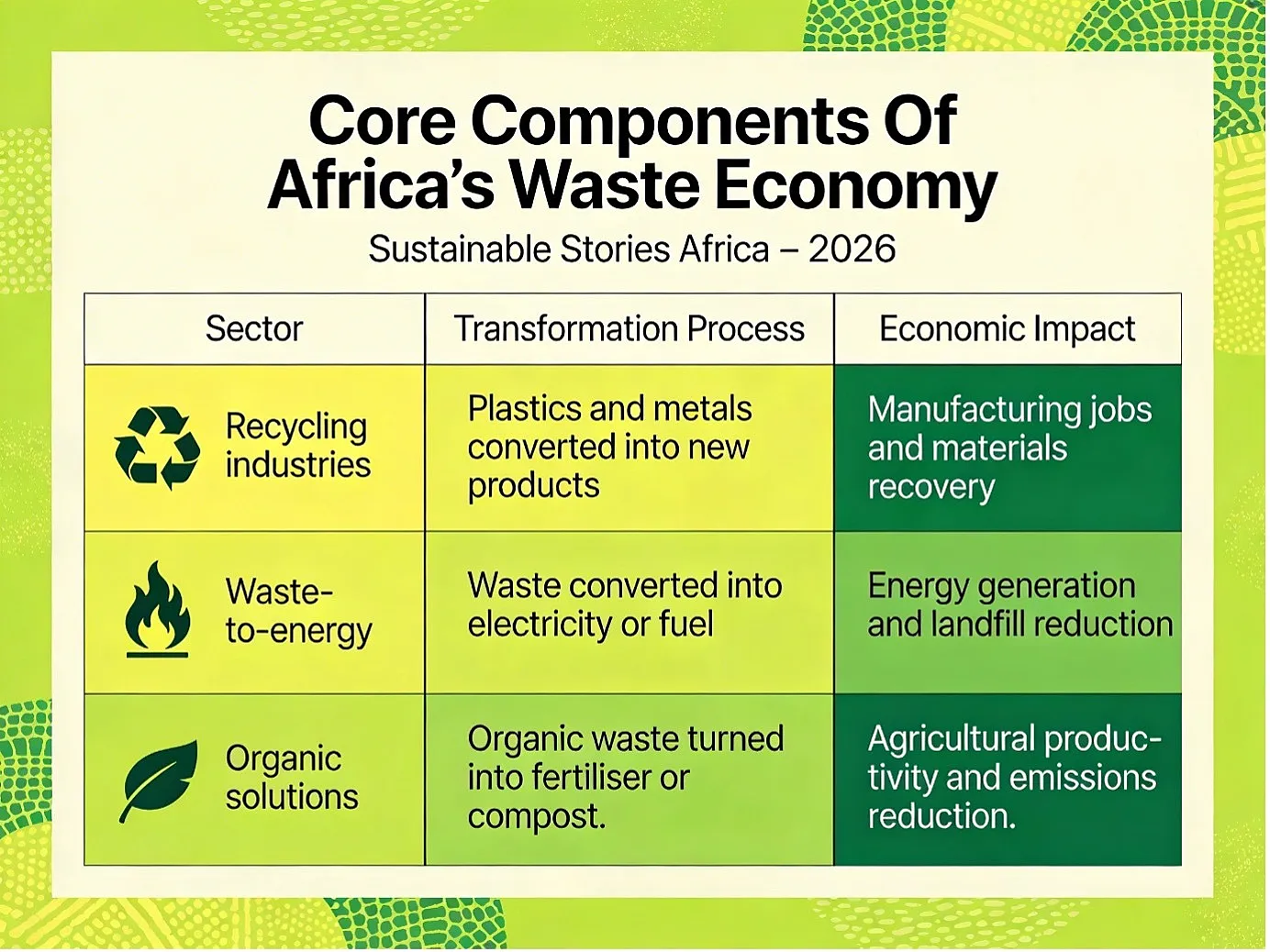
Core Components Of Africa’s Waste Economy
Sector | Transformation Process | Economic Impact |
|---|---|---|
Recycling industries | Plastics and metals are converted into new products | Manufacturing jobs and materials recovery |
Waste-to-energy | Waste converted into electricity or fuel | Energy generation and landfill reduction |
Organic solutions | Organic waste turned into fertiliser or compost | Agricultural productivity and emissions reduction |
Why The Waste Economy Matters For Africa
The potential benefits of a well-developed waste economy are substantial.
- First, the sector could generate millions of jobs across waste collection, recycling, manufacturing and energy production.
- Second, improved waste systems could significantly reduce urban pollution and health risks associated with unmanaged waste.
- Third, circular waste systems help reduce greenhouse gas emissions by limiting landfill methane and replacing fossil-fuel energy sources.
The infographic highlights how these outcomes collectively contribute to jobs, clean cities and sustainable economic growth.
For rapidly growing African cities, the waste economy therefore represents both an environmental solution and a development strategy.
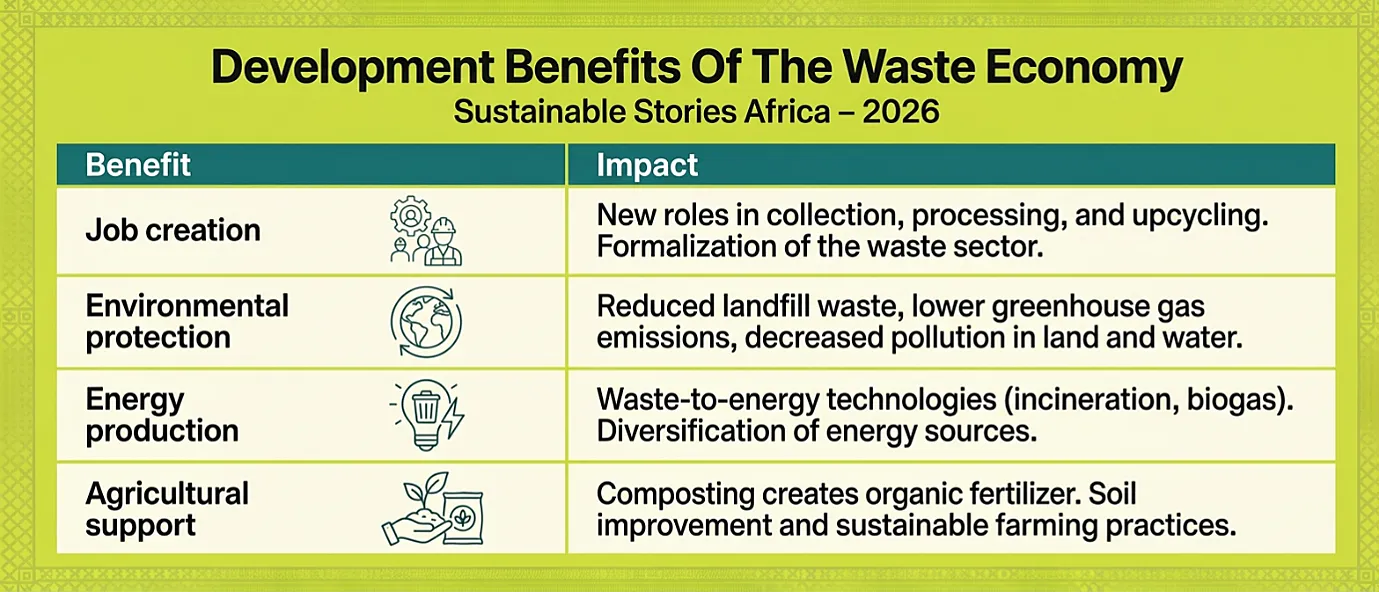
Development Benefits Of The Waste Economy
Benefit | Impact |
|---|---|
Job creation | Employment across recycling, logistics and energy sectors |
Environmental protection | Reduced landfill pollution and plastic waste |
Energy production | Alternative electricity and fuel sources |
Agricultural support | Organic fertilisers and soil health improvement |
Building Africa’s Circular Waste Systems
To unlock the potential of the waste economy, several policy and investment priorities must be addressed.
- Invest in Waste Infrastructure – Cities need modern collection systems, recycling facilities and waste-processing plants.
- Integrate Informal Waste Workers – Millions of informal waste pickers already contribute to recycling systems.
Formalising and supporting these workers can improve livelihoods while strengthening recycling supply chains.
- Encourage Private Sector Innovation – Entrepreneurs and startups are increasingly developing solutions for plastic recycling, waste-to-energy technologies and compost production.
Supportive policies and financing mechanisms can accelerate this innovation.
- Strengthen Policy and Regulation – Clear waste-management regulations and extended producer responsibility frameworks can incentivise companies to reduce waste and support recycling systems.
- Promote Circular Economy, Models – Encouraging product redesign, material recovery and resource efficiency helps reduce waste generation across entire value chains.
Path Forward – Turning Waste Into Wealth
Africa’s waste challenge is growing, but so is the opportunity to transform it.
By investing in recycling industries, waste-to-energy technologies and organic waste solutions, countries can convert environmental liabilities into engines of economic growth.
If supported by strong policies and innovative business models, the waste economy could play a pivotal role in creating cleaner cities, new industries and a more sustainable future for the continent.