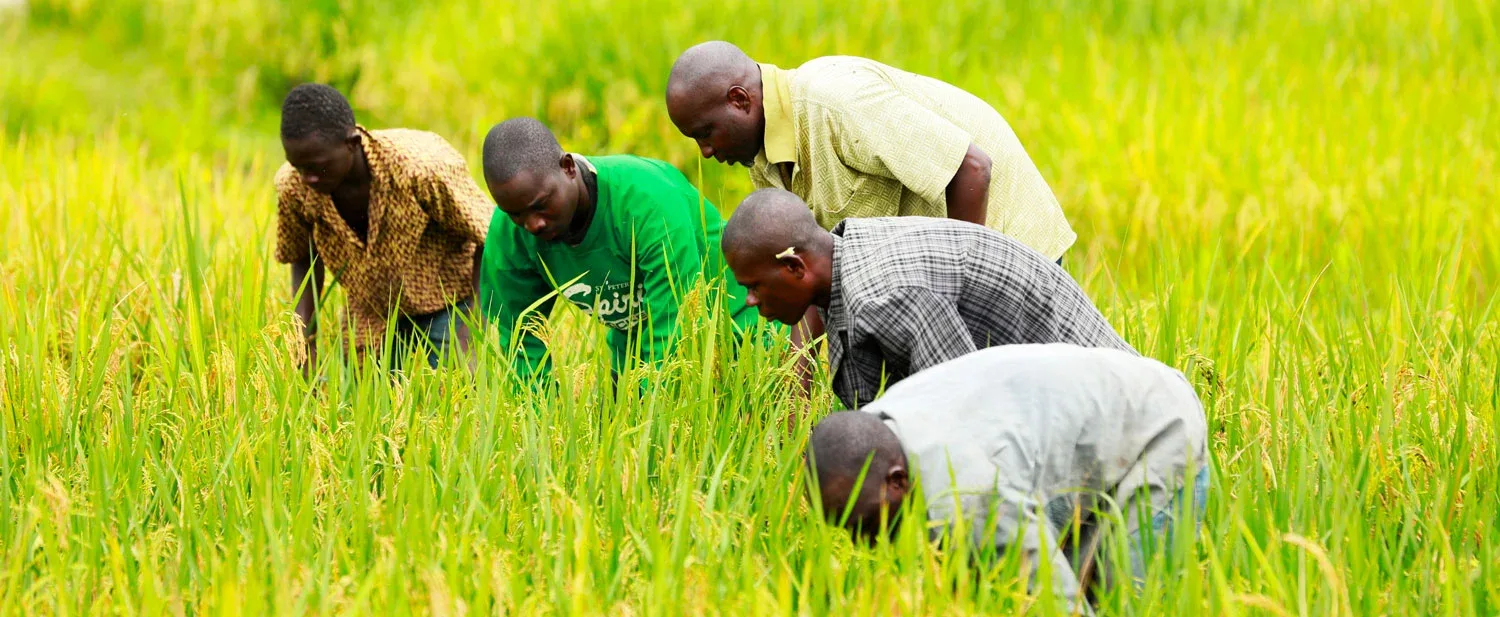
At 61, Maboudou Dosso has more than doubled his income after receiving fertiliser, training and technical support.
His rice, maize and soybean output rose sharply in Gouaké, northwest Côte d’Ivoire.
For his family, the change now means better meals, school fees, healthcare access and a future no longer defined only by survival.
A Harvest That Changed One Household
For more than three decades, Maboudou Dosso worked the same soil with the same hope: that the next rainy season would bring enough food, enough income and enough dignity for his family.
At 61, the Ivorian smallholder farmer has finally seen that hope take firmer root.
Dosso, who farms 10 hectares in Gouaké, in the Touba area of Côte d’Ivoire’s Bafing region, has more than doubled his annual income after receiving support through Côte d’Ivoire’s Emergency Food Production Programme, known as 2PAU-CI, backed by the African Development Bank Group.
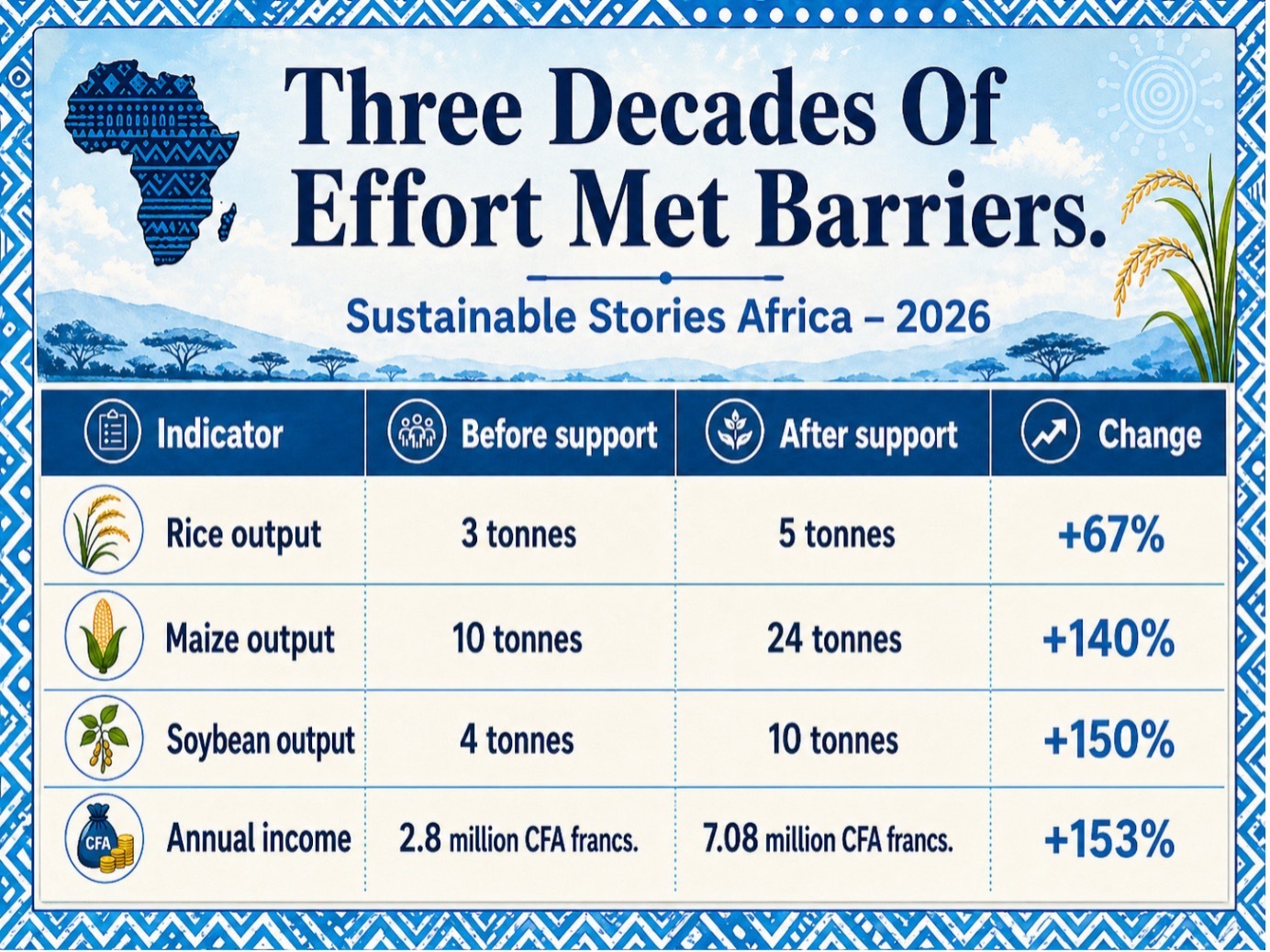
His income rose from about 2.8 million CFA francs to 7.08 million CFA francs, an increase of roughly 153%, after improved fertiliser access, technical training and field support helped lift production across rice, maize and soybeans.
The story matters because it shows what agricultural transformation looks like at the household level.
It is not only a policy line or development target. It is a father watching children go to school, a family eating better, and a farmer who once produced enough to survive starting to produce enough to plan for the future.
Three Decades Of Effort Met Barriers
Dosso began cultivating rice, maize and soybeans in 1991. He never attended school; however, he set himself a clear mission: feed his family and give his children the education he did not receive.
For years, that ambition ran into familiar rural constraints, limited access to improved seeds, high fertiliser costs, transport difficulties and labour shortages.
Before the intervention, his yields remained modest. Rice and maize yielded about two tonnes per hectare, while soybeans yielded about one tonne per hectare. Across his farm, that translated into roughly three tonnes of rice, 10 tonnes of maize and four tonnes of soybeans each year. It was enough to keep going, but not enough to build resilience.
The turning point came when 2PAU-CI provided 80 bags of NPK fertiliser and 40 bags of urea, along with training in fertiliser application and pest control, including managing fall armyworm threats to maize.
Field agents from the National Agency for Rural Development Support, ANADER, also helped Dosso convert new knowledge into better farming practices.
Inputs Became Meals, Schooling, Care
The emotional weight of Dosso’s story lies in what the numbers unlock. His increased earnings improved the family’s nutrition, making three balanced meals a day a possibility.
His children are now enrolled in school. Healthcare has become more accessible. He has also started diversifying into food products and cashew-nut trading, creating additional income streams beyond the farm.
For many rural families across Africa, this is the difference between income and security.
- A good harvest can pay debts.
- A better harvest can keep children in school.
- A resilient harvest can allow a household to imagine a future beyond the next planting season.
Dosso put the shift plainly: his production has “more than doubled,” allowing him to feed his family better and invest in trade.
Smallholders Can Become Growth Engines
Dosso’s progress shows why smallholder agriculture remains central to Africa’s food security and poverty-reduction agenda.
Farmers like him are not passive beneficiaries of aid. They are producers, risk managers, parents, informal employers and local traders.
When they receive the right mix of inputs, training, extension services and market access, productivity gains can move quickly from the field into the home.
The gains also reveal what can be lost when support arrives late or inconsistently. Without timely fertiliser distribution, technical advice and pest-control knowledge, farmers remain exposed to low yields, income volatility and climate pressure.
In that reality, children’s schooling, food quality and healthcare decisions often become seasonal calculations.
The better future is practical: stronger extension systems, reliable input supply chains, rural mechanisation, irrigation access and farmer-focused finance.
Dosso now plans to install a borehole to secure irrigation and further improve his yields, a reminder that one good intervention can open the door to the next investment.
Invest Where Farmers Already Stand
The call to action is clear.
African governments, development finance institutions and agribusiness partners should treat smallholder support as core economic infrastructure, rather than social welfare.
Programmes like 2PAU-CI show that when farmers receive the tools they need at the right time, productivity can rise, incomes can grow, and families can build resilience.
However, scale will require discipline. Inputs must arrive before planting windows close.
- Extension officers must be trained, resourced and present in farming communities.
- Rural roads, storage and market systems must reduce post-harvest losses.
- Financing should help farmers invest in irrigation, mechanisation and diversification without trapping them in unsustainable debt.
Dosso’s story is personal, but its lesson is structural.
Africa’s food systems will not be transformed in conference rooms alone. They will be transformed hectare by hectare, through farmers whose work already feeds communities.
Path Forward – Make Smallholder Support Permanent
Dosso’s experience shows that targeted inputs, training and extension support can convert decades of effort into measurable social progress.
For African markets, the priority is to institutionalise farmer support: timely inputs, irrigation, rural finance, pest management, mechanisation and market access.
When smallholder productivity rises, ESG impact becomes visible in meals, classrooms, clinics and stronger rural economies.
Culled From: At 61 years old, Maboudou Dosso more than doubles his income and transforms his family's life