A Lagos High Court has ruled that Meta Platforms Inc., operator of Facebook, is jointly liable as a data controller for a false, health-related video posted by a third party, awarding $25,000 to human rights lawyer Femi Falana, SAN.
The judgment, now under appeal, strikes at the heart of Big Tech's "mere platform" defence.
This ruling, analysed in depth by Streamsowers & Kohn (SSKOHN), matters profoundly for Africa's 600 million internet users: it signals that the era of unaccountable digital intermediaries may be ending, and that the continent's courts are ready to lead that charge.
Africa's Reckoning With Big Tech
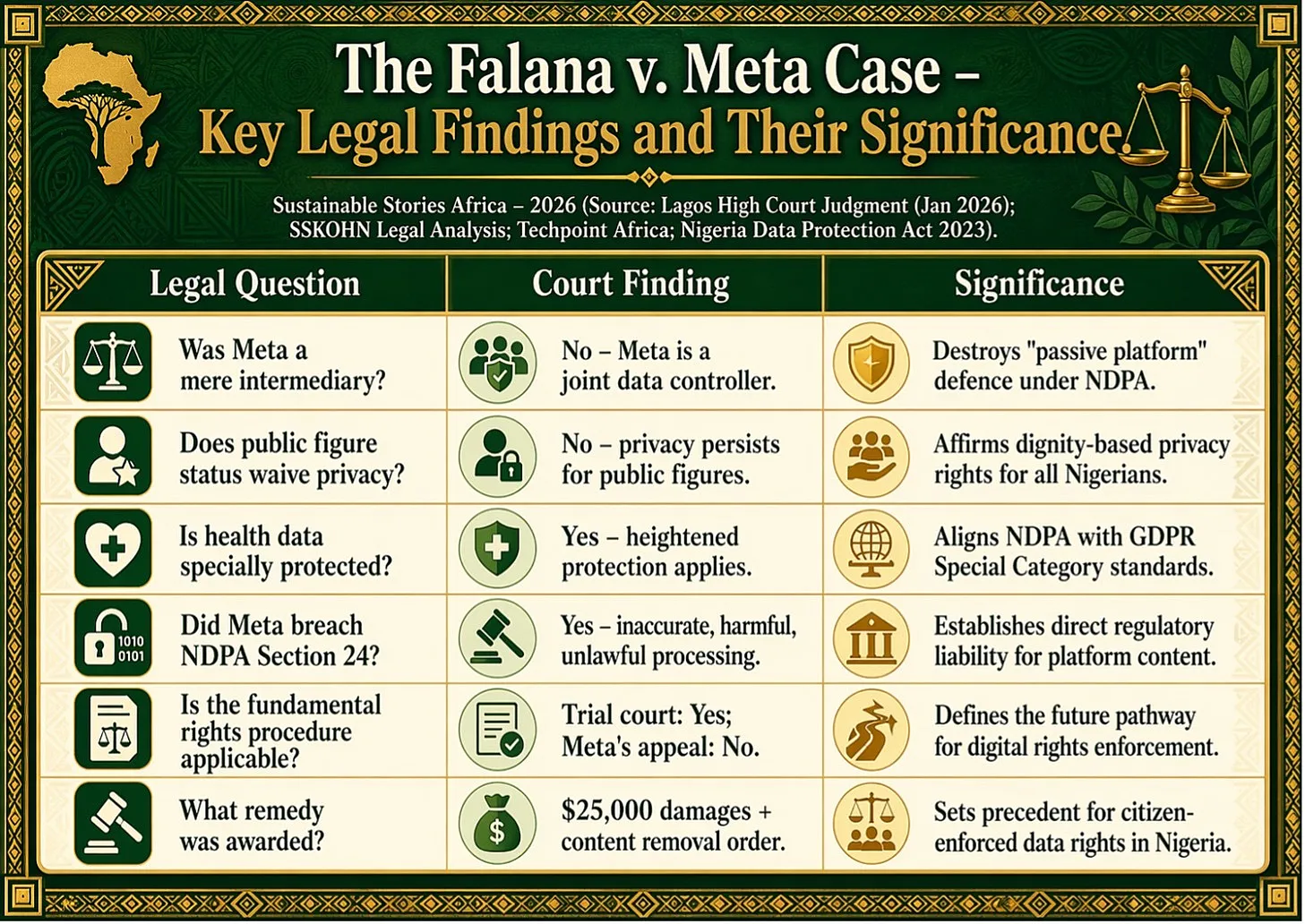
In January 2026, a Lagos High Court delivered what could become one of the most consequential digital-rights judgments in Nigerian legal history. Justice Akeem Fashola held that Meta Platforms Inc. breached Section 24 of the Nigeria Data Protection Act 2023 by hosting and algorithmically distributing a video that falsely claimed Femi Falana, SAN, Nigeria’s leading human rights lawyer, was terminally ill.
The court ordered Meta to remove the content and pay $25,000 in damages.
The case, Femi Falana, SAN v. Meta Platforms Inc. (Suit No: LD/17783MFHR/2025), was intentionally framed not as defamation, but as a data protection and constitutional privacy action under Section 37 of the 1999 Constitution and Sections 24(1)(a) and (e) of the NDPA 2023.
As analysed by the legal team at Streamsowers & Kohn (SSKOHN), the legal strategy broadens the case beyond one viral falsehood.
It raises deeper questions about who controls digital content in Nigeria, when a platform crosses into publisher territory, and how accountability should work in an economy where harmful engagement still generates profit.
Meta has appealed, contesting both jurisdiction and liability. Nigeria’s appellate courts now face a ruling that could shape digital platform accountability far beyond this single dispute.
The "Mere Platform" Defence Is Crumbling
If Meta determines what users see, profits from its distribution, and controls the algorithm that amplifies it, it can no longer credibly claim to be merely a platform.
That is the central conclusion of the Lagos High Court in Falana v. Meta, one that challenges the long-standing liability shield on which Big Tech has relied for decades.
The court held that Meta determines the means and purposes of content processing, monetises pages, and manages the algorithms that distribute content.
On that basis, it was treated as a joint data controller with page owners, rather than a passive intermediary.
Under the NDPA 2023, that status carries full compliance duties, including responsibility for the accuracy of personal data processed on its systems.
In effect, the defence that “the algorithm did it” carries little weight under Nigeria’s data protection framework.
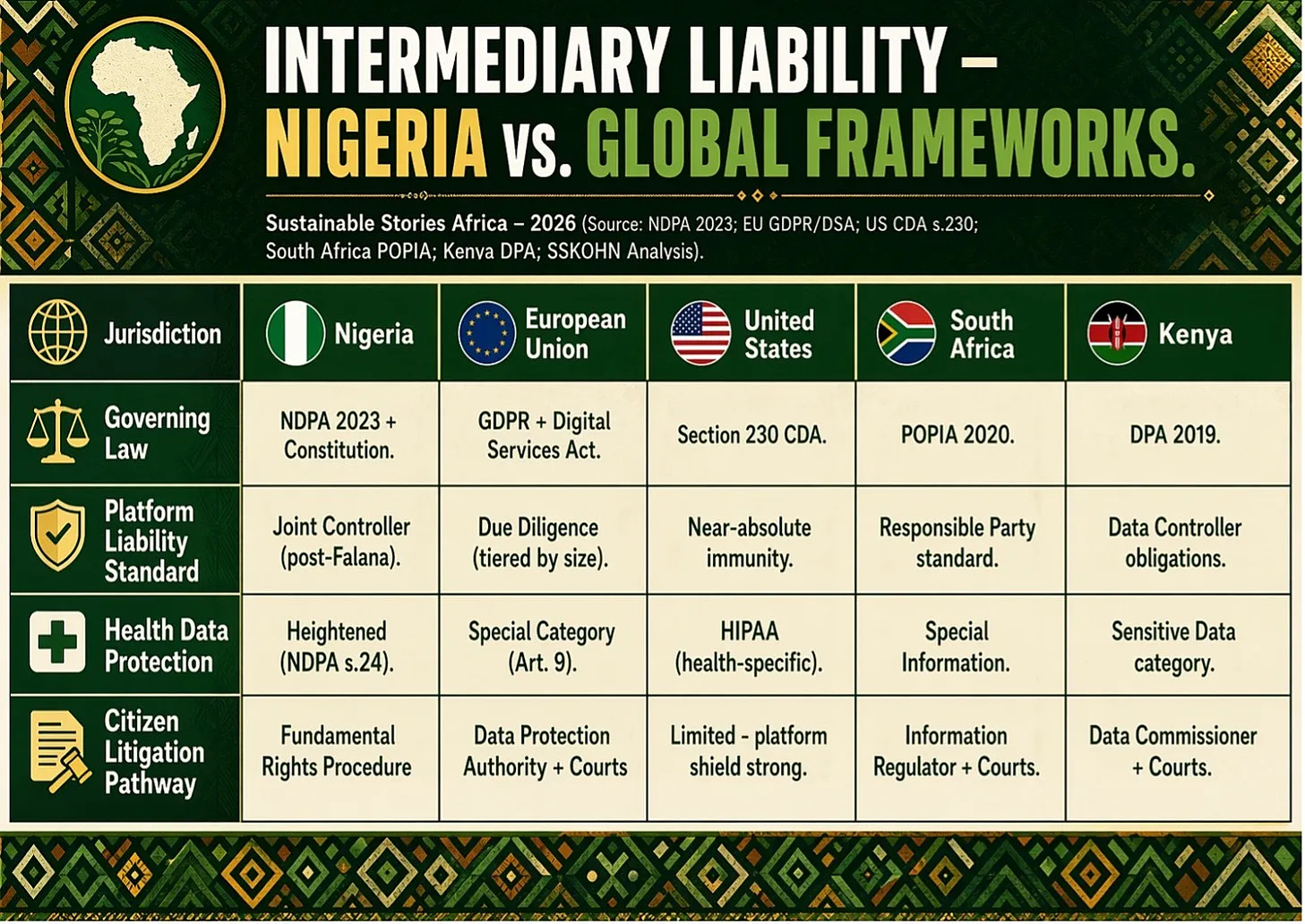
This goes beyond legal technicality. While the United States remains locked in debate over Section 230 and the European Union’s Digital Services Act imposes only limited duties, Nigeria’s ruling signals a sharper standard: accountability follows the platform that profits from distribution.
Interest: The Stakes, the Precedents, and the Pattern
The Falana judgment did not emerge in isolation.
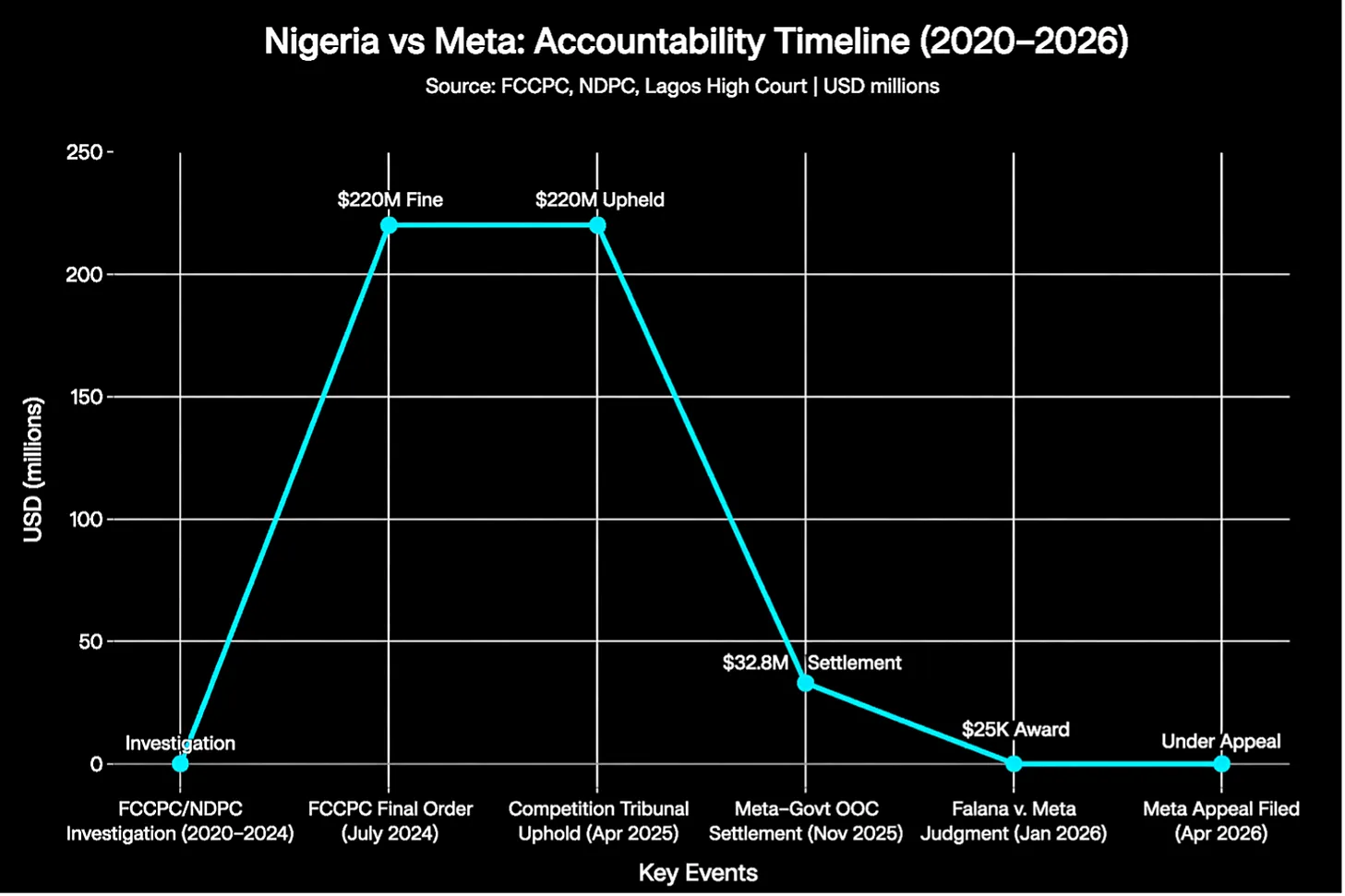
It reflects a broader regulatory stance in Nigeria, where actions against Meta Platforms increasingly point to a more assertive era of Big Tech accountability. In July 2024, the FCCPC, after a 38-month joint investigation with the NDPC, imposed a $220 million penalty on Meta and WhatsApp for discriminatory and exploitative practices against Nigerian consumers.
In April 2025, the Competition and Consumer Protection Tribunal upheld that penalty in full and awarded an additional $35,000 in investigation costs. By November 2025, Meta had settled another government dispute for $32.8 million.
Then, in January 2026, the Falana ruling added a citizen-led, court-enforced dimension to that growing accountability framework.
SSKOHN’s analysis highlights the deeper stakes of Meta’s appeal. Its jurisdictional challenge is not merely procedural; it could shape the future of digital-rights enforcement in Nigeria.
If successful, it may force data-protection claimants away from the faster fundamental-rights route and into slower, costlier defamation litigation.
Beyond Nigeria, the implications are continental, especially as countries such as Ghana, Kenya, South Africa, and Rwanda expand data-protection regimes to include dignity, privacy, and personal autonomy.
A Digital Africa Where Rights Are Real
Imagine a Nigeria and an Africa where citizens do not need the status of a Senior Advocate of Nigeria to enforce their digital privacy rights.
In that future, data protection law would mean exactly what it says: a platform that hosts and amplifies false, harmful content about a person’s health could not hide behind claims of algorithmic neutrality.
Big Tech’s business model, built on monetising attention, including outrage and misinformation, would be required to bear the cost of the harm it enables.
That possibility is no longer remote. The NDPA 2023 stands as one of Africa’s strongest data protection laws, ambitious in scope and, in some respects, more progressive in protecting citizens’ rights.
The Falana judgment gives that law practical force, transforming it from a compliance framework into a real instrument of rights enforcement for ordinary citizens, not only regulators.
If Meta succeeds in jurisdiction, much could be lost. The faster, more accessible fundamental-rights route could be displaced by slower, more expensive defamation litigation, effectively making justice harder to afford and deepening inequality in access to legal remedy.
From Precedent to Policy Reform
The Falana v. Meta ruling is not the finish line. It is the starting gun. Translating a single, impactful judgment into durable, systemic accountability requires deliberate action across institutions, branches of government, and the private sector.
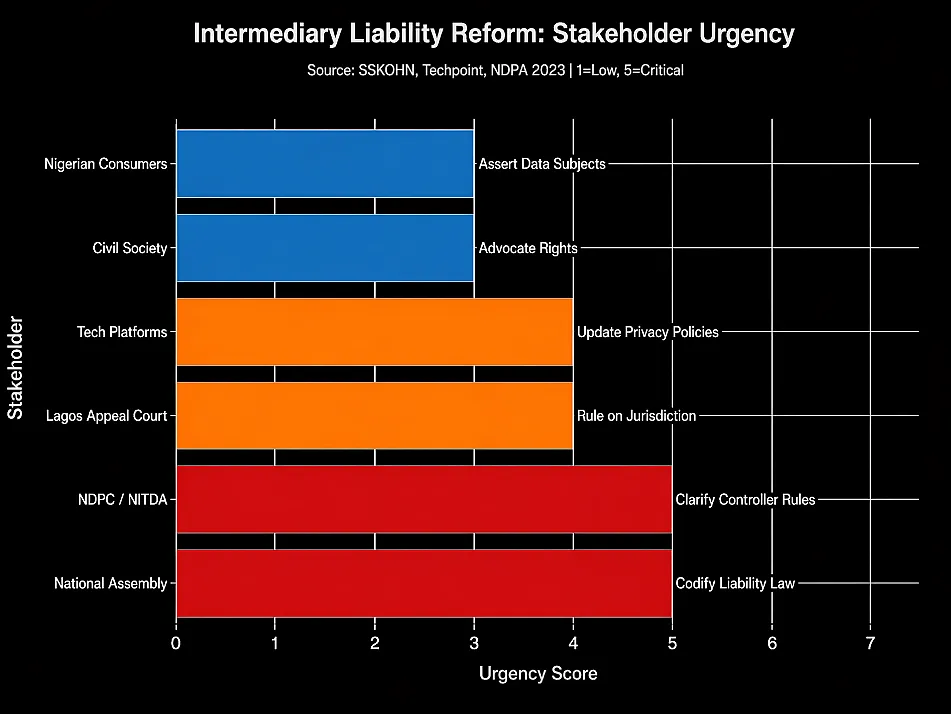
Nigeria’s digital governance landscape is entering a decisive phase, requiring coordinated action across legislative, regulatory and judicial institutions.
- For the National Assembly, the priority is clear: enact an Intermediary Liability Bill that codifies the joint data controller principle established in the Falana judgment, distinguishes between passive conduits and algorithmically active platforms, and sets proportionate liability standards.
- Rather than replicating external models like Section 230, the framework should reflect the NDPA’s dignity-centred architecture. Complementing this, the Nigerian Data Protection Commission and NITDA must issue binding guidance clarifying when platforms qualify as data controllers, particularly with regard to algorithmic amplification, content monetisation and cross-border data flows.
At the judicial level:
- The Lagos Court of Appeal now has a pivotal opportunity to affirm that constitutional rights remain enforceable in digital environments.
- For technology platforms, this moment signals the end of one-size-fits-all compliance, requiring privacy policies and moderation systems aligned with Nigerian law.
- Meanwhile, civil society organisations can build on the Falana precedent, deploying strategic litigation to address emerging risks, including algorithmic harm, targeted advertising abuses and cross-border data governance gaps.
Path Forward – Accountability Must Outlast the Appeal
The appellate outcome in Falana v. Meta will shape Nigeria’s digital-rights landscape for a generation.
However, the Court of Appeal rules on jurisdiction, the Lagos High Court has already affirmed a deeper principle: that health information is personal data deserving constitutional protection, and that platforms which control, monetise, and amplify content can bear legal responsibility for its accuracy.
Nigeria’s legislators, regulators, and civil society should not wait for the appeal to end before acting. The legislative, regulatory, and advocacy work needed to build a durable intermediary-liability framework must proceed in parallel. Africa’s digital future will depend not on Big Tech’s goodwill, but on the strength and coherence of the institutions designed to hold it accountable.