Nigeria's proposed Petroleum Industry Act (Amendment) Bill 2025 seeks to transfer the government's representative role in upstream oil contracts from NNPC Limited to the Nigerian Upstream Petroleum Regulatory Commission (NUPRC), making the sector's primary regulator its own commercial counterparty.
This structural collapse of institutional separation, a hard-won achievement of the PIA 2021, signals a governance regression that threatens investor confidence and undermines accountability precisely when Nigeria's energy transition ambitions demand the opposite.
When the Referee Picks Up the Ball
Nigeria’s oil sector has long served as the backbone of the economy, generating more than 80% of export revenues and about 50% of government income.
However, for over four decades, its deepest weakness was structural: the old NNPC functioned at once as the regulator, commercial operator, and policy tool.
The result was predictable: opacity, inefficiency, and chronic under-investment. The Petroleum Industry Act of 2021 was designed to break from that model.
Separating the roles, creating institutions with clearer mandates, and signalling a stronger governance framework, it suggested Nigeria was finally prepared to manage its oil sector more responsibly.
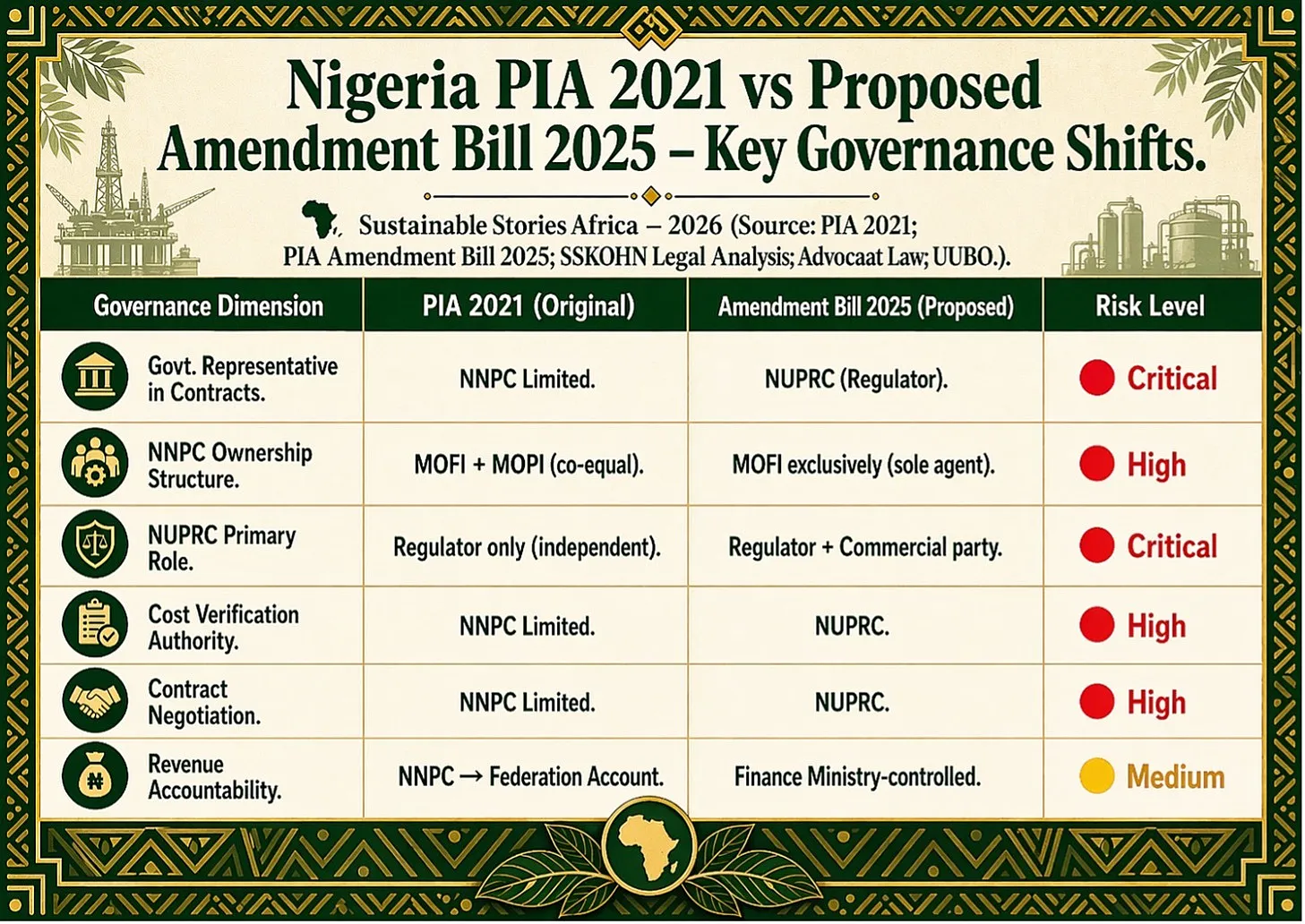
Four years later, that progress is under renewed pressure. The Petroleum Industry Act (Amendment) Bill 2025, now before the National Assembly, reviewed by legal experts at Streamsowers & Kohn (SSKOHN), proposes shifting the government’s representative role in production-sharing, profit-sharing, and risk service contracts from NNPC Limited to the Nigerian Upstream Petroleum Regulatory Commission.
It also seeks to place all NNPC shares under MOFI solely, removing the Ministry of Petroleum Incorporated as a co-equal shareholder. The implications are profound: this is less a reform than a return to institutional overlap.
The Governance Trap Hidden in Plain Sight
Nigeria’s most consequential oil-governance decision in four years is not about drilling, but about who holds the whistle.
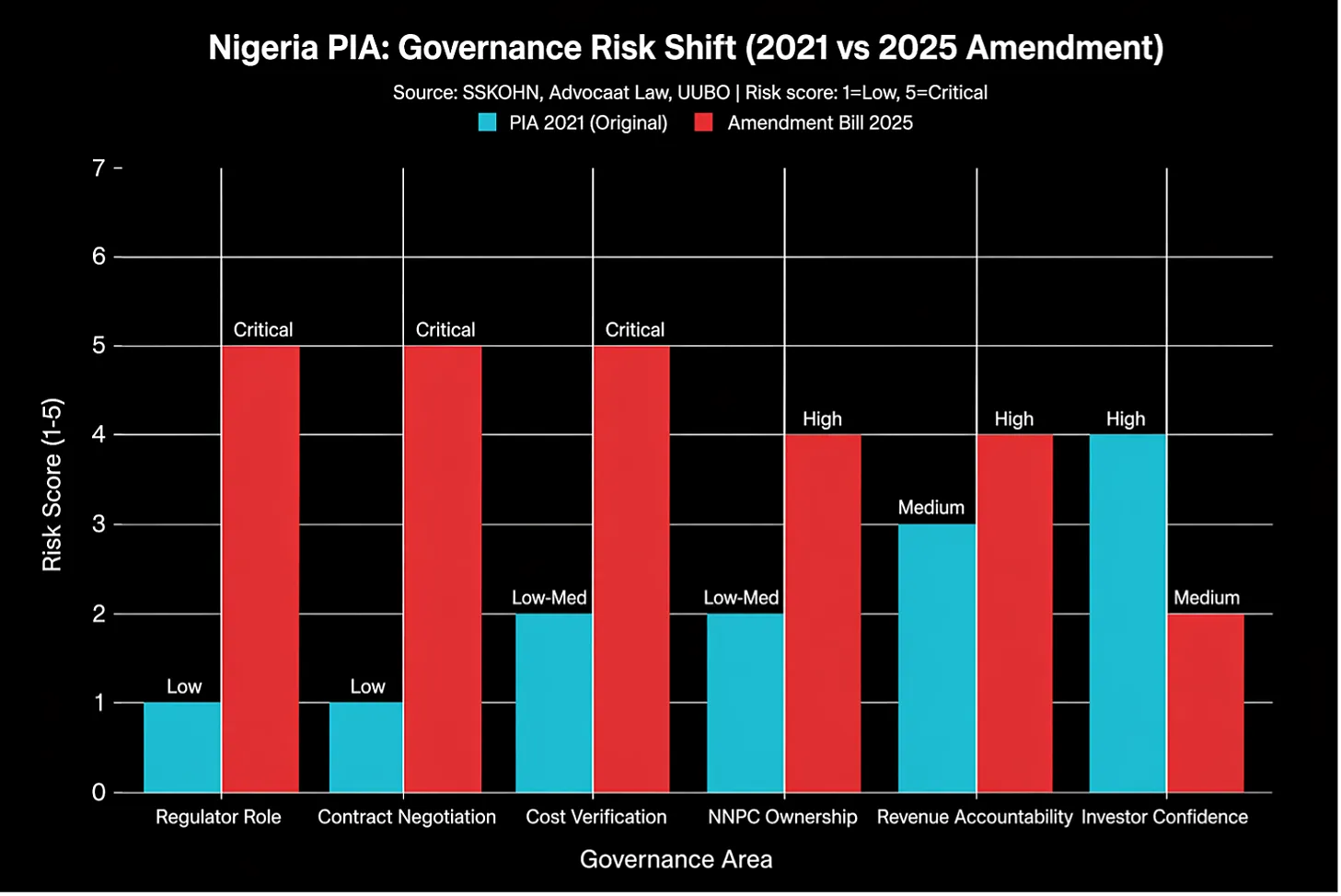
The proposed PIA Amendment Bill 2025 would make the Nigerian Upstream Petroleum Regulatory Commission both the independent regulator of the upstream sector and the government’s commercial representative in contracts worth billions of dollars.
That would give NUPRC power to negotiate model contracts, assess work programmes, verify recovery costs, and impose sanctions, all without independent oversight of its dual role.
As Streamsowers & Kohn argue, this revives a governance problem the PIA 2021 was designed to prevent.
The legal principle Nemo Judex in Causa Sua, no one should be a judge in their own cause, was built into the Act through the separation of regulatory and commercial functions.
That separation was a structural safeguard, not an administrative detail. Norway, Brazil, and Ghana all keep those roles distinct. Nigeria’s proposed model would make it an outlier, not a leader.
What Is at Stake, and Why Now
The timing of this amendment is as significant as its substance.
Nigeria’s oil sector is already in a fragile phase: major international oil companies have divested onshore assets, new licensing rounds are ongoing, and the country is trying to present itself as a credible destination for energy-transition investment in sub-Saharan Africa.
Against that backdrop, the proposed amendment, framed around fiscal consolidation and stricter cost verification, risks reintroducing the very institutional uncertainty investors have waited years for Nigeria to move beyond.
The government’s rationale is credible on the surface. Plugging fiscal leakages, reducing revenue losses to the Federation Account, and strengthening discipline around cost recovery in upstream contracts are legitimate policy goals.
NNPC Limited has, by several accounts, retained funds that should have gone to the Federation Account, while cost-recovery verification in production-sharing contracts has long suffered from opacity.
These are real weaknesses. However, the proposed solution could prove more damaging than the problem it seeks to solve.
For investors, the risk is straightforward.
- Regulatory independence builds confidence because it limits commercial compromise.
Once NUPRC becomes both regulator and contractual counterparty, that independence is weakened.
As Advocaat Law notes, this would give the Commission overlapping powers over work programmes, cost validation, and sanctions, an arrangement likely to raise serious red flags for foreign investors considering multi-billion-dollar contracts in Nigeria.
The Nigeria That Is Possible, and the One We Risk Losing
- Imagine a Nigeria where the Nigerian Upstream Petroleum Regulatory Commission is recognised globally as a truly independent upstream regulator, with decisions that carry weight because the market knows it has no commercial stake in the outcome.
- Imagine, too, an NNPC Limited operating as a lean, commercially disciplined national oil company, accountable to its shareholders and the Federation Account, and governed to standards comparable with Equinor or Petrobras.
That was the institutional design the PIA 2021 set out to build, and four years on, however unevenly, it had begun to take shape.
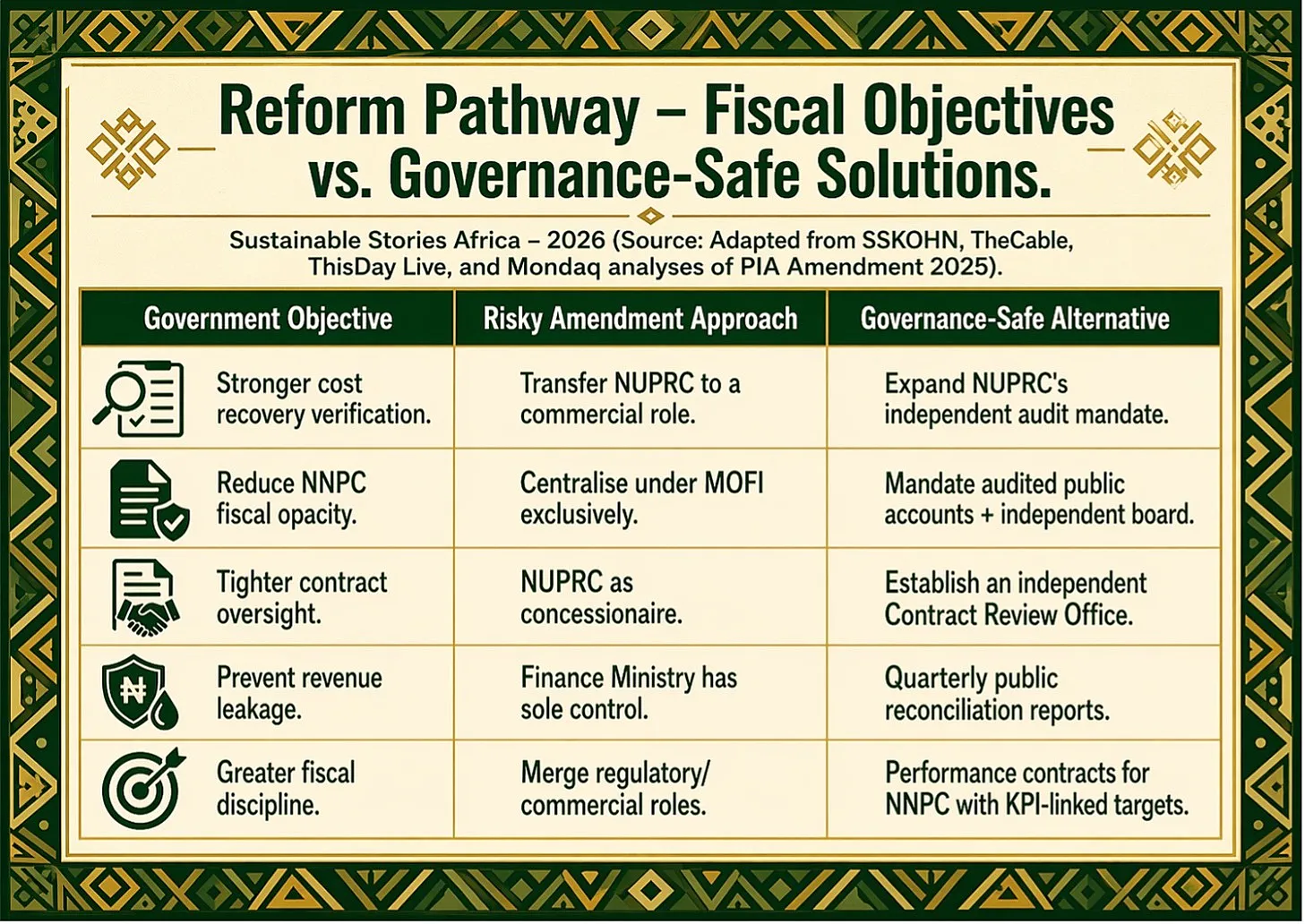
That future need not be abandoned. The amendment’s stated aims, tighter fiscal oversight, lower revenue leakage, and stronger cost recovery, are achievable without dismantling institutional separation.
The stronger path is not to turn NUPRC into a market participant, but to strengthen its role as an independent referee.
Expanding its auditing powers over upstream cost verification, requiring quarterly public reconciliation of NNPC remittances to the Federation Account, and establishing a genuinely independent NNPC board with measurable performance targets would address the government’s concerns without weakening the sector’s structure.
If the amendment proceeds unchanged, the costs could be severe. Nigeria risks losing investor confidence, undermining impartial dispute resolution, and eroding the institutional checks that protect the Federation Account from disappearing into opacity.
From Crossroads to Course Correction
Nigeria's policymakers, legislators, and investors face a clear choice that requires specific, concrete decisions in the weeks ahead. The following actions are essential:
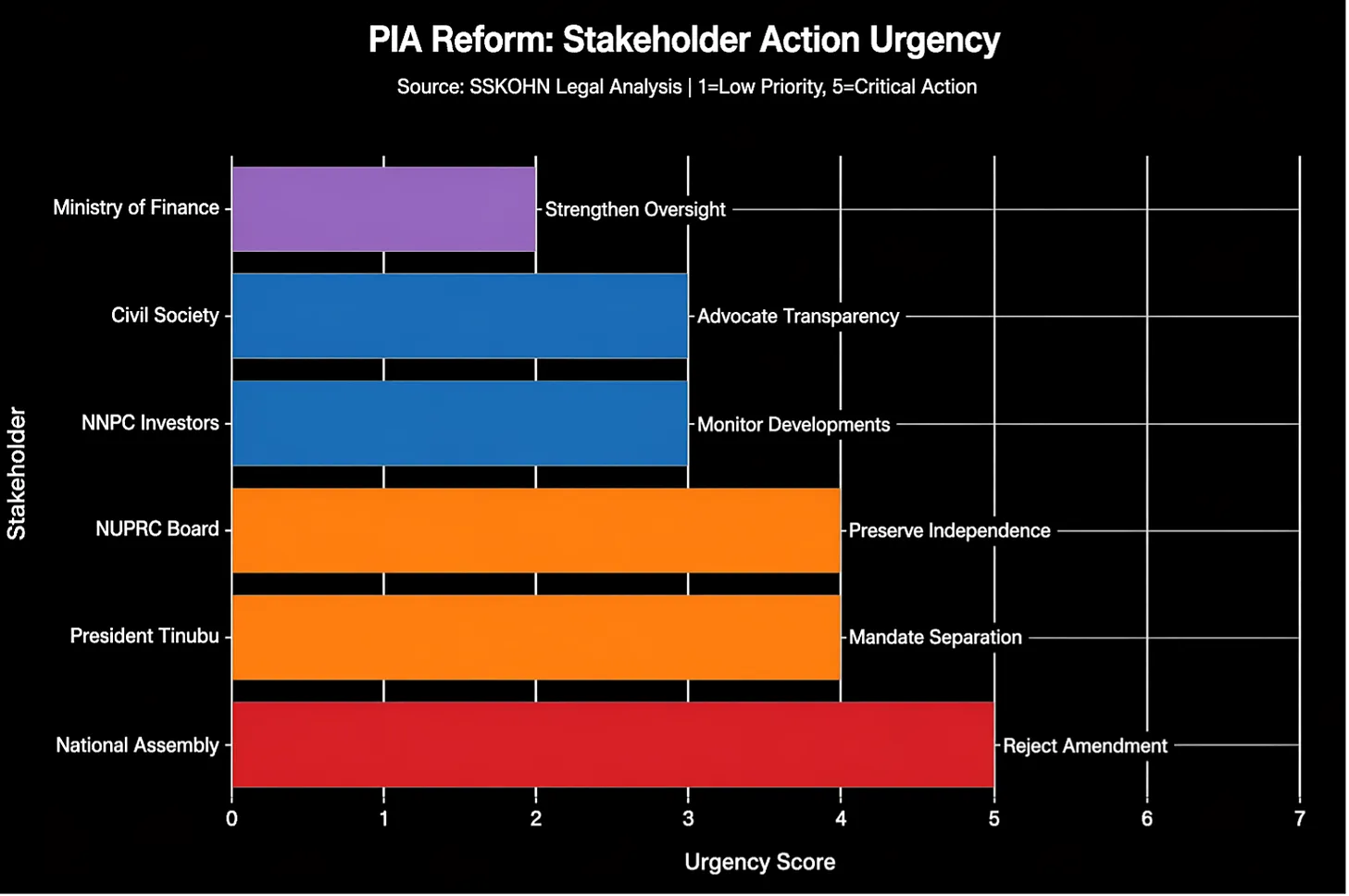
- For the National Assembly – Reject the provision transferring NUPRC's mandate to include commercial representation in upstream contracts. The Senate and House of Representatives must hold open, stakeholder-inclusive hearings before any amendment to the PIA is advanced. Mandate independent, quarterly audits of NNPC remittances to the Federation Account as a standalone legislative instrument.
- For President Tinubu's Administration – Separate the legitimate fiscal reform agenda, tighter cost recovery, stronger revenue accountability, from the structural governance question. Commission a dedicated technical review panel comprising the NUPRC, NNPC, Ministry of Finance, and independent legal experts to design a reform framework that achieves fiscal objectives without institutional conflict.
- For NUPRC's Board and Leadership – Publicly and formally communicate the regulatory risks of the dual-role model to the National Assembly. NUPRC's leadership must advocate for its own independence, not as institutional self-interest, but as the single most important guarantee of its long-term credibility and effectiveness.
- For International Investors and Development Finance Institutions – Engage the Nigerian government through formal channels, including the Nigerian Investment Promotion Commission, to articulate the investment confidence implications of the amendment. The World Bank, African Development Bank, and bilateral partners with active energy portfolios in Nigeria have both the standing and the obligation to signal clearly that governance regression carries a financial cost.
- For Civil Society and Media – Demand transparency in the amendment process. The PIA 2021 was Nigeria's most publicly debated energy legislation in history. Its amendment deserves no less scrutiny.
Path Forward – Nigeria's Reform Is Reversible
Nigeria’s governance crossroads calls for resolve, not retreat. The PIA 2021 was not perfect, but it was principled, reflecting a generational effort to govern Africa’s largest oil producer with stronger institutional discipline.
Four years of uneven implementation do not justify dismantling that framework; they justify repairing it.
The National Assembly should treat Streamsowers & Kohn’s analysis not simply as a legal brief, but as a warning.
Nigeria can pursue fiscal discipline and regulatory independence together. The real challenge is building the institutional capacity to deliver both.