Sustainability is no longer a distant policy language reserved for climate summits, donor reports, or large corporations. It is becoming a daily business test for African economies to balance growth, resource security, social trust, and investor expectations.
In Sustainability Simplified, Chanda Kalasa argues that the concept is best understood through three linked pillars: environmental integrity, social well-being, and economic resilience.
The real question now is whether organisations can turn that clarity into practice.
Clarity Is The First Sustainability Step
Sustainability has often been treated as a complicated word for environmental responsibility. However, a new explainer, Sustainability Simplified: Part 1, What Sustainability Really Means, presented by Chanda Kalasa, reframes it as a more practical decision-making lens for businesses, governments, communities, and citizens.
Kalasa, an Environmental and Social Sustainability Professional, GRI-Certified Sustainability Professional, and holder of master’s degrees in Sustainability and Consultancy, and Environmental Management, presents sustainability as a framework built around three intersecting pillars: environmental, social, and economic.
For African and emerging markets, the message is urgent. Sustainability is no longer just about emissions, waste, or biodiversity.
It is about whether a mining project earns community trust, whether agriculture can survive climate variability, whether companies can access capital, and whether growth today preserves opportunity tomorrow.
Sustainability Moves Beyond Corporate Language
The most important point in Kalasa’s presentation is also the simplest: sustainability is about ensuring that today’s actions do not compromise future generations’ ability to meet their needs.
However, in practice, that definition is frequently narrowed to environmental protection alone.
That misunderstanding matters because businesses and governments often respond to the part they can see most easily: carbon emissions, plastic waste, water use, or conservation.
These are critical, but they are only one side of the story. Kalasa’s framework insists that sustainability must also measure how decisions affect people and whether economic systems can remain viable over time.
In African markets, this distinction is not academic. A hydropower project exposed to drought, a mining company facing community resistance, or a small manufacturer unable to meet export-market disclosure requirements all face the same question: are they creating long-term value, or simply shifting risk?
Three Pillars Define Practical Sustainability
Kalasa’s presentation explains sustainability through the familiar “Triple Bottom Line” of people, profit, and planet.
- The environmental pillar focuses on how organisations interact with the natural world, including resource use, waste management, energy consumption, emissions, water management, and biodiversity protection.
- The social pillar asks how organisations affect people: employees, suppliers, host communities, customers, and wider society. Its key considerations include labour and working conditions, community engagement, equity and inclusion, and health and safety.
The presentation makes a particularly important point for infrastructure and energy markets: weak stakeholder engagement can delay, damage, or even cancel projects.
- The economic pillar then brings sustainability back to viability. It is not about limiting growth; it is about enabling growth that can endure.
That means financial stability, ethical business practice, efficient resource allocation, and equitable distribution of economic benefits.
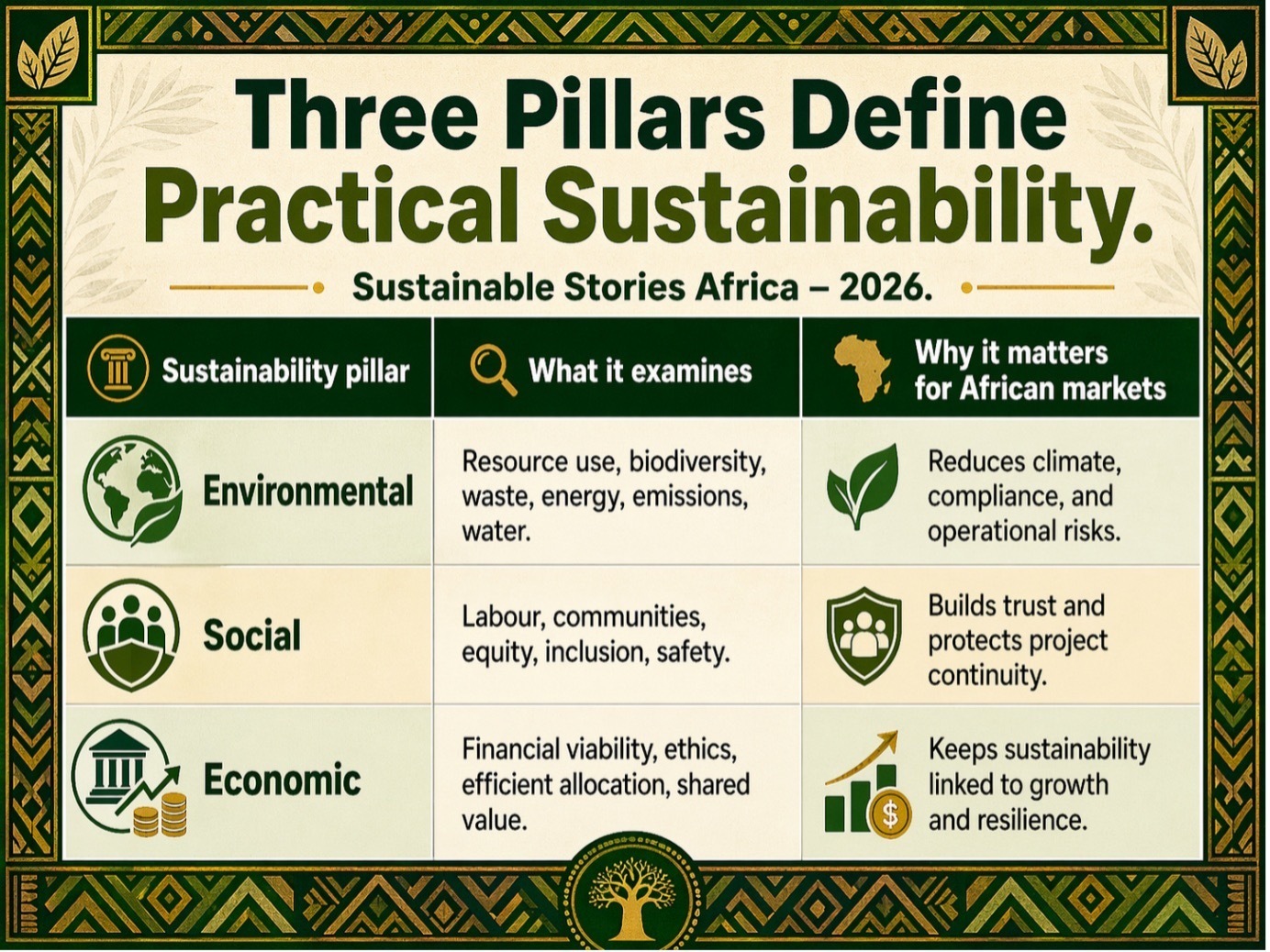
This is where the presentation’s strongest insight lies: sustainability is only achieved when these three pillars are applied together.
- Environmental ambition without social legitimacy fails.
- Social programmes without financial durability fade.
- Economic growth without ecological discipline becomes fragile.
ESG Turns Intent Into Evidence
Kalasa also draws a clear distinction among sustainability, corporate sustainability, and ESG, terms which are often used interchangeably but not always correctly.
Sustainability is the end goal: a vision of development that is environmentally sound, socially responsible, and economically viable.
Corporate sustainability is the application of that vision into organisational policy, strategy, and operations.
ESG is the measurement and management framework that tracks performance and communicates outcomes.
That distinction is increasingly important because investors, regulators, lenders, and export markets are asking companies to prove performance, not merely state intentions. ESG provides metrics, such as carbon emissions, water usage, waste management, labour practices, diversity and inclusion, human rights, customer satisfaction, community engagement, board composition, ethics, data security, and anti-corruption systems.
For companies, this creates an opportunity. Sustainability can move from communications language to a management system. A manufacturer can identify waste savings.
A bank can better price climate risk. A mining company can reduce community conflict. A government agency can align development planning with resilience.
The reward is not only reputational. It is financial, regulatory, and operational. The presentation challenges four common myths: that sustainability is only about the environment, only for large companies, too expensive, or merely a trend.
Its counterpoint is clear: organisations of all sizes can integrate sustainability, and upfront costs can lead to long-term savings and risk reduction.
Zambia Shows Why Timing Matters
Zambia sits at a critical crossroads. Rich in minerals, fertile land, and water resources, the country's long-term prosperity depends on how it manages these assets today.
Climate change is already reshaping that equation, through droughts, erratic flooding, disrupted agriculture, and rural livelihood stress, making sustainability not a future concern but a present economic reality.
Regulatory pressure is also intensifying. International investors and development finance institutions are demanding ESG disclosures.
The Zambia Institute of Chartered Accountants has mandated full adoption of IFRS S1, IFRS S2, and Integrated Reporting from January 1, 2027.
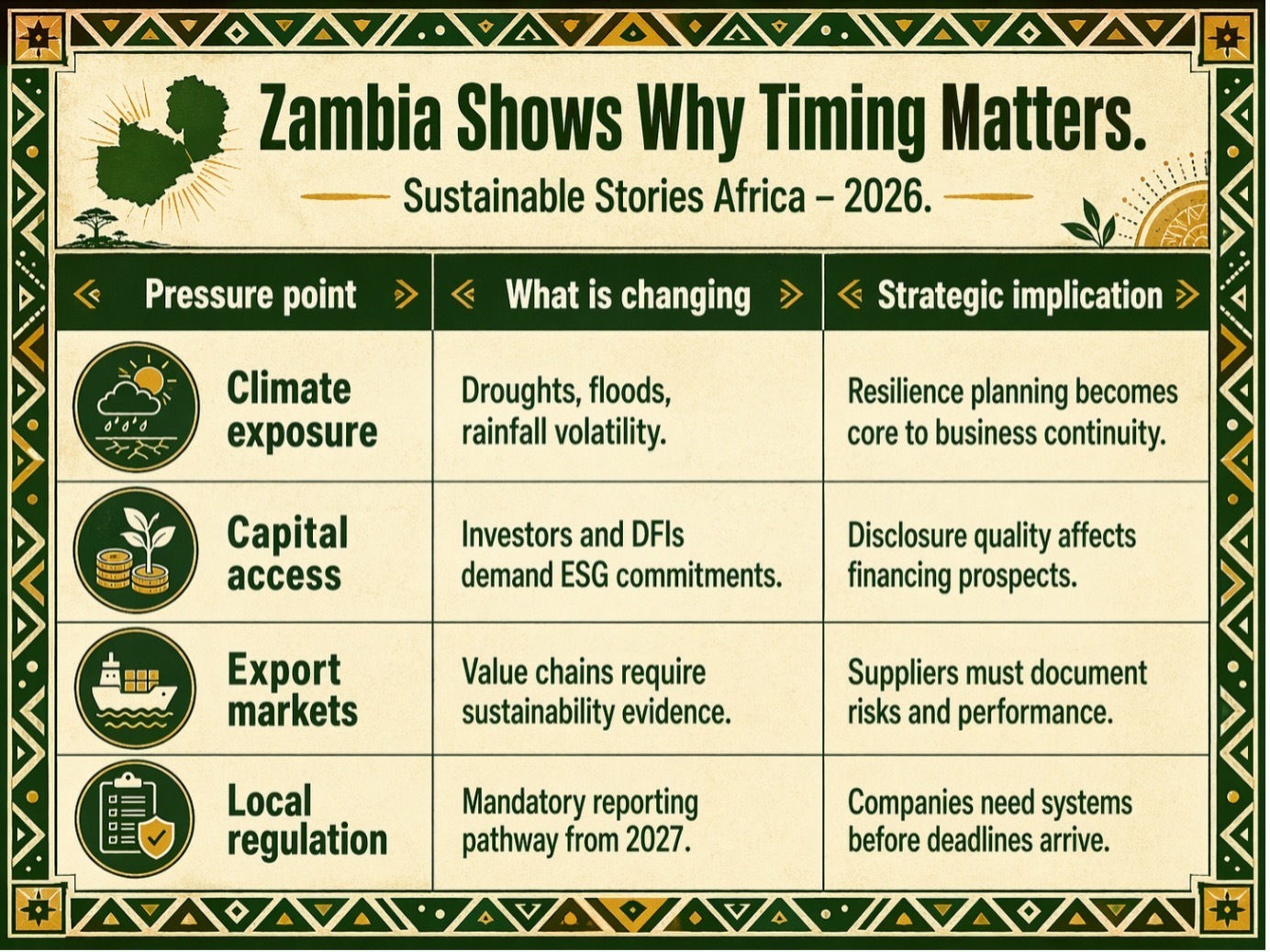
The strategic message for African businesses is unambiguous: compliance preparation cannot wait for a deadline.
Organisations that begin building data systems, governance structures, and credible sustainability narratives now will be better positioned to attract investment, manage risk, and demonstrate accountability when mandatory reporting arrives.
Better Questions Build Better Systems
The most practical section of the presentation comes in its conclusion. Kalasa argues that sustainability need not be complicated.
At its core, it means making better decisions; decisions that balance environmental integrity, social well-being, and economic resilience.
That is where African boards, project teams, regulators, financiers, and citizens can begin. The guiding questions are simple but powerful:
- What are the long-term implications of this decision?
- Who is affected, and how?
- Are we creating value, or simply shifting risk?
The options are clear:
- For governments, that means embedding sustainability into procurement, infrastructure planning, mining regulation, climate adaptation, and fiscal policy. For companies, it means connecting ESG teams with finance, operations, legal, risk, and strategy functions.
- For financiers, it means rewarding credible transition plans and penalising weak governance.
- For citizens and communities, it means demanding development that does not externalise harm.
The shift is cultural as much as technical. Sustainability must leave the slide deck and enter the budget, the contract, the feasibility study, the community meeting, and the board paper.
Path Forward – From Theory Into Practice
Africa’s sustainability challenge is not a choice between growth and responsibility. It is a test of whether growth can be made durable, inclusive, and investable.
The priority now is practical integration: credible reporting, stronger governance, community-centred project design, climate-resilient planning, and better everyday decisions
As Kalasa’s presentation argues, clarity is the first step. The next is execution.