Forced labour remains embedded in global supply chains, not because the world lacks information, but because that information sits in disconnected systems.
A World Economic Forum (WEF) white paper argues that federated data, agentic AI, and shared governance can turn fragmented audits, inspections, worker grievances, and migration records into collective intelligence for prevention, remedy, and accountability.
Data Must Become Worker Protection
Forced labour is increasingly becoming a data-governance test for global business. The World Economic Forum’s January 2026 white paper, Harnessing Data and Intelligence for Collective Advantage, warns that nearly 28 million people remain trapped in coercive work across sectors and borders, despite decades of reform, compliance programmes, and advocacy.
The paper’s core argument is sharp: forced labour persists because evidence is scattered, incentives are misaligned, and trust is thin.
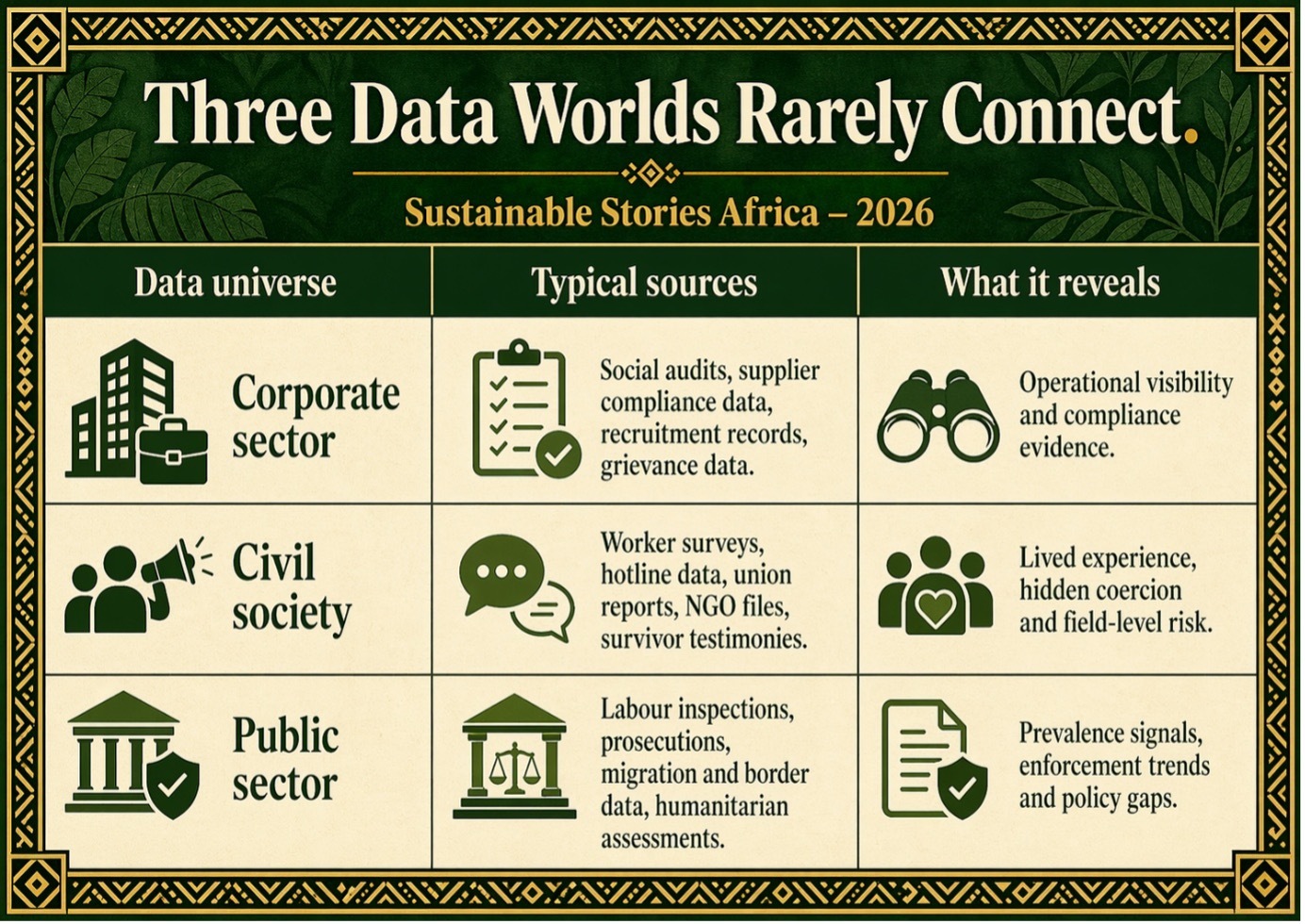
- Governments collect labour inspection and migration data.
- Companies collect audit and supplier information.
- NGOs, unions, and worker platforms collect grievances and lived-experience evidence.
However, these systems rarely connect.
For African and emerging markets, the lesson is urgent.
As supply chain due diligence, import restrictions, and investor scrutiny tighten globally, countries and companies that cannot demonstrate credible labour-risk intelligence may face exclusion, reputational damage, or higher compliance costs.
The new ESG question is no longer whether data exists, but whether it can be trusted, connected, and acted upon.
Visibility Is Still Fragmented
The report opens with a hard contradiction: global action on forced labour has expanded; however, prevalence has not fallen.
The ILO’s 2022 estimates cited by the WEF show that nearly 28 million people are in forced labour, including about 17 million in private-sector supply chains, an increase of roughly 2.7 million since 2016.
That makes forced labour both a human-rights crisis and a governance failure. Social audits, worker hotlines, traceability tools, ethical recruitment programmes, and national enforcement systems all generate useful evidence.
However, without interoperability, each actor sees only a fragment of the risk landscape.
The report describes the result as a vicious cycle: limited visibility weakens accountability, weak accountability reduces incentives to collaborate, and mistrust keeps institutions siloed.
In practice, this means warning signals are missed, suppliers face repeated audits, workers experience reporting fatigue, and responsibility for remedy remains unclear.
For African exporters in apparel, agriculture, mining-linked manufacturing, logistics, and food value chains, this is not distant.
Buyers, regulators, and financiers increasingly expect stronger proof of responsible sourcing.
Weak labour-risk data can become a market-access problem.
Three Data Worlds Rarely Connect
The WEF paper, drawing on Tech Against Trafficking’s “Three Universes of Data”, groups forced-labour intelligence into corporate, civil-society, and public-sector systems. The challenge is not scarcity. It is fragmentation.
The report identifies four systemic barriers:
- Data and measurement challenges, weak incentives, trust deficits, and governance gaps.
- Information is collected in different formats, languages, and levels of detail.
- Businesses fear reputational and commercial exposure.
- Governments guard sovereignty and legal mandates. Civil society may lack a secure infrastructure.
- Workers often under-report exploitation because of fear, weak grievance systems, or lack of protection.
The Global Data Partnership Against Forced Labour, launched at the WEF Annual Meeting in January 2025, is designed to break this pattern.
It provides a precompetitive technical and governance infrastructure that allows stakeholders to share insights securely while retaining control of their underlying data.
Its purpose is not to create another central database, but to connect existing systems through standards, governance protocols, and privacy-preserving technologies.
The model uses federated data and agentic AI. In simple terms, data stays where it is, but approved queries can generate aggregated intelligence across systems.
AI acts as an intelligence layer, linking signals from worker grievances, labour inspections, recruitment records, migration flows, and supply-chain data to identify patterns that individual datasets may miss.
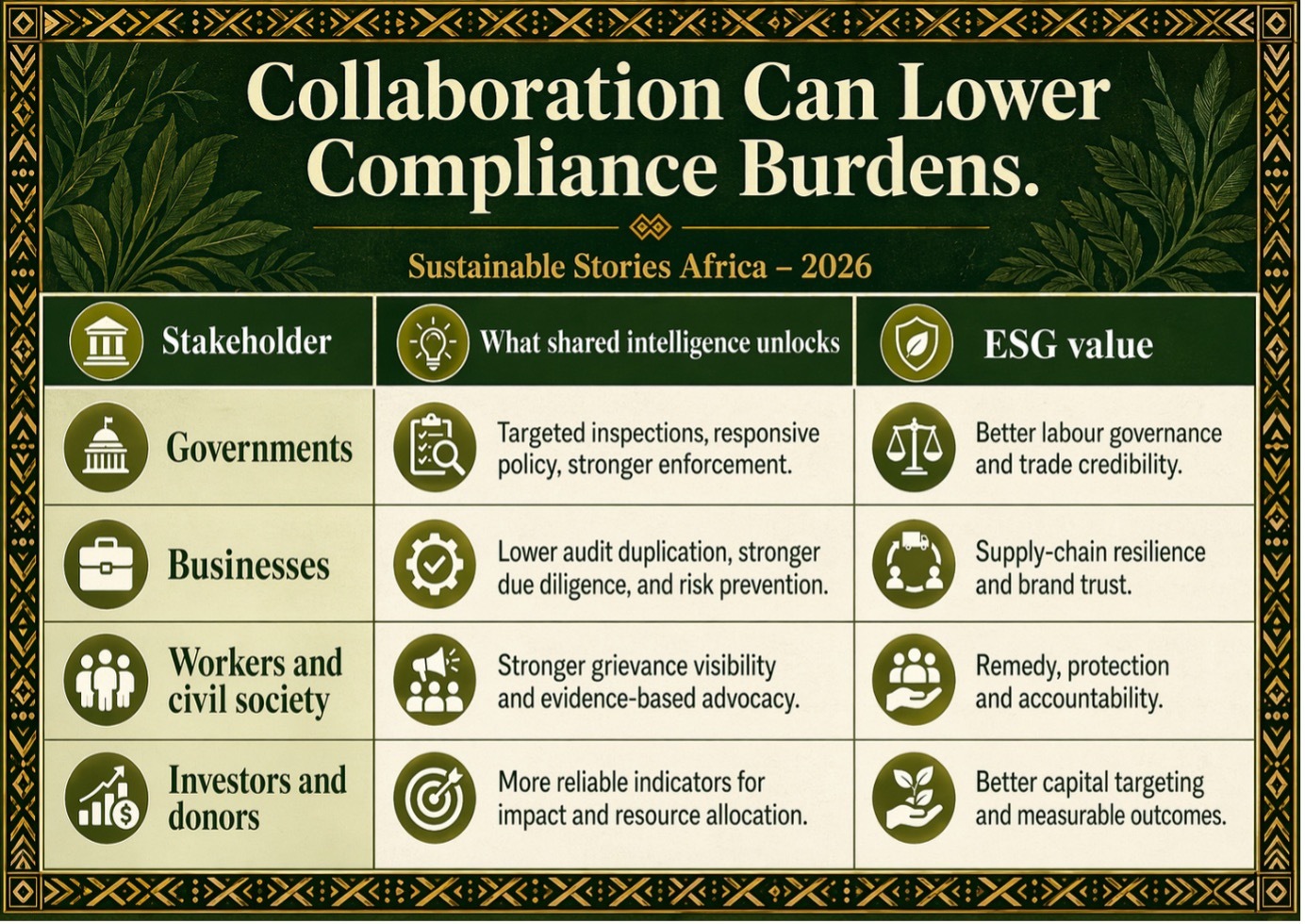
Collaboration Can Lower Compliance Burdens
The strongest opportunity is that better intelligence can serve everyone without requiring every actor to surrender data ownership.
- Governments gain clearer visibility to target inspections and policy design.
- Businesses reduce duplication, strengthen due diligence, and improve risk management.
- Civil society and worker organisations can ensure worker voice shapes systemic responses.
- Investors and donors gain better evidence to allocate resources.
Thailand is the first test case. The Partnership’s Proof of Concept examines how anonymised datasets, including migration-flow records, labour inspection results, prosecution data, workplace assessments, supply-chain data, and worker grievance information, can be queried through a federated system while protecting data privacy and sovereignty.
The POC is not presented as the final impact. It is a feasibility test.
However, it matters because it shows how countries and companies can move beyond reactive compliance towards coordinated prevention.
For African markets, the approach could support safer labour migration corridors, stronger recruitment oversight, better monitoring of the agricultural supply chain, and more credible ESG reporting.
Build Trust Before Scaling Technology
The report is clear that technology alone will not solve forced labour. Better data does not automatically produce better decisions.
Impact depends on how information is interpreted, shared, and acted upon by stakeholders with different mandates and incentives.
That means African governments, regulators, and businesses should focus:
- First on governance. Labour-risk data systems need clear rules on privacy, consent, anonymisation, accountability, transparency, and remedy. Worker-generated data must not become a surveillance tool. It must serve prevention, protection, and accountability.
- Second, companies should align supplier audits, grievance channels, and recruitment records with common taxonomies. The aim should be fewer duplicate checks and more useful insights. A factory audited five times but never connected to worker voice, recruitment-fee data, or migration-risk signals is still a weak ESG system.
- Third, investors and development finance institutions should treat labour-data infrastructure as part of sustainable-market development. Funding secured through worker voice platforms, labour-inspection digitisation, ethical recruitment monitoring, and privacy-preserving analytics can help markets meet global due diligence expectations.
- Fourth, civil society and unions must be included by design. The WEF paper’s governance principles emphasise transparency, ethical use, accountability, and inclusion, with data used for prevention, remedy, and accountability rather than punitive or commercial misuse.
- Finally, AI ethics must sit at the centre. HPE’s assessment of the Proof of Concept stresses privacy-enabled design, robust security, restricted access, misuse testing, inclusion for workers with limited connectivity or English proficiency, explainability, accountability, and regular stress testing.
Path Forward – Make Labour Data Accountable
African markets should build labour-intelligence systems that connect public enforcement, corporate due diligence, and worker voice without centralising sensitive data. The priority is trusted visibility, not data extraction.
Governments, companies, investors, and civil society should align on privacy, interoperability, remedy, and shared accountability.
That is how forced labour shifts from hidden supply-chain risk to preventable governance failure, and how ESG becomes protection for people, not paperwork.