Sport is becoming a multitrillion-dollar development engine, but its growth story is now exposed to heat, pollution, water stress, waste and rising physical inactivity.
The World Economic Forum’s 2026 report argues that the sector’s future depends on a new model: healthier people, greener cities, circular supply chains and capital that rewards resilience, not only spectacle.
Sport Becomes A Sustainability Economy
Sport is no longer only a game, a weekend ritual, or a global entertainment product.
It is becoming a development sector, a tourism engine, a consumer-goods market, a media asset class and, increasingly, an ESG test for cities, investors and governments.
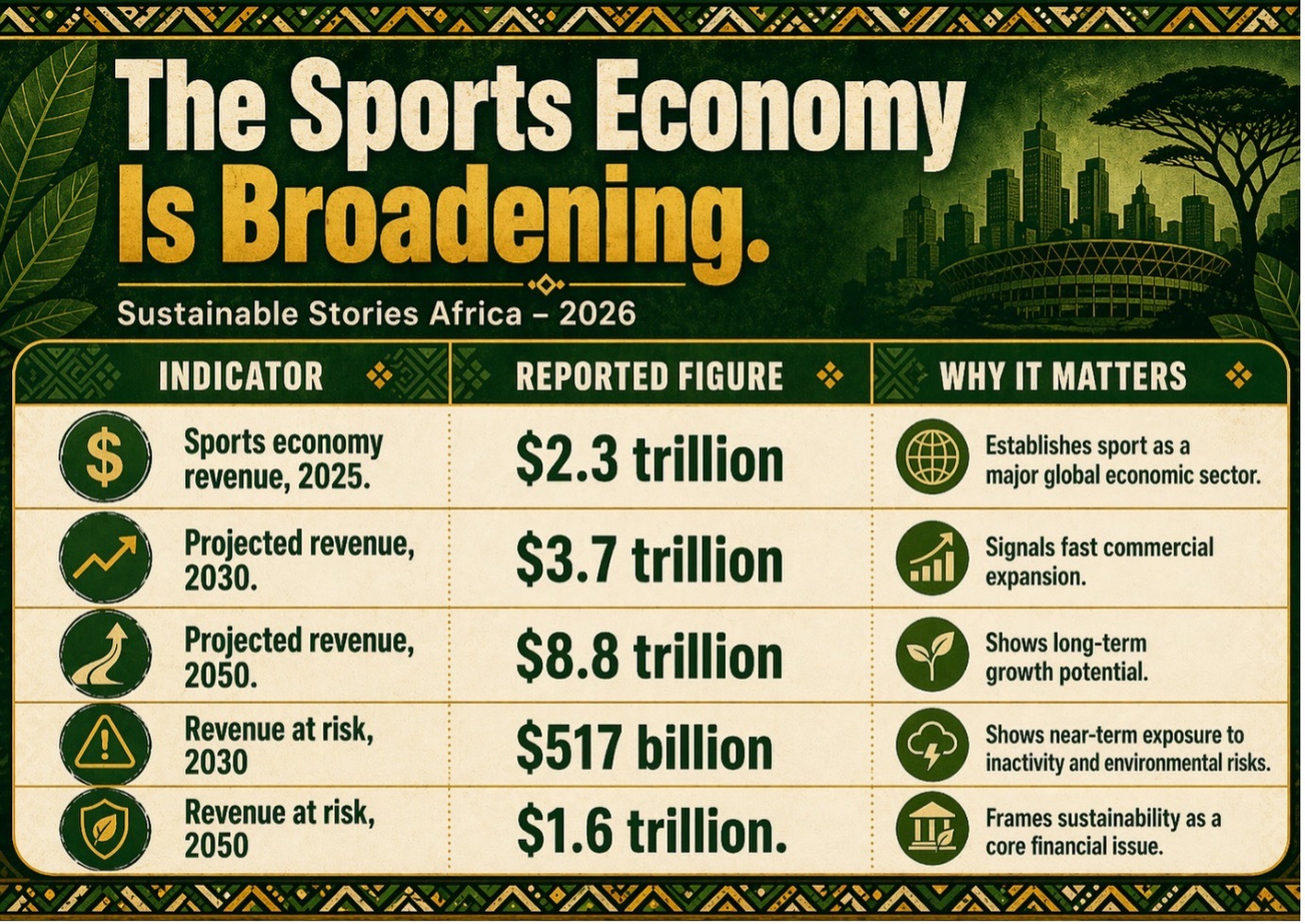
A January 2026 World Economic Forum report, Sports for People and Planet, produced with Oliver Wyman, estimates that the global sports economy generated about $2.3 trillion in annual revenue in 2025 and could expand to $3.7 trillion by 2030 and $8.8 trillion by 2050.
However, the same report warns that physical inactivity, climate change and nature loss could put $517 billion in annual revenue at risk by 2030 and $1.6 trillion by 2050.
For African and emerging markets, the message is direct: sport can create jobs, improve health, attract tourism and mobilise capital.
However, without climate-smart infrastructure, inclusive participation and resource stewardship, the sector could reproduce the same environmental and social risks now testing energy, agriculture, transport and manufacturing.
Sport’s Growth Now Carries Risk
The striking figure is not only the projected $8.8 trillion opportunity by mid-century. It is the warning that nearly 18% of that future annual revenue could be exposed to health and environmental disruption if current trends continue.
That makes sport a serious economic-risk story. Extreme heat can make outdoor competitions unsafe.
- Flooding can damage pitches and stadiums.
- Poor air quality can disrupt games.
- Water stress can affect fields, swimming, rowing, textile production and equipment supply chains.
At the community level:
- Unsafe or poorly designed urban spaces can reduce physical activity.
- Weakening the grassroots base that sustains fans, athletes, tourism and sporting goods demand.
The report frames sport as a “powerful social and economic force” whose influence cuts across culture, health, trade, tourism, jobs and community life.
However, it also argues that a thriving sports economy is inseparable from a thriving natural environment.
In other words, the sector cannot grow sustainably while degrading the conditions that make play possible.
The Sports Economy Is Broadening
The WEF defines the sports economy as an interconnected ecosystem with more than 15 stakeholder groups, anchored by four core industries: professional and elite sport, participatory sport and physical activity, sporting goods, and sports tourism.
Five connected industries, broadcast and streaming, gaming, nutrition, wearables, technology software, and sports services, add further commercial scale.
The fastest growth is linked to four drivers:
- Sports tourism
- Sport as an asset class
- Women’s sport
- Emerging-market expansion.
Sports tourism is expected to account for 60% of the growth of total sports economy revenue until 2030. Women’s professional sport revenue is projected to reach $2.35 billion in 2025, more than triple its 2022 level.
For Africa, the “emerging markets” angle is especially relevant. The report identifies Africa, Asia and Latin America as regions where sport is increasingly tied to job creation, health promotion and infrastructure development.
It also notes that Latin America, Africa and the Middle East are among the fastest-growing markets for sporting goods, with double-digit annual growth expected over the coming decade.
That calls for a practical development question: will African cities treat sport as a luxury entertainment sector, or as part of urban resilience, youth employment, public health and sustainable tourism?
Better Sport Can Build Better Cities
The opportunity is larger than stadium revenue.
Well-designed sport systems can improve public health, reduce pressure on healthcare systems, make cities more liveable, support women’s participation, expand youth pathways and create new markets for green products and circular business models.
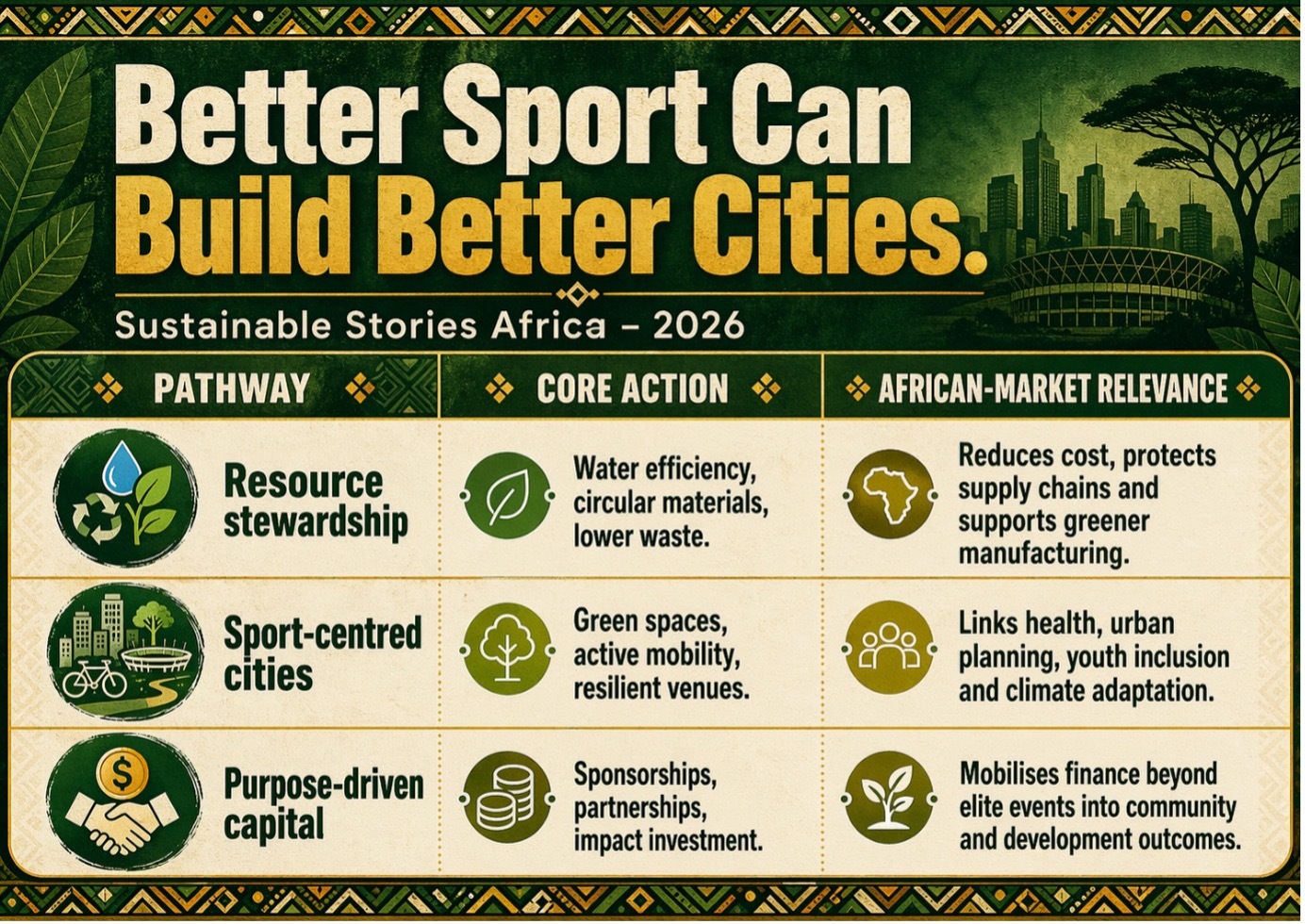
The WEF report proposes three pathways:
- Championing resource stewardship
- Placing sport at the heart of cities
- Catalysing purpose-driven capital flows.
These are not abstract ESG slogans. They translate into water-efficient venues, recycled and repairable sporting goods, active mobility, green and blue public spaces, resilient community infrastructure, purpose-led sponsorships and blended finance for sport-linked social outcomes.
For Lagos, Nairobi, Kigali, Accra, Cairo or Johannesburg, this could mean treating parks, waterfronts, school fields, cycling routes and community courts as productive infrastructure.
The upside is tangible. Sport can become a practical entry point for ESG: easy for citizens to understand, visible for sponsors to support, and measurable for governments to track through participation, jobs, emissions, waste, water use and community access.
Governance Must Match The Opportunity
The next step is governance. African governments and city authorities need to move sport from the margins of youth and culture policy into integrated planning across health, tourism, education, transport, investment and climate adaptation.
That means national sports strategies should include ESG indicators. Stadium procurement should include energy, water and waste standards.
School sports should be tied to public-health goals. Major events should be assessed not only by ticket sales and broadcast reach, but also by local jobs, supplier inclusion, emissions, transport planning and post-event community use.
Private capital also has work to do. Sponsors, broadcasters, sporting goods companies and investors should treat sustainability as part of brand protection and asset resilience.
If extreme weather disrupts events, if participation falls, if supply chains face water shortages, the commercial model weakens.
This is why the report’s call for purpose-driven capital matters: sponsorship can fund community facilities, women’s sport, disability access, green mobility and circular product systems, rather than only logo visibility.
Sports federations and clubs should also build discipline of disclosure. They need credible data on energy use, water use, waste, travel emissions, gender participation, accessibility and local economic impact.
What is measured can be financed; what is disclosed can be improved.
Path Forward – Make Sport Development Infrastructure
Africa should treat sport as climate-smart social infrastructure: a platform for health, jobs, tourism, inclusion and city resilience.
The priority is not only hosting bigger events, but building systems that make daily participation safer, cheaper and more accessible.
Governments, investors, sponsors and sports bodies should align around measurable ESG outcomes: active cities, circular goods, low-carbon venues, inclusive participation and resilient community assets.
That is how sport moves from entertainment to sustainable economic strategy.