
The World Economic Forum’s (WEF’s) latest white paper argues that regulation is no longer merely a brake on risk.
It is now part of the infrastructure that determines where innovation scales, where capital flows and which countries shape global standards.
For African and other emerging markets, the question is no longer whether to regulate faster.
It is whether rules are designed to protect citizens, widen access and still create room for innovation to grow.
Rules Now Shape Innovation Markets
The World Economic Forum, working with Boston Consulting Group and the Government of the United Arab Emirates, has made a pointed argument in its January 2026 white paper: regulation must evolve from static control into dynamic enablement.
In the Forum’s telling, the countries that design clear, adaptive and trusted rulebooks will attract investment, build legitimacy and shape the next map of economic power.
That matters deeply for African markets, where the challenge is rarely innovation alone. It is whether regulatory systems can keep pace with digital finance, health technology, AI, cross-border data flows and new public infrastructure without either smothering enterprise or leaving citizens exposed.
The paper frames regulation not as a compliance afterthought, but as a strategic tool for competitiveness, inclusion and public trust.
Its core warning is simple: if rules arrive too late, markets drift into uncertainty; if they are too rigid, innovation slows; if they are too weak, trust breaks.
For governments and firms alike, the real contest is now about designing rules that learn as quickly as technology changes.
Regulation Becomes Economic Infrastructure
The paper’s strongest insight is that regulation now functions like infrastructure. Its architecture influences how quickly ideas reach market, whether smaller firms can compete and whether societies believe new technologies are being deployed in their interest.
The Forum says this is already visible across payments, health, digital assets and AI.
Its headline examples are telling.
- Brazil’s central bank-backed Pix instant payments system reached more than 150 million registered users within a year after launch, illustrating how public rule-setting and platform design can widen access at speed.
- Kenya’s mobile money experience is cited as another example of smart access regulation, by allowing telecom operators into payments under dedicated e-money supervision rather than forcing full banking licences, regulators helped create a system used by more than 80% of Kenyan adults within a few years.
- India’s UPI, meanwhile, was processing more than 16 billion transactions a month by 2024, showing the scale public digital rails can unlock.
For African readers, that is the hook: when regulation is well designed, it not only reduces harm. It can lower entry barriers, widen financial access and move innovation from pilots into everyday life.
Five Design Choices Matter Most
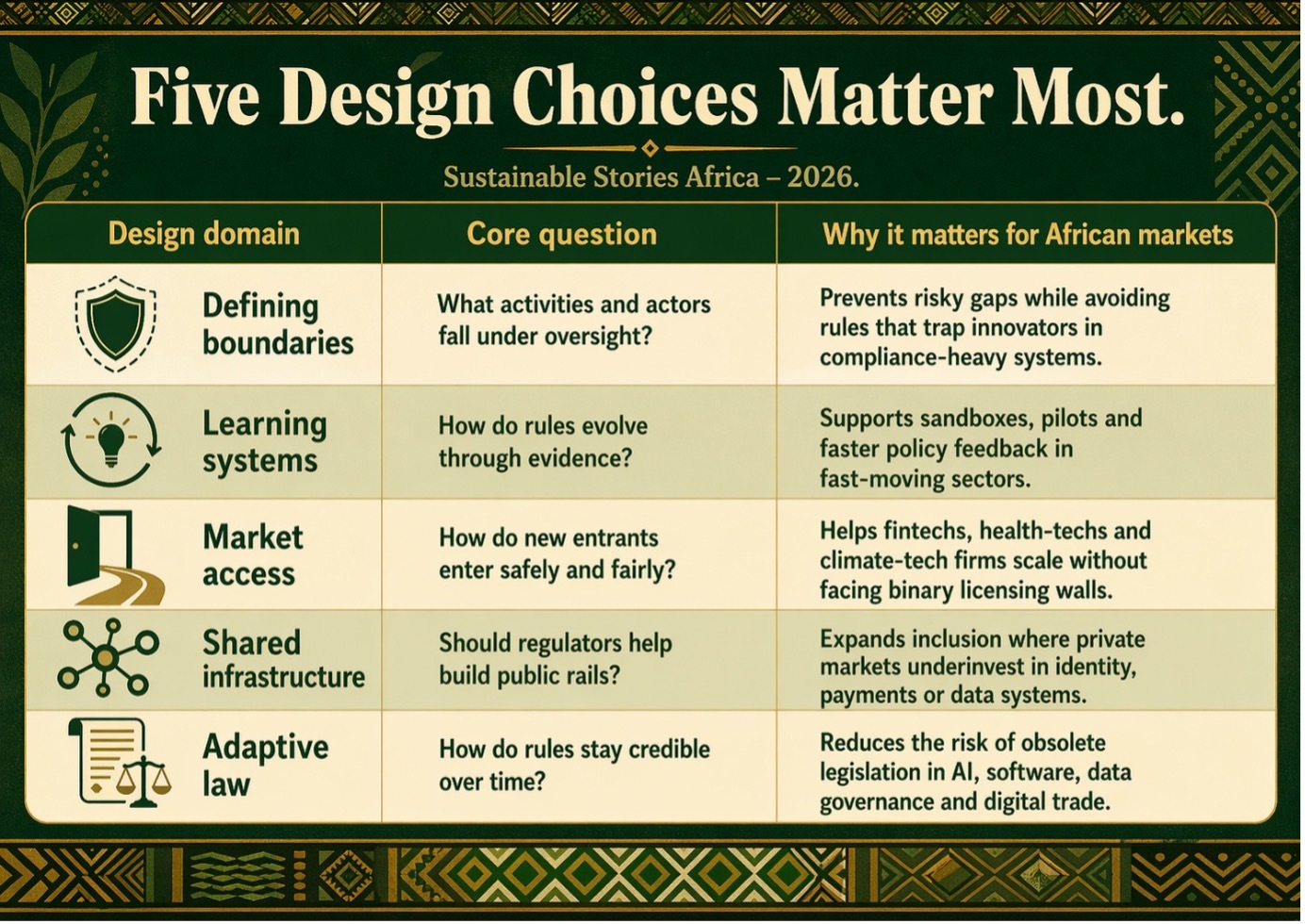
The report says the performance of regulation depends on five interacting design domains:
- Defining boundaries.
- Designing learning systems.
- Opening market access
- Building shared infrastructure
- Keeping the law adaptive as technology changes.
The paper’s table on page 6 presents these as the core choices that determine whether innovation scales with confidence or stalls in uncertainty.
The report also groups regulatory strategy into three pathways:
- Adaptive pathfinders, which refine existing rules through experimentation; systemic architects, which rebuild markets around new digital and legal foundations
- Standards convergers, which align domestic systems with international rulebooks for interoperability and access. Its argument is not that one model fits every country, but that strategic coherence matters more than speed for its own sake.
That is a relevant message for the Global South. In many emerging economies, capacity is uneven across sectors. Financial regulation may be relatively mature, while AI governance, digital health oversight or cross-border data enforcement remain fragmented.
The paper’s practical point is that governments can mix approaches: adapt where institutions are strong, rebuild where legacy systems are broken, and harmonise where market access depends on global recognition.
What Better Regulation Could Unlock
The upside, the Forum argues, is not abstract. Better-designed regulation can channel innovation towards safety, transparency and redress while also lowering uncertainty for entrepreneurs, researchers and investors.
In effect, trust becomes an economic asset.
For African economies, that could mean more than smoother compliance. It could mean faster rollout of interoperable payment systems, clearer pathways for health software, safer AI deployment in public services, and stronger credibility in sectors where international investors increasingly care about governance quality.
The report argues that transparent and predictable frameworks widen participation and distribute growth more evenly, rather than concentrating opportunity among incumbents or foreign first movers.
There is also a sovereignty angle. The paper notes that countries that act early and credibly often shape the standards others must later follow, much as the Basel rules, FATF standards and GDPR-style data protection frameworks influenced global practice.
For African regulators, that suggests a more ambitious role: not merely adopting external templates, but helping shape how integrity, accountability and market access are defined in sectors where the continent is scaling rapidly.
What Governments And Firms Must Do
The Forum is unusually concrete here. It says regulators need three core capabilities: foresight, technical depth and engagement.
They must anticipate how technologies reshape markets, understand complex systems well enough to write proportionate rules, and work with innovators, academia and civil society in shared test environments.
On page 16, the paper also lists five priorities for chief executives:
- Read the regulatory path early
- Build trust as a product feature
- Shape standards collaboratively
- Differentiate the above shared rails
- Design compliance for scale.
For African policy-makers, the implication is pragmatic.
- Build activity-based rules where old entity-based categories no longer fit.
- Use phased licensing where promising innovations need room to prove themselves.
- Invest in public-interest digital rails where markets alone will not solve access.
- Keep core legal principles stable, but let technical standards evolve.
- Avoid the false choice between innovation and protection.
The report’s central message is that strong markets increasingly need both.
Path Forward – Design Rules That Learn
The WEF paper is ultimately advocating a shift in mindset: regulation should be treated as a strategic design problem, not a delayed reaction to disruption.
Countries that combine trust, adaptability and market clarity will be better placed to attract capital and shape future standards.
For African markets, the task now is to turn that principle into institutions, skills and public infrastructure.
The real prize is not just safer innovation, but more inclusive growth built on rules citizens and investors can trust.