
Digital health has attracted billions in investment, but many health systems remain fragmented, reactive and expensive.
A World Economic Forum (WEF) white paper argues that the next leap is not more tools, but intelligent systems that connect data, AI, policy, and care to enable prevention at the population scale.
Health Data Becomes Prevention Power
Digital health is entering a new phase: from fragmented innovation to system-wide intelligence.
A January 2026 World Economic Forum white paper, A New Era for Digital Health: Abu Dhabi’s Leap to Health Intelligence, argues that health systems can no longer rely on isolated pilots, electronic records or AI tools that do not connect across patients, providers, payers and policy-makers.
The report, produced with the Department of Health, Abu Dhabi, says the real value of digital health lies in intelligence: the ability to integrate clinical, financial, genomic, behavioural, lifestyle and environmental data, then translate it into real-time decisions that prevent disease, reduce waste and personalise care.
For African and emerging markets, the implication is direct. Digital health should not be treated only as an app economy or hospital technology upgrade.
It should be seen as public infrastructure, such as power, broadband or transport, capable of improving access, reducing avoidable costs and making prevention measurable.
Health Systems Are Data-Rich, Insight-Poor
The WEF report begins with a hard diagnosis: despite unprecedented investment in digital health, global health outcomes have barely shifted in proportion to the money spent.
Health systems remain fragmented, costs are rising, and inequities persist. The problem, it argues, is not innovation itself, but poor implementation, weak integration and limited intelligence at scale.
The economic pressure is severe. The report notes that diabetes costs the world more than $1 trillion annually, while cancer-related losses are projected to exceed $25 trillion between 2020 and 2050.
Health spending has already surpassed $9.8 trillion annually, accelerating to over 10% of global GDP; however, as much as one-fifth of OECD health spending remains ineffective or wasteful.
This is where the African relevance sharpens. Many African health systems face rising non-communicable diseases, underfunded primary care, uneven digital records, limited specialist access, climate-sensitive disease risks and workforce shortages.
Without interoperable data, prevention remains guesswork. Hospitals treat disease after it arrives; governments struggle to know where risks are rising; patients only receive help when the system is already under pressure.
Interest: Abu Dhabi Builds A Learning System
Abu Dhabi’s model is presented as a pathfinder because it moves beyond digitisation into health intelligence.
The emirate’s system is guided by a “Predict–Prevent–Act to Cure and to Restore” framework: predict risks before they become visible, prevent disease burden through targeted action, and act quickly across clinical, financial and policy settings.
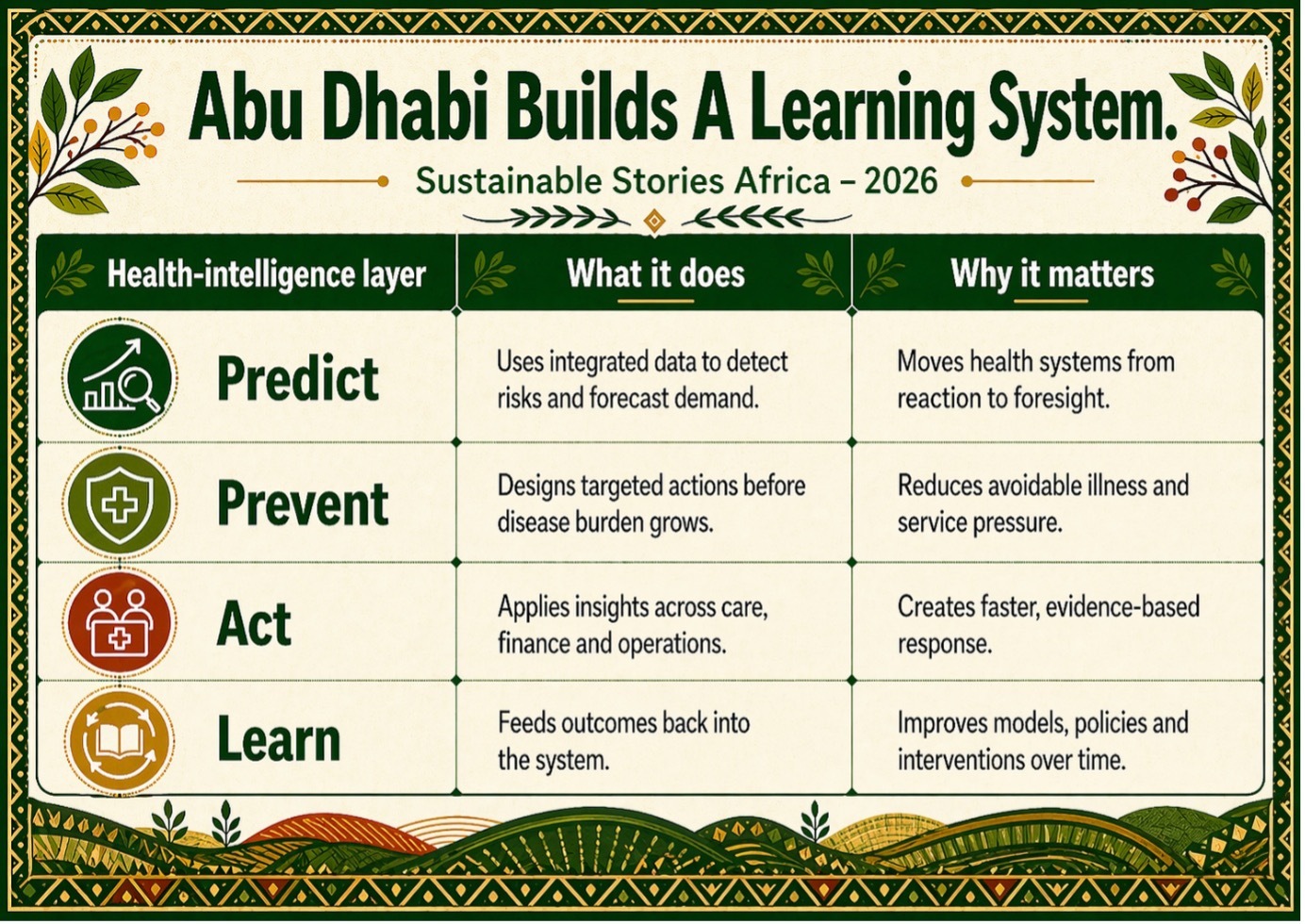
The scale of Abu Dhabi’s data foundation is striking. More than 100,000 integrated data streams feed the intelligent health system across clinical, financial, genomic and environmental domains.
Its infrastructure includes more than 3.5 billion unique clinical records through Malaffi, more than 2 billion financial claims activities through Shafafiya, and more than 850,000 genomic samples sequenced through the Emirati Genome Programme.
The model is not only about hospitals. Abu Dhabi’s Population Health Intelligence platform, unveiled in October 2025 and built with Microsoft, creates a digital twin that aggregates and analyses de-identified data across the ecosystem.
It identifies disease trends, risk clusters and prevention opportunities, helping policy-makers target interventions before health risks become system-wide crises.
Intelligence Can Make Prevention Practical
The opportunity is to make prevention operational, rather than aspirational. In many countries, health policy talks about prevention, but budgets and systems still reward late treatment. Intelligence changes this by making risk visible early enough to act.
Abu Dhabi’s reported results show how this can work. Predictive modelling informed a decision to lower the breast-cancer screening age after analysis suggested some patients could have been detected earlier.
The same intelligence approach helped redesign colorectal-cancer screening, where low participation among eligible people pushed the system towards awareness campaigns and less invasive testing options.
The Unified Medical Operations Centre offers another practical example. The report states that Abu Dhabi’s AI-enabled command centre reduced average heart attack response times by 30%, placing performance well below the global 90-minute benchmark.
A later case study notes emergency response times of 11 minutes 49 seconds in urban areas and 14 minutes 26 seconds in rural areas, compared with a global average of 30 minutes.
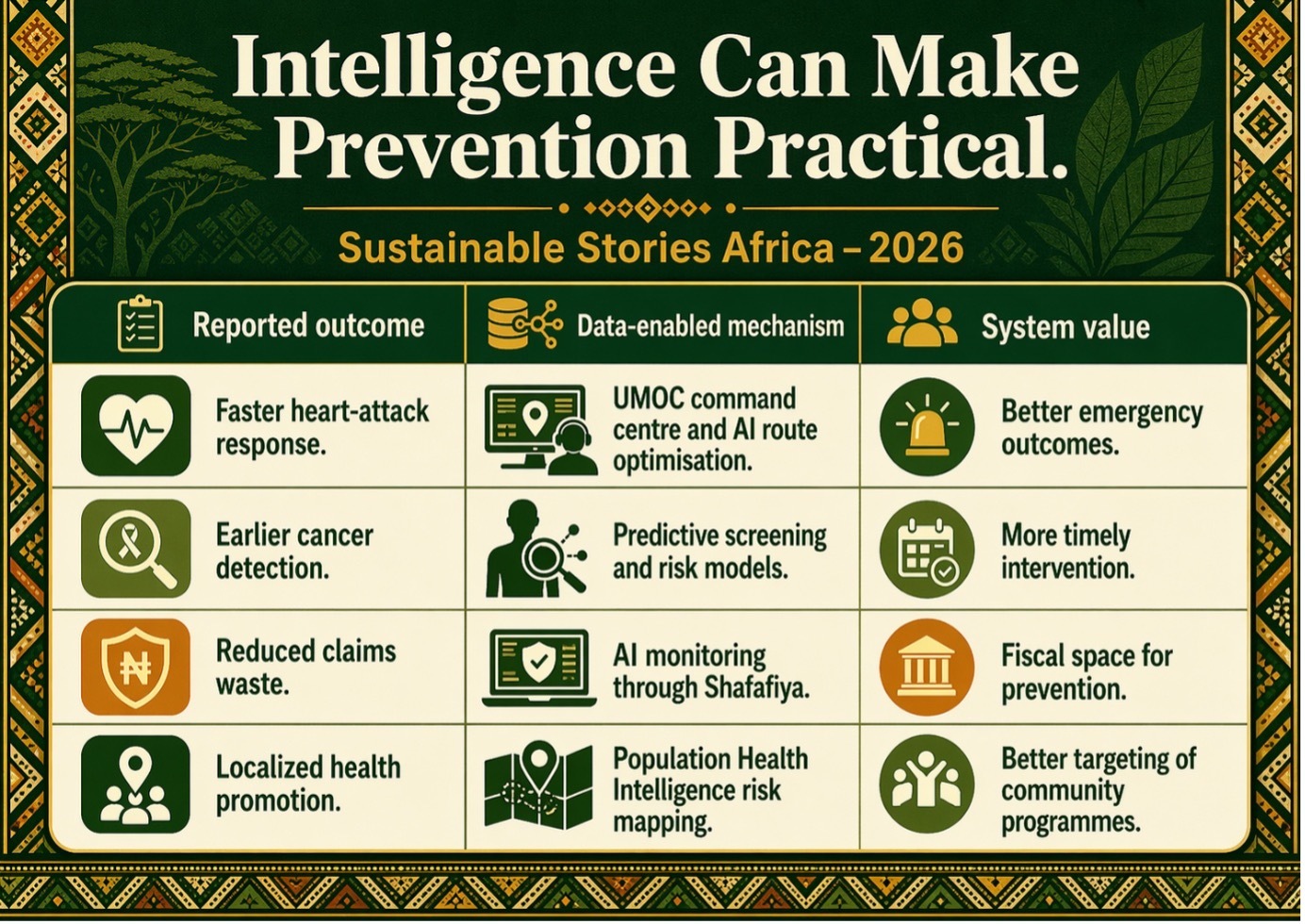
For African markets, these examples point to a practical agenda. A national digital health strategy should not simply count hospital systems connected or apps launched.
It should ask harder questions:
- Can the system detect diabetes risk earlier?
- Can it map maternal-health gaps by district?
- Can it predict malaria or heat-risk clusters?
- Can it reduce duplicate testing?
- Can it identify where doctors, nurses and medicines are most needed?
Build Trust, Governance, and Interoperability
The WEF report makes it clear that intelligence is not another dashboard. It is a governance model, a data architecture and a decision system.
The core enablers include leadership and political will, data sovereignty, interoperable infrastructure, public-private partnerships, workforce capacity, and the integration of diverse data sources beyond clinical records.
- African governments should begin with interoperability. Fragmented hospital records, insurance claims, disease surveillance, laboratory data, environmental signals and demographic information cannot support prevention if they sit in disconnected systems. Data standards, patient privacy rules, cybersecurity, consent, accountability and secondary-use policies must be designed early.
- Second, health intelligence should be linked to primary care. The biggest gains in African markets may come not from high-end AI diagnostics alone, but from using data to strengthen immunisation, maternal care, chronic disease screening, referral systems, medicine availability and community health worker deployment.
- Third, financing must shift from pilots to platforms. Too many digital health projects begin as donor-funded experiments and end as isolated tools. Health intelligence requires long-term infrastructure funding, local capacity, maintenance budgets and procurement models that reward integration.
- Fourth, citizens must trust the system. Health data is sensitive. If people believe digital systems are extractive, opaque or unsafe, adoption will suffer. The purpose must be clear: better care, earlier prevention, fairer resource allocation and stronger public health.
- Finally, private-sector innovation should plug into national architecture. Technology companies, insurers, telecoms firms, hospitals and researchers can accelerate progress, but only if their tools connect to shared standards and public-interest safeguards.
Path Forward – Turn Data Into Care
African health systems should treat digital health as a prevention infrastructure rather than scattered innovation.
The priority is interoperable data, trusted governance and real-time intelligence that support policy, providers and citizens.
Governments, payers, providers and technology partners should build systems that predict risks, prevent avoidable disease and act quickly.
That is how digital health becomes measurable ESG value: healthier people, reduced waste, stronger resilience and more equitable access.