Global uncertainty has become a business operating condition, not a passing shock. A new WEF white paper says companies must turn geopolitical awareness into strategy, investment and execution.
For African and emerging-market firms, the message is urgent: supply chains, tariffs, technology rules and political volatility now shape resilience, competitiveness and ESG delivery.
Geopolitics Now Shapes Corporate Survival
Companies can no longer treat geopolitics as background noise. A January 2026 World Economic Forum white paper, developed with IMD and Boston Consulting Group, argues that firms need stronger “geopolitical muscle” to sense, interpret and respond to disruption in a world of trade tensions, policy volatility, economic fragmentation and technology rivalry.
The paper, Building Geopolitical Muscle: How Companies Turn Insights into Strategic Advantage, draws on more than 55 executive interviews across sectors and geographies. Its central warning is direct: leadership attention is rising, but many companies have not yet institutionalised geopolitical capability into the decisions that matter most.
For African businesses, investors and policymakers, the issue is immediate. Energy projects, mining supply chains, food imports, currency exposure, climate finance, critical minerals, technology regulation and infrastructure investment are increasingly shaped by geopolitical choices made far beyond the continent’s borders.
Uncertainty Has Reached Boardroom Level
In 2025, global uncertainty reached a 20-year peak, more than four times higher than during the global financial crisis and about 50% above COVID-19 levels, according to the paper’s use of the IMF Global World Uncertainty Index and World Trade Uncertainty Index.
The same section notes that 82% of chief economists surveyed by the WEF in April 2025 described current uncertainty as “very high.”
That is no longer a scenario-planning footnote. It is now a business model risk.
The WEF defines geopolitics as an act, event, driver, or trend with cross-border and security dimensions likely to significantly affect commercial performance.
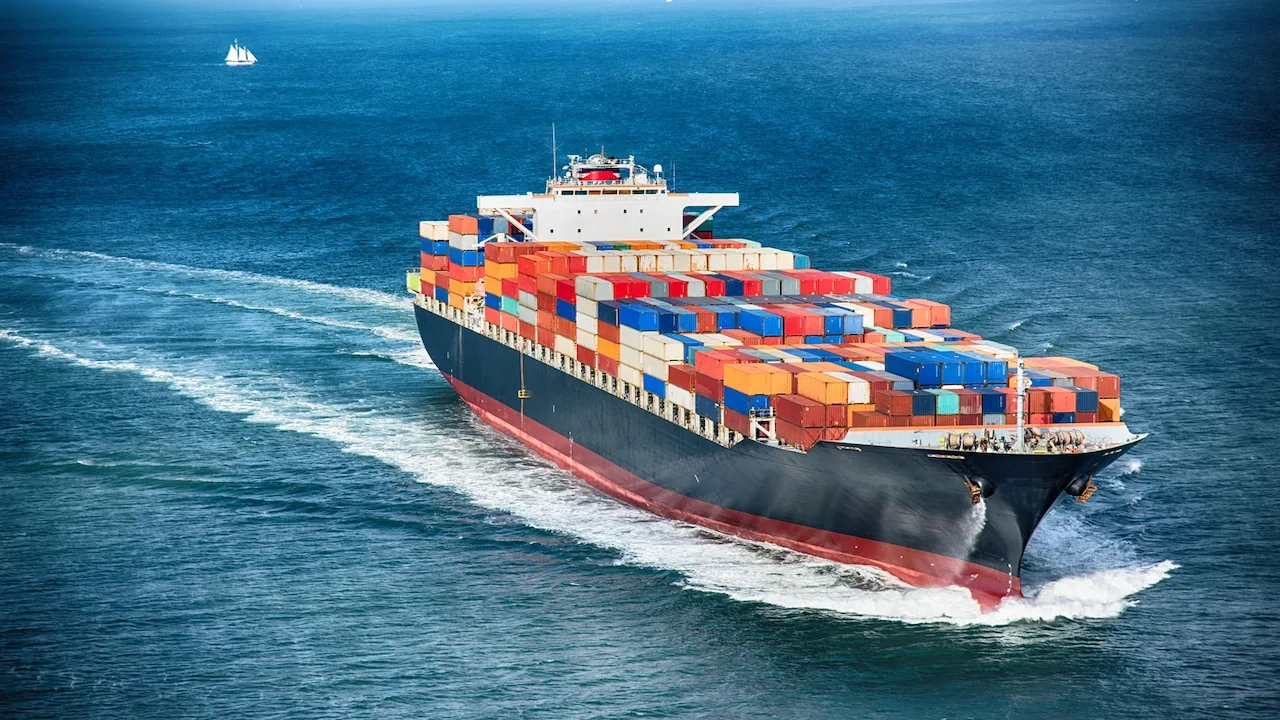
In practice, that means tariff changes, export controls, supply chain disruptions, sanctions, cyber threats, industrial policy, regional conflict and the weaponisation of technology or resources.
For companies operating in African markets, this can show up as higher import costs, delayed equipment deliveries, shifting investor risk appetite, tighter compliance rules, reduced development finance, or sudden opportunities in minerals, renewables, agribusiness and digital infrastructure.
Awareness Is Not Yet Strategy
The WEF paper finds a gap between executive concern and organisational readiness. Geopolitics are traditionally handled by boards and chief executives.
However, the scale and speed of disruption now exceed what leadership attention alone can manage. Many companies are building capabilities, particularly after COVID-19 and Russia’s full-scale invasion of Ukraine; however, only a minority have fully embedded these systems into decision-making.
The numbers are telling. More than half of the companies interviewed place geopolitical capability within government or corporate affairs, while fewer than 20% have a dedicated geopolitics or international relations unit.
The report stresses, however, that there is no single blueprint: firms may use task forces, senior advisers, full-time teams, or hybrid models depending on size, exposure, structure and culture.
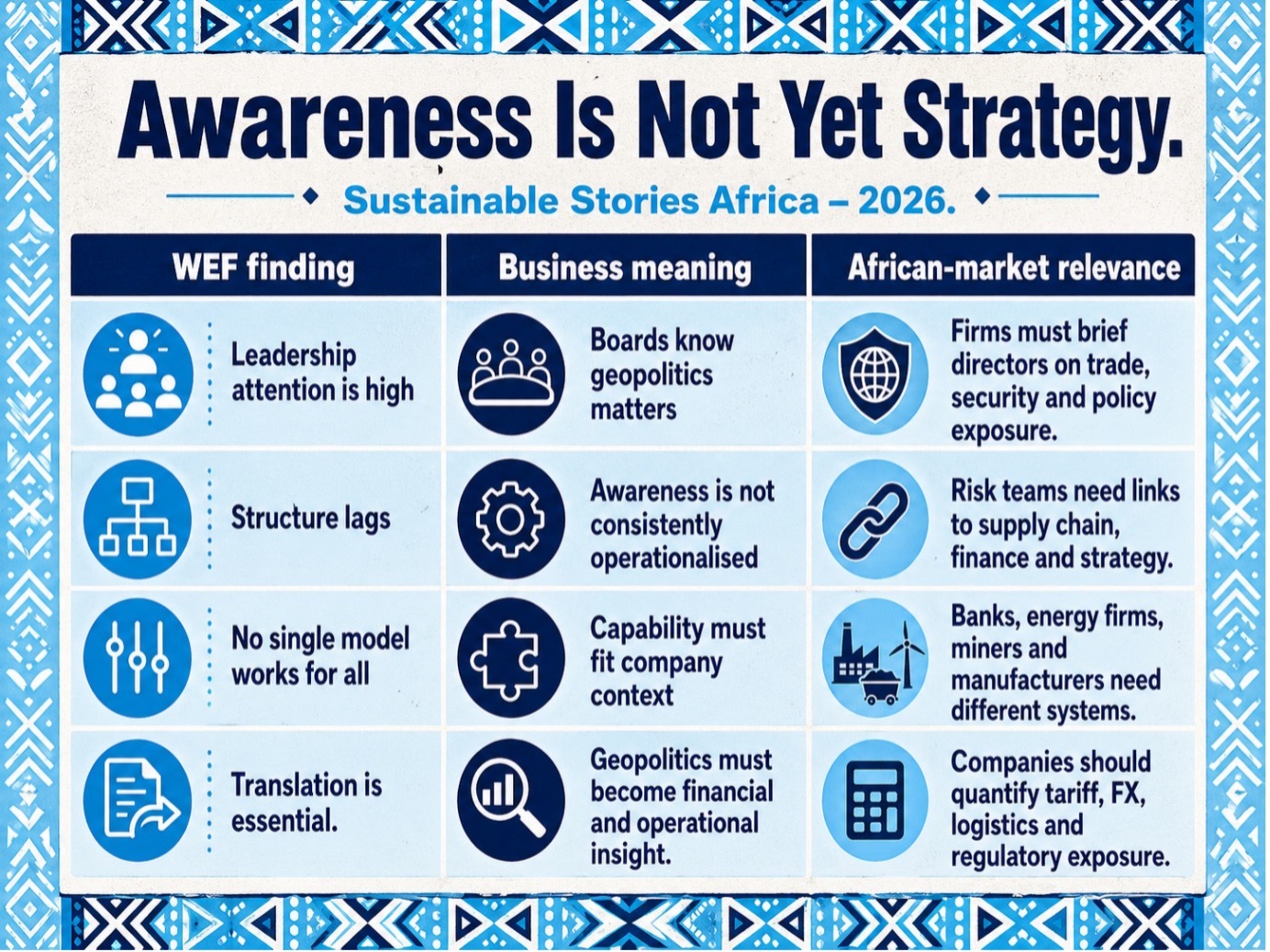
The paper’s use of the phrase “geopolitical muscle” is useful because it goes beyond risk monitoring. It describes the organisational capability to sense, plan and act—turning signals into decisions on sourcing, investment, procurement, market entry, logistics and stakeholder engagement.
Capability Can Become Competitive Advantage
The report argues that geopolitics is not only a threat. When done well, it can become a source of strategic advantage: stronger reputation, better policy engagement, smarter market positioning and faster operational response.
That is where African companies and investors can take a constructive lesson. A food manufacturer that anticipates export restrictions can diversify its supply earlier.
- A renewable-energy developer that maps policy risk can secure stronger government engagement.
- A mining company that understands critical minerals diplomacy can negotiate better offtake and financing terms.
- A bank that monitors sanctions, capital flows and sovereign risk can protect clients before disruptions spread.
The paper cites companies that have begun embedding geopolitics into business systems.
Siemens, for example, created a dedicated geopolitics function in 2020 and developed tools such as geopolitical trend and scenario reports, intelligence systems and “value at stake” assessments to connect developments to revenue, market access, technology exposure and country attractiveness.
Rio Tinto shifted from general political advice to cross-functional task forces anchored in operational exposure, bringing together legal, risk, procurement, commercial and regional teams.
Teva Pharmaceutical created a Tariff and Policy Command Centre in 2025, linking tariffs, pricing rules, intellectual property and regional instability to cost structures, capital allocation and supply continuity.
Build Systems Before Shocks Hit
The WEF framework identifies five building blocks for geopolitical muscle: mandate, radar and sonar, operating model, talent and decision integration. These are not abstract corporate ideas.
They are practical governance tools for a fragmented world.
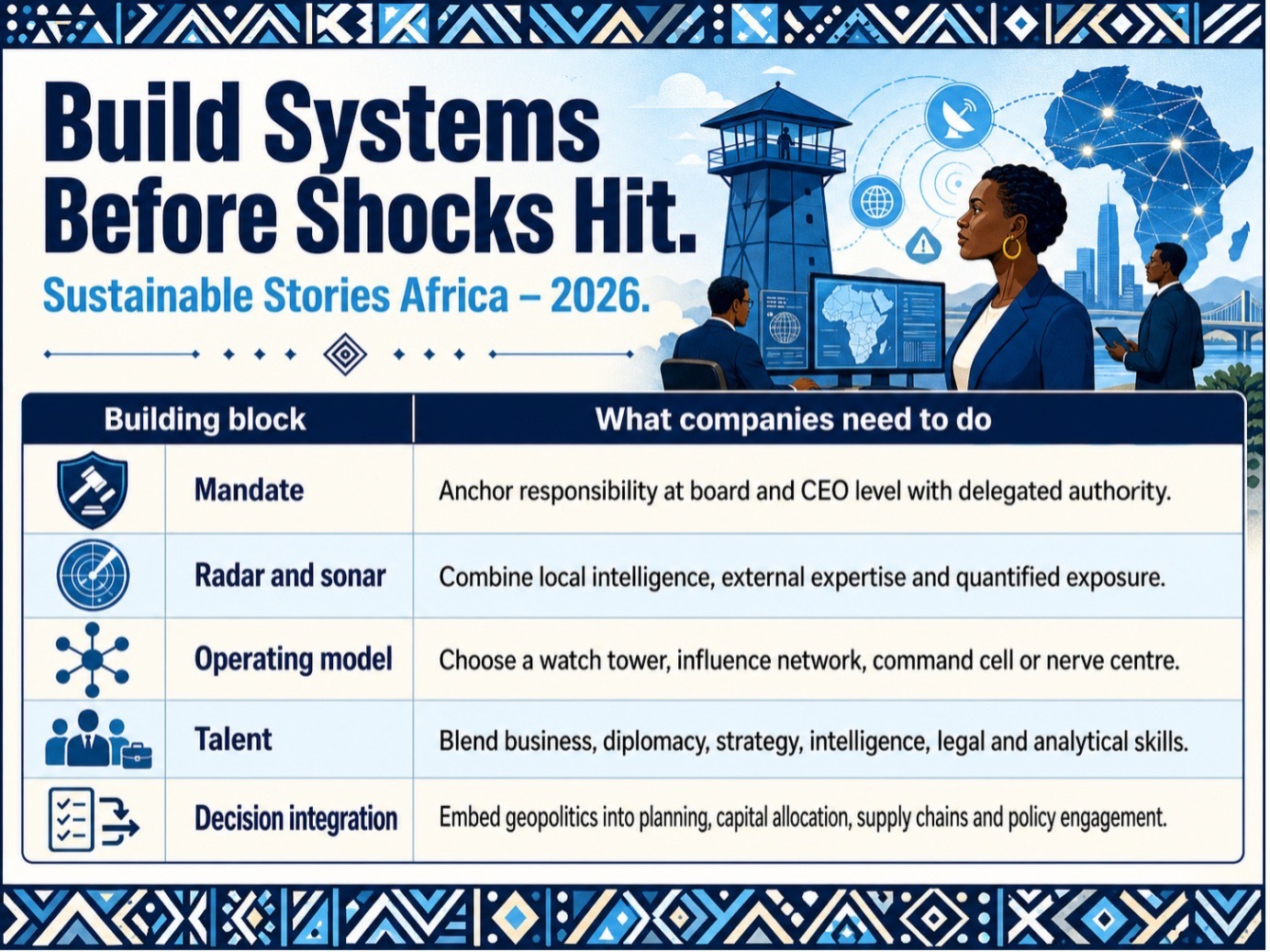
For African firms, the most important step is translation. Political analysis only becomes valuable when converted into commercial language: revenue at risk, cost exposure, supply chain delay, financing pressure, compliance burden, market opportunity or social-impact disruption.
This means boards should ask sharper questions.
- Which products depend on one corridor, supplier or currency?
- Which markets are exposed to tariffs, sanctions or election cycles?
- Which ESG commitments depend on imported technology or concessional finance?
- Which government relationships are strategic, not merely ceremonial?
Companies also need local intelligence. The WEF paper notes that local offices and management teams are often the first line of geopolitical information because they are closest to clients, regulators and political shifts.
However, the advantage comes from turning those local signals into enterprise-wide intelligence.
Path Forward – Make Geopolitics Operational Discipline
African companies should treat geopolitical capability as core governance infrastructure, not an emergency function.
Boards need mandates, management needs playbooks, and teams need data that connects global shocks to local decisions.
The priority is disciplined execution: quantify exposure, build cross-functional response teams, strengthen policy engagement and integrate geopolitical insight into ESG, finance, supply chains and investment planning.
In a fractured world, resilience belongs to firms that prepare before disruption arrives.