Nigeria’s updated mini-grid regulation is designed to make private electrification faster, clearer and more bankable for communities still outside reliable grid supply.
The core question is whether regulation can now translate into real connections, lower project risk and improved power for households, small businesses and local economies.
Mini-Grids Enter Nigeria’s Power Mainstream
Nigeria is sharpening its mini-grid rules at a time when electricity access remains one of the country’s most consequential development constraints.
Millions of households and businesses in unserved and underserved communities continue to rely on unreliable alternatives, making power not an infrastructure issue, but rather a productivity, equity and climate challenge.
The Mini-Grid Regulations, introduced by the Nigerian Electricity Regulatory Commission in 2023 and updated in 2026, seek to create a structured framework for private developers, operators, communities and distribution licensees.
The goal is to support small-scale generation and distribution systems that can serve remote rural areas, dense urban neighbourhoods and poorly supplied communities without waiting for full central-grid expansion.
For one of Africa’s largest economies, the policy signal is clear: decentralised energy is no longer a side story. It is becoming a core part of the country’s power-sector reform agenda, linking private capital, consumer protection and local economic development.
Power Access Is Market Infrastructure
Nigeria’s mini-grid regulation is trying to solve a simple but stubborn problem: communities need electricity now, while grid expansion remains slow, uneven and capital-intensive.
The updated 2026 framework, according to the regulatory insight note, is intended to accelerate private-sector participation by clearly classifying isolated and interconnected mini-grids, simplifying registration and permitting, and providing structured pathways for interconnection and future grid arrival.
It also introduces proportionate requirements based on project size and risk, while balancing developer incentives with consumer protection and the distribution licensee’s interests.
That balance matters.
- For a village clinic, reliable electricity can determine whether vaccines stay cold.
- For a rice mill or tailor, it can mean the difference between daily output and generator downtime.
- For a developer, however, the same project must also survive tariff risk, licensing delays, community disputes, grid uncertainty and financing costs.
In that sense, Nigeria’s mini-grid regulation is not just an energy-sector instrument.
It is a governance test: can regulation make small-scale clean power investable while protecting communities that need affordable, reliable electricity?
Regulation Is Targeting Bankability
Nigeria's updated mini-grid regulatory framework is built on a clear legal foundation. NERC oversight, the Electricity Act 2023, the Distribution Code, and NESIS Regulations are designed to ensure safe, efficient, and compliant operations while assigning sharper roles to private developers, operators and communities.
A tiered licensing structure reflects the diversity of mini-grid projects on the ground. Systems below 100 kilowatts require registration only.
Larger isolated systems up to 5 megawatts follow standardised permits, while interconnected systems up to 10 megawatts are streamlined through Short-Form System Impact Studies.
The logic is sound: a solar-battery developer serving a rural community should not carry the same regulatory burden as a larger grid-connected project.
The framework also addresses one of the sector's most persistent uncertainties, grid arrival. Provisions for non-export, limited export and managed export modes, alongside tripartite agreements involving distribution licensees and communities, now define responsibilities, compensation and asset handover arrangements with greater clarity.
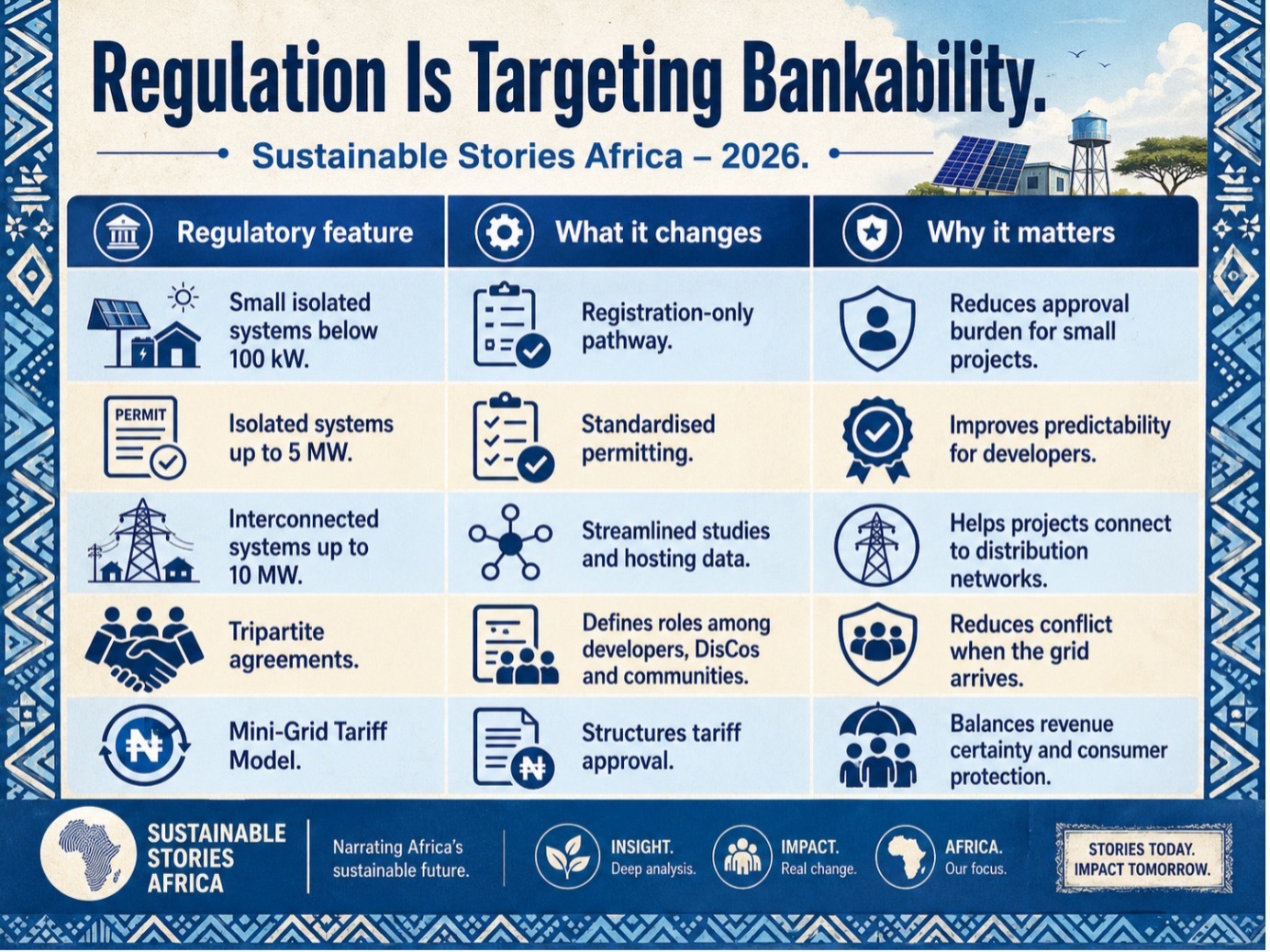
For investors, the attraction is clarity. The note identifies several advantages: lower licensing barriers, direct contracts with communities, exclusive development periods for early developers and more predictable grid-arrival risks through defined compensation rules.
Communities Gain From Reliable Local Power
If implemented well, the regulation could help convert Nigeria’s power deficit into a distributed investment pipeline.
Mini-grids can support electrification in truly off-grid areas, interconnected power in underserved neighbourhoods, solar photovoltaic and battery-based systems, portfolio projects across multiple sites and direct partnerships with communities and distribution companies.
The development case is compelling. Reliable mini-grid power can extend trading hours, cut diesel dependence, improve household welfare and strengthen the economics of local enterprises.
- For farmers, it can power cold storage and processing.
- For schools, it can support digital learning.
- For health centres, it can keep essential equipment running.
The ESG relevance is equally strong. Mini-grids, especially renewable-based systems, can reduce reliance on polluting generator sets, improve local air quality and support a cleaner energy transition.
- For development finance institutions and impact investors, the sector offers measurable outcomes: connections delivered, diesel avoided, enterprises supported and emissions reduced.
However, the promise depends on execution. A regulation can make the market clearer; it cannot by itself guarantee bankable projects, functional communities or timely approvals.
Implementation Will Decide The Outcome
The most immediate task is to turn regulatory clarity into administrative efficiency. The note identifies several constraints that could slow progress, including limited grid capacity, transmission bottlenecks, regional regulatory differences, tariff and dispute-resolution uncertainties, incomplete or outdated Hosting Capacity Information and the need for strong community engagement.
- For NERC, the priority is fast, transparent processing of registrations and permits.
- For distribution companies, the responsibility is to provide reliable grid-related information and cooperate on interconnection planning.
- For state electricity regulators, coordination is crucial as Nigeria’s decentralised electricity governance landscape evolves.
- Developers also have work to do. Strong technical compliance, early community buy-in, realistic tariff modelling and disciplined project documentation will determine which firms can scale.
The most competitive developers will likely be those that understand the tripartite agreement process, maintain community trust and build portfolios that can attract blended finance or commercial capital.
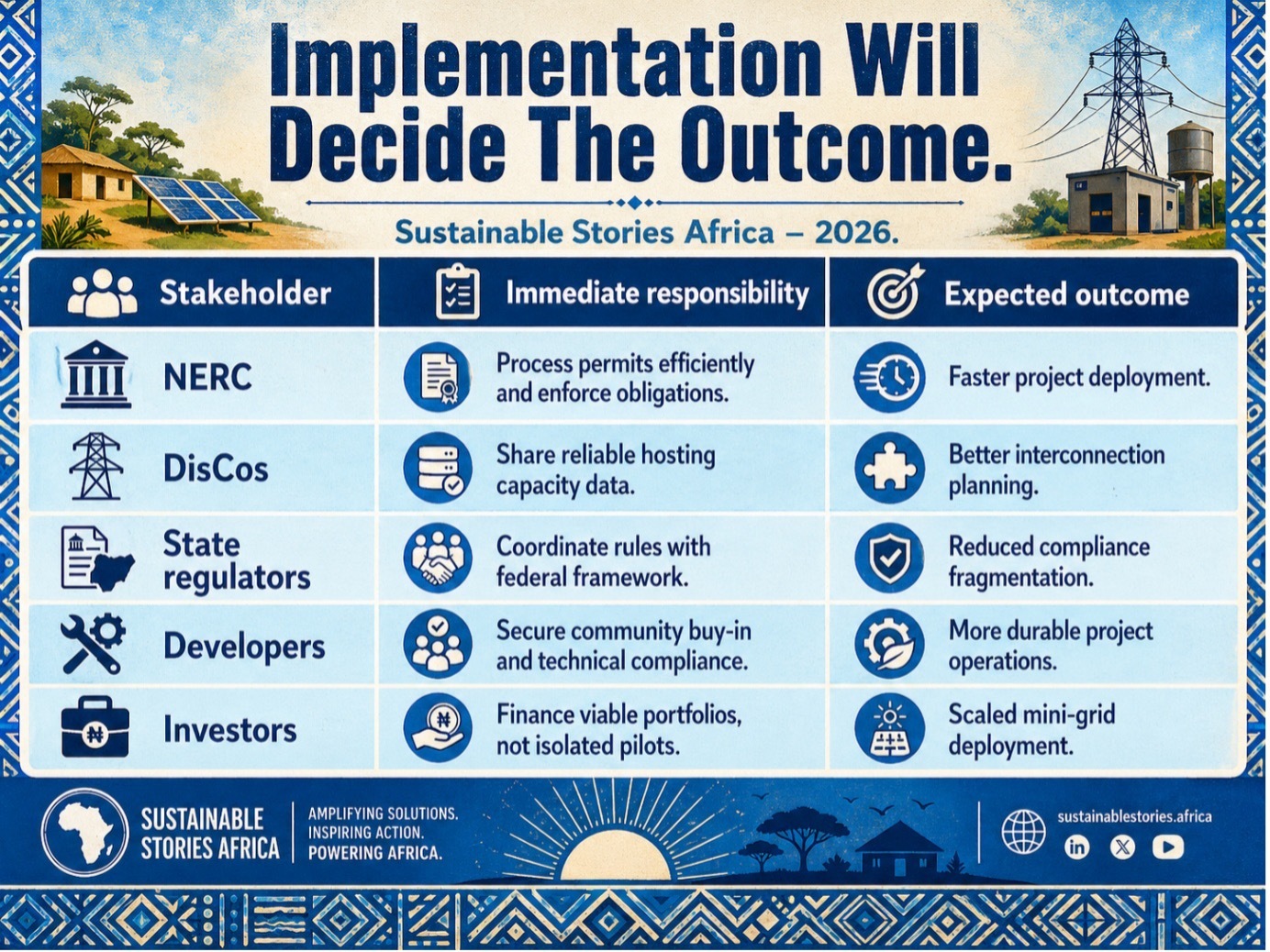
The strategic priorities are therefore practical: rapid publication and regular updates of Hosting Capacity Information, digitised applications and reporting, capacity building for communities and partners, and continued coordination between NERC and state electricity regulators.
Path Forward – Power Rules Need Delivery
Nigeria’s mini-grid regulation can accelerate private electrification if approvals are fast, hosting data is reliable and communities are treated as partners, not passive consumers.
The next phase should focus on implementation discipline: digitised permitting, enforceable timelines, transparent tariffs and coordinated federal-state oversight.
When done well, mini-grids can advance Nigeria’s ESG goals by delivering cleaner, more reliable power to underserved communities.