
Human capital is not built only in classrooms and clinics. A new World Bank report argues that homes, neighbourhoods and workplaces now need to become central to development policy.
For Africa and other emerging markets, the warning is urgent: stalled learning, weak job training and unequal local services could lock millions out of productivity gains.
Human Capital Needs Local Foundations
The World Bank is calling for a rethink of how countries build human capital, arguing that policy must move beyond schools and health systems to the everyday places where people grow, learn and work.
In Building Human Capital Where It Matters: Homes, Neighbourhoods, and Workplaces, edited by Alaka Holla, Norbert Schady and Joana Silva, the institution says people’s health, skills, knowledge and experience are shaped not only by formal systems but also by household care, neighbourhood conditions and workplace learning.
The message lands sharply for African economies, where demographic growth, climate pressure, youth unemployment and informal work are converging.
If governments want higher productivity, stronger resilience and more inclusive growth, the report suggests, they must invest where human capital is actually formed.
Stalled Progress Is Now a Development Risk
The central finding is stark: two-thirds of low- and middle-income countries have experienced declines in health, learning or on-the-job skill development over the past 15 years, despite progress in income and poverty reduction.
The report also notes that student learning has stagnated in low- and lower-middle-income countries, while female labour force participation remains low and stagnant.
For African markets, this is not an abstract human development problem. It is an economic competitiveness issue.
Human capital determines whether a child becomes a skilled worker, whether a young graduate can adapt to a changing labour market, and whether a country can attract investment into higher-productivity sectors.
The World Bank frames human capital as the health, knowledge, and skills people need to thrive, support families and secure good jobs. Its policy challenge is simple but demanding. Countries cannot treat human capital as something produced by only ministries.
It is also produced by parents, communities, employers, local infrastructure and daily social conditions.
Homes, Streets, and Jobs Shape Futures
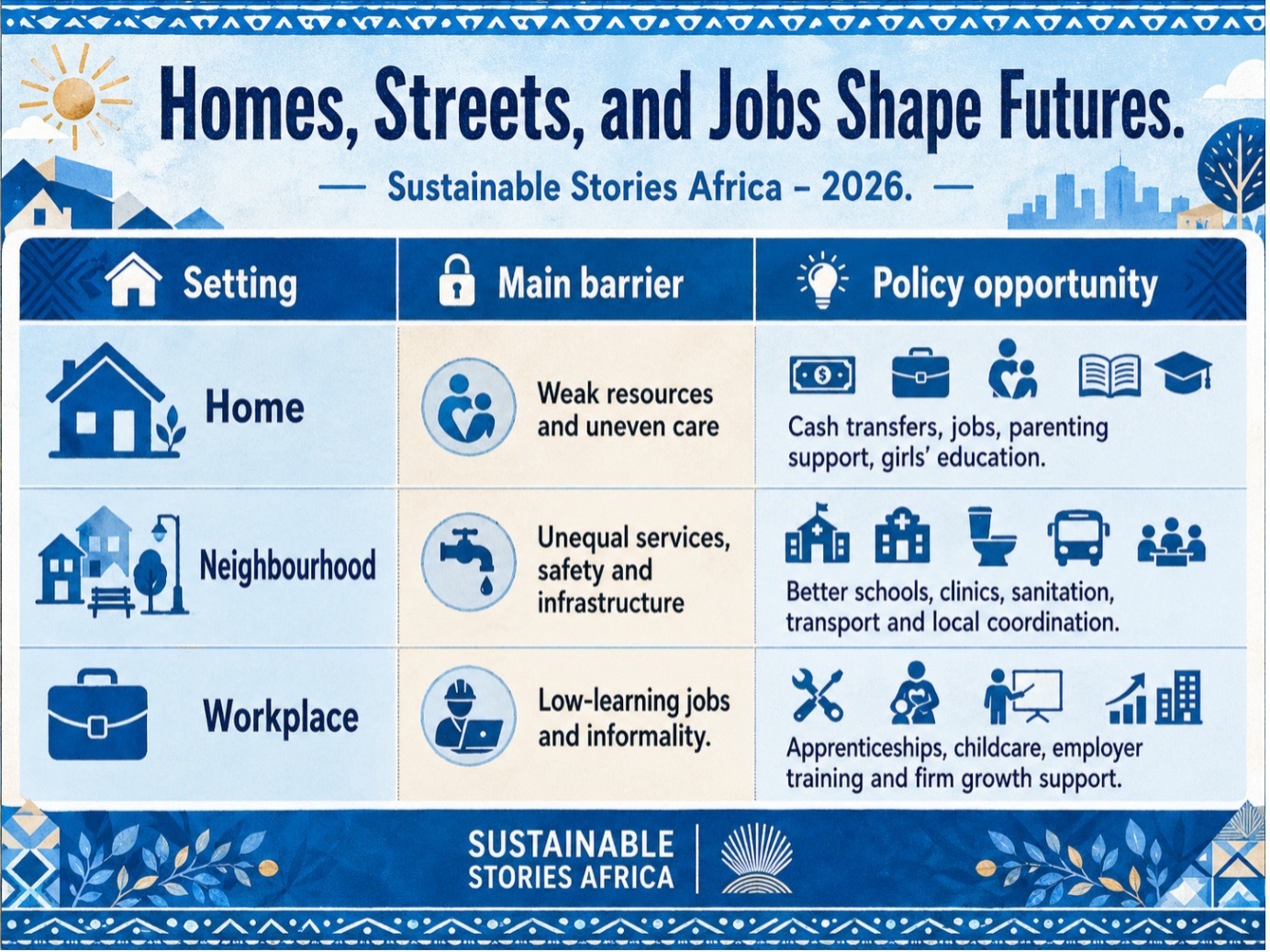
Early childhood experience is decisive. The World Bank's latest report finds that children of more-educated mothers outperform peers in vocabulary and mathematics before age five; however, those gaps persist well into adolescence.
In African contexts where maternal education, nutrition, electricity access and caregiving time vary sharply across communities, this finding carries urgent weight.
Resources matter, but the report is clear: money alone is insufficient. Attentive, supportive parenting shapes outcomes just as powerfully.
Where a child grows up matters equally.
Two separate families with identical incomes can produce vastly different outcomes depending on the quality of their neighbourhood. Schools, clinics, sanitation, safety and social norms all determine whether children learn and adults work productively.
Evidence from Brazil shows that a low-income child raised in a wealthy neighbourhood earns twice as much in adulthood as a child raised in a poor neighbourhood with the same household income.
The workplace completes the picture. The World Bank estimates that half of all human capital accumulated over a lifetime is built on the job.
However, approximately 70% of workers in low- and middle-income countries remain in small agriculture, informal self-employment or microfirms, environments that offer limited training and few meaningful learning opportunities.
Better Settings Can Unlock Productivity
The opportunity is that human capital policy becomes more practical when it is designed around lived reality.
A child who receives better nutrition at home, attends a functional local school, grows up in a safer neighbourhood and later enters a job that teaches new skills is more likely to become a productive adult.
The report points to clear gains from targeted interventions. It says job programmes and cash transfers can raise household resources, while parenting programmes can help families create more stimulating and nurturing home environments.
It also notes that such interventions can improve educational attainment, lifelong health and future earnings.
At work, the potential is equally direct. The report cites an on-the-job soft-skills training programme in India that increased garment workers' productivity by more than 13% and improved productivity among untrained co-workers by almost 12%.
It also says large-scale apprenticeship programmes in Colombia, Côte d’Ivoire and Nigeria increased both skills and earnings.
For African countries, the evidence supports a development agenda that links ESG, labour markets and social investment.
Human capital is not only a social-sector concern. It is material to productivity, inequality, gender inclusion, investor confidence and long-term fiscal resilience.
Governments Must Coordinate Across Settings
The report’s strongest policy implication is coordination. A malnutrition strategy, for example, cannot sit only within a health ministry. Families need income and food access.
Neighbourhoods need clean water, sanitation and health centres. Workplaces need to provide parents with earnings, flexibility and stability.
This means governments need integrated delivery systems.
- Social registries can identify vulnerable households across programmes.
- Social assistance centres can act as single entry points for support.
- Case management can help families navigate multiple needs at once.
The same logic can guide struggling neighbourhoods through packages that combine school improvement, primary health, transport, sanitation, safety and environmental action.
Businesses also have a role. Employer training, apprenticeships, safe transport, childcare support, and stronger pathways from informal to formal work can turn jobs into engines of learning.
For investors, the signal is clear: markets with healthier, better-skilled workers are more likely to deliver durable returns.
Path Forward – Build Where People Live
Africa’s human capital agenda should move from fragmented programmes to place-based systems that connect homes, neighbourhoods and workplaces.
The priority is not only to spend more, but to spend more coherently.
Governments, financiers and firms should align social protection, education, health, labour and infrastructure policy around measurable human outcomes.
That is how ESG commitments become productivity gains, and how development policy reaches people where it matters most.