Clean cooking finance visibility is increasing; however, it remains difficult to track, is unevenly distributed and far below what access-deficient countries need.
An IRENA report shows why better data, concessional finance and stronger national policy frameworks are now central to health, climate and energy-access goals.
Clean Cooking Finance Needs Clearer Data
The global clean cooking challenge is no longer only about technology. It is about money, data and whether governments can turn scattered financing into reliable access for households still cooking with polluting fuels.
A report by the International Renewable Energy Agency, Tracking Financial Support Across 100 Clean Cooking Access-Deficit Countries, estimates clean cooking investment across 100 access-deficit countries between 2022 and 2024 using a tiered approach: “proven,” “probable”, and “possible” finance.
The report draws on IRENA surveys of Global South governments and OECD DAC data.
For Africa and other emerging markets, the findings are sobering. Clean cooking lies at the intersection of health, gender, forests, climate, household income and energy justice.
However, the financing picture remains incomplete, fragmented and too weak to support the universal pace of access required.
Billions Still Cook With Polluting Fuels
Roughly 2.1 billion people still lack access to clean cooking solutions, despite clean cooking being directly linked to Sustainable Development Goal 7.
IRENA’s report notes that finance has remained volatile and uneven, with many countries receiving no funding between 2014 and 2022.
This is a daily development emergency hiding in plain sight. In many African homes, cooking is still powered by firewood, charcoal, kerosene or other polluting fuels. The result is not just smoke in the kitchen; it is time lost collecting fuel, health risks for women and children, pressure on forests, and higher barriers to education and livelihoods.
IRENA’s central insight is that decision-makers cannot close the clean cooking gap if they cannot clearly see where the money is going. Today, the finance landscape is blurred by inconsistent reporting, unclear definitions and overlapping data sources.
Finance Exists, But Tracking Is Weak
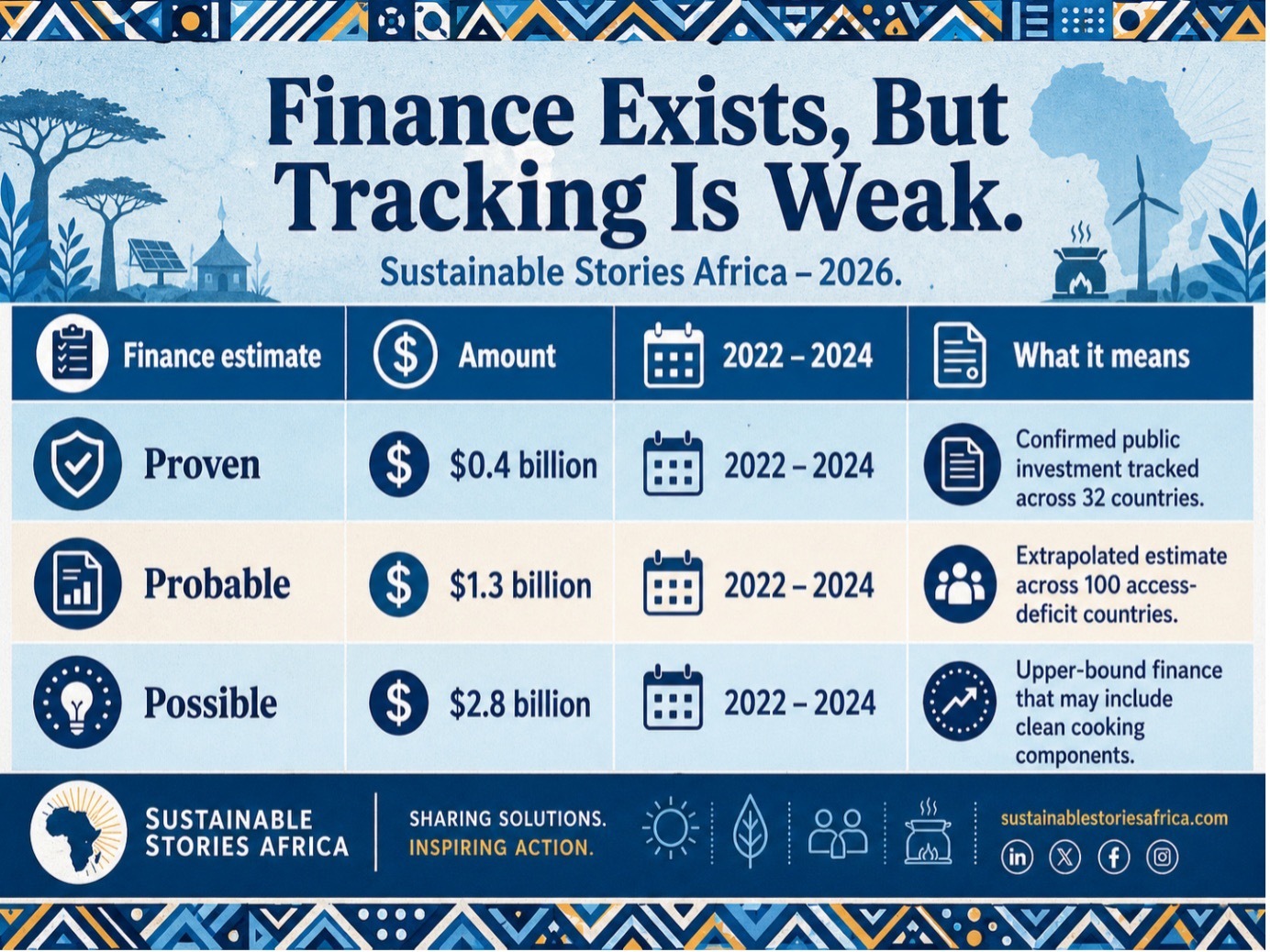
IRENA estimates that clean cooking investment across the 100 access-deficit countries ranged from a proven $0.4 billion to a possible $2.8 billion between 2022 and 2024, with a probable estimate of $1.3 billion.
The proven figure is based on $385 million reported through government surveys and $18 million from targeted OECD DAC investments.
That wide range tells its own story. It does not simply show uncertainty; it shows a data architecture problem. Clean cooking finance is often buried within the broader energy, health, gender, agriculture, climate or rural development projects.
The OECD DAC database, for example, does not have a dedicated clean cooking sector code, making it difficult to isolate relevant flows.
The report also finds that domestic public budgets dominate verified support. Government spending reported through IRENA surveys totalled $385 million, representing 96% of the proven estimate.
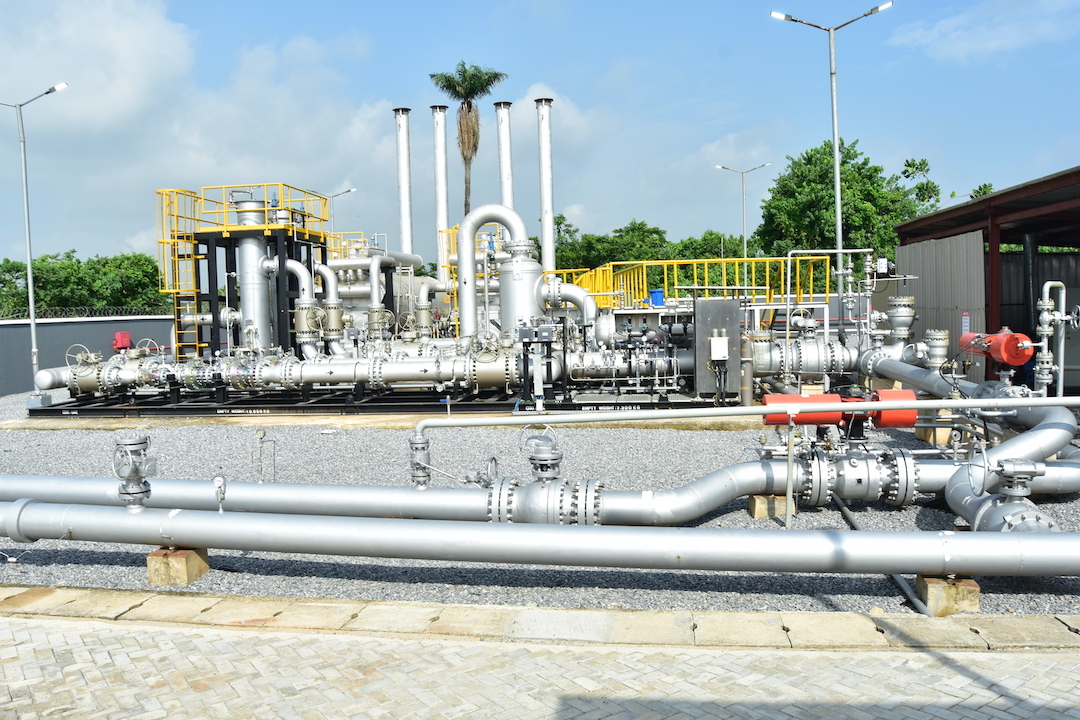
Two-thirds of that support came from national budgets, with LPG infrastructure receiving 65% and improved biomass cookstoves 32%.
This matters for African governments. Domestic budgets hold much of the verified burden, even though governments themselves say external finance, especially grants and concessional loans, is crucial for achieving access goals.
Better Finance Can Change Daily Life
Clean cooking finance is not a narrow energy investment. It is a social investment with measurable benefits across households, health systems, climate plans and local markets.
When a family moves from smoky fuel to cleaner cooking, the benefits ripple outward.
- Women and girls can spend less time gathering fuel.
- Children can study in healthier homes.
- Small enterprises can adopt more efficient food processing. Forest pressure can be reduced.
- Governments can improve public health outcomes while advancing climate and energy-access commitments.
The report highlights a growing role for carbon finance, noting that carbon credit revenues accounted for around 10% of clean cooking financing in 2023.
It also cites more than $218 million invested in clean cooking companies globally in 2023, with carbon finance increasingly shaping company funding models.
Debt finance is also increasing globally. IRENA notes that debt represents approximately 84% of all capital raised in 2023, compared with 17% in 2018.
Equity and grants remained much smaller shares. However, for many access-deficient countries, debt alone cannot solve affordability barriers for low-income households.
That is why concessional finance matters. Nearly one-third of survey respondents 32%, identified grants and concessional loans as important tools for reducing investment risks and unlocking private capital.
Policy Must Make Finance Investable
The next step is not simply to announce more money. It is to make clean cooking finance traceable, investable and locally useful.
IRENA’s survey suggests that governments understand this. When asked what would stimulate private sector participation, 34% of governments highlighted the need for stable, progressive domestic policy frameworks to attract foreign direct investment.
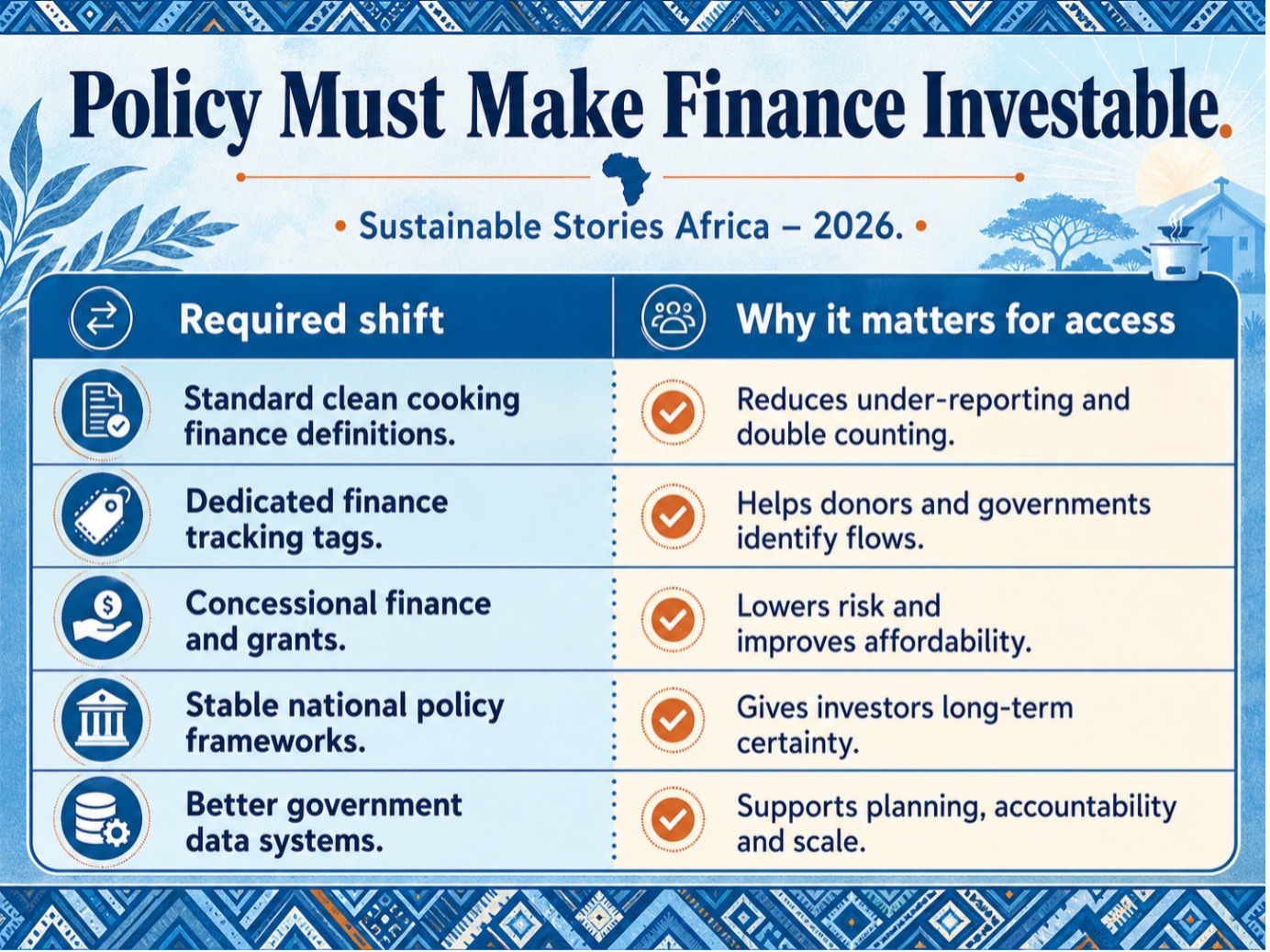
- Governments should therefore treat clean cooking as part of national infrastructure planning, not as a household-product niche.
That means integrating cooking into energy transition plans, climate strategies, health policy, gender policy and national budgets.
- Development banks and donors also need to improve reporting quality. If clean cooking is embedded in larger programmes, the clean cooking component should be tagged, valued and monitored.
Without that, countries cannot know whether finance is reaching households or merely appearing in broad access commitments.
- Private investors, meanwhile, need policy certainty, local distribution partners and credible demand-side support.
For low-income households, affordability remains decisive. Clean cooking solutions will scale only when finance reaches the full chain: infrastructure, enterprises, distributors, consumer credit, after-sales service and policy support.
Path Forward – Track, Fund, and Scale
Clean cooking finance needs a stronger accountability system: clearer definitions, better reporting, dedicated finance tags and stronger national data capacity.
African governments and partners should align concessional capital, carbon finance, domestic budgets and private investment around measurable household access.
Clean cooking is not peripheral to sustainability; it is one of the fastest routes to healthier homes, cleaner energy and more inclusive climate action.