South Africa’s decision to extend coal power is no longer only an energy-security debate.
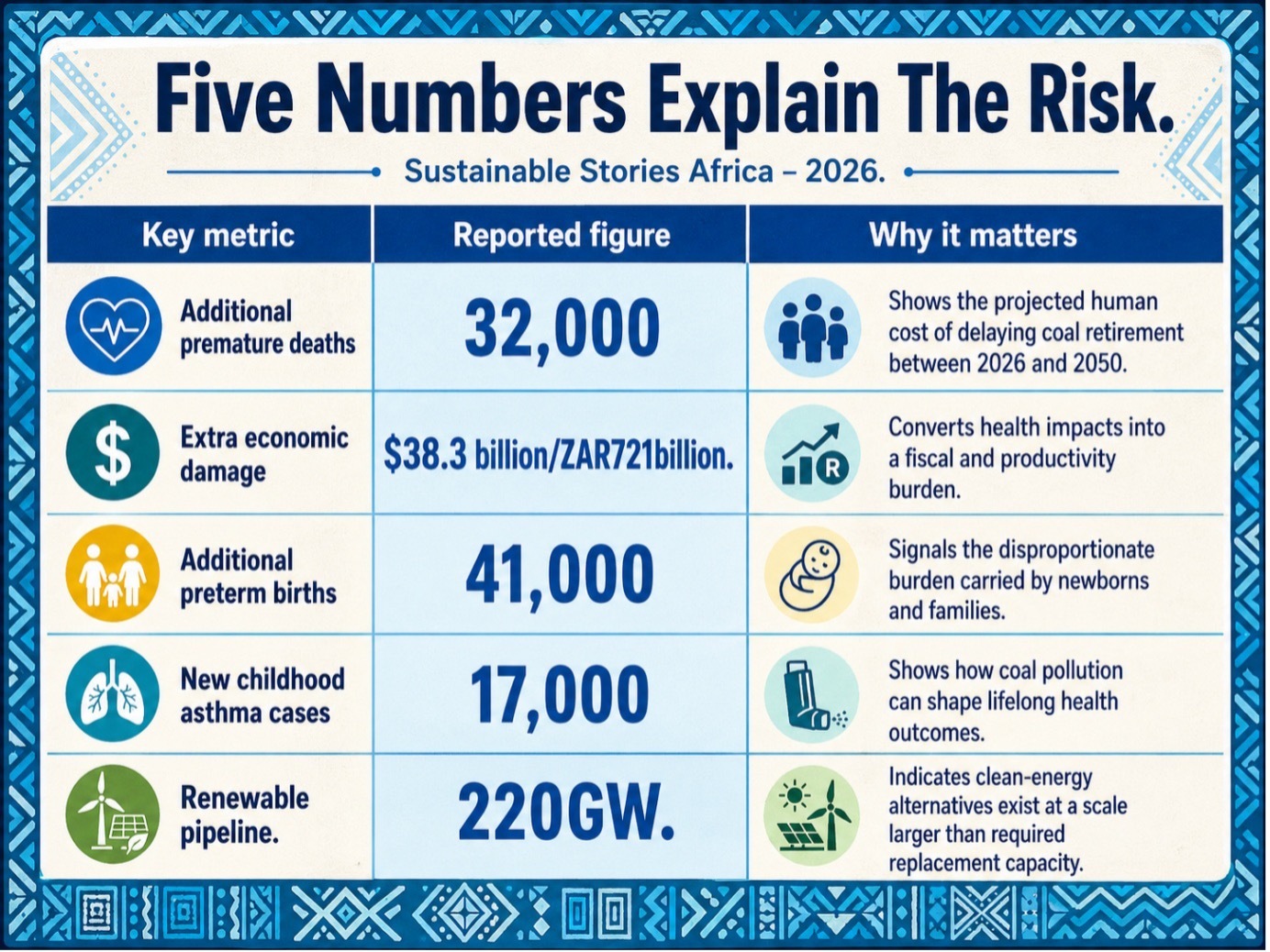
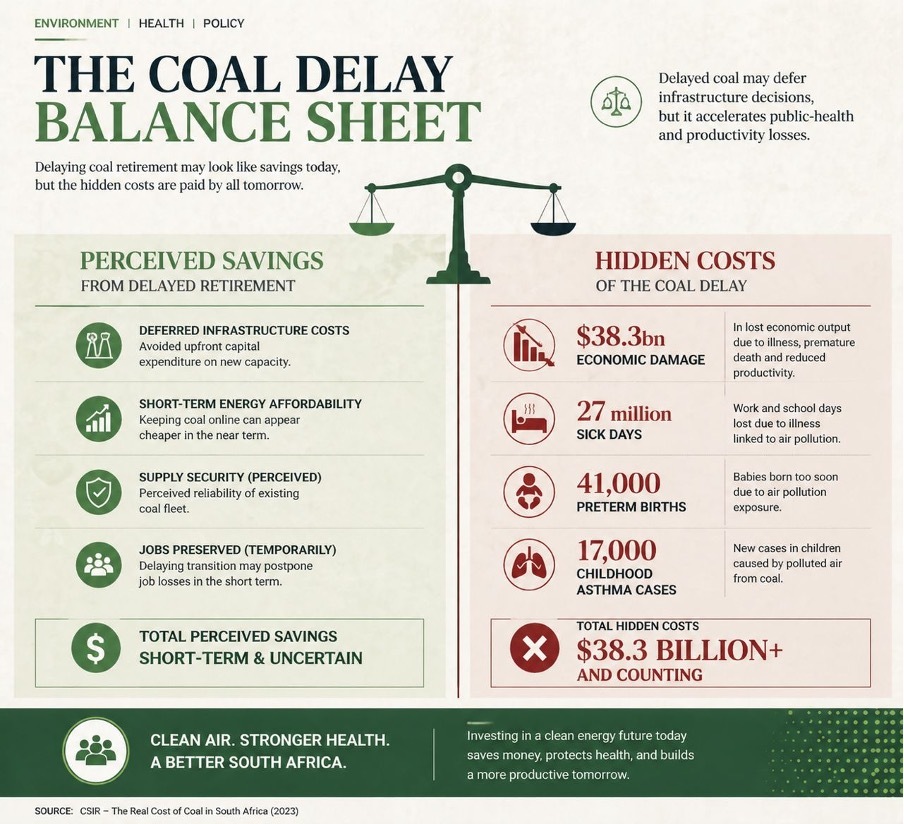
A Greenpeace Africa and CREA report estimates that delayed coal retirement could add 32,000 premature deaths and $38.3 billion in health-related economic damage by 2050.
The findings turn coal planning into a public-health, fiscal and governance test for Africa’s most industrialised economy, and a warning for emerging markets managing energy transition under pressure.
Coal Delay Reveals Hidden Public Costs
South Africa’s coal transition has entered a sharper phase: not because the country has found an easy route away from coal, but because the cost of waiting has now been counted in human lives, household strain and billions of dollars in economic losses.
An April 2026 report by Greenpeace Africa and the Centre for Research on Energy and Clean Air, titled Unmasked: The health and economic cost of delaying coal phase-out in South Africa, estimates that the country’s decision to extend the operating lives of coal-fired power plants under the 2025 Integrated Resource Plan could result in 32,000 additional premature deaths between 2026 and 2050.
The report reframes South Africa’s coal debate. What has often been presented as a technical argument over grid stability is also a question of governance, intergenerational equity and fiscal discipline.
For African markets watching South Africa’s energy transition, the message is stark: delay may look cheaper on a power-system spreadsheet, but its wider bill may arrive in clinics, classrooms, labour markets and public budgets.
The Price Of Waiting Rises
A Greenpeace Africa and CREA report delivers a stark finding: extending South Africa's coal fleet under the 2025 Integrated Resource Plan would cause approximately 97,000 deaths over plant lifetimes, compared to 65,000 under the original decommissioning schedule, a projected difference of 32,000 lives.
The IRP formalises lifetime extensions for 10 Eskom coal plants, some by at least a decade, across a fleet exceeding 40GW.
For communities in Mpumalanga, Limpopo, and Free State, the stakes are immediate. Coal represents employment, municipal revenue, and daily exposure to pollution.
Its health impact extends further, reaching economic centres like Gauteng even without proximity to plant sites.
The report's deeper warning reframes the cost of delay. When pollution drives illness, lost productivity, and rising healthcare expenditure, coal quietly transfers financial burdens onto households, workers, and the state.
The energy transition is not only an environmental question; it is a public health and development imperative.
The report compares two scenarios: a base scenario in which coal plant retirements proceed according to the 2019 Integrated Resource Plan timeline, and a delayed scenario where plant lifetimes are extended under the 2025 plan.
This framing matters because it isolates the impact of the policy choice itself.
The geography of harm is one of the most revealing parts of the analysis. Mpumalanga hosts most coal capacity, at approximately 31.3 GW, followed by Limpopo with 8.8 GW and Free State with 3.7 GW.
However, Gauteng, which has no large Eskom coal-fired power plants, is projected to face the highest number of additional deaths, 15,200, because pollution moves across provincial boundaries.
KwaZulu-Natal is projected to record 5,600 additional deaths, Mpumalanga 4,800, Limpopo 2,400, North West 2,100 and Free State 1,100. Smaller but still significant impacts are projected in the Eastern Cape and Northern Cape.
The report notes that fine particulate matter, PM2.5, can persist for one to two weeks and be transported by regional wind patterns, exposing communities far from the original power plant stack.
A Cleaner Grid Can Still Work
The report does not argue that South Africa can switch off coal without planning.
Its stronger point is that delay should not be treated as inevitable.
According to the analysis, about 32 GW of coal capacity can be retired by the mid-2030s within a reliable power system, alongside the expansion of wind, solar and storage by between 50 GW and 60 GW by 2030 and more than 100 GW by 2040.
This is where the story shifts from cost to opportunity. The South African Renewable Energy Grid Survey identifies a development pipeline of about 220 GW of wind, solar and storage projects, far above the scale needed to replace retiring coal capacity, according to the report.
- For investors, this is a transition-finance signal.
- For policymakers, it is a planning test.
- For communities, it is a demand for fairness. If renewable generation, storage, grid upgrades and local economic diversification are sequenced properly, coal-dependent regions can move from being sacrifice zones to transition centres.
However, the risk of a poorly managed shift remains serious. Coal workers and coal-linked municipalities cannot be asked to carry the burden alone.
A credible transition must include retraining, income support, municipal diversification, community participation and targeted investment in areas that have powered South Africa’s economy while absorbing the pollution burden.
Coal Policy Becomes Governance Test
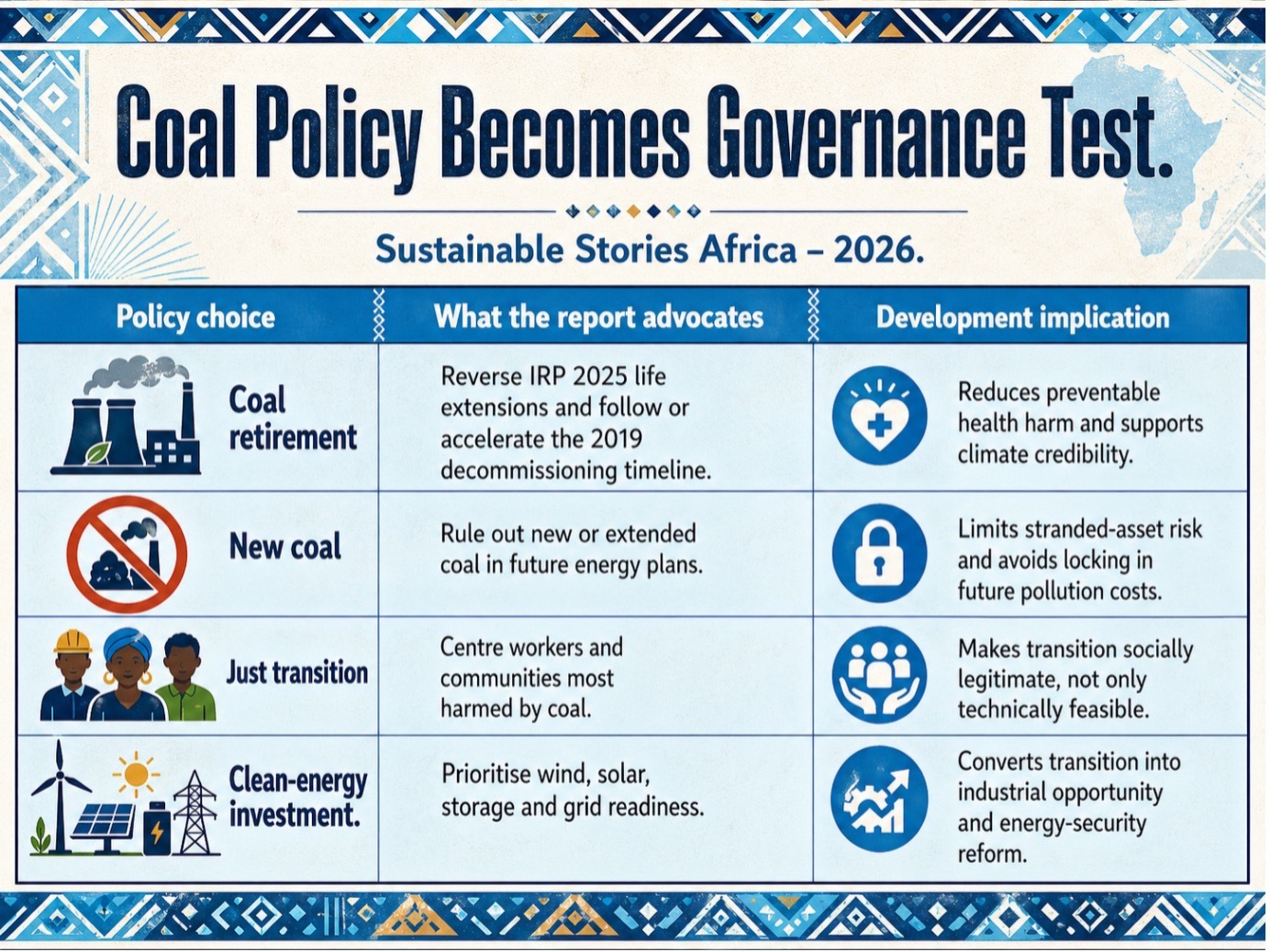
The policy recommendations are direct: retire coal plants on the original schedule or faster, approve no new coal, and deliver a just transition centred on communities most harmed by coal.
Greenpeace Africa and CREA argue that every year beyond the original schedule is a decision to continue exposing communities to preventable harm.
That statement lands in a country where electricity reliability has become politically sensitive. South Africa’s load-shedding crisis has made energy security a household issue, a business risk and a national planning priority.
However, the report challenges a narrow definition of security. Reliable electricity matters; so do breathable air, functioning clinics, healthy children, and a labour force not weakened by pollution-linked illness.
The fiscal argument is equally strong. The report estimates that delayed coal retirement would add ZAR721bn, or $38.3bn, in health-related economic damage. It also projects 27 million individual work absences, or sick days, under the delayed coal scenario.
For a country managing unemployment, infrastructure strain and pressure on public finances, these are not side effects. They are macroeconomic concerns. Health costs reduce household resilience.
Work absences weaken productivity. Pollution-linked disease raises pressure on public systems. In ESG terms, coal delay affects environmental performance, social outcomes and governance credibility at once.
Path Forward – Make Transition Count Locally
South Africa’s next energy decisions must treat coal phase-out as a health, economic and justice agenda, not only a power-sector timetable.
The clearest priorities are faster retirement, no new coal, cleaner replacement capacity, and enforceable support for workers and coal-dependent municipalities.
The promise of transition will be judged locally: in Emalahleni, Steve Tshwete, Gauteng townships, clinics, schools and households.
A cleaner grid must also be a fairer economy, with communities first to benefit from what replaces coal.