
As sustainability expectations intensify across global markets, companies face a fundamental challenge: determining which ESG issues truly matter for long-term business performance and societal impact.
The ESG materiality matrix is emerging as a strategic compass, helping organisations prioritise the sustainability issues that matter most to both stakeholders and the business itself.
Finding What Truly Matters In ESG
For many organisations, sustainability reporting has grown dramatically over the past decade. Companies now disclose dozens of environmental, social and governance indicators across climate, labour standards, biodiversity, ethics and corporate governance.
However, this expansion has created a new challenge.
With so many potential ESG topics competing for attention, businesses increasingly struggle to determine which sustainability issues deserve strategic focus.
This is where ESG materiality analysis enters.
By identifying which issues are most important to stakeholders and most impactful to business performance, the materiality matrix helps organisations prioritise the sustainability risks and opportunities that genuinely influence long-term value creation.
For African companies navigating expanding ESG regulations, investor expectations and climate transition pressures, materiality analysis is becoming a central tool for aligning sustainability strategy with economic competitiveness.
The Compass For Corporate Sustainability
Across boardrooms worldwide, a simple but powerful question is shaping sustainability strategy:
Which ESG issues truly matter most?
The ESG materiality matrix provides a framework for answering that question.
According to the infographic “The ESG Compass: How the Materiality Matrix Shows What Truly Matters”, materiality analysis helps organisations focus on ESG topics that matter most to both stakeholders and business operations.
The matrix typically evaluates issues across two dimensions:
- Importance to stakeholders
- Impact on business performance
Issues that rank highly on both axes become priority sustainability topics.
The framework allows organisations to move beyond broad sustainability commitments toward targeted strategic action.
In an era of increasing ESG scrutiny, this prioritisation is becoming essential.
Understanding The ESG Materiality Matrix
A materiality matrix is essentially a decision-making tool.
It maps sustainability topics based on two key criteria:
- Stakeholder Importance – how strongly investors, employees, communities, regulators and customers care about an issue.
- Business Impact – how significantly the issue affects operations, financial performance, regulatory exposure or long-term competitiveness.
The linked infographic clearly illustrates this structure.
On one axis is stakeholders' importance, and on the other is impact on business.
Issues located in the upper-right quadrant, where both importance and impact are high, become the organisation’s core ESG priorities.
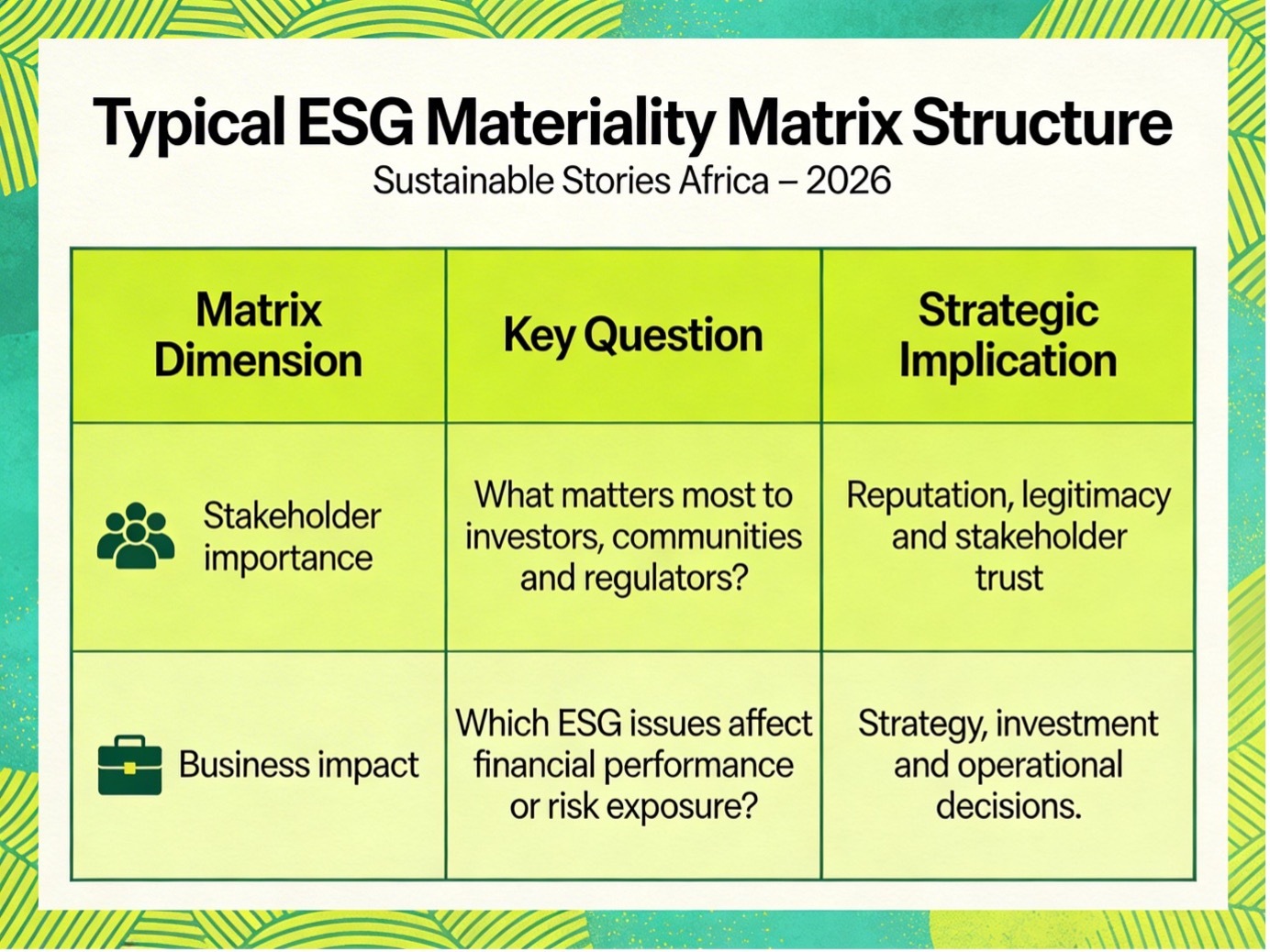
Typical ESG Materiality Matrix Structure
Matrix Dimension | Key Question | Strategic Implication |
|---|---|---|
Stakeholder importance | What matters most to investors, communities and regulators? | Reputation, legitimacy and stakeholder trust |
Business impact | Which ESG issues affect financial performance or risk exposure? | Strategy, investment and operational decisions |
This structured approach helps organisations focus resources where sustainability initiatives create the greatest value.
Examples Of Material ESG Issues
In the ESG Compass infographic, several sustainability issues appear in the high-priority quadrant, including:
- climate change
- worker safety
- ethical sourcing
- data privacy
These issues rank highly because they affect both stakeholder expectations and operational performance.
Other issues, such as energy use and waste management, may still matter but often rank slightly lower depending on the organisation’s sector.
The matrix, therefore, helps differentiate between:
- strategic ESG priorities
- operational sustainability topics
- emerging issues to monitor
This clarity is particularly valuable for companies navigating complex regulatory frameworks, such as:
- IFRS sustainability standards
- EU Corporate Sustainability Reporting Directive (CSRD)
- Task Force on Climate-related Financial Disclosures (TCFD)
- Global Reporting Initiative (GRI)
Why Materiality Matters For African Markets
For African companies, ESG materiality analysis offers several strategic advantages.
- First, it helps organisations align sustainability initiatives with core business priorities rather than treating ESG as a compliance exercise.
- Second, it improves communication with investors who increasingly evaluate companies based on ESG risk management and sustainability performance.
- Third, it supports more effective allocation of resources.
Many companies attempt to address every sustainability issue simultaneously. Materiality analysis helps focus attention where impact is greatest.
In sectors such as mining, energy, agriculture and financial services, industries central to Africa’s economic development, material ESG risks can significantly affect operational resilience and market access.
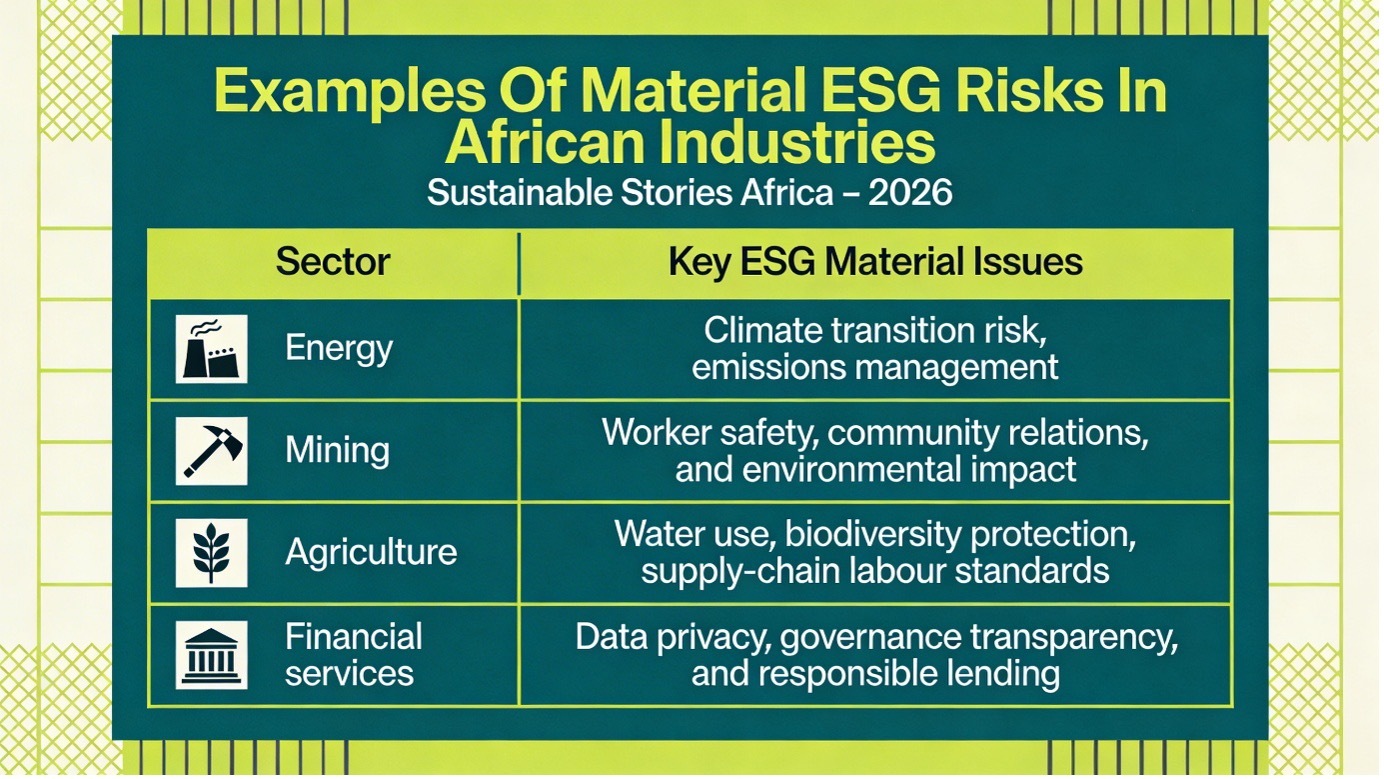
Examples Of Material ESG Risks In African Industries
Sector | Key ESG Material Issues |
|---|---|
Energy | Climate transition risk, emissions management |
Mining | Worker safety, community relations, and environmental impact |
Agriculture | Water use, biodiversity protection, supply-chain labour standards |
Financial services | Data privacy, governance transparency, and responsible lending |
By identifying which issues matter most, companies can integrate sustainability considerations directly into strategic planning.
Turning ESG Priorities Into Competitive Advantage
When used effectively, ESG materiality analysis becomes more than a reporting exercise.
It becomes a strategic tool for value creation.
Companies that clearly identify their material sustainability issues often achieve several advantages:
- improved risk management
- stronger stakeholder relationships
- better regulatory preparedness
- enhanced investor confidence
Materiality also supports innovation.
For example:
- Identifying climate risk may accelerate renewable-energy investments
- Recognising labour risks may lead to stronger supply-chain standards
- Prioritising data privacy may strengthen digital governance systems
In this way, ESG priorities can evolve from compliance obligations into drivers of strategic transformation.
For African companies seeking global capital and partnerships, demonstrating a clear ESG materiality analysis is increasingly becoming a prerequisite.
Integrating Materiality Into Corporate Strategy
To unlock the full value of ESG materiality analysis, organisations must integrate the process into their governance and strategic planning systems.
- Engage Stakeholders Systematically – Companies should conduct structured consultations with investors, employees, regulators and communities to understand stakeholder priorities.
- Align ESG with Risk Management – Material sustainability issues should be integrated into enterprise risk management frameworks.
- Link ESG Priorities To Business Strategy – Material issues must influence corporate strategy, investment planning and operational decisions.
- Strengthen ESG Data Systems – Reliable sustainability metrics allow organisations to track progress and communicate performance transparently.
- Update Materiality Regularly – Materiality assessments should be revisited periodically as regulatory frameworks, market expectations and environmental realities evolve.
Path Forward – Materiality As Strategic ESG Navigation
In a world of expanding sustainability expectations, companies cannot address every ESG issue simultaneously.
The ESG materiality matrix provides a practical compass, helping organisations identify the sustainability priorities that truly influence long-term value creation.
For African businesses navigating global ESG standards, materiality analysis will increasingly determine which sustainability strategies deliver genuine impact—for both society and economic competitiveness.