
As global brands confront slowing growth and shifting consumer expectations, leadership under pressure is back in focus.
Starbucks CEO Brian Niccol’s turnaround philosophy offers a timely lens into how companies can rebuild trust, drive performance, and realign purpose.
For African corporates navigating ESG compliance, capital constraints, and governance reforms, the question is clear: what does effective turnaround leadership look like in today’s volatile markets?
Resetting Growth Through Leadership Discipline
Global coffee giant Starbucks is once again under the strategic microscope, as CEO Brian Niccol outlines a disciplined, execution-led approach to corporate turnaround, one that extends beyond financial recovery into culture, customer trust, and operational clarity.
Niccol, known for revitalising brands through structured transformation, signals a shift away from reactive management toward deliberate leadership systems.
His insights arrive at a moment when companies across emerging markets, including Africa, are grappling with governance pressures, ESG compliance demands, and declining consumer loyalty.
At its core, the message is simple but consequential: turnarounds are not events; they are systems.
Turnarounds Are Leadership, Not Luck
“Turnarounds don’t start with strategy decks; they start with clarity of purpose and disciplined execution.”
That framing defines Brian Niccol’s leadership signal. At Starbucks, where performance volatility, union tensions, and shifting customer expectations have created strategic friction, the turnaround playbook is anchored on three pillars:
- Operational focus over expansion distractions
- Customer experience as the primary growth engine
- Cultural reset within frontline workforce systems
For African corporates facing similar complexities, especially in banking, energy, or telecoms, the parallels are striking. ESG reporting gaps, regulatory scrutiny, and trust deficits are increasingly becoming performance risks, not just compliance issues.
Turnarounds, therefore, are no longer about cutting costs; they are about rebuilding legitimacy.
Inside the Mechanics of a Modern Turnaround
Niccol’s approach reflects a broader shift in corporate transformation thinking, moving from short-term financial engineering to long-term systems redesign.
Key Turnaround Levers Identified
Lever | Description | Relevance to African Markets |
|---|---|---|
Operational Simplification | Streamlining processes to improve speed and consistency | Critical for reducing inefficiencies in large corporates |
Customer-Centric Innovation | Rebuilding loyalty through service quality and relevance | Key in competitive, price-sensitive markets |
Workforce Alignment | Empowering frontline staff with clarity and incentives | Essential for service delivery and brand perception |
Data-Driven Execution | Using real-time metrics to guide decisions | Supports ESG tracking and performance transparency |
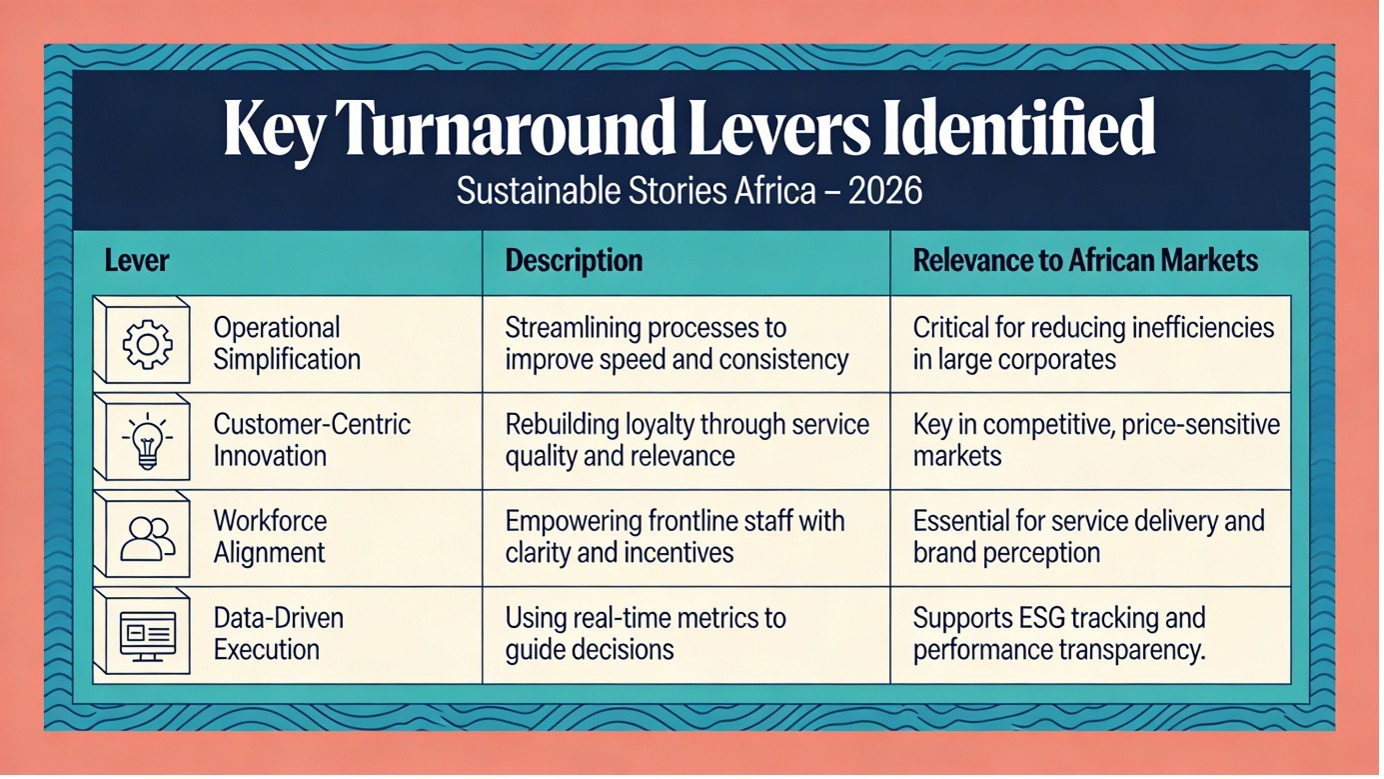
Niccol emphasises that companies often fail in turnarounds because they attempt too many initiatives simultaneously, diluting focus and execution quality.
Instead, Starbucks is prioritising fewer, high-impact actions that are measured rigorously.
This approach mirrors lessons from African ESG landscapes, where companies adopt multiple frameworks (GRI, IFRS S1/S2, TCFD), often struggle to align depth of implementation with the breadth of reporting.
What Success Could Look Like
If executed effectively, turnaround strategies like Niccol’s unlock multi-dimensional value, not just financial recovery, but institutional resilience.
Potential Outcomes of Effective Turnarounds
Outcome Area | Impact |
|---|---|
Financial Performance | Improved margins through operational efficiency |
Customer Trust | Increased loyalty and brand equity |
ESG Alignment | Stronger governance and reporting credibility |
Workforce Productivity | Higher engagement and service quality |
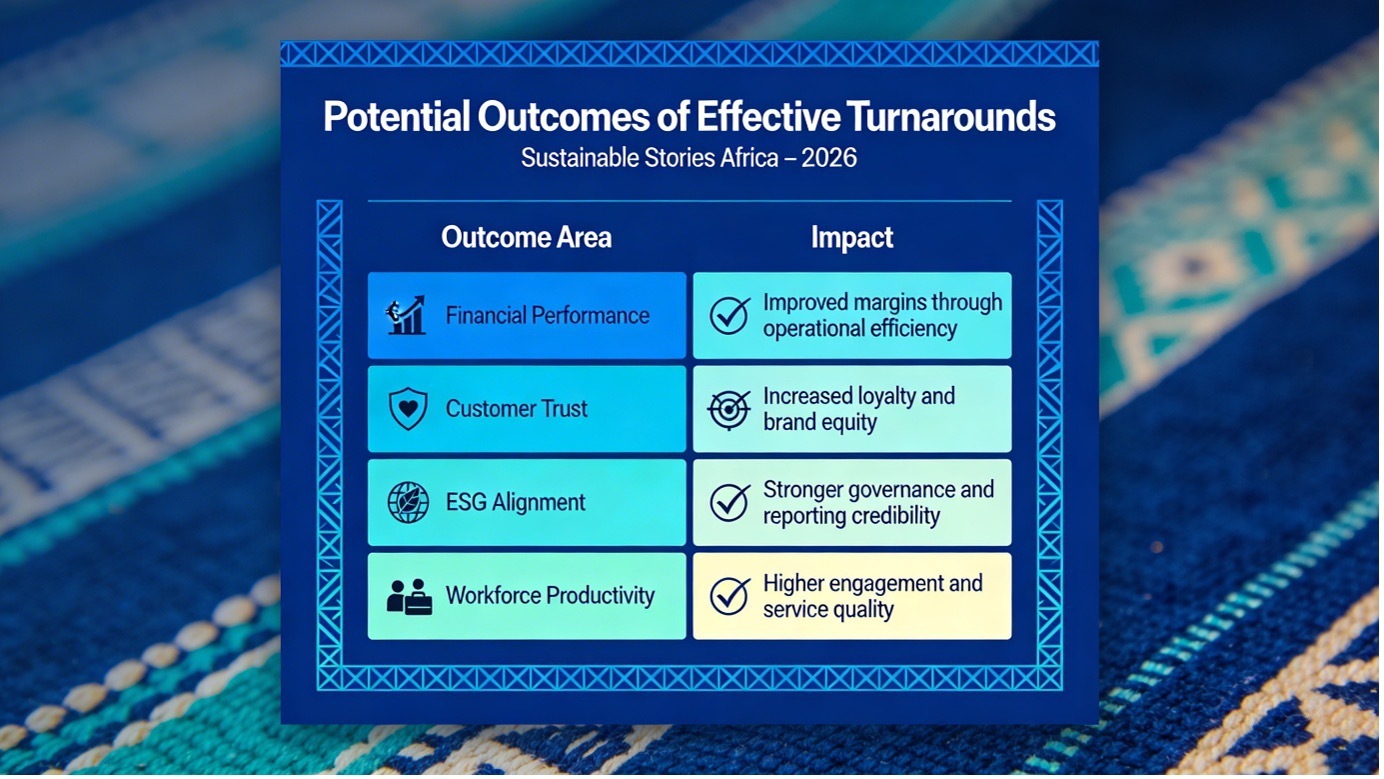
For African markets, the upside is even more profound:
- Stronger investor confidence, particularly from global ESG-focused funds
- Improved regulatory alignment, reducing compliance risks
- Enhanced competitiveness, especially for companies operating across borders
The risk of inaction, however, is equally clear: continued erosion of trust, declining market share, and rising cost of capital.
Turnarounds, in this context, are not optional; they are existential.
What Leaders Must Do Now
Niccol’s leadership blueprint translates into a set of actionable imperatives for executives, regulators, and investors:
- Focus on Fewer, High-Impact Priorities – Avoid “initiative overload.” Identify 2 to 3 critical areas that directly influence performance and execute relentlessly.
- Embed Accountability Across the Organisation – Turnaround success depends on frontline execution, not just boardroom strategy. Metrics must be clear, measurable, and owned.
- Align ESG with Core Business Strategy – ESG should not sit in isolated reports. It must be integrated into operational decision-making, risk management, and performance evaluation.
- Invest in Culture as a Performance Driver – Workforce engagement is not a soft issue; it directly impacts customer experience and operational efficiency.
- Use Data as a Strategic Asset – Real-time insights enable faster adjustments and better decision-making, particularly in volatile markets.
These actions are particularly relevant for African corporates navigating fragmented regulatory environments and evolving ESG expectations.
Path Forward – From Recovery to Resilience
Turnarounds must move beyond short-term fixes to long-term system redesign. Leaders must prioritise execution discipline, cultural alignment, and data-driven decision-making to sustain performance.
For African markets, embedding ESG into operational strategy will be central to rebuilding trust, attracting capital, and driving inclusive growth.