As climate finance accelerates, carbon credits are emerging as one of the most debated tools in the global net-zero transition.
However, the market remains complex, with multiple types of credits linked to different technologies, ecosystems and emissions-reduction pathways.
Understanding these categories is critical for African governments, businesses and communities seeking to participate in global climate markets while ensuring environmental integrity and equitable economic benefits.
Carbon Credits Explained For Climate Markets
Carbon credits have become one of the most visible instruments in the global effort to reduce greenhouse-gas emissions.
Governments, corporations and investors increasingly rely on them to offset emissions while funding climate solutions ranging from forest protection to advanced carbon-removal technologies.
For African economies, the stakes are particularly high. The continent holds vast natural carbon sinks, including tropical forests, peatlands and coastal ecosystems, that could generate billions of dollars in climate finance if carbon markets function transparently and equitably.
However, the system is often misunderstood. Carbon credits are not a single commodity, but a family of instruments created through different climate interventions.
Each type reflects a distinct pathway for either reducing emissions or removing carbon from the atmosphere. Understanding these distinctions is essential for policymakers, investors and communities navigating the rapidly expanding carbon economy.
Carbon Markets Expanding Across Africa
Global carbon markets are evolving rapidly as governments and corporations intensify efforts to meet net-zero commitments.
Voluntary carbon markets alone are projected to grow into a multi-billion-dollar industry over the coming decade, creating new opportunities for climate finance in developing economies.
At the centre of this system are carbon credits, tradable certificates representing the reduction or removal of one metric tonne of carbon dioxide or equivalent greenhouse gases.
However, not all carbon credits are the same.
The carbon market is structured around several categories that reflect different climate solutions.
According to the classification illustrated in the “Types of Carbon Credits” framework, in the link above, carbon credits broadly fall into two major groups:
- Nature-based credits
- Technology-based credits
Each category includes multiple subtypes based on the method used to reduce or remove emissions.
Understanding these categories is increasingly important as African nations explore carbon trading frameworks and climate-finance strategies.
The Main Types Of Carbon Credits
Carbon credits generally fall into two broad families: reduction credits and removal credits. These credits originate from projects that either prevent emissions from occurring or actively remove carbon from the atmosphere.
Major Carbon Credit Categories
Category | Core Function | Examples |
|---|---|---|
Nature-based credits | Protect or restore ecosystems that absorb or store carbon | Forest conservation, mangrove restoration |
Renewable energy credits | Replace fossil-fuel energy with clean energy | Solar, wind, hydro |
Energy efficiency credits | Reduce energy demand through improved technologies | Clean cooking, efficient transport |
Fuel switch credits | Replace high-carbon fuels with lower-carbon alternatives | Biofuels, hydrogen |
Carbon removal technologies | Remove CO₂ directly from the atmosphere | Direct air capture, bioenergy with CCS |
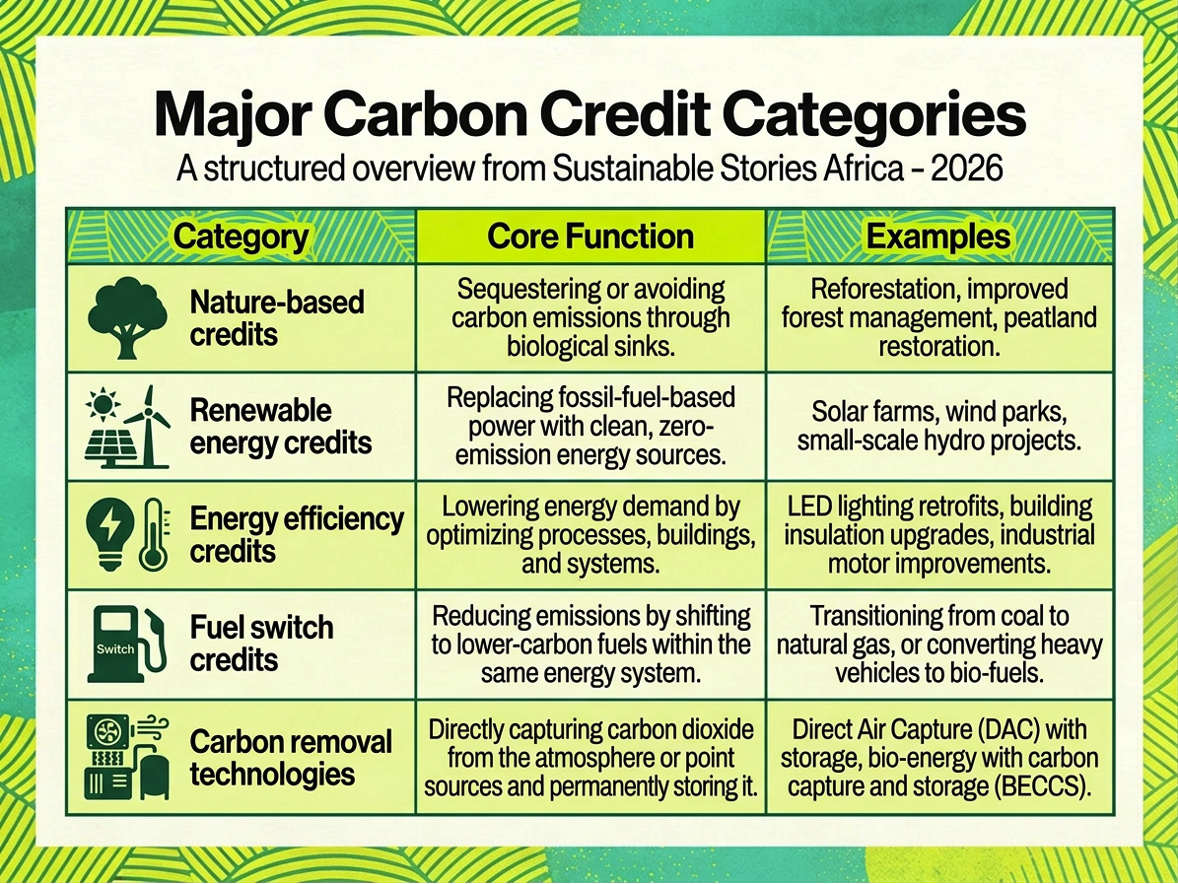
The linked infographic document highlights two major clusters: nature-based credits and technology-driven credits, each with several sub-categories.
Nature-Based Carbon Credits
Nature-based credits rely on ecosystems that naturally absorb carbon. These projects often occur in forests, wetlands and coastal environments.
Examples include:
- Forest Protection (REDD+) – REDD+ programmes generate credits by preventing deforestation and forest degradation. Projects may include jurisdictional REDD+, planned deforestation prevention or protection of high-risk forest areas.
- Land Restoration Projects – Credits may also be obtained by restoring degraded land or improving agricultural practices.
Examples include:
- Agricultural land management
- Improved forest management
- Grassland protection
- Blue Carbon Projects – Coastal ecosystems such as mangroves, seagrasses and tidal marshes capture large amounts of carbon. These “blue carbon” projects are increasingly recognised as high-value climate assets.
Nature-based credits are particularly relevant for Africa, which hosts approximately one-fifth of the world’s remaining tropical forests.
Technology-Based Carbon Credits
Technology-based credits originate from industrial or energy interventions designed to reduce emissions.
Examples include:
- Renewable Energy Projects – Renewable-energy installations generate credits by replacing fossil-fuel electricity.
Examples include:
- Solar power
- Wind energy
- Hydropower
- Organic waste energy systems
These credits played a dominant role in early voluntary carbon markets.
- Energy Efficiency Credits – Projects that reduce energy consumption also generate credits.
Examples include:
- Clean cooking programmes
- Efficient transport systems
- Energy demand reduction technologies
These projects often deliver both climate benefits and development impacts.
- Fuel Switching – Credits can also be generated by replacing carbon-intensive fuels with cleaner alternatives.
Examples include:
- Biofuels
- Hydrogen
- Hybrid energy systems
- Non-CO₂ Emissions Reduction Credits – Some projects target greenhouse gases other than carbon dioxide.
These include:
- Methane capture from landfills
- Fugitive methane emissions reduction
- Waste management improvements
Methane reduction projects are considered particularly impactful because methane has a significantly higher warming potential than CO₂.
- Carbon Removal Technologies – A growing segment of the carbon market focuses on removing carbon from the atmosphere rather than simply avoiding emissions.
Examples include:
- Carbon Capture and Storage (CCS)
- Direct Air Capture (DAC)
- Bioenergy with Carbon Capture and Storage (BECCS)
- Biochar and marine carbon capture
These technologies are at the forefront of carbon markets but remain relatively expensive compared with nature-based solutions.
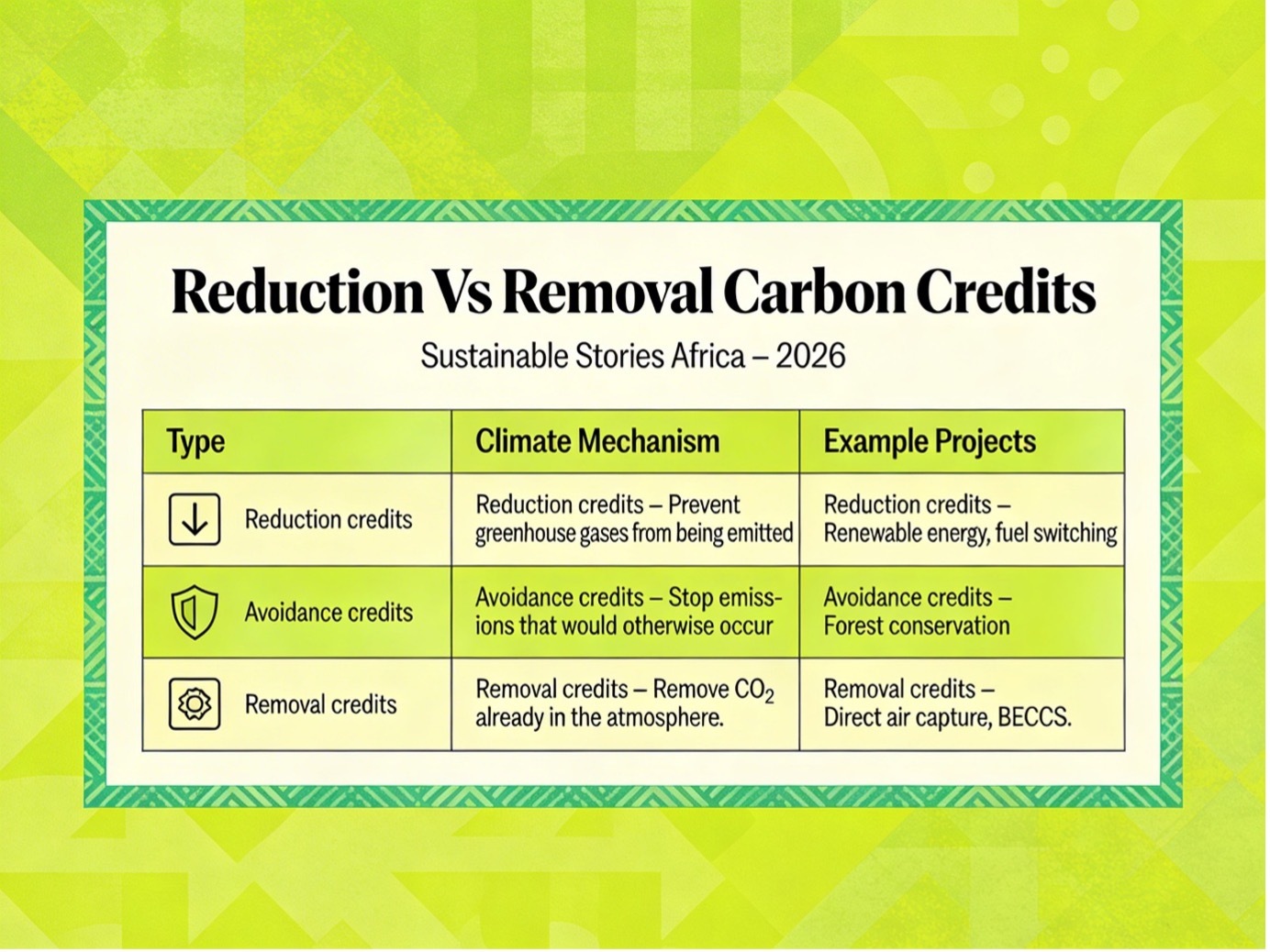
Reduction Vs Removal Carbon Credits
Type | Climate Mechanism | Example Projects |
|---|---|---|
Reduction credits | Prevent greenhouse gases from being emitted | Renewable energy, fuel switching |
Avoidance credits | Stop emissions that would otherwise occur | Forest conservation |
Removal credits | Remove CO₂ already in the atmosphere | Direct air capture, BECCS |
Why Carbon Credit Markets Matter For Africa
If managed effectively, carbon markets could unlock significant climate finance for Africa.
The continent possesses several advantages:
- Vast forest carbon sinks
- Large renewable-energy potential
- Expanding land restoration opportunities
- Rapidly growing carbon-removal innovation
For rural communities, nature-based carbon projects could generate new income streams while supporting biodiversity protection and sustainable agriculture.
For governments, carbon markets offer a pathway to attract international climate investment while advancing national climate commitments under the Paris Agreement.
However, the opportunity is not without risks.
Concerns remain about carbon-credit integrity, double-counting, land-use conflicts and inequitable revenue distribution. Ensuring transparent governance and credible verification systems will therefore be essential for building trust in African carbon markets.
Building Credible Carbon Markets
To unlock the full potential of carbon credits, several actions are needed across governments, businesses and international institutions.
- Strengthening Carbon Governance – African governments must establish clear regulatory frameworks for carbon trading to ensure that projects align with national climate strategies and community rights.
- Improving Verification Standards – Independent verification and monitoring systems are critical to ensure credits represent real, measurable climate benefits.
- Supporting Community Participation – Local communities should receive fair compensation and a decision-making component of power projects located on their land.
- Investing in Carbon Innovation – African economies can also participate in emerging carbon-removal technologies, positioning themselves in future climate markets.
Path Forward – Building Fair And Transparent Carbon Markets
Africa’s carbon economy is entering a pivotal phase. Clear governance frameworks, credible verification systems and strong community safeguards will determine whether carbon markets deliver genuine climate benefits.
If implemented responsibly, diverse carbon credit types, from forest protection to carbon-removal technologies, could transform the continent into one of the world’s most important hubs for climate finance.