Energy policy is no longer only about climate targets. It is now a hard test of security, household affordability, industrial competitiveness and public finance.
The IEA’s State of Energy Policy 2026 shows governments spending more, regulating unevenly and racing to protect supply chains — while Africa’s access agenda gains momentum under renewed global shocks.
Energy Security Returns To Centre Stage
Energy policy has entered a more volatile phase. After five years of pandemic disruption, Russia’s invasion of Ukraine, trade restrictions, extreme heat and conflict affecting major energy suppliers, governments are treating energy as a core matter of national and economic security.
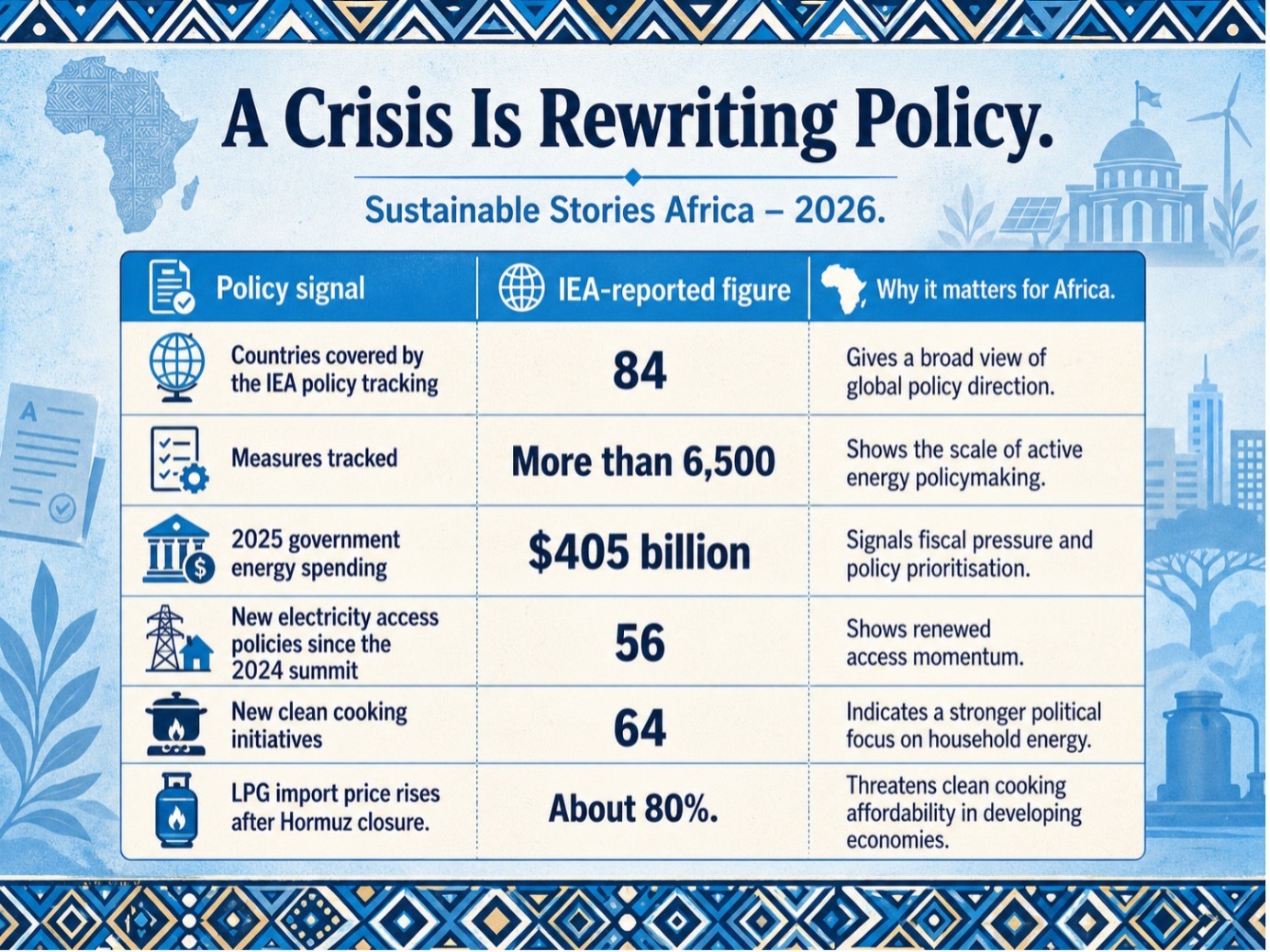
The International Energy Agency’s State of Energy Policy 2026 tracks more than 6,500 policy measures across 84 countries, representing more than 90% of global energy demand and emissions.
It finds no single global storyline, but one clear pattern: governments are trying to manage the pressures of the cost of living, resilient supply chains and climate commitments at the same time.
For Africa, the report lands at a crucial moment. Energy access is regaining political attention, but the same global shocks driving new emergency policies are also raising fuel costs, straining public budgets and testing whether clean energy promises can survive volatility.
A Crisis Is Rewriting Policy
The most important message from the IEA’s 2026 review is that energy security has returned with force, but in a broader form than during the oil crises of the 1970s.
Emergency measures to manage oil and natural gas supply disruptions are now legally in place in 60 countries.
Countries accounting for 95% of global oil imports have adopted stockholding and emergency response legislation, and gas storage requirements and strategic buffers have expanded to nearly 30 countries since Russia invaded Ukraine in 2022.
The report also notes that conflict-related disruption in the Middle East prompted a collective action decision on 11 March 2026, making 400 million barrels of oil from IEA emergency reserves available to the market.
For households and businesses, this kind of policy response is not abstract. It influences fuel availability, transport costs, electricity bills and inflationary pressure.
Spending Rises As Standards Soften
Governments are spending more on energy than before the crisis years, even after some emergency support was rolled back.
The IEA estimates energy-related provisions reached $405 billion in 2025, equal to 1.4% of total government expenditure, up from 0.8% a decade earlier.
Spending in 2024 and 2025 remained far above 2010s levels, at around $370 billion and $405 billion, respectively.
The money is moving through different channels. Power generation and grids received USD 135 billion in 2025.
Building spending rose sixfold since 2015 to $56 billion, while support for low-emissions passenger cars increased 15-fold to $40 billion. Mass and alternative transit reached $82 billion.
However, the policy picture is uneven. In 2025, efficiency and fuel-switching rules were relaxed overall, especially in transport. The report says 30% of energy consumption under regulation experienced some rollback, delay or relaxation, while only 17% was covered by new, stricter rules.
Without those rollbacks, global energy efficiency stringency would have increased by 50% through 2030, rather than the currently expected 30%.
That matters for African markets because weak efficiency standards raise long-term costs. Inefficient vehicles, appliances, buildings and industrial motors can lock households and firms into higher energy bills, especially where electricity supply is expensive or unreliable.
Access Momentum Can Change Lives
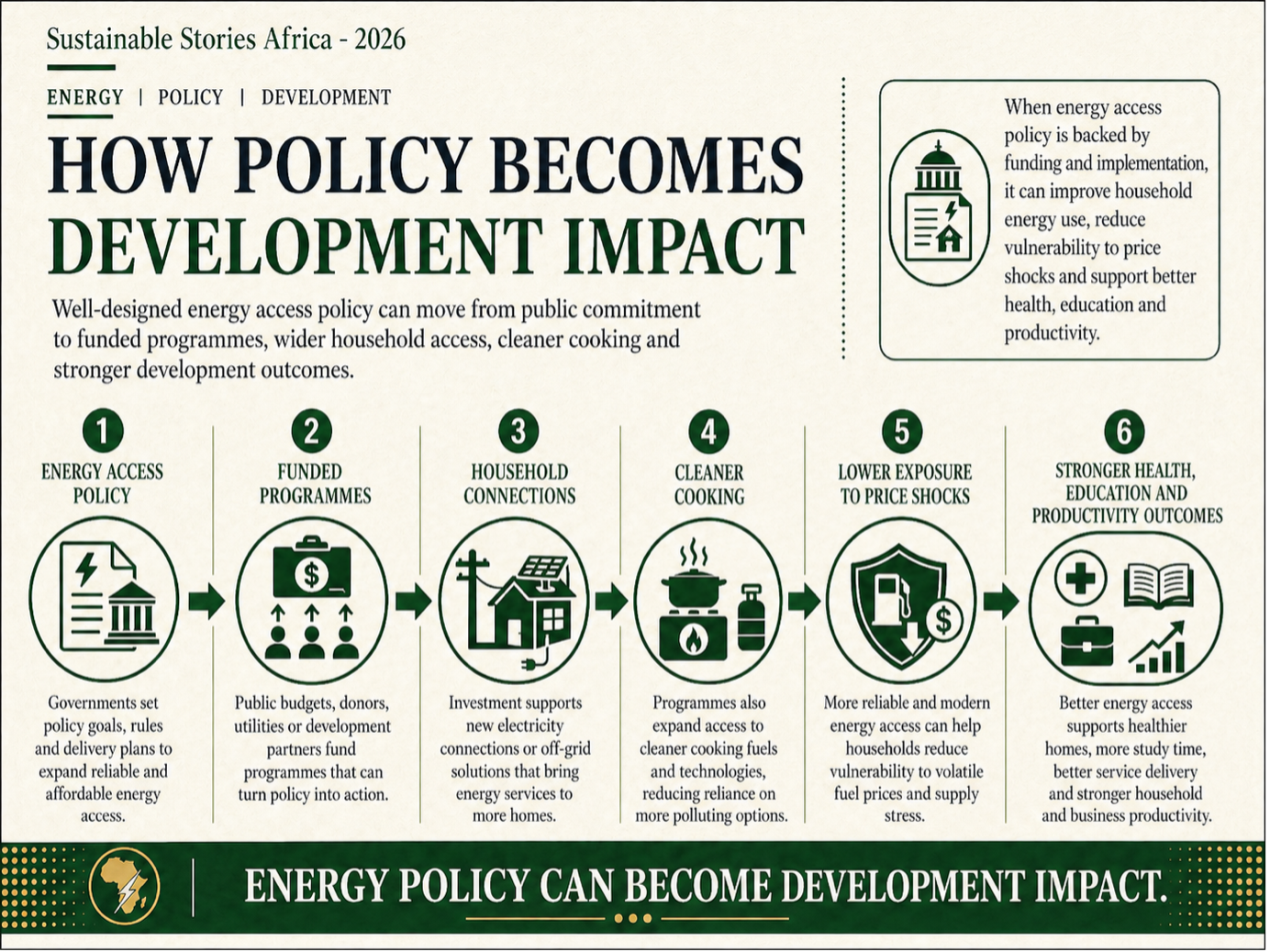
The most hopeful signal for Africa is the renewed policy momentum around energy access. The IEA says 56 electricity access policies have been implemented or announced since the 2024 IEA Summit on Clean Cooking in Africa, alongside 64 new clean cooking initiatives.
Sub-Saharan Africa accounts for most of this new activity, with countries home to 70% of African people without access to electricity and 90% of those without clean cooking adopting new energy access policies over the past year.
This is where energy policy becomes human. A rural clinic connected to reliable power can refrigerate vaccines.
- A school with electricity can extend learning hours.
- A household that shifts from traditional biomass to clean cooking can reduce smoke exposure, save time and improve daily dignity.
The report cites practical examples:
- South Africa’s National Free Basic Electricity policy
- Tariff adjustments in Zambia
- Budget allocations for electricity access in Togo
- Kenya’s use of rural electrification funding for underserved counties.
Kenya has also secured about $200 million to connect 280,000 households under the Last Mile Connectivity Project.
Governments Must Target Support Better
The IEA’s warning is that public money alone is not enough. Design matters. Emergency affordability measures after the 2022 energy crisis disbursed about $220 billion to households between 2022 and 2023, roughly ten times pre-crisis annual support levels, but only 25% of short-term interventions since 2022 targeted vulnerable households most exposed to price shocks.
African governments should take that lesson seriously. Energy subsidies that are broad, expensive and poorly targeted can weaken public finances without solving energy poverty.
Better policy means protecting the poorest consumers while investing in grids, distributed renewables, clean cooking supply chains, efficient appliances and productive-use electricity.
Clean cooking is especially exposed. Following the closure of the Strait of Hormuz, LPG import prices rose by around 80% on average in March 2026 in developing economies where LPG is widely used for cooking.
The IEA estimates that one out of six households could shift from LPG back to traditional biomass, showing how quickly progress can reverse when fuel affordability collapses.
Governments, regulators and financiers therefore need three shifts:
- Targeted affordability support
- Stronger efficiency standards
- Deeper investment in domestic and regional clean energy systems.
For Africa, that means not only importing cleaner fuels and technologies, but building resilient local markets around mini-grids, solar, clean cooking, efficient buildings and modern grids.
Path Forward – Build Resilience Into Transition
Africa’s energy transition must be designed for shocks, not just targets. Access, affordability, efficiency and security should be treated as a single agenda, backed by transparent budgets and targeted support.
The priority is practical delivery: connect households, protect vulnerable consumers, fund clean cooking, strengthen grids and avoid policy rollbacks that raise long-term costs. Energy security is now a development policy.