Africa’s infrastructure assets have quietly delivered strong returns for investors, often outperforming global benchmarks. However, the continent still faces some of the highest financing costs in global markets.
New research suggests the problem is not performance but perception. As evidence mounts that African infrastructure investments generate resilient returns and low default rates, investors are beginning to question long-standing assumptions about risk across emerging markets.
Infrastructure Returns And Africa’s Investment Paradox
Africa’s infrastructure investment story contains a paradox. While the continent urgently needs more capital to close an estimated $100 billion annual infrastructure financing gap, evidence increasingly shows that existing projects deliver competitive returns and strong credit performance.
However, global investors still price African infrastructure as one of the riskiest asset classes in emerging markets.
This disconnect sits at the centre of the debate explored in the research paper “Africa Infrastructure Investment Returns: Evidence, Debt Repayment Realities, and the Colmin Group Coin (CGS) as a Bridging Mechanism.” The study examines how African infrastructure assets perform relative to global markets and why investor perceptions continue to diverge from empirical evidence.
Drawing on decades of investment data, the findings suggest that Africa’s infrastructure sector may be significantly undervalued in global capital markets.
Africa’s Infrastructure Returns Challenge Perceived Risk
Across global financial markets, Africa is widely perceived as a high-risk investment destination.
That perception has translated into higher borrowing costs, limited institutional investment, and persistent financing gaps for infrastructure projects.
However, the evidence increasingly tells a different story.
According to long-term data from infrastructure investment studies, African infrastructure equity investments have delivered returns comparable to or higher than many other emerging markets.
During the period analysed by infrastructure researchers, projects across Sub-Saharan Africa consistently generated strong investment performance relative to risk.
The study highlights a key insight: the market’s perception of risk is often disconnected from actual project performance.
In practice, infrastructure assets such as ports, energy systems, logistics corridors, and telecommunications networks generate predictable cash flows once operational.
Long-term contracts and regulated revenue structures can provide strong downside protection for investors.
However, Africa’s risk premium remains persistently elevated.
Evidence Of Strong Returns And Low Default Rates
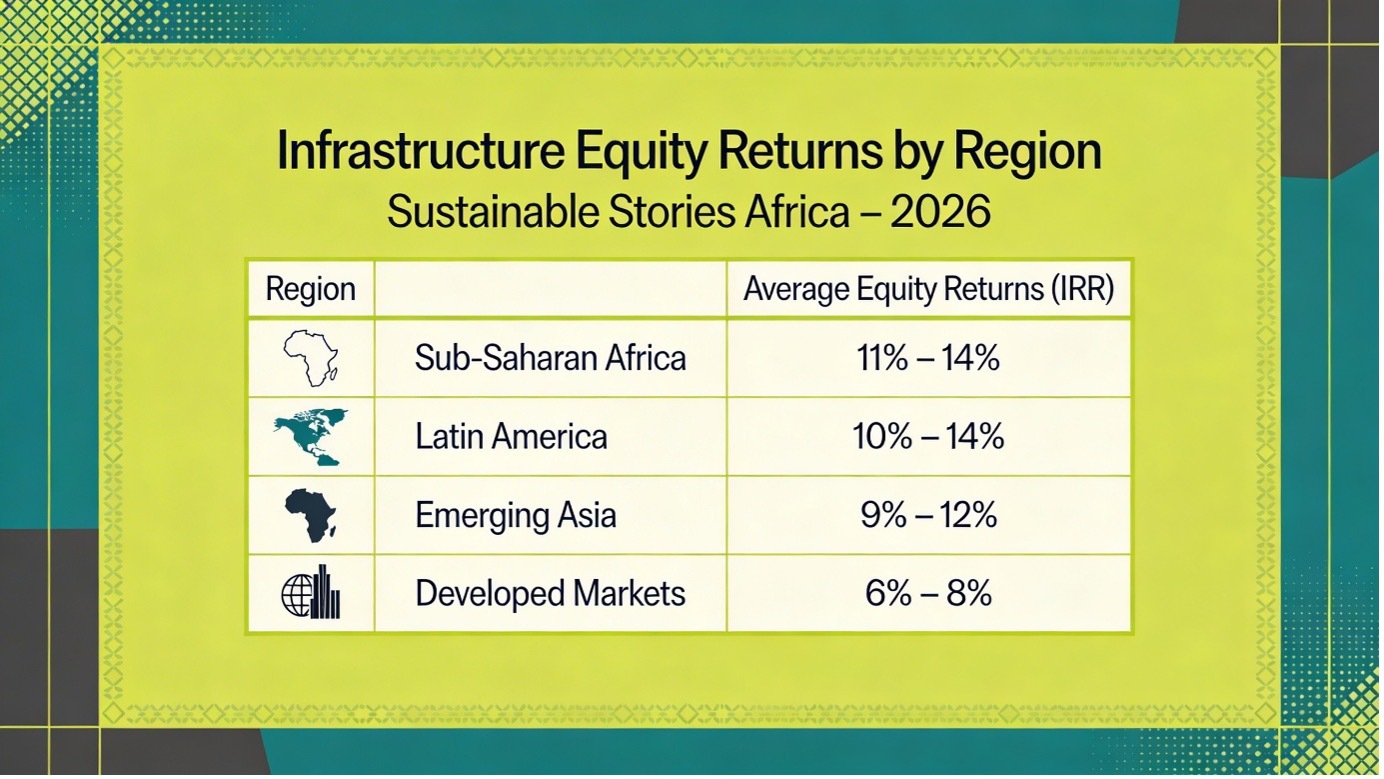
The data suggest that African infrastructure investments have delivered returns broadly aligned with, and sometimes exceeding, those in comparable emerging markets.
Infrastructure Equity Returns by Region
Region | Average Equity Returns (IRR) |
|---|---|
Sub-Saharan Africa | 11% – 14% |
Latin America | 10% – 14% |
Emerging Asia | 9% – 12% |
Developed Markets | 6% – 8% |
The research also highlights another important metric: debt repayment performance.
Contrary to common assumptions, African infrastructure loans have historically had lower default rates than many developed markets.
Infrastructure Debt Default Rates (Selected Regions)
Region | Default Rate |
|---|---|
Africa | 1.7% |
Latin America | 3.5% |
Europe | 4% – 5% |
North America | 4% – 5% |
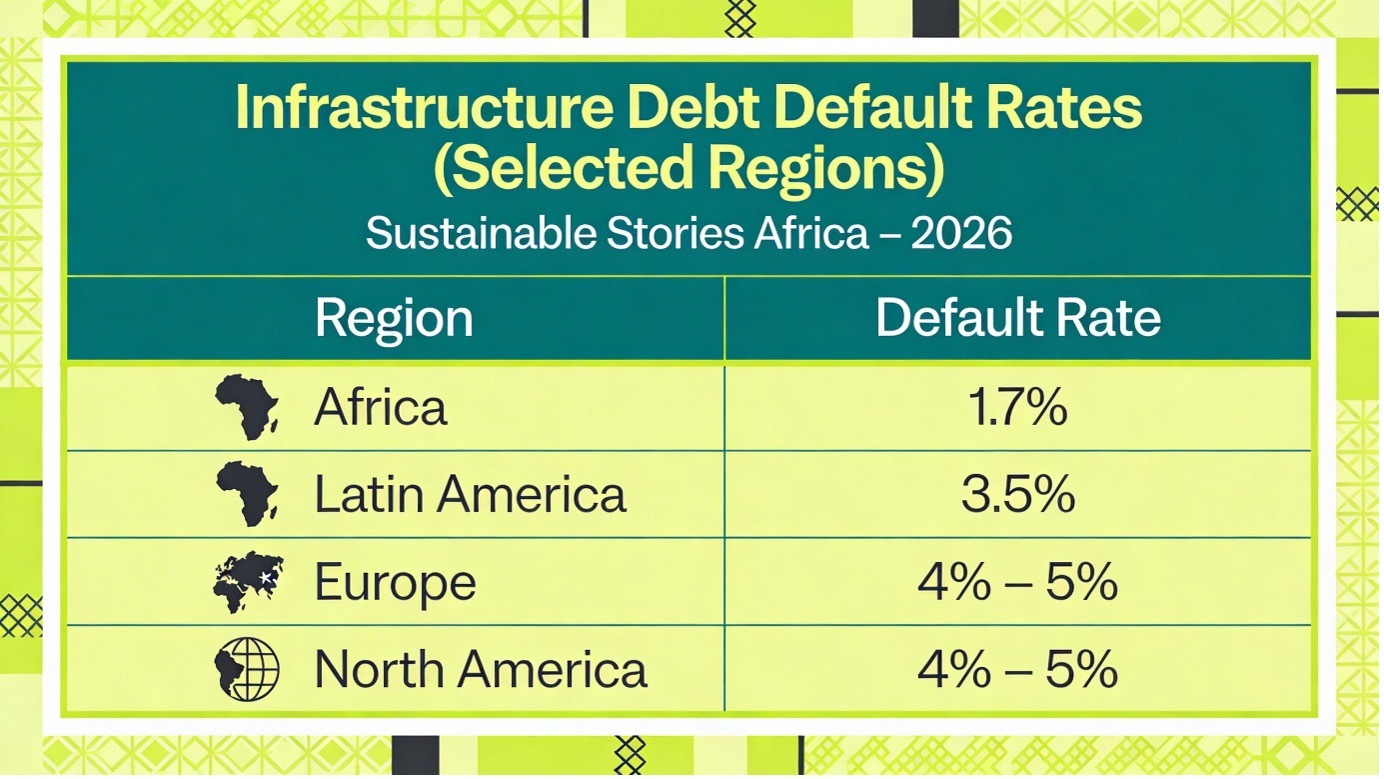
These findings challenge the widespread narrative that infrastructure projects across the continent carry exceptional credit risk.
The gap between headline project returns and realised investor returns, however, remains an important issue.
A major reason lies in currency risk.
Infrastructure revenues are typically generated in local currencies, while financing is often denominated in US dollars or euros. Currency depreciation over time can erode investor returns, particularly in economies experiencing inflation or macroeconomic volatility.
For example, currencies in several African economies depreciated significantly against the US dollar between 2014 and 2024, reducing the effective foreign currency returns for international investors.
Unlocking Africa’s Infrastructure Opportunity
If capital markets begin to align perception with performance, the implications for Africa could be transformative.
Infrastructure investment sits at the centre of Africa’s development agenda.
Power generation, transport corridors, logistics networks, ports, digital infrastructure, and urban mobility systems all depend on long-term capital flows.
However, the continent receives a fraction of global infrastructure investment.
Closing the financing gap could unlock major economic gains:
- Expanded electricity access for hundreds of millions of people
- Faster regional trade through modern transport infrastructure
- Increased industrial productivity
- Stronger digital connectivity for African businesses
For investors, the opportunity is equally compelling.
Infrastructure assets offer long-term stable cash flows, inflation protection, and diversification benefits within global portfolios.
As the study notes, if infrastructure investment in Africa achieved returns comparable to those observed historically, the continent could attract significantly greater institutional capital.
However, doing so requires addressing the structural barriers that sustain the perception gap.
Bridging Africa’s Infrastructure Financing Gap
Several policy and market reforms could help align investor perception with reality.
- Strengthening Infrastructure Data Transparency – Global investors often lack reliable data on the performance of African infrastructure.
Improved disclosure of project returns, loan performance, and operating metrics would help reduce information asymmetry and build investor confidence.
- Expanding Local Currency Financing – Reducing currency mismatch remains critical.
Greater use of local-currency infrastructure financing, supported by domestic capital markets, could shield projects from exchange-rate volatility.
- Developing Innovative Financial Instruments – The research proposes new financing mechanisms designed to bridge Africa’s investment perception gap.
One example is the Colmin Group Coin (CGS), a digital asset-backed instrument designed to connect global investors with African infrastructure assets while mitigating sovereign risk exposure.
Such instruments aim to channel capital into infrastructure projects while reducing the risk premiums associated with sovereign balance sheets.
- Strengthening Institutional Governance – Investors increasingly prioritise governance transparency, ESG compliance, and regulatory stability.
Clear infrastructure procurement frameworks, predictable regulatory systems, and credible dispute-resolution mechanisms are essential for attracting institutional capital.
Path Forward – Aligning Perception With Performance
Africa’s infrastructure investment story is not one of weak returns but of misunderstood risk. Evidence increasingly shows that projects across the continent deliver competitive performance and resilient debt repayment.
The next step is closing the information gap between global investors and African infrastructure markets.
With stronger data transparency, innovative financing tools, and improved governance frameworks, Africa’s infrastructure sector could become one of the most compelling investment opportunities of the coming decade.