
Corporate sustainability commitments have expanded dramatically in recent years; however, many ESG initiatives struggle to gain traction inside organisations.
A growing body of corporate experience suggests the problem is not sustainability itself, but how it is presented.
When ESG is framed as a compliance exercise rather than a strategic business issue, even well-designed initiatives can lose executive support before they begin.
When Sustainability Strategies Fail Early
Across boardrooms worldwide, environmental, social and governance (ESG) strategies have become central to corporate conversations. Companies increasingly set carbon-reduction targets, publish sustainability reports and commit to responsible supply-chain practices.
However, inside many organisations, ESG initiatives struggle to secure sustained support from senior leadership.
The reason is often surprisingly simple.
Sustainability programmes frequently begin with environmental or social goals rather than with the business realities that shape executive decision-making, costs, risks, competitiveness and long-term value creation.
For companies navigating climate transition, regulatory change and investor scrutiny, the challenge is not merely implementing ESG initiatives. It is positioning sustainability as a core business strategy rather than a separate compliance agenda.
Understanding why ESG initiatives fail, and how to reposition them, has therefore become a crucial leadership question for corporations across Africa and the global economy.
The Fastest Way to Kill ESG
“The fastest way to kill an ESG initiative is to call it one.”
This provocative insight reflects a growing recognition among corporate strategists that framing matters as much as policy design.
An infographic in the uploaded document titled “The Fastest Way to Kill an ESG Initiative” highlights how sustainability proposals often lose executive support when presented primarily as ESG commitments rather than as commercial strategies.
Typical board presentations begin with:
- carbon reduction targets
- Scope 3 commitments
- regulatory reporting timelines
But executives often interpret these proposals through a different lens: cost exposure.
When sustainability initiatives are viewed as financial burdens rather than strategic opportunities, boardrooms can disengage quickly, sometimes before the discussion fully begins.
Why ESG Proposals Lose The Room
In many organisations, ESG proposals are presented primarily through environmental or social narratives.
While these topics are important, they often fail to resonate with decision-makers responsible for financial performance.
According to the framework illustrated in the infographic, the core mistake is leading with ESG rather than leading with economics.
This disconnect can create a predictable reaction among executives.
A sustainability proposal framed as:
- emissions reduction
- regulatory compliance
- ethical commitments
may be mentally categorised as “cost we have to absorb.”
Once this perception forms, the initiative struggles to gain strategic momentum.
The Alternative: A Commercial Entry Point
The same infographic proposes a different approach, a sequence that aligns sustainability initiatives with business strategy.
Instead of starting with ESG, organisations should begin with commercial analysis.
The recommended sequence includes:
- Start with cost or financial impact
- Add carbon exposure analysis
- Introduce social dimensions using business frameworks
- Allow trade-offs and value creation to emerge naturally
This approach reframes sustainability as a business opportunity rather than a regulatory obligation.
Two Ways ESG Initiatives Are Presented
Presentation Approach | Boardroom Reaction |
|---|---|
Start with ESG commitments | Seen as compliance or cost |
Start with financial analysis | Seen as a strategic opportunity |
ESG added later | Supports long-term value creation |
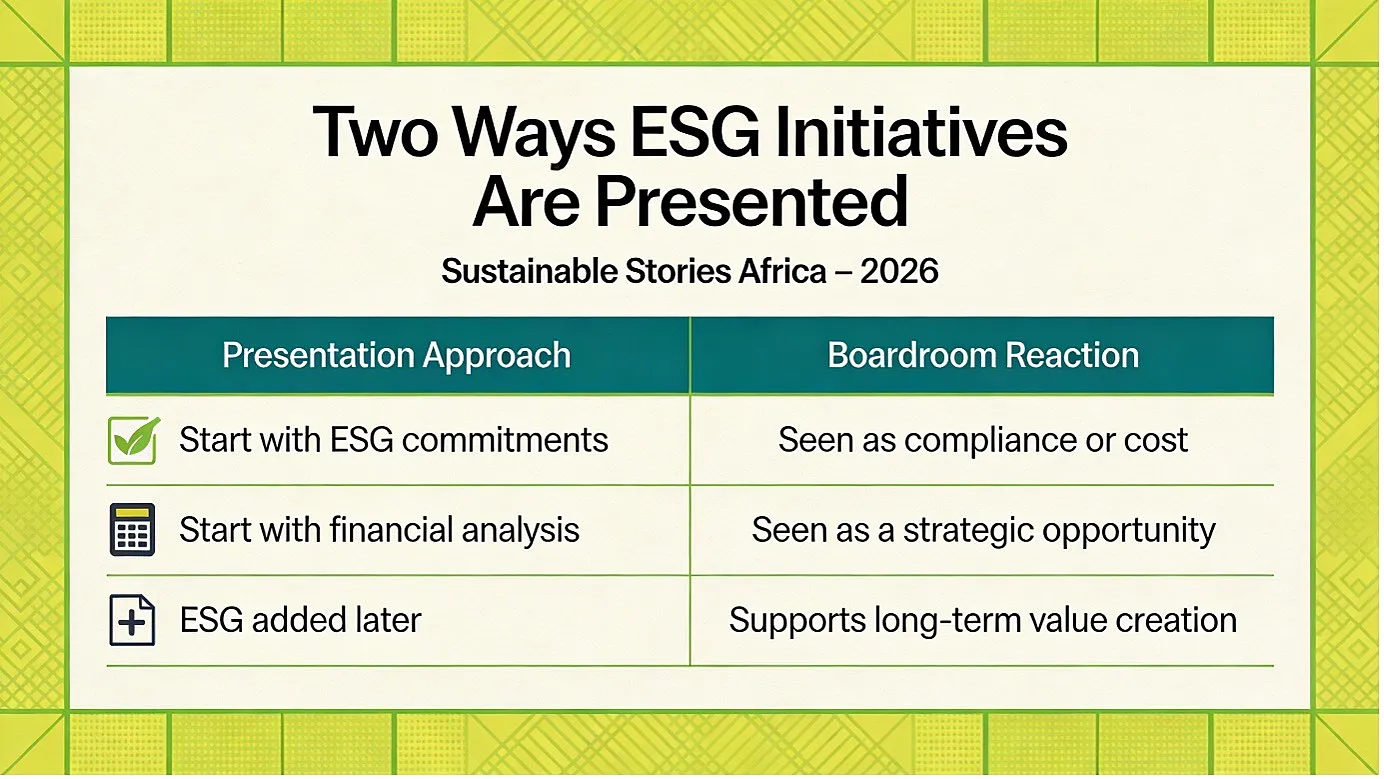
The difference is not the initiative itself. It is the conversation surrounding it.
Why The Framing Matters More Than Ever
Several forces are intensifying pressure on organisations to integrate sustainability into their core strategy.
These include:
- climate regulation and carbon pricing
- supply-chain transparency requirements
- investor expectations for ESG disclosure
- consumer demand for responsible business practices
However, these forces rarely transform industries overnight.
More commonly, they gradually reshape the economics of business.
Energy costs shift. Supply chains evolve. Regulatory expectations tighten.
When sustainability initiatives are framed purely as compliance exercises, organisations often react slowly to these structural changes.
Turning ESG Into Strategic Advantage
When sustainability initiatives are integrated into business strategy, the results can be transformative.
Companies that successfully align ESG with financial strategy often experience:
- improved operational efficiency
- reduced regulatory risk
- stronger investor confidence
- enhanced supply-chain resilience
In sectors critical to Africa’s development, including energy, agriculture, manufacturing and finance, ESG-aligned innovation can unlock new market opportunities.
Examples include:
- renewable-energy investments reducing long-term power costs
- sustainable supply chains improving export competitiveness
- circular-economy initiatives lowering material expenses
These outcomes illustrate a crucial shift.
Sustainability initiatives succeed when they are framed as value creation strategies rather than compliance obligations.
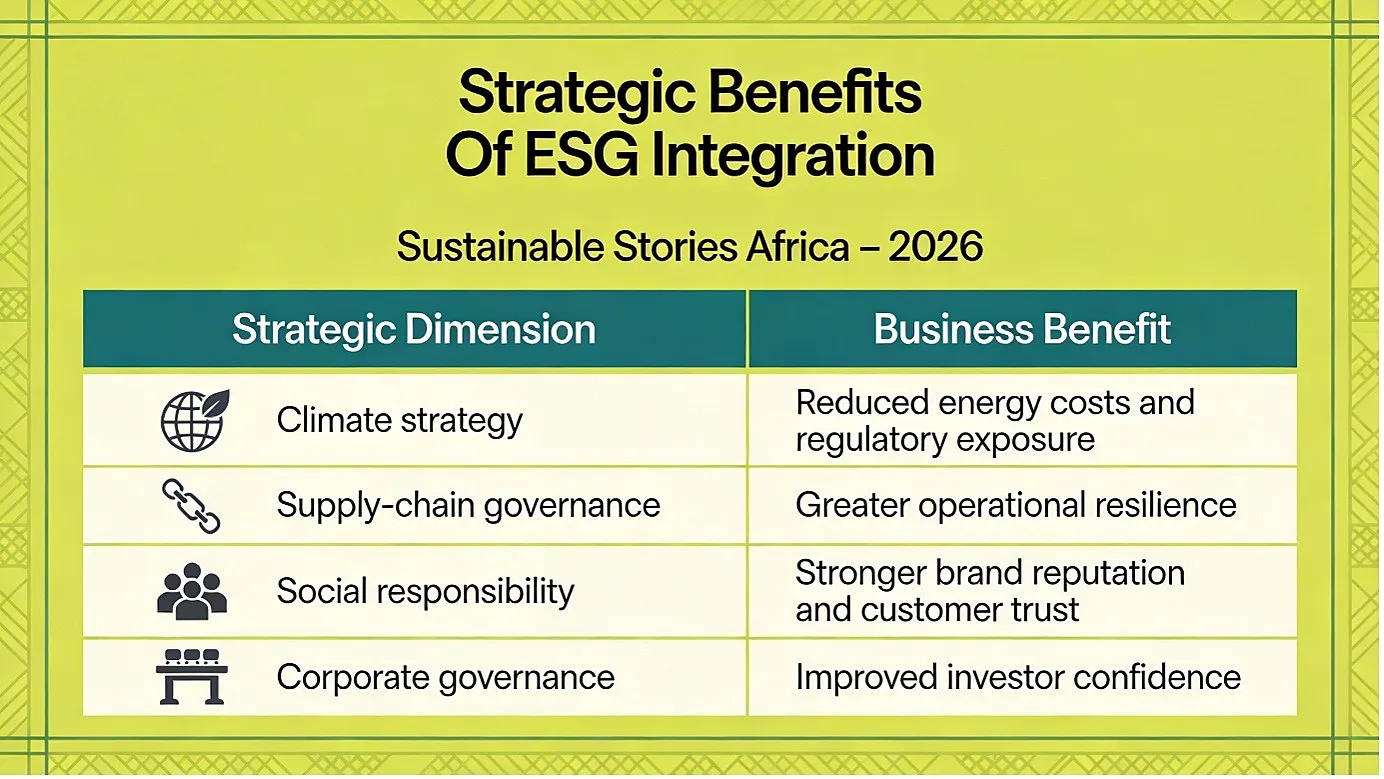
Strategic Benefits Of ESG Integration
Strategic Dimension | Business Benefit |
|---|---|
Climate strategy | Reduced energy costs and regulatory exposure |
Supply-chain governance | Greater operational resilience |
Social responsibility | Stronger brand reputation and customer trust |
Corporate governance | Improved investor confidence |
Reframing ESG For Boardroom Strategy
To prevent ESG initiatives from failing prematurely, organisations must rethink how sustainability is presented and integrated into decision-making.
- Lead With Financial Analysis – Executives respond first to economic implications.
Presenting sustainability initiatives through cost, revenue and risk analysis builds credibility.
- Connect ESG to Business Strategy – Sustainability initiatives should be linked directly to corporate priorities, such as:
- market expansion
- operational efficiency
- regulatory preparedness
- Use Data-Driven Scenarios – Scenario modelling helps demonstrate how climate regulation, supply-chain disruption or resource scarcity could affect long-term profitability.
- Align Sustainability and Procurement – Procurement decisions increasingly shape ESG performance.
Integrating sustainability into sourcing strategies can generate both environmental and financial benefits.
- Foster Cross-Functional Leadership – Sustainability teams must collaborate closely with finance, operations and strategy departments.
This integration ensures ESG priorities influence real business decisions.
Path Forward – Strategy First, ESG Follows
The future of corporate sustainability will depend less on commitments and more on strategy.
When ESG initiatives begin with commercial logic, costs, risks and competitiveness, they gain credibility in the boardroom.
For companies navigating climate transition and evolving global markets, reframing sustainability as a business strategy rather than a compliance exercise may determine which initiatives succeed and which quietly disappear before they begin.