Uganda’s Just Transition Framework is positioning the country as a continental leader in equitable climate action, embedding fairness into economic transformation.
However, critical gaps remain. Without stronger data systems, governance clarity, and grant-based financing, the promise of a just transition risks leaving vulnerable communities behind.
Balancing Growth, Equity, and Climate Risks
Uganda’s transition to a low-carbon economy is no longer a distant ambition; it is an active policy reality. Anchored in Vision 2040 and the Fourth National Development Plan (NDP IV), the country’s Just Transition Framework (JTF) is designed to ensure that climate action does not deepen inequality but instead drives inclusive growth.
At its core, the framework highlights a dual challenge: accelerate structural transformation while protecting millions of informal workers, smallholder farmers, and low-income households whose livelihoods are tied to carbon-intensive and resource-dependent systems.
The stakes are high. With over 80% of Uganda’s workforce in the informal sector and more than 70% employed in agriculture, the transition intersects directly with livelihoods, poverty dynamics, and national stability.
A Just Transition Under Pressure
Uganda’s Just Transition Framework is being tested in real time.
As climate risks intensify, including droughts, floods, and wetland degradation, Uganda is simultaneously navigating rapid population growth projected to exceed 60 million by 2030 and mounting global trade pressures from AfCFTA and EU environmental standards.
The response has been deliberate: a nationally coordinated framework that embeds fairness into energy, agriculture, transport, forestry, and urban development.
But the urgency is clear. Without effective implementation, transitions risk:
- Increasing unemployment in vulnerable sectors
- Raising the costs of energy, food, and mobility
- Deepening regional and income inequalities
Uganda’s approach, therefore, shifts the narrative from green transition to just transition.
Inside Uganda’s Just Transition Architecture
Uganda’s JTF is structured around three pillars of justice:
- Distributive justice – Fair sharing of costs and benefits
- Procedural justice – Inclusive participation in decision-making
- Restorative justice – Addressing historical environmental and social harms
These principles are not theoretical; they are operationalised across policy systems.
Uganda’s Just Transition Integration Mechanisms
Policy Tool | Function in Just Transition |
|---|---|
PIAPs (Programme Implementation Action Plans) | Embed welfare considerations into sectoral planning |
SEAs (Strategic Environmental Assessments) | Identify systemic environmental and social risks |
ESIAs (Environmental & Social Impact Assessments) | Mitigate project-level impacts |
Project Appraisal Systems | Screen investments for equity and sustainability |
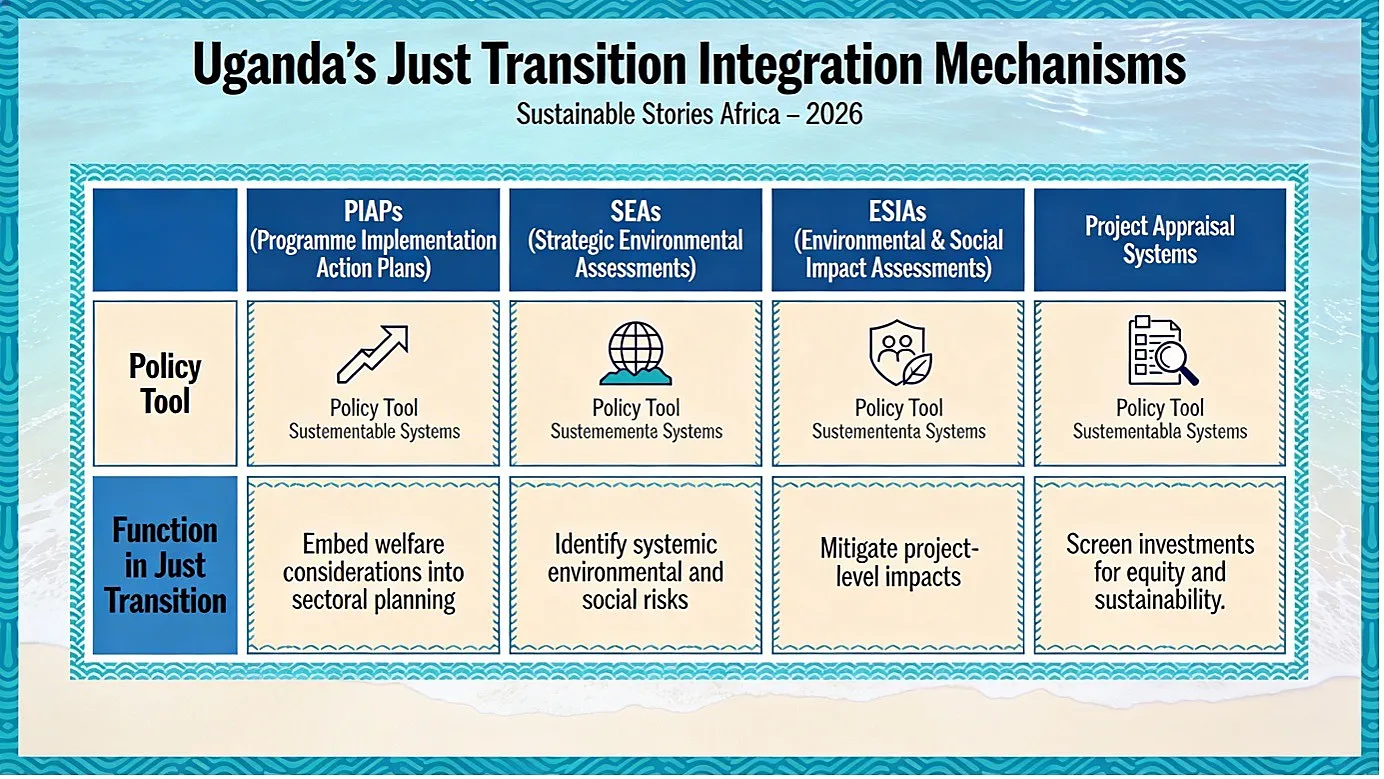
Institutionally, the framework is anchored by multi-stakeholder coordination.
Technical working groups bring together ministries, the private sector, civil society, and development partners to ensure cross-sectoral alignment.
From Policy to Practice: Early Progress
Uganda has already recorded notable milestones:
- An 18-month stakeholder-driven framework development process
- Integration of JTF principles into national planning cycles
- Alignment of climate finance criteria with just transition screening
- Nationwide awareness campaigns and stakeholder engagement initiatives
The storyboard diagram on page 4 visually maps this journey, from national goals to implementation, best practices, and financing gaps, highlighting a structured pathway for equitable transition.
Real-world applications are emerging. For example, wetland restoration projects were redesigned to include phased implementation and alternative livelihoods such as aquaculture and ecotourism, demonstrating how environmental goals can align with social protection.
The Constraints: Where the System Fractures
Despite progress, structural barriers remain significant.
Key Constraints to Uganda’s Just Transition
Constraint | System Impact |
|---|---|
High informality (80% workforce) | Limits social protection and policy targeting |
Data gaps (limited disaggregated data) | Weakens evidence-based decision-making |
Absence of resettlement policy | Creates inconsistencies in compensation |
Fiscal constraints | Limits domestic funding capacity |
Institutional capacity gaps | Reduces implementation effectiveness |
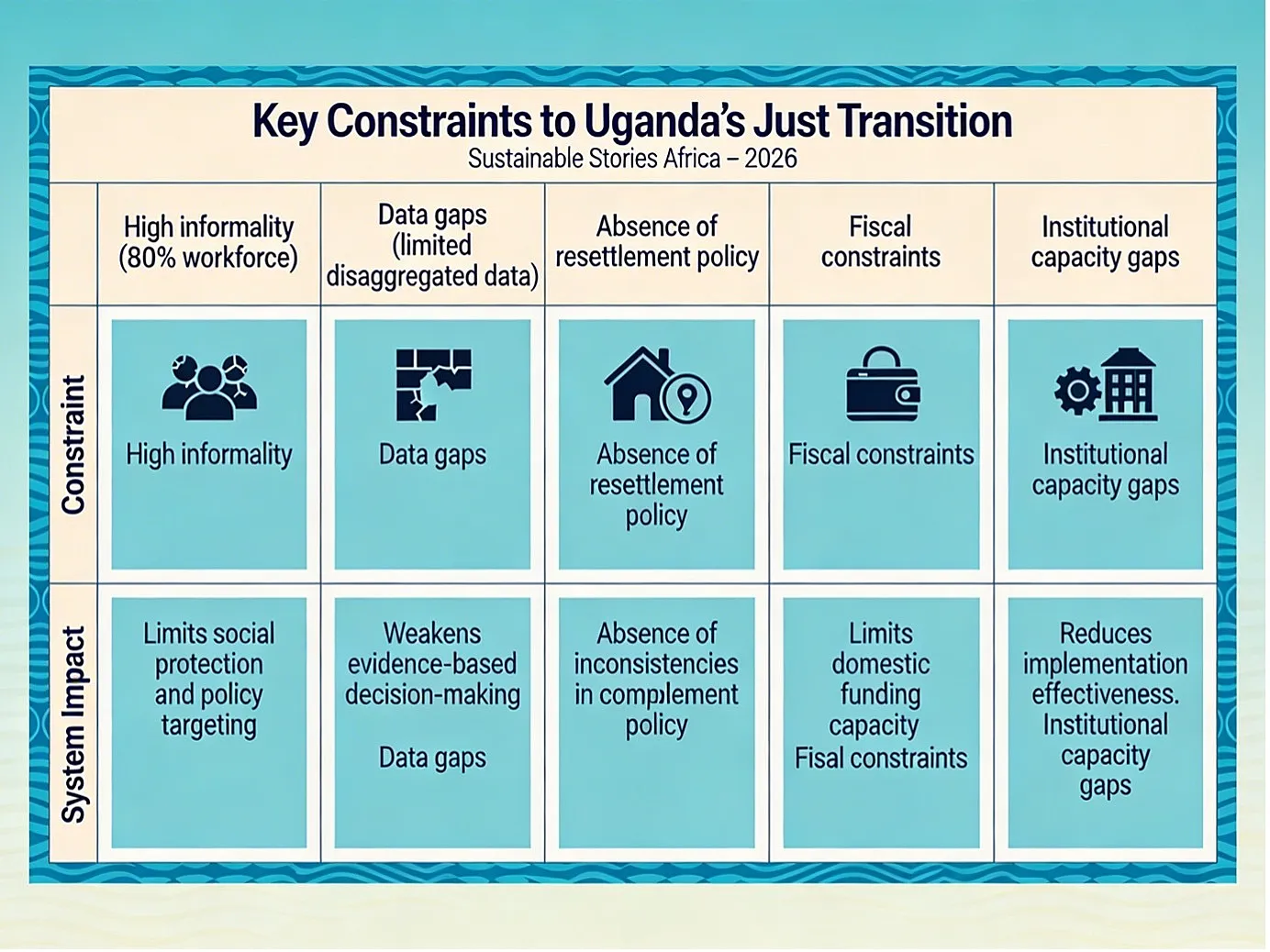
These challenges are interconnected. Weak labour data undermines policy design; fiscal constraints limit implementation; and governance gaps reduce trust and efficiency.
The Opportunity of an Inclusive Green Economy
If successfully implemented, Uganda’s Just Transition could unlock transformative outcomes:
- Job Creation at Scale – Green sectors, including renewable energy, agro-processing, forestry restoration, and urban infrastructure, could generate millions of decent jobs.
- Reduced Inequality – Targeted interventions can narrow regional disparities and protect vulnerable populations.
- Improved Energy and Environmental Outcomes – Cleaner energy systems reduce pollution, health costs, and reliance on imports.
- Stronger Global Competitiveness – Alignment with international standards enhances export resilience and access to climate finance.
- Fiscal and Economic Resilience – Reduced environmental degradation and improved productivity lower long-term fiscal burdens.
The alternative is stark: unmanaged transitions, such as the historical collapse of the Kilembe mines, risk long-term economic decline, environmental damage, and social dislocation.
What Must Happen Now
The policy brief outlines a clear, actionable roadmap:
- Build Robust Data Systems – Support Uganda Bureau of Statistics and National Planning Authority in developing labour and welfare models that capture informality and distributional impacts.
- Establish a National Resettlement Framework – Align policies with international standards to reduce social conflict and improve investor confidence.
- Mobilise Grant-Based Financing – Develop programmatic finance windows for:
- Livelihood restoration
- Workforce re-skilling
- SME retooling
- Strengthen Institutional Capacity – Train ministries, local governments, and civil society on inclusive planning and social impact analysis.
- Integrate Performance Metrics – Embed Just Transition indicators into national monitoring frameworks (NDP IV and Green Growth Strategy).
- Enhance Climate Finance Readiness – Develop pipelines aligned with CIF, AfDB, GCF, and global funding criteria to unlock concessional finance.
Crucially, the emphasis is on grants, rather than loans, to avoid exacerbating debt vulnerabilities.
Path Forward – From Framework to Implementation
Uganda’s Just Transition Framework signals a shift from ambition to execution. The next phase will depend on closing data gaps, strengthening governance systems, and mobilising grant-based finance.
If these conditions are met, Uganda can move beyond policy leadership to implementation leadership, delivering a transition that is not only green but genuinely inclusive, equitable, and economically transformative.