Sustainable finance is rapidly reshaping global capital markets as investors redirect trillions of dollars toward projects that balance economic growth with environmental and social responsibility.
From renewable energy to climate-resilient infrastructure, sustainable finance frameworks are becoming the backbone of investment strategies that support long-term economic stability while accelerating the transition to a low-carbon global economy.
Capital Markets Powering Sustainable Development
Across global financial markets, the concept of sustainable finance is moving from niche investment strategy to mainstream economic policy.
Governments, institutional investors and corporations are increasingly recognising that long-term economic stability depends on aligning financial flows with environmental sustainability and social resilience.
At its core, sustainable finance integrates environmental, social and governance (ESG) considerations into financial decision-making, directing capital toward projects that generate both economic returns and measurable societal benefits.
These include renewable energy infrastructure, sustainable transport systems, water management projects and climate-resilient urban development.
As climate risks intensify and regulatory frameworks expand, sustainable finance is becoming a critical instrument for funding the global transition to a low-carbon and resilient economy.
For emerging markets, especially across Africa, the model offers a pathway to mobilise international capital while supporting inclusive development.
Understanding The Architecture Of Sustainable Finance
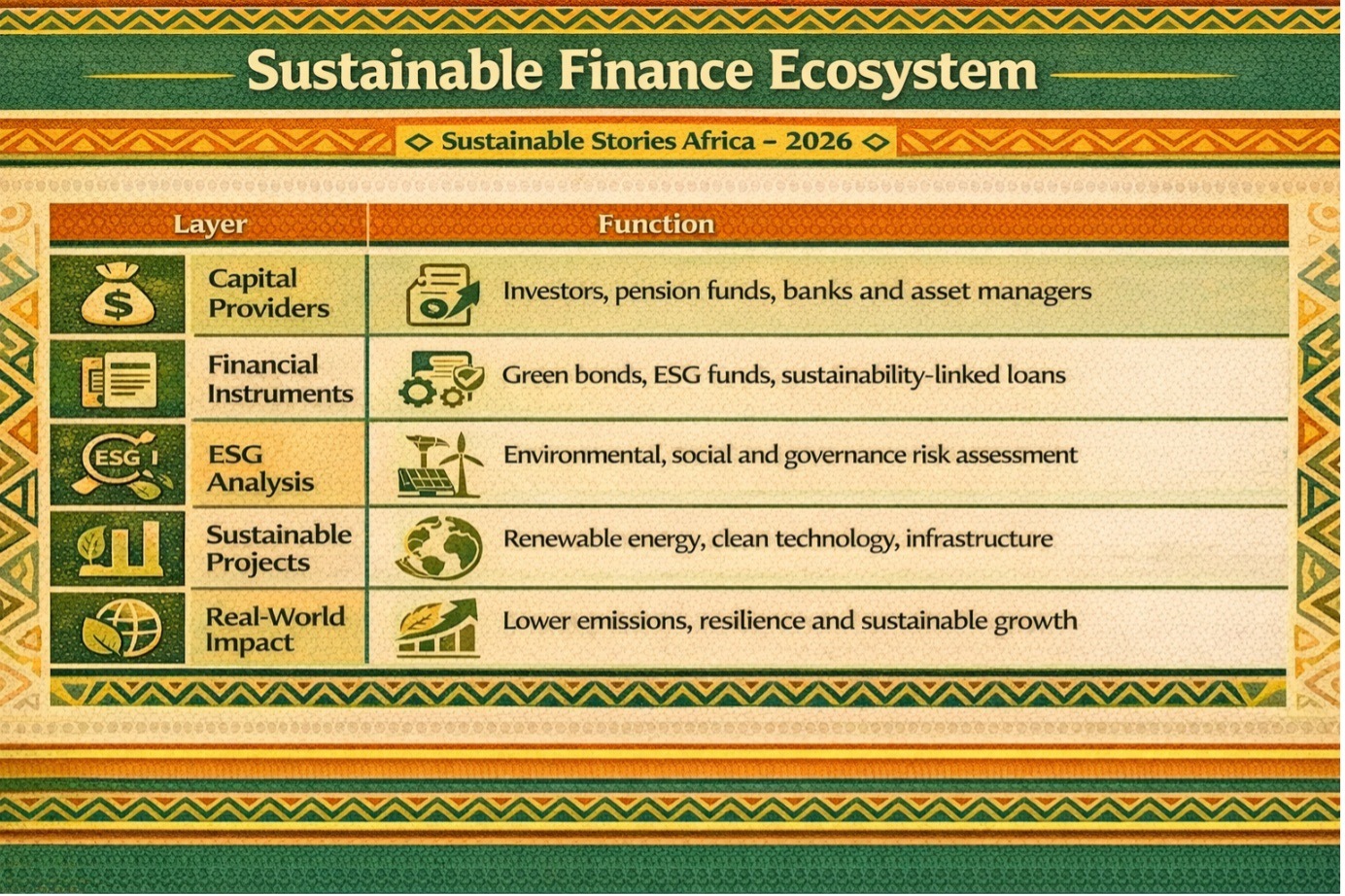
Sustainable finance operates through a layered framework that connects investors, financial instruments and real-world environmental outcomes.
The infographic in the uploaded document illustrates this structure as a multi-level ecosystem.
At the base are capital providers, including investors, pension funds, banks and asset managers, who supply the financial resources required to fund sustainability initiatives.
These resources flow through financial instruments such as green bonds, sustainability-linked loans, ESG investment funds and climate finance facilities.
Financial capital is then allocated to sustainable projects, including renewable energy, sustainable transportation systems, clean technology development and green infrastructure.
Ultimately, these investments produce real-world impacts such as lower greenhouse gas emissions, stronger climate resilience and sustainable economic growth.
Sustainable Finance Ecosystem
Layer | Function |
|---|---|
Capital Providers | Investors, pension funds, banks and asset managers |
Financial Instruments | Green bonds, ESG funds, sustainability-linked loans |
ESG Analysis | Environmental, social and governance risk assessment |
Sustainable Projects | Renewable energy, clean technology, and infrastructure |
Real-World Impact | Lower emissions, resilience and sustainable growth |
This layered approach ensures that capital allocation decisions incorporate environmental and social considerations alongside traditional financial metrics.
Sustainability, Green Finance and Climate Finance Explained
A major source of confusion in discussions of sustainable finance indicates the relationship among sustainability, green finance and climate finance.
The hierarchy diagram in the document clarifies the distinctions.
At the broadest level sits sustainability, a framework balancing environmental protection, social inclusion and economic performance to achieve long-term development.
Within this umbrella lies green finance, which specifically directs capital toward projects delivering measurable environmental benefits, such as renewable energy systems, pollution control initiatives and water management programmes.
Nested within green finance is climate finance, focused specifically on addressing climate change through mitigation and adaptation strategies.
Key focus areas include reducing greenhouse gas emissions, strengthening climate resilience and supporting low-carbon infrastructure development.
This hierarchy underscores an important point: sustainable finance extends beyond environmental objectives to incorporate social and governance considerations that strengthen long-term economic systems.
Climate Finance Expanding Global Investment Flows
Climate finance is emerging as one of the most dynamic segments of sustainable finance.
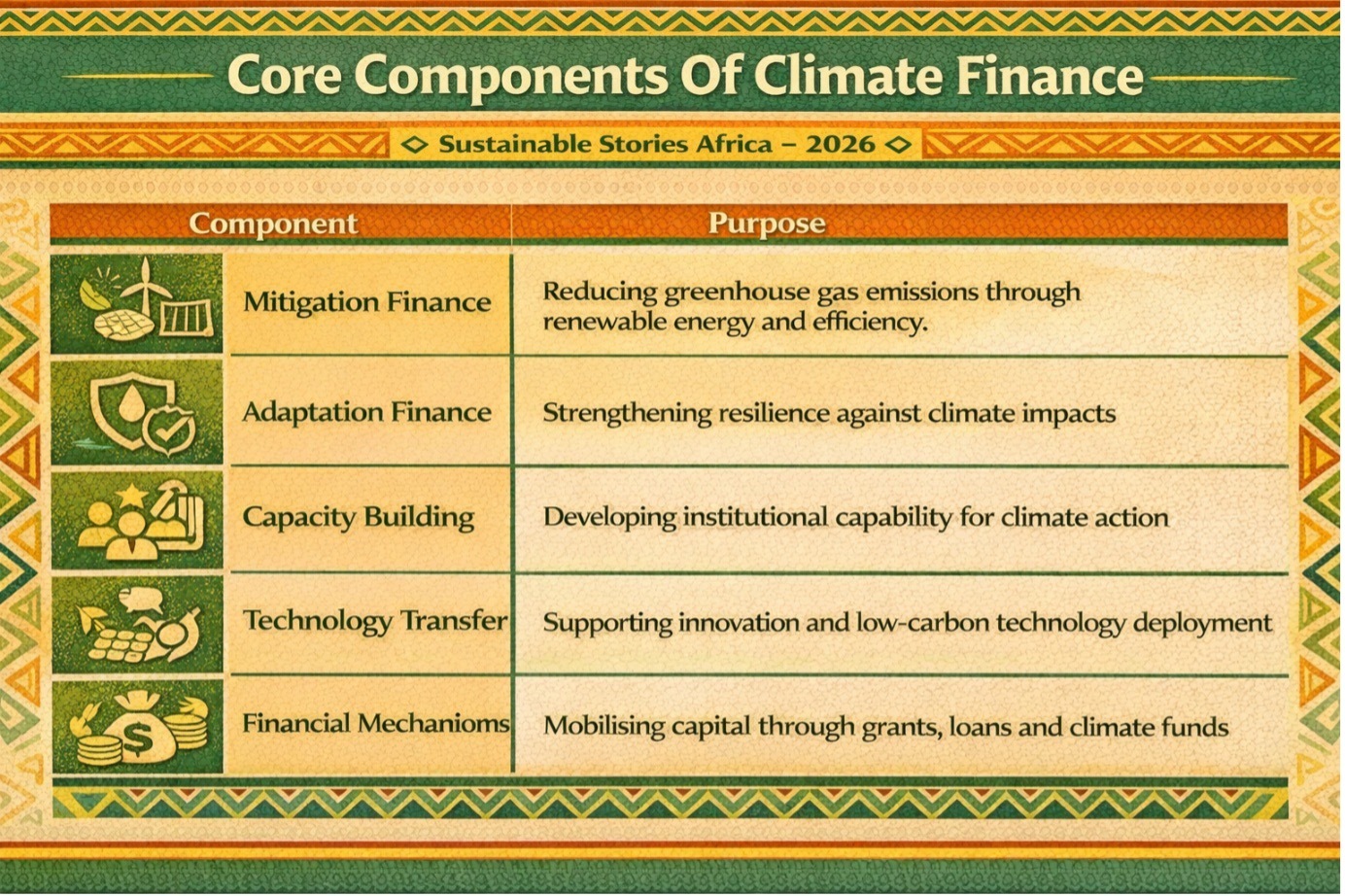
According to the infographic on page three of the uploaded file, climate finance encompasses financial resources mobilised to support activities that mitigate climate change or help societies adapt to its impacts.
The framework identifies several key components driving climate investment.
Core Components Of Climate Finance
Component | Purpose |
|---|---|
Mitigation Finance | Reducing greenhouse gas emissions through renewable energy and efficiency |
Adaptation Finance | Strengthening resilience against climate impacts |
Capacity Building | Developing institutional capability for climate action |
Technology Transfer | Supporting innovation and low-carbon technology deployment |
Financial Mechanisms | Mobilising capital through grants, loans and climate funds |
These financial flows are essential to achieving global climate targets and supporting the Sustainable Development Goals.
For emerging economies, climate finance also represents a pathway to accelerate infrastructure development while avoiding carbon-intensive growth models.
Why Sustainable Finance Matters For Africa
For African economies, sustainable finance represents both an economic necessity and a strategic opportunity.
The continent faces a significant financing gap in areas such as renewable energy deployment, climate-resilient agriculture and sustainable urban infrastructure.
Traditional public funding alone cannot meet these demands.
By mobilising capital through sustainable finance instruments, such as green bonds, sustainability-linked loans and climate investment funds, African countries can unlock new sources of long-term investment.
International investors are increasingly seeking opportunities aligned with ESG mandates, and Africa’s renewable energy potential and infrastructure needs position the continent as a key destination for sustainable capital.
However, unlocking this opportunity will require stronger regulatory frameworks, transparent ESG reporting standards and deeper capital markets capable of supporting sustainable investment flows.
Path Forward – Mobilising Capital For Climate-Resilient Economies
Sustainable finance must evolve from a specialised investment category into a central pillar of economic planning. Governments and financial institutions will need to strengthen ESG frameworks, improve disclosure standards and scale sustainable financial instruments.
In Africa, aligning capital markets with sustainability priorities could unlock transformative investment in energy systems, climate resilience and green infrastructure, towards improving economic growth while safeguarding environmental and social stability.