
Traditional financial statements have long been the backbone of corporate reporting; however, they capture only a fraction of what drives modern business value.
As investors increasingly scrutinise environmental, social and governance performance, organisations are under pressure to explain not just profits, but how those profits are created.
A growing global shift toward integrated reporting, bridging between financial results, sustainability performance, and long-term value creation, redefining how companies communicate strategy, risks and prospects.
Bridging Numbers And Narratives In Corporate Reporting
Financial statements remain the cornerstone of corporate disclosure. They tell investors how much a company earned, how assets were financed and where cash moved during the year.
However, in an economy increasingly driven by knowledge, relationships, innovation and environmental stewardship, the numbers alone rarely capture the full story.
That gap between financial performance and real business value is becoming more evident across global markets, especially as investors demand clarity on sustainability, governance and long-term resilience.
At a technical session hosted by the ICAN Ogba/Ojodu District Society, finance and risk expert Dr Olumuyiwa Adebayo JP argued that the future of corporate reporting lies in integrating financial data with broader indicators of value creation.
His presentation, “Bridging the Gap: Transforming Financial Statements into Integrated Reports,” highlighted how integrated reporting is reshaping how companies communicate strategy, risks and societal impact.
Financial Statements Reveal Performance But Miss Context
For more than five centuries, double-entry bookkeeping has structured how organisations measure success.
Modern financial statements, profit and loss, balance sheet, cash flow statement, equity changes and notes, remain essential tools for assessing financial performance.
However, Dr Adebayo noted that these reports primarily capture historical financial outcomes, leaving much of the real drivers of corporate value unexplained.
More than 80% of value drivers in modern businesses are not reflected in traditional financial statements, particularly intangible assets such as intellectual capital, brand reputation, employee capabilities and stakeholder relationships.
The result is a growing disconnect between reported earnings and the broader ecosystem that determines whether a company will thrive over the next decade.
Integrated reporting seeks to close that gap by linking financial results with strategy, governance, environmental performance and long-term prospects.
Integrated Reporting Connects Strategy, Risks, and Value
Integrated reporting (IR) emerged as a global framework designed to provide a more holistic narrative of corporate performance.
The International Integrated Reporting Council (IIRC) first introduced the IR framework in 2013, and adoption initiatives are now underway in more than 50 countries and by more than 2,600 companies worldwide producing integrated reports.
The framework emphasises how organisations create value across six interconnected capitals:
- Financial capital
- Manufactured capital
- Intellectual capital
- Human capital
- Social and relationship capital
- Natural capital
Traditional financial reporting captures only the first two, leaving the remaining four, often the most strategic, largely invisible.
“Financial statements answer what happened,” Dr Adebayo explained.
“Integrated reporting explains why it happened and what will happen next.”
This shift transforms corporate reporting from a compliance exercise into a strategic communication tool for investors and stakeholders.
Comparing Financial Reporting And Integrated Reporting Models
A critical distinction between traditional reporting and integrated reporting lies in scope and time horizon.
Financial Statements vs Integrated Reporting
Dimension | Financial Statements | Integrated Reporting |
|---|---|---|
Time Horizon | Historical performance | Past, present and outlook |
Capital Coverage | Financial capital primarily | All six capitals |
Primary Audience | Shareholders and creditors | All stakeholders |
Value Drivers | Tangible financial metrics | Tangible, intangible and ESG factors |
Narrative Depth | Limited notes and disclosures | Strategic narrative and business model |
Risk Coverage | Financial risks | Financial, operational and ESG risks |
Information Structure | Separate statements | Integrated and connected insights |
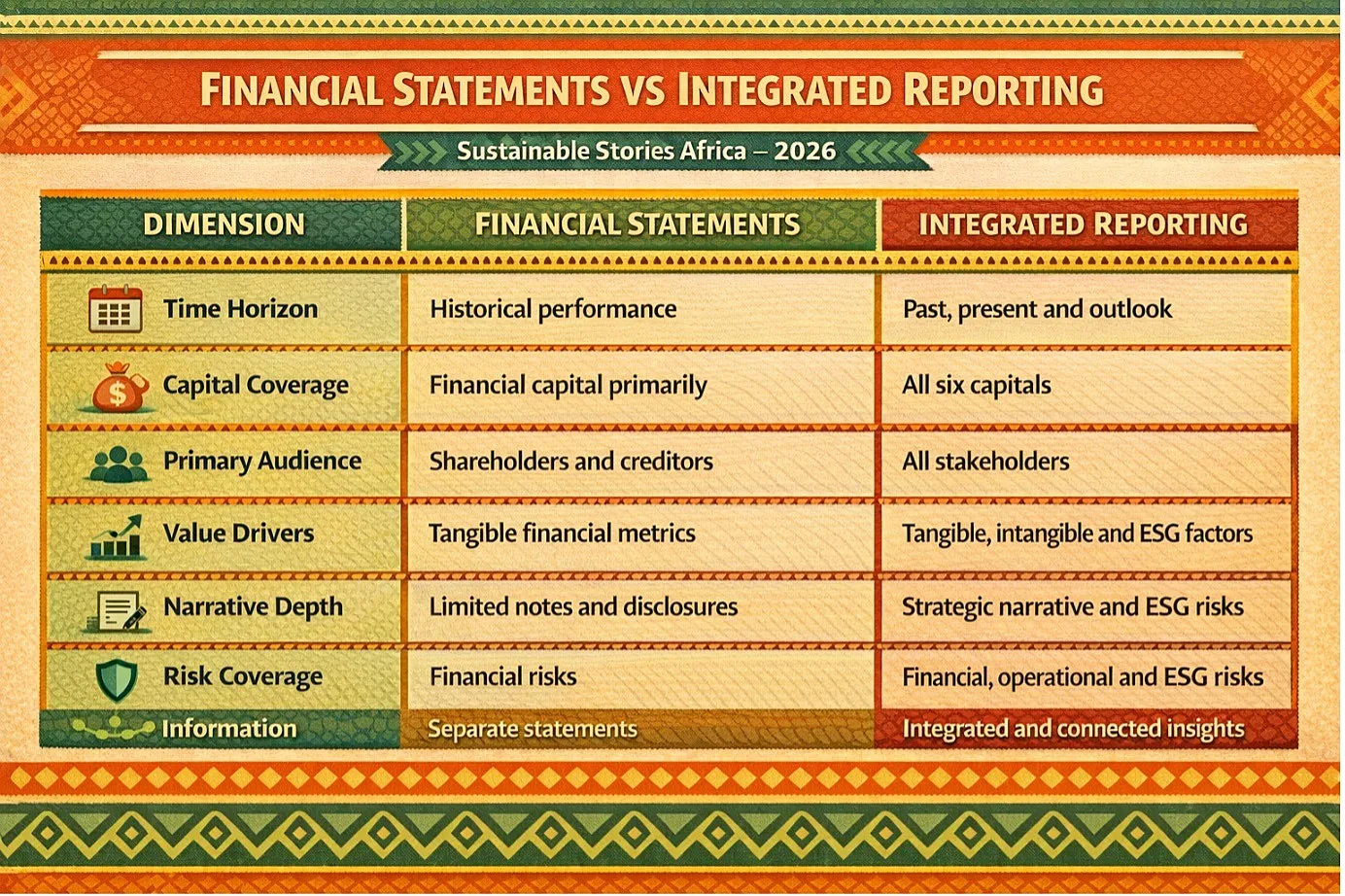
Integrated reporting also emphasises connectivity of information, enabling organisations to show how governance, strategy and resource allocation interact to generate sustainable value.
Five Phases For Transforming Corporate Reporting
Adopting integrated reporting requires a structured transformation process rather than a simple change in disclosure format.
Dr Adebayo outlined a five-phase roadmap organisations can follow to move from traditional reporting toward integrated thinking.
Transformation Roadmap Toward Integrated Reporting
Phase | Timeline | Key Activities |
|---|---|---|
Diagnose | Months 1 – 3 | Gap analysis, materiality assessment, benchmarking |
Design | Months 3 – 6 | IR framework design and six-capital KPIs |
Pilot | Months 6 – 12 | Internal integrated reporting and stakeholder testing |
Publish | Year 2 | Public IR launch with assurance and analyst engagement |
Embed | Year 3 and over | Institutionalising integrated thinking and metrics |
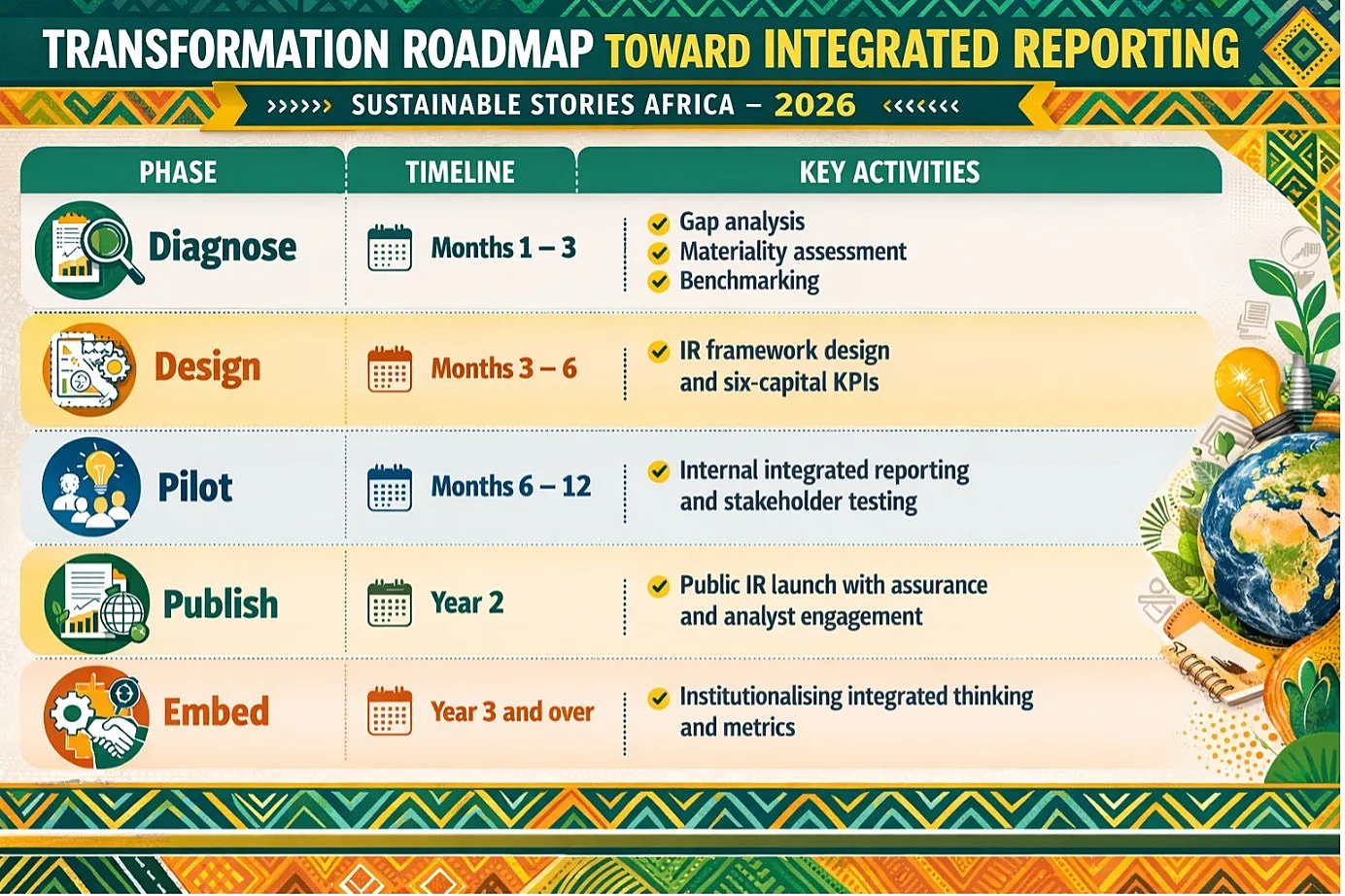
Beyond regulatory compliance, companies that adopt integrated reporting have recorded tangible financial benefits.
Research cited during the session shows that organisations implementing integrated reporting frameworks can experience:
- 23% lower cost of equity
- 17% improved analyst forecast accuracy
- 35% higher ESG investor interest
- 40% fewer investor information queries
These outcomes suggest that clearer communication of strategy and sustainability performance reduces information asymmetry between companies and investors.
PATH FORWARD – Nigeria’s Reporting Evolution Must Accelerate Now
Nigeria’s regulatory environment is gradually aligning with global sustainability disclosure frameworks. Guidelines issued by the Financial Reporting Council and ESG disclosure expectations from the Securities and Exchange Commission signal a shift toward more integrated forms of reporting.
For Nigerian corporates and finance professionals, the challenge is no longer whether integrated reporting will become standard practice, but how quickly organisations can develop the skills, systems and governance structures needed to implement it effectively.
SSA Insights
The transition from financial statements to integrated reporting reflects a broader transformation in how markets evaluate corporate performance.
Investors increasingly demand evidence that companies can create durable value, not just quarterly profits.
By linking financial outcomes with environmental stewardship, human capital development and stakeholder relationships, integrated reporting provides a more complete picture of organisational resilience.
As Dr Adebayo concluded during the session, the role of accountants is evolving alongside this shift.
“The accountant of tomorrow will not just count money, they will count what matters.”
And in a world where sustainability, governance and innovation increasingly determine corporate survival, that expanded perspective may define the next era of corporate reporting.