A new set of guidelines from global capital market regulators is redefining how high-emission industries access sustainable finance.
The question now is not whether transition finance will scale, but whether markets, especially in Africa, can align fast enough to turn guidance into capital flows.
Transition Finance Rules Meet Market Reality
The global sustainable finance landscape is entering a new phase. In November 2025, the International Capital Market Association (ICMA) released its Climate Transition Bond Guidelines, establishing a structured framework to finance decarbonisation in hard-to-abate sectors.
The move addresses a long-standing gap: while green bonds have funded renewable energy and low-carbon projects at scale, they have largely excluded sectors such as oil and gas, heavy industry, and transport, industries responsible for a significant share of global emissions.
By introducing a dedicated Climate Transition Bond (CTB) label, ICMA is signalling a shift from “green-only” finance to real-economy decarbonisation finance, particularly for sectors that cannot transition overnight.
For Africa and other emerging markets, where industrialisation and energy security remain central to development, this shift could redefine access to capital, if implemented with credibility and discipline.
$30 Trillion Gap Meets New Rules
The urgency is stark.
According to the ICMA framework, an estimated $30 trillion in additional capital is required to decarbonise key high-emission sectors. This represents approximately 40% of global greenhouse gas emissions by 2050 (page 4).
However, existing sustainable finance instruments have fallen short.
Green bonds have largely financed “already green” activities, renewables, green buildings, and clean transport, while leaving high-emission sectors underfunded in their transition journey.
The CTB Guidelines aim to correct this imbalance by:
- Creating a credible financing pathway for transition activities
- Introducing safeguards against greenwashing and carbon lock-in
- Expanding the role of capital markets in industrial decarbonisation
In effect, ICMA is reframing the question from “Is it green?” to “Is it transitioning credibly?”
What the New Guidelines Actually Change
At the core of the framework is a clear principle: transition finance must be credible, measurable, and aligned with long-term decarbonisation pathways.
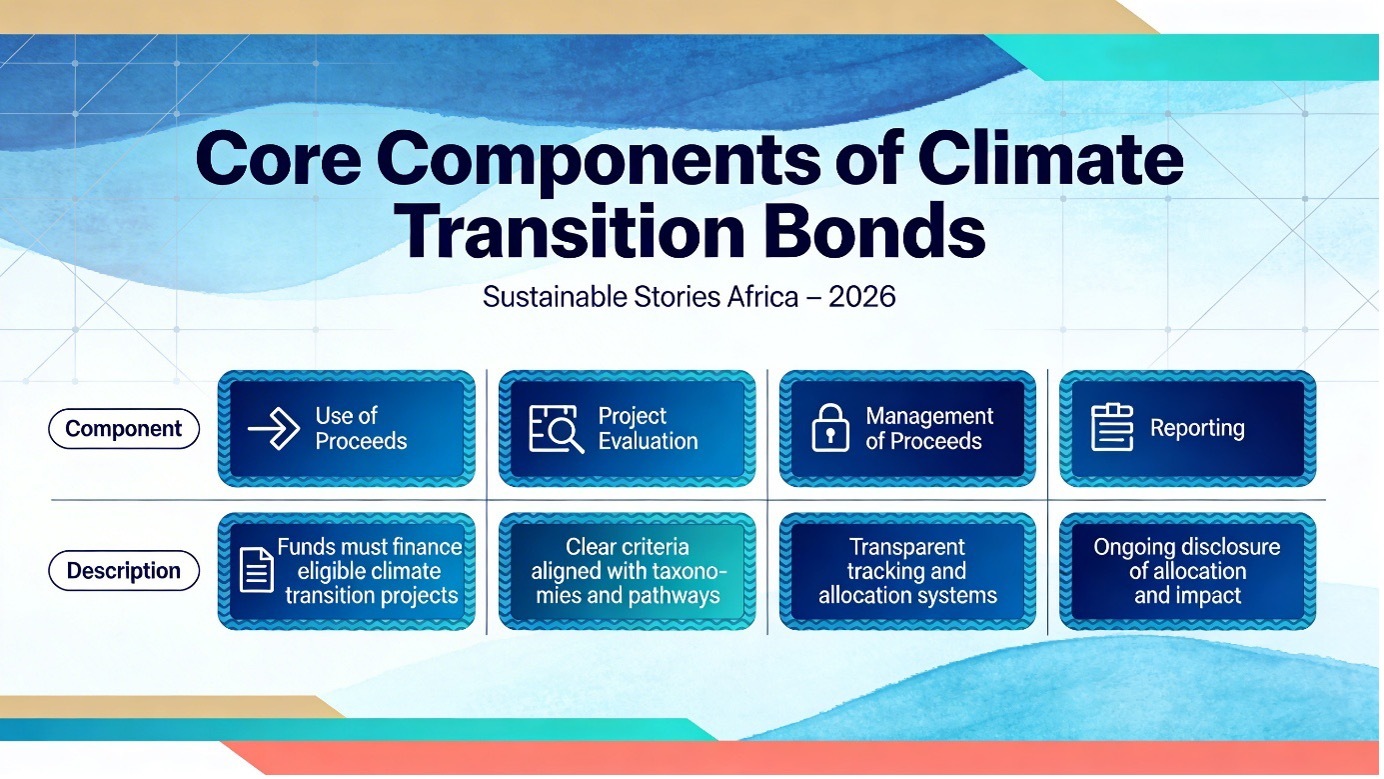
Core Components of Climate Transition Bonds
Component | Description |
|---|---|
Use of Proceeds | Funds must finance eligible climate transition projects |
Project Evaluation | Clear criteria aligned with taxonomies and pathways |
Management of Proceeds | Transparent tracking and allocation systems |
Reporting | Ongoing disclosure of allocation and impact |
- Defining “Transition Projects” – The Guidelines expand eligibility beyond traditional green assets.
As outlined on page 6, eligible projects include:
- Early retirement of high-emission infrastructure (e.g., coal plants)
- Fuel switching (e.g., coal to gas) with future low-carbon integration
- Carbon capture, utilisation, and storage (CCUS)
- Methane reduction and flaring abatement in oil and gas
- Development of lower-carbon fuels and industrial processes
This reflects a pragmatic recognition: transition pathways differ by sector, geography, and technological feasibility.
- Safeguards: Preventing Carbon Lock-In – One of the most critical features of the framework is its emphasis on avoiding carbon lock-in.
The Guidelines require issuers to demonstrate: (page 6–7)
- Alignment with decarbonisation pathways and taxonomies
- Evidence that low-carbon alternatives are not yet feasible
- Measurable emissions reductions beyond business-as-usual
- Disclosure of risks related to long-term fossil dependency
The diagram on page 12 further illustrates this transition logic, showing a spectrum from “significant harm” to “substantial contribution,” with “amber” transition activities positioned as intermediate steps toward green outcomes.
- Beyond Bonds: Linking to Sustainability Targets – The Guidelines also integrate Sustainability-Linked Bonds (SLBs) for high-emission issuers.
As highlighted on page 10, issuers are encouraged to:
- Define Key Performance Indicators (KPIs) tied to emissions reductions
- Align targets with science-based pathways
- Ensure independent validation of targets where possible
This introduces a dual model:
- Use-of-proceeds bonds (CTBs) → project-based transition
- SLBs → entity-wide transition commitments
Together, they create a more comprehensive transition finance ecosystem.
Unlocking Capital for Africa’s Transition
For African economies, the implications are significant.
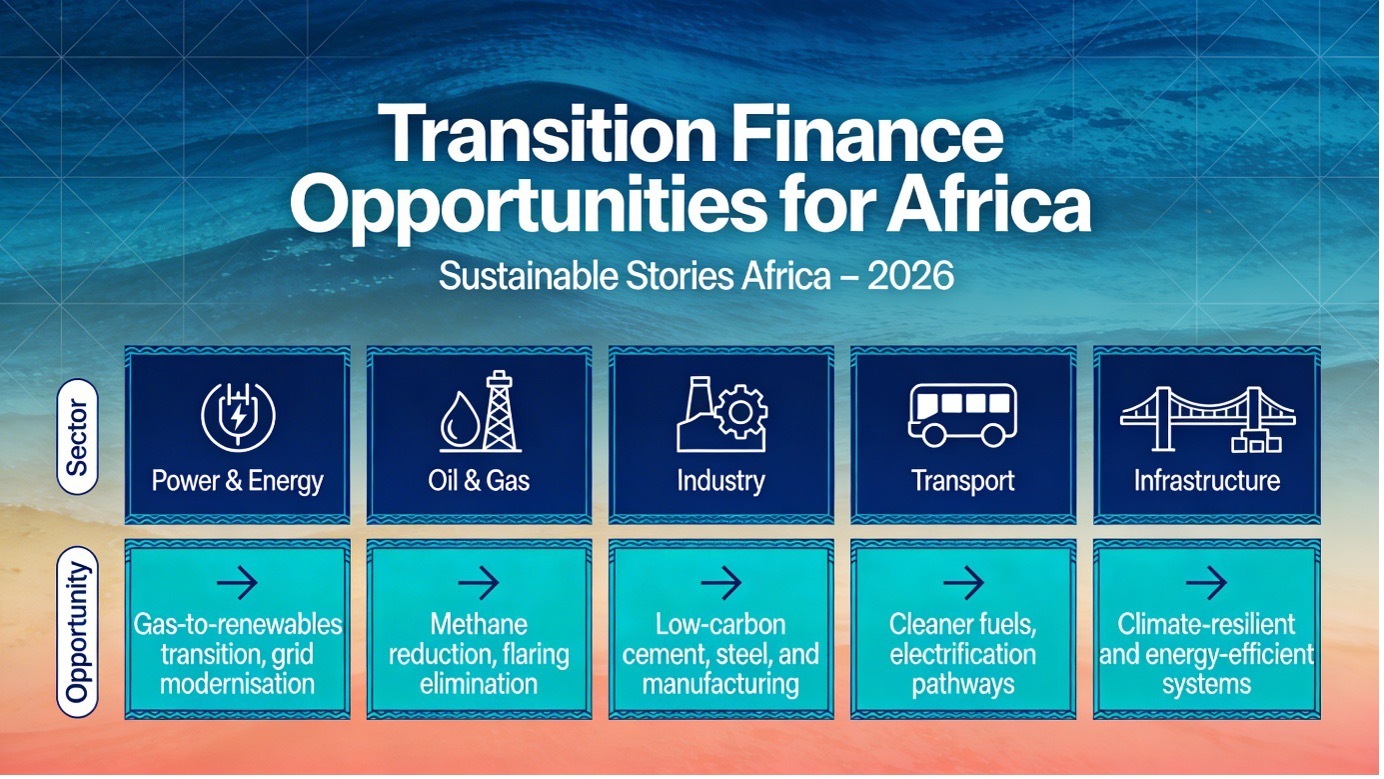
Transition Finance Opportunities for Africa
Sector | Opportunity |
|---|---|
Power & Energy | Gas-to-renewables transition, grid modernisation |
Oil & Gas | Methane reduction, flaring elimination |
Industry | Low-carbon cement, steel, and manufacturing |
Transport | Cleaner fuels, electrification pathways |
Infrastructure | Climate-resilient and energy-efficient systems |
The framework recognises that transition is not linear.
As shown in Annex 1 (pages 9–11), global taxonomies, from ASEAN to the EU, include “amber” categories to accommodate transitional activities.
For Africa, this means:
- Greater flexibility in financing pathways
- Increased investor confidence through standardisation
- Potential to attract blended finance and private capital
Critically, it allows African issuers to tell a more nuanced transition story, one that reflects developmental realities rather than rigid green classifications.
Turning Guidelines into Capital Flows
However, the Guidelines are voluntary, and implementation will determine impact.
Key Actions for Stakeholders
- Governments and Regulators
- Align national taxonomies with global transition frameworks
- Provide policy clarity on eligible transition activities
- Strengthen disclosure and verification standards
- Corporations and Issuers
- Develop credible transition strategies linked to CTBs
- Improve data systems for emissions tracking
- Engage external reviewers for credibility
- Financial Institutions
- Structure transition finance products aligned with CTBs
- Support pipeline development for eligible projects
- Integrate transition risk into credit frameworks
- Investors
- Demand transparency and science-based targets
- Differentiate credible transition strategies from greenwashing
- Allocate capital toward real-economy decarbonisation
The Guidelines emphasise that credibility hinges on transparency, alignment, and accountability, not labels alone.
Path Forward – From Guidance to Transformation
ICMA’s Climate Transition Bond Guidelines mark a decisive shift from exclusion to engagement, bringing high-emission sectors into the sustainable finance fold. But credibility will depend on rigorous implementation, transparent reporting, and alignment with global climate pathways.
For Africa, the opportunity is clear: translate guidance into investable pipelines, bridge the transition-finance gap, and position its industries not as laggards, but as active participants in the global net-zero transition.