Climate risk is no longer just about emissions; it is about the choices societies make.
Shared Socioeconomic Pathways are emerging as a critical tool for understanding how development trajectories shape climate outcomes, and why Africa’s policy decisions today could define its resilience tomorrow.
Future Pathways, Present Decisions Matter
Climate modelling is evolving, and with it, the way governments, investors, and businesses understand risk.
At the centre of this shift are Shared Socioeconomic Pathways (SSPs), a framework developed by global scientific bodies to map how different development choices shape emissions, economic growth, and climate outcomes.
Rather than focusing solely on emissions, SSPs combine economic growth patterns, population dynamics, technological progress, and policy decisions to create plausible future scenarios.
As outlined in the description on page 2, SSPs represent “future emissions and concentration scenarios that result from combining socio-economic development pathways with climate mitigation assumptions.”
For Africa, this framework offers a critical way to align development planning with climate resilience, bridging the gap between growth ambitions and sustainability realities.
Climate Outcomes Depend on Development Choices
The key insight behind SSPs is simple, but powerful.
Climate outcomes are not predetermined. They are shaped by how societies grow, invest, govern, and innovate.
The SSP framework identifies five broad pathways, each representing a different trajectory:
- Sustainable development
- Middle-of-the-road growth
- Fragmented, unequal development
- Fossil-fuel intensive growth
- Rapid technological transition
These pathways are then paired with emissions outcomes, expressed by radiative forcing levels by 2100, to form scenarios such as SSP1-1.9 or SSP3-7.0 (page 3).
In practical terms, SSPs answer a critical question:
What kind of world are we building, and what climate will that world create?
Breaking Down the SSP Scenarios
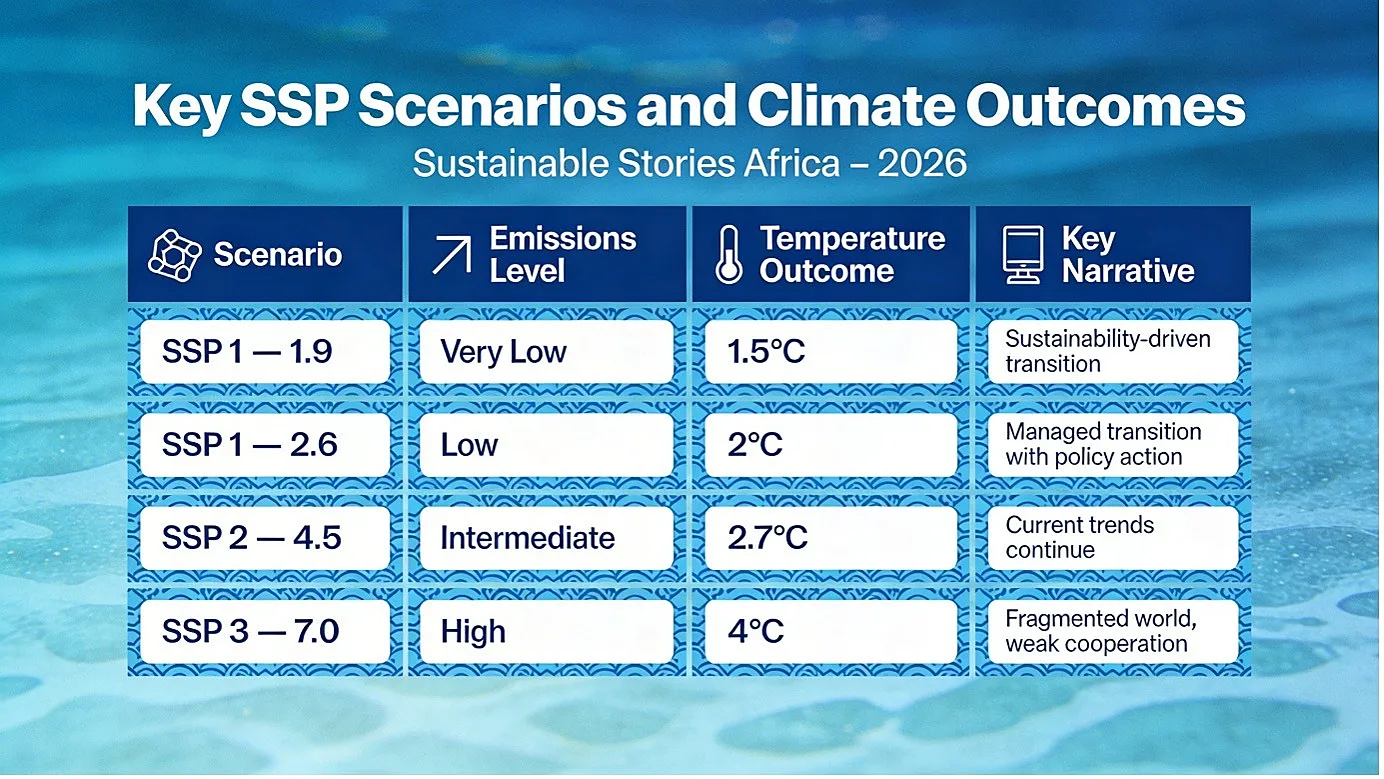
Key SSP Scenarios and Climate Outcomes
Scenario | Emissions Level | Temperature Outcome | Key Narrative |
|---|---|---|---|
SSP 1 - 1.9 | Very Low | 1.5°C | Sustainability-driven transition |
SSP 1 - 2.6 | Low | 2°C | Managed transition with policy action |
SSP 2 - 4.5 | Intermediate | 2.7°C | Current trends continue |
SSP 3 - 7.0 | High | 4°C | Fragmented world, weak cooperation |
What the Scenarios Reveal
The visual on page 4 highlights SSP 1 - 1.9 as the most ambitious pathway, limiting warming to approximately 1.5°C, with net-zero emissions achieved around mid-century.
By contrast, the scenario on page 7 (SSP 3 - 7.0) projects a fragmented world with minimal climate policy, where emissions could double by 2100, leading to 4°C warming.
Between these extremes lies SSP 2 - 4.5, the “middle-of-the-road” scenario, where emissions remain relatively stable until mid-century, resulting in approximately 2.7°C warming (page 6).
Why SSPs Matter for Business and Policy
SSPs are increasingly being integrated into:
- Corporate climate risk assessments (IFRS S2 alignment)
- Financial stress testing and scenario analysis
- National climate policy and NDC planning
The framework allows decision-makers to:
- Model physical risks (floods, heatwaves, droughts)
- Assess transition risks (policy shifts, carbon pricing)
- Identify investment opportunities in low-carbon sectors
For African economies, this is particularly relevant.
Many countries face dual pressures: accelerating development while managing climate vulnerability.
A Strategic Tool for Africa’s Development
SSPs offer more than analysis; they provide a roadmap.
SSP Implications for African Markets
Area | Opportunity Under Low-Emission Pathways |
|---|---|
Energy | Expansion of renewables and grid resilience |
Agriculture | Climate-smart farming and food security |
Infrastructure | Resilient urban and transport systems |
Finance | Growth in green and transition finance |
Employment | New jobs in clean energy and adaptation sectors |
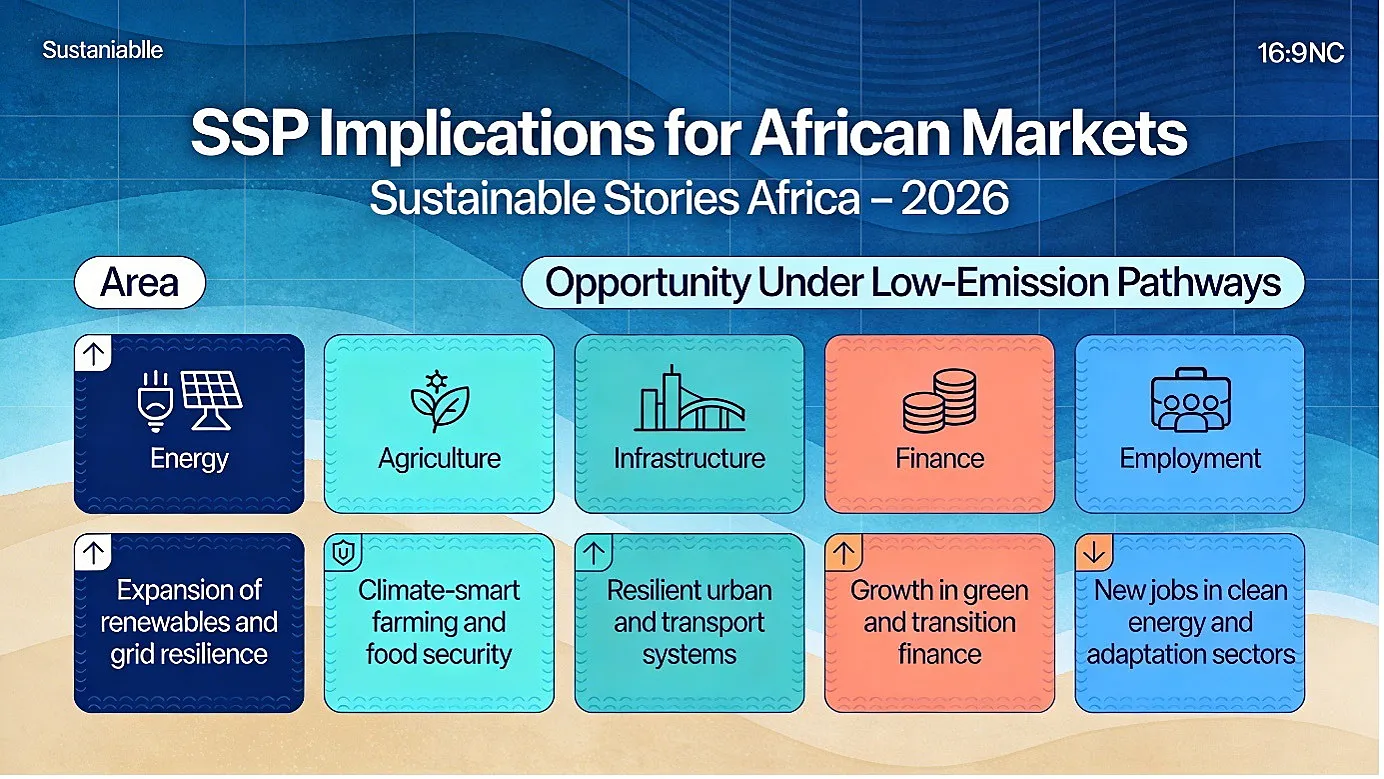
Under sustainable pathways (SSP1), Africa could:
- Leapfrog into clean energy systems
- Reduce reliance on fossil fuels and diesel generators
- Attract climate-aligned investment flows
- Build resilient cities and infrastructure
Conversely, under high-emission pathways (SSP3), the risks are severe:
- Increased climate shocks
- Rising adaptation costs
- Slower economic growth
- Greater inequality
The difference between these futures is not theoretical; it is policy-driven and investment-dependent.
Turning Scenarios into Strategy
The SSP framework is only as powerful as its application.
Key Actions for Stakeholders
- Governments
- Integrate SSP scenarios into national development plans
- Align NDCs with low-emission pathways
- Invest in climate-resilient infrastructure
- Corporates
- Conduct scenario analysis aligned with SSPs
- Stress-test business models under different climate futures
- Align capital allocation with transition pathways
- Financial Institutions
- Incorporate SSPs into risk modelling and portfolio strategy
- Develop financing instruments for adaptation and transition
- Support blended finance initiatives
- Development Partners
- Provide technical support for SSP-based planning
- Scale funding for climate resilience projects
- Facilitate knowledge transfer and capacity building
As the framework underscores, the goal is not prediction, but preparedness.
Path Forward – From Scenarios to Decisions
Shared Socioeconomic Pathways are redefining climate strategy, shifting the focus from abstract targets to real-world development choices. For Africa, they offer a powerful lens to align growth, resilience, and investment.
The challenge now is execution. Translating scenarios into policy, finance, and infrastructure decisions will determine whether Africa’s future aligns with sustainable pathways, or faces the escalating costs of inaction.