
As ESG regulation tightens globally, companies are under pressure to understand not only how sustainability affects their finances but also how their activities affect society and the environment.
A growing number of firms are employing double materiality assessments, a structured approach that connects impact with financial risk, reshaping how African businesses define value, risk, and long-term competitiveness.
Rethinking Value Through Double Materiality
Double materiality is rapidly moving from a compliance concept to a strategic imperative. For African companies navigating global ESG expectations, it offers a structured way to understand both financial exposure and real-world impact.
At its core, the approach asks two critical questions: how do environmental and social issues affect a company’s performance, and how does the company itself affect people and the planet?
This dual lens is becoming central to frameworks such as EU sustainability reporting and emerging global standards.
For African markets, the stakes are even higher. As trade rules tighten and investors demand transparency, double materiality provides a pathway to align local realities, jobs, communities, and ecosystems with global ESG expectations and capital flows.
From ESG Reporting to Strategic Risk Management
“Most ESG impacts occur beyond direct operations.” This insight, highlighted in the guide (page 3), captures the urgency of double materiality.
Companies can no longer limit ESG thinking to internal compliance. Instead, they must assess:
- Upstream supplier risks
- Downstream customer impacts
- Community and ecosystem effects
This shift is being driven by:
- Global regulations (e.g., CSRD, CBAM)
- Investor demand for decision-useful ESG data
- Rising exposure to climate and social risks
In effect, ESG is no longer a reporting exercise; it is a risk-management and value creation system.
How Double Materiality Works in Practice
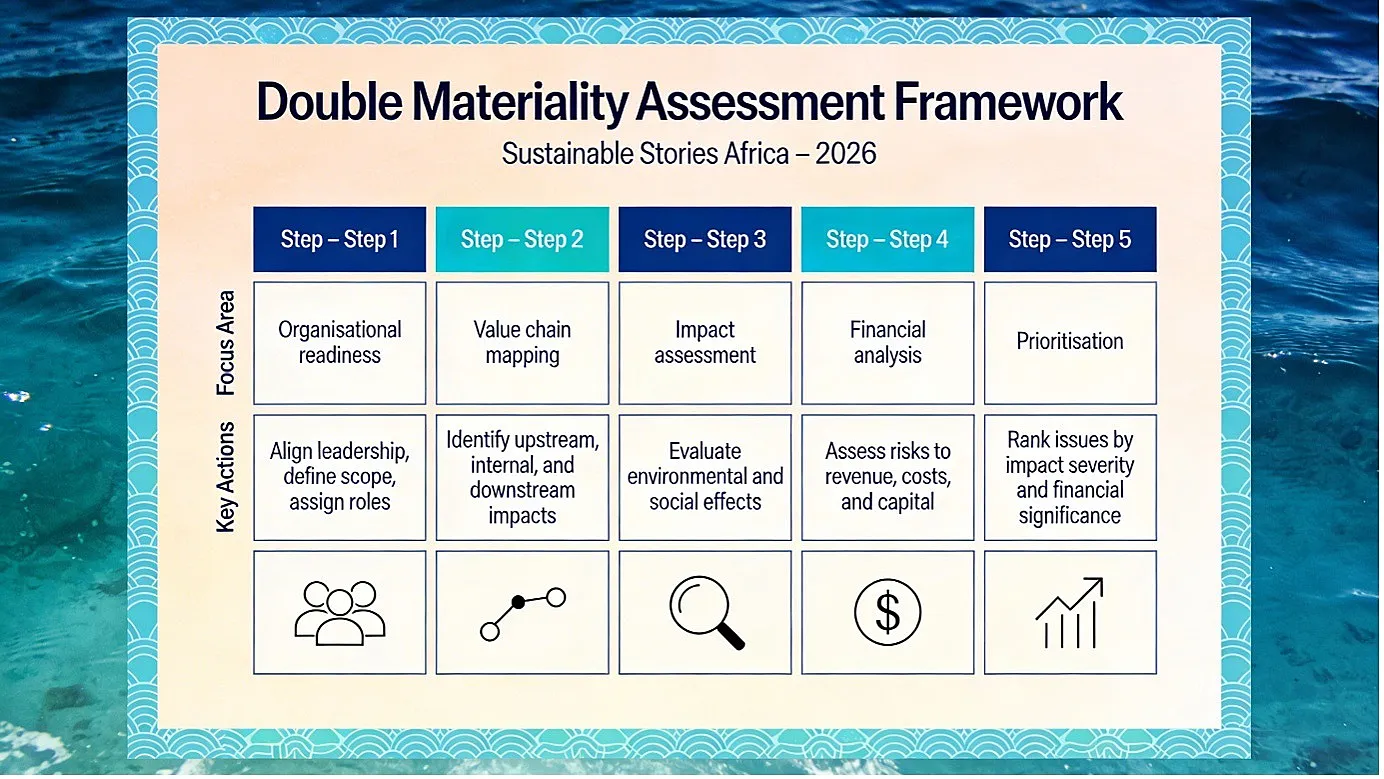
The guide outlines a five-step framework for implementing double materiality, transforming a complex concept into an operational process.
Double Materiality Assessment Framework
Step | Focus Area | Key Actions |
|---|---|---|
Step 1 | Organisational readiness | Align leadership, define scope, assign roles |
Step 2 | Value chain mapping | Identify upstream, internal, and downstream impacts |
Step 3 | Impact assessment | Evaluate environmental and social effects |
Step 4 | Financial analysis | Assess risks to revenue, costs, and capital |
Step 5 | Prioritisation | Rank issues by impact severity and financial significance |
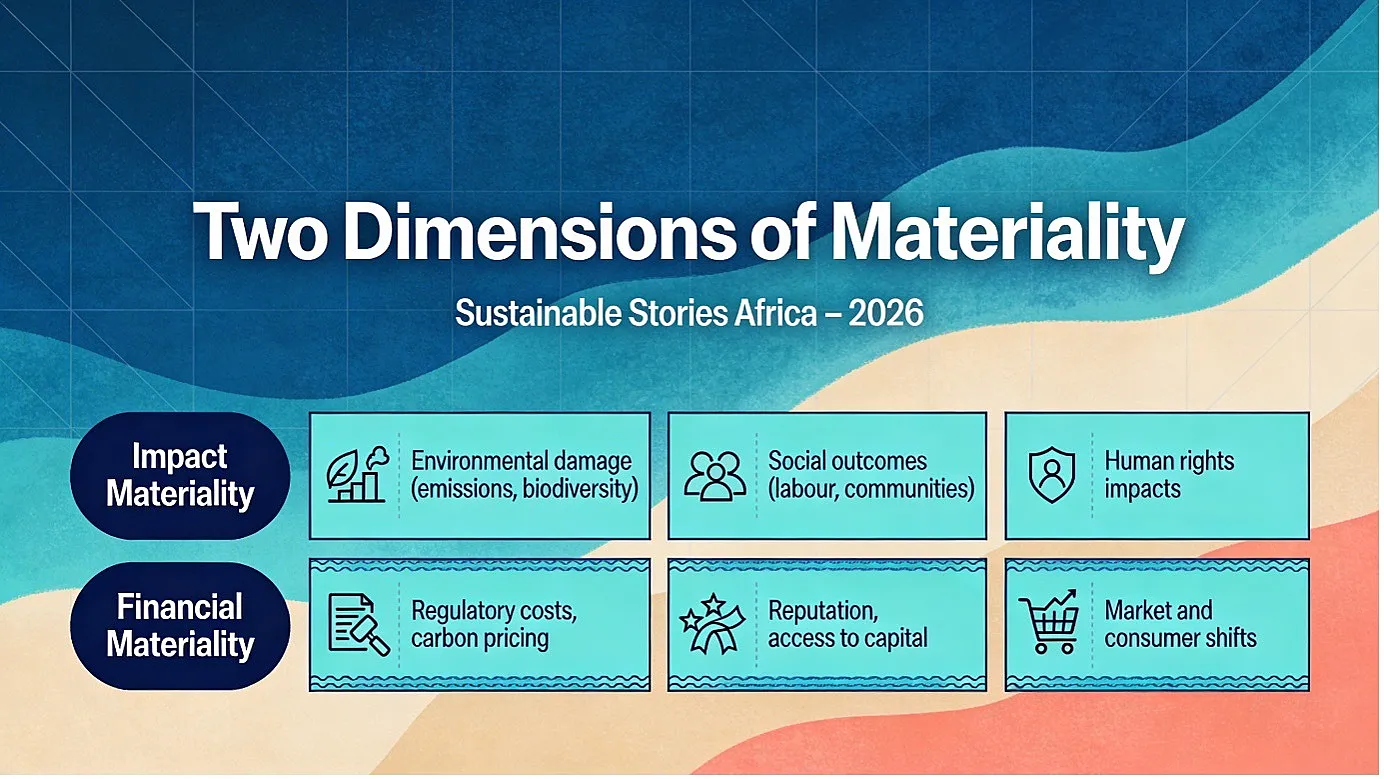
Two Dimensions of Materiality
Impact Materiality | Financial Materiality |
|---|---|
Environmental damage (emissions, biodiversity) | Regulatory costs, carbon pricing |
Social outcomes (labour, communities) | Reputation, access to capital |
Human rights impacts | Market and consumer shifts |
On page 4, the guide emphasises evaluating both positive and negative impacts, reinforcing that ESG is not only about risk mitigation but also about opportunity identification.
Meanwhile, page 5 highlights financial exposure areas such as:
- Regulatory changes
- Climate disruptions
- Market shifts
- Reputation risks
- Access to finance
This dual lens enables companies to connect sustainability directly to financial performance and resilience.
What Double Materiality Unlocks for African Markets
When effectively implemented, double materiality delivers more than compliance—it becomes a strategic advantage.
- For Businesses
- Better risk identification and mitigation
- Improved capital access, especially ESG-linked finance
- Stronger reputation and stakeholder trust
- For Investors
- Clearer insight into long-term value drivers
- More reliable non-financial disclosures
- For Communities
- Increased accountability for environmental and social outcomes
- Greater alignment between corporate activity and local development needs
Critically, the prioritisation step (page 6) ensures that companies focus on “high impact and high financial risk” issues first, guiding resource allocation and strategy.
For African economies, this could mean aligning ESG priorities with:
- Job creation
- Energy transition
- Climate resilience
- Inclusive growth
The opportunity is clear: firms that integrate double materiality early will be better positioned in global value chains and capital markets.
What Companies Must Do Next
The transition to double materiality requires deliberate, system-level changes.
- Leadership Alignment
- Embed ESG into board and executive decision-making
- Treat sustainability as a core strategic function
- Build Cross-Functional Teams
- Integrate sustainability, finance, and risk units
- Break down silos across departments
- Strengthen Data Systems
- Invest in ESG data collection and analytics
- Ensure traceability across value chains
- Engage Stakeholders Actively
- Include employees, communities, and investors in assessments
- Build legitimacy and trust
- Link ESG to Financial Strategy
- Align material issues with capital allocation and risk frameworks
- Integrate into enterprise risk management (ERM)
- Prioritise and Act
- Focus on high-impact, high-risk areas
- Translate insights into measurable actions and disclosures
The message is clear: double materiality is not a one-off exercise; it is an ongoing strategic process.
PATH FORWARD – From Compliance to Competitive Advantage
Double materiality will define the next phase of ESG in Africa. Companies that align impact with financial risk will gain credibility, attract capital, and strengthen resilience.
The priority now is execution, building systems, aligning leadership, and embedding ESG into core strategy, ensuring businesses focus on what truly matters for both society and long-term value creation.