As ESG compliance tightens globally, African markets are finding practical answers in circular economy models. The “10 R’s of Circularity” are emerging not just as sustainability principles, but as strategic tools for cost efficiency, resilience, and regulatory alignment.
The real question is no longer whether African firms can comply, but whether circularity can become their competitive edge in a fast-evolving global economy.
Circularity Becomes Africa’s Strategic Advantage
Africa’s ESG journey is entering a decisive phase. As global sustainability standards tighten, companies across the continent are being forced to rethink how they produce, consume, and manage resources.
What was once a compliance exercise is now becoming a question of survival and competitiveness.
At the centre of this transition lies a powerful framework: the 10 R’s of Circularity; Rethink, Refuse, Reduce, Reuse, Repair, Refurbish, Remanufacture, Repurpose, Recycle, and Recover.
These principles are increasingly being adopted as practical pathways to meet ESG expectations while addressing local economic realities.
From Lagos to Nairobi, and Johannesburg to Accra, circularity is no longer theoretical.
It is becoming operational, reshaping supply chains, redefining value creation, and positioning African firms to navigate the complex intersection of global rules and local realities.
The ESG Pressure is Real, But So is the Opportunity
African companies face a dual pressure: comply with global ESG frameworks or risk exclusion from international capital and trade markets.
However, compliance costs remain high, data gaps persist, and infrastructure constraints slow progress.
This is where circularity is gaining traction, not as an abstract sustainability concept, but as a pragmatic response.
The 10 R’s of Circularity offer a structured, scalable approach to ESG integration:
Instead of focusing solely on reporting emissions or disclosures, the framework shifts attention to resource efficiency, waste minimisation, and lifecycle value creation, areas where African markets can innovate rapidly.
Breaking Down the 10 R’s in an African Context
The 10 R’s are not equal in impact or feasibility. In African markets, their relevance varies across sectors and value chains.
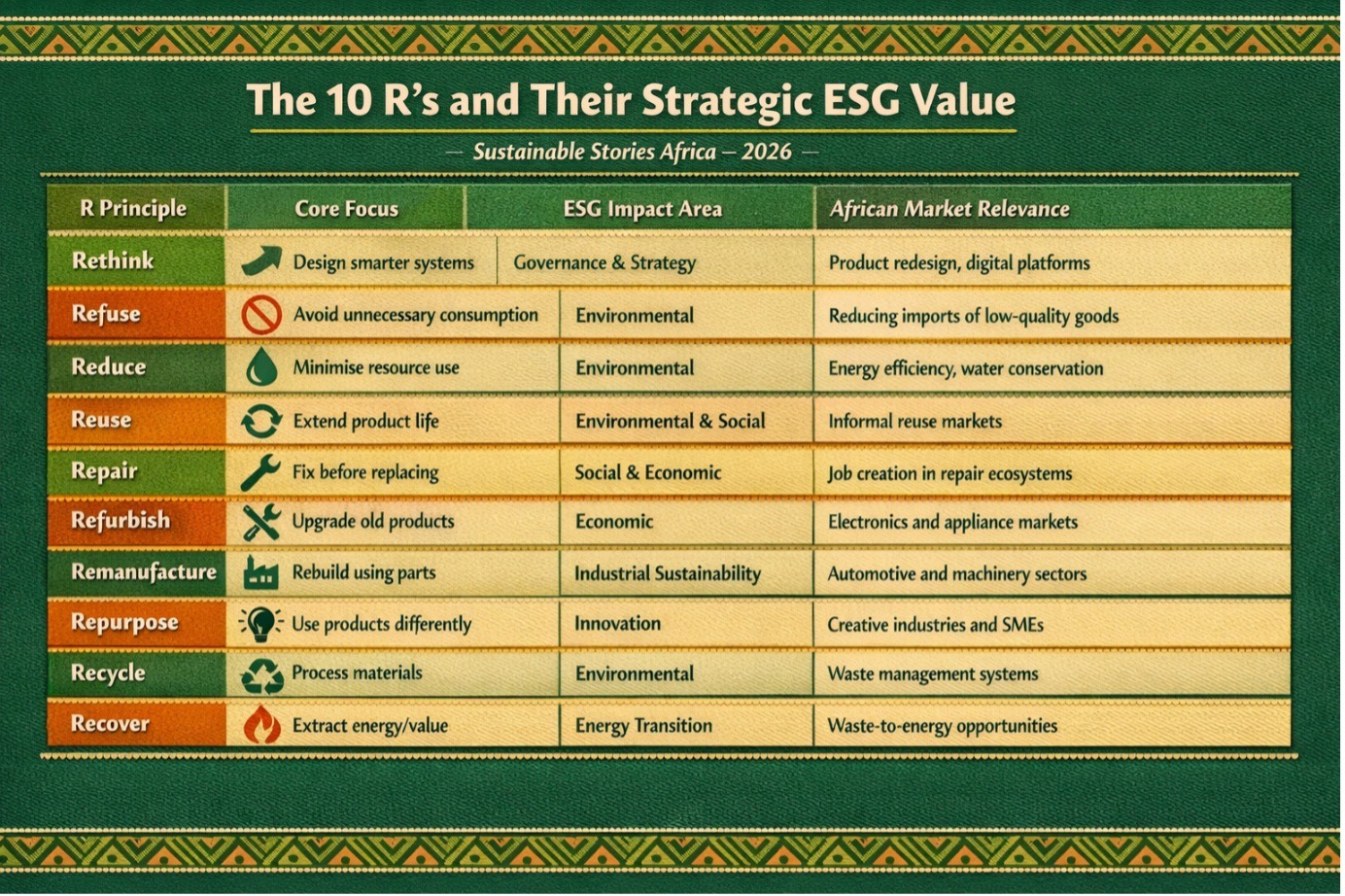
The 10 R’s and Their Strategic ESG Value
R Principle | Core Focus | ESG Impact Area | African Market Relevance |
|---|---|---|---|
Rethink | Design smarter systems | Governance & Strategy | Product redesign, digital platforms |
Refuse | Avoid unnecessary consumption | Environmental | Reducing imports of low-quality goods |
Reduce | Minimise resource use | Environmental | Energy efficiency, water conservation |
Reuse | Extend product life | Environmental & Social | Informal reuse markets |
Repair | Fix before replacing | Social & Economic | Job creation in repair ecosystems |
Refurbish | Upgrade old products | Economic | Electronics and appliance markets |
Remanufacture | Rebuild using parts | Industrial Sustainability | Automotive and machinery sectors |
Repurpose | Use products differently | Innovation | Creative industries and SMEs |
Recycle | Process materials | Environmental | Waste management systems |
Recover | Extract energy/value | Energy Transition | Waste-to-energy opportunities |
A System Already in Motion
Unlike many developed economies, Africa already operates informal circular systems, from repair markets in Alaba International Market (Nigeria) to second-hand economies across East Africa.
This creates a unique advantage: circularity in Africa is both organic and scalable.
Sector-Level Momentum
- Manufacturing – Firms are adopting remanufacturing and recycling to manage input costs
- Retail & FMCG – Reuse and refill models are gaining traction
- Energy – Recovery models (waste-to-energy) are emerging in urban centres
- Technology – Refurbished electronics markets are expanding rapidly
The Business Case for Circularity
If scaled effectively, the 10 R’s can unlock significant economic and ESG value.
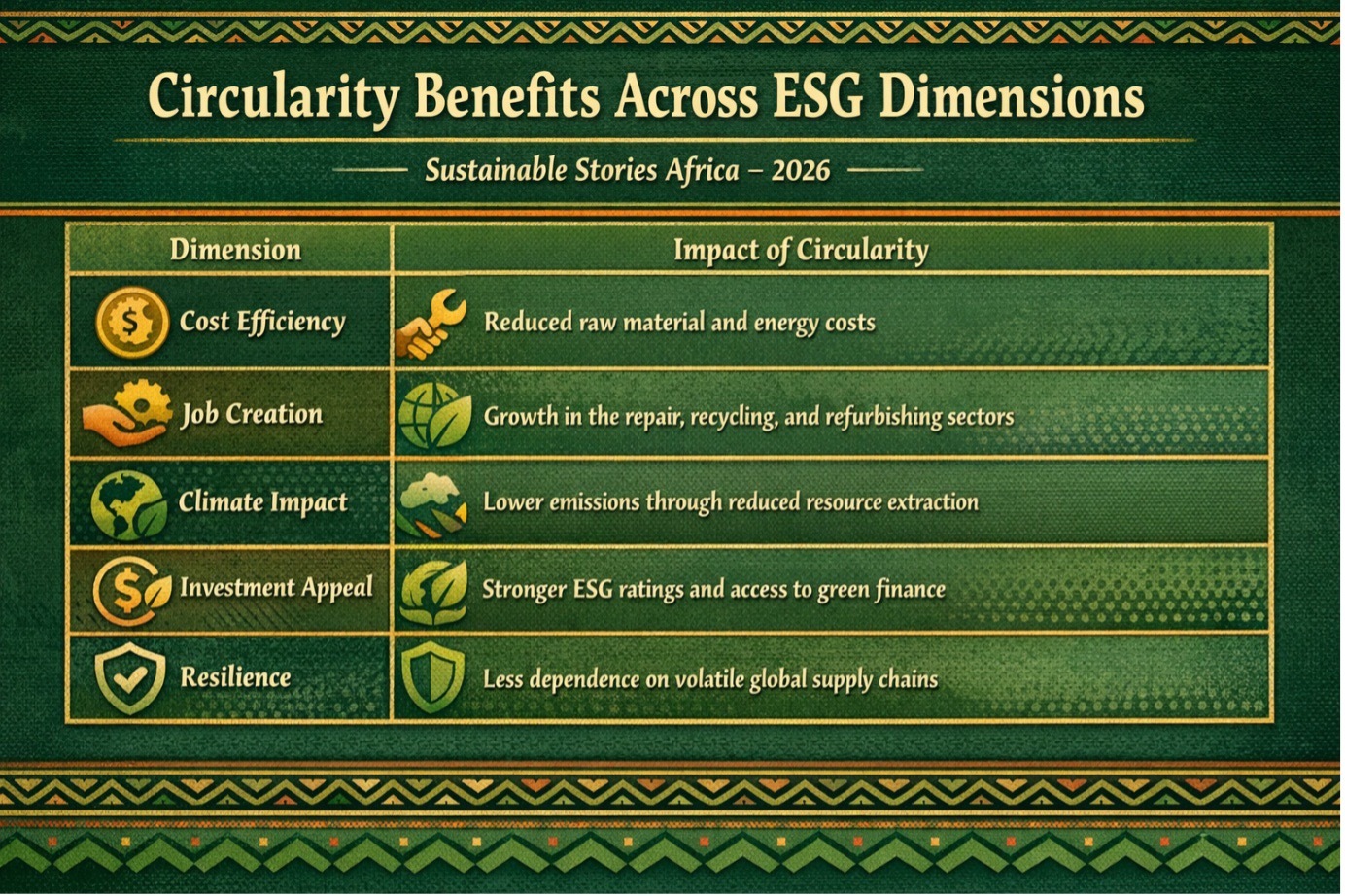
Circularity Benefits Across ESG Dimensions
Dimension | Impact of Circularity |
|---|---|
Cost Efficiency | Reduced raw material and energy costs |
Job Creation | Growth in the repair, recycling, and refurbishing sectors |
Climate Impact | Lower emissions through reduced resource extraction |
Investment Appeal | Stronger ESG ratings and access to green finance |
Resilience | Less dependence on volatile global supply chains |
From Compliance Burden to Competitive Advantage
Circularity reframes ESG:
- From reporting → to operational transformation
- From cost → to value creation
- From obligation → to innovation
For African firms, this is critical. Instead of struggling to “catch up” with global standards, circular models allow them to leapfrog into sustainable production systems.
Scaling the 10 R’s Across African Economies
To fully realise the potential of circularity, coordinated action is required:
- Policy Alignment – Governments must embed circular economy principles into national ESG frameworks, industrial policies, and climate strategies.
- Infrastructure Investment – Recycling systems, waste collection networks, and energy recovery facilities require significant capital.
- Formalisation of Informal Systems – Recognising and integrating informal sector actors, repairers, recyclers, traders, into formal value chains.
- Corporate Integration – Businesses must shift from linear “take-make-dispose” models to circular design and operations.
- Financing Mechanisms – Blended finance, ESG-linked loans, and green bonds can support circular transitions.
Path Forward – Circularity as Africa’s ESG Playbook
The 10 R’s offer more than a sustainability checklist; they represent a practical roadmap for aligning ESG compliance with economic growth.
By embedding circularity into policy, business models, and investment strategies, African markets can turn global ESG pressure into a catalyst for innovation and resilience.
The future of ESG in Africa will not be imported; it will be built locally, through circular systems that reflect the continent’s realities and opportunities.