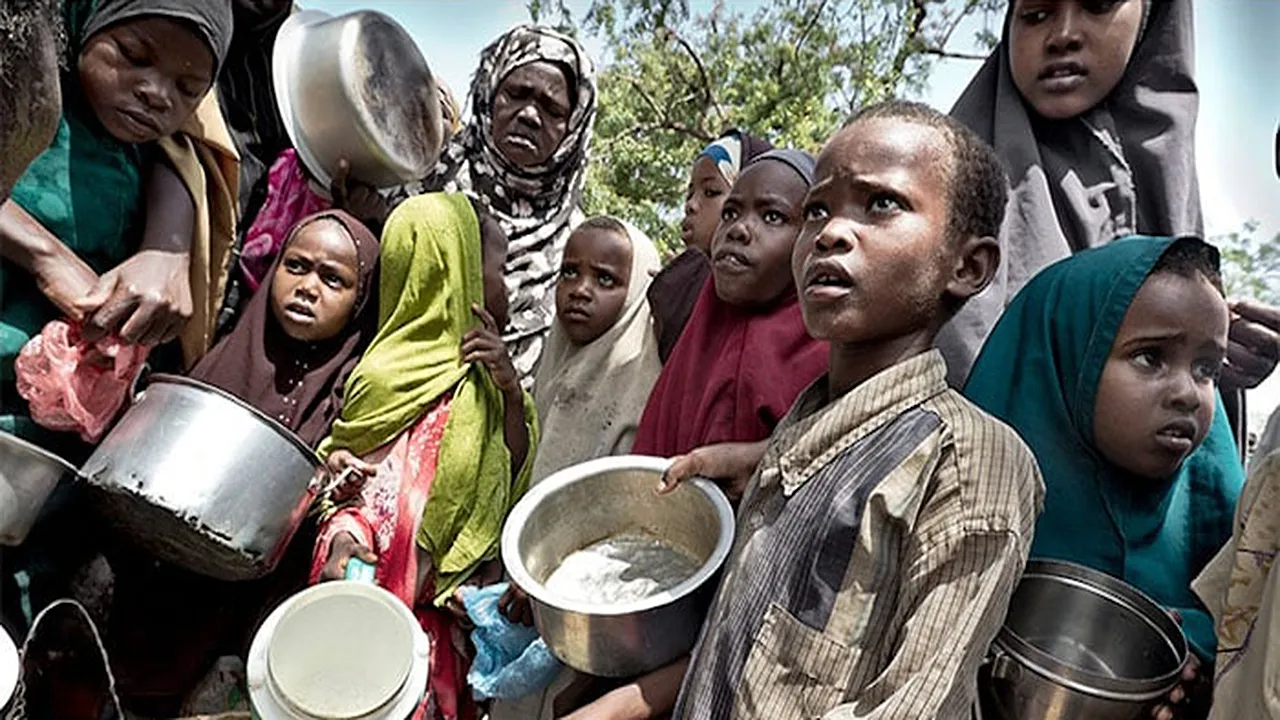
FAO’s March 2026 external-assistance list shows Africa carrying most of the world’s sharpest food-security emergencies, with conflict, climate shocks and price stress now colliding across the continent.
The deeper question is no longer whether aid is needed, but whether governments and markets can convert repeated warnings into stronger local food systems before dependence becomes structural.
Aid Dependence Exposes Africa’s Food-System Faultlines
The Food and Agriculture Organisation’s latest GIEWS external-assistance watchlist is blunt: countries on the list “are expected to lack the resources to deal with reported critical problems of food insecurity”.
In the March 2026 edition, FAO counts 41 countries that require external food assistance.
By Sustainable Stories Africa’s count, 31 of those 41 countries are in Africa - roughly three in every four cases on the FAO list.
That concentration matters for investors, development financiers, food traders, humanitarian agencies and policymakers because it signals that Africa’s food-security challenge is no longer episodic. It is increasingly systemic.
The stakes are immediate. Nigeria alone has 27.2 million people estimated to face severe acute food insecurity; the Democratic Republic of the Congo has 26.6 million; Sudan has 19.1 million; and South Sudan’s burden reaches 53% of the analysed population.
Kenya is a new result of drought conditions and high food prices.
Africa now carries the heaviest load
The headline number is not just that Africa dominates the list; it is how the crises are compounding.
In Sudan, conflict, displacement and food prices are converging at a famine-risk scale.
In Somalia, drought and insecurity are driving severe acute food insecurity for 6.5 million people.
In South Sudan, floods, insecurity and economic deterioration are pulling more than half of the analysed population into crisis conditions.
This is not a single-shock story. It is a story of a multi-shock system that results from failed rains reducing harvests, conflict closing markets, inflation weakening purchasing power, and displacement stripping households of the very assets they need to recover.
Across the FAO list, the same pattern keeps returning fewer buffers, weaker resilience, and deeper external dependence.
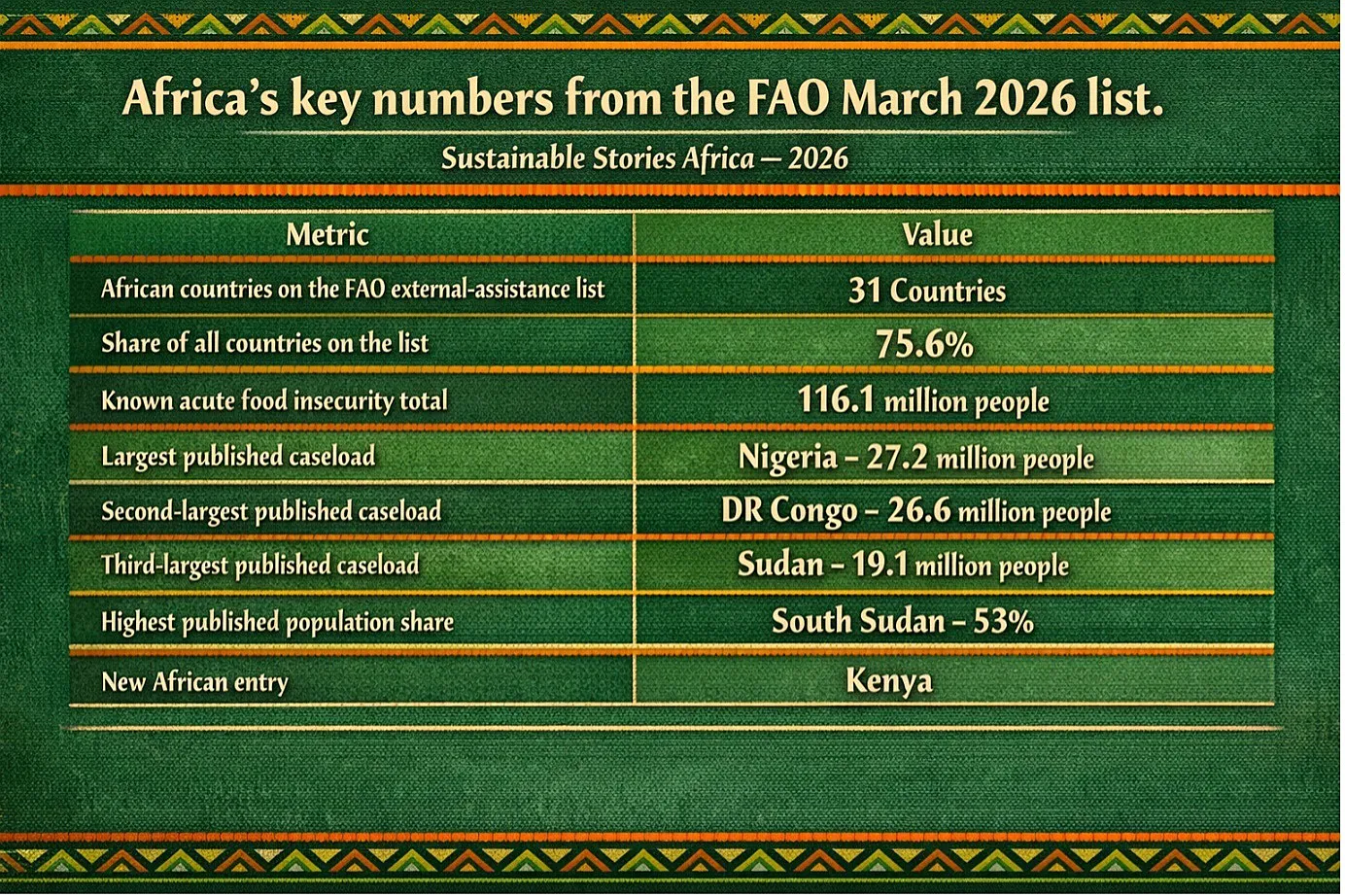
Africa’s key numbers from the FAO March 2026 list
Metric | Value |
|---|---|
African countries on the FAO external-assistance list | 31Countries |
Share of all countries on the list | 75.6% |
Known acute food insecurity total | 116.1 million people |
Largest published caseload | Nigeria - 27.2 million people |
Second-largest published caseload | DR Congo - 26.6 million people |
Third-largest published caseload | Sudan - 19.1 million people |
Highest published population share | South Sudan - 53% |
New African entry | Kenya |
The crisis is broad, but not uniform
The data also show why Africa’s food crisis cannot be reduced to drought alone. Weather and climate stress is consistent across much of the continent: Kenya, Somalia, Burundi, Ethiopia, Madagascar, Mozambique, Senegal, Sierra Leone, Tanzania, Zambia and Zimbabwe all experience weather-related triggers, including drought, flooding, cyclones and broader adverse conditions.
However, conflict and insecurity remain equally decisive. Sudan, DR Congo, Central African Republic, Burkina Faso, Mali, Mozambique, northern Nigeria, Somalia and parts of Cameroon show how violence does more than displace people; it hollows out markets, interrupts planting cycles, constrains trade corridors and slows humanitarian access.
Then there is the economic layer. High food prices, currency weakness, low incomes, and macroeconomic strain are repeatedly cited by FAO in Kenya, Burundi, Nigeria, South Sudan, Sierra Leone, Libya and others. That matters for African markets because it means food insecurity is not only about production shortfalls but also about affordability in import-dependent and fiscally constrained economies.
However, the list also carries an under-reported signal: some countries improve when production and prices improve. Malawi’s projected acute food insecurity burden fell from 5.7 million to just over 4 million.
Namibia’s caseload halved year on year. Zambia declined to 1.7 million from 5.8 million, supported by stronger production and lower staple prices.
That is the clearest evidence from the policy document: rainfall recovery, market stability and agricultural output can change the trajectory.
What is driving Africa’s food-assistance burden?
Driver category | African countries flagged |
|---|---|
Weather/climate shock | 26 Countries |
Economic/price stress | 19 Countries |
Conflict/insecurity | 15 Countries |
Displacement/refugee pressure | 11 Countries |
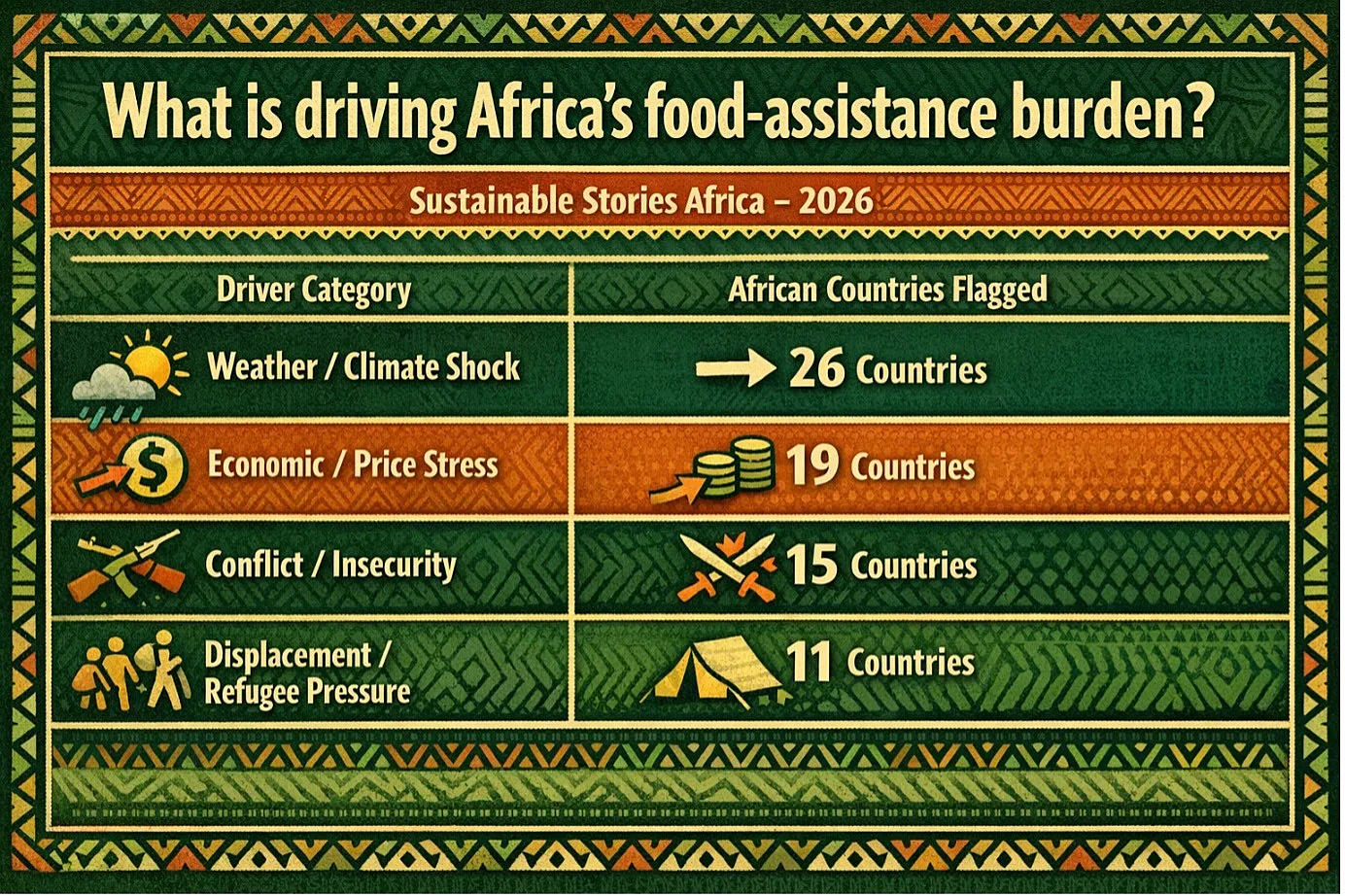
Categories overlap; one country can sit in multiple drivers.
The data point to a better outcome
There is a practical upside to reading FAO’s list as an investment and policy signal rather than as a humanitarian roll call.
If governments, development banks, and private agrifood actors act earlier, the gains are tangible: stronger domestic grain supply, lower import pressure, more stable rural incomes, shallower price spikes and fewer households tipping into crisis.
Malawi, Namibia and Zambia already show that improved agricultural output and moderating prices can reduce the number of people needing emergency support.
That matters for Africa’s ESG and development agenda. Food resilience is not separate from sustainability; it sits at the centre.
Better irrigation, climate-smart seeds, storage, rural roads, cross-border trade efficiency, refugee-host support and targeted safety nets all improve human welfare and reduce macroeconomic fragility.
The cost of delay is equally clear: more emergency spending, more lost productivity, deeper malnutrition and wider political risk.
Four moves the data demand now
The FAO page is updated three times a year. That means this is not a one-off warning. It is a recurring decision-making tool, and African stakeholders should treat it as one.
- First, protect production – Governments and financiers need to accelerate drought resilience, smallholder irrigation, input access and local storage in countries where weather shocks repeatedly erode harvests.
- Second, protect markets – Conflict-affected corridors need logistics support, safer transport routes and faster release of grain and humanitarian supplies where market failure is intensifying food-access shocks.
- Third, protect purchasing power – where macroeconomic stress is a named driver, targeted cash transfers, school feeding, refugee settlement support and carefully designed food subsidies can keep vulnerable households from falling into crisis.
- Fourth, protect regional resilience – AfCFTA-era trade policy should be used to accelerate production, improve cross-border transportation, reduce friction costs and build regional buffers before the next climate or conflict shock.
Path Forward – Build Buffers Before The Next Shock
Africa does not need fewer warnings; it needs stronger follow-through. The FAO list makes the priorities clear: invest earlier, localise resilience, stabilise markets and protect households before shocks harden into chronic dependence.
The real sustainability test for African markets is whether recurrent food alerts can be converted into permanent food-system capacity. That is the shift from aid dependence to resilience.