Sustainability is no longer a compliance exercise; it is rapidly becoming a defining lens for risk, strategy, and growth across African markets.
Here are four sustainability mindsets that reveal how African companies can shift from reactive risk management to proactive value creation, with profound implications for capital flows, competitiveness, and long-term resilience.
Four Mindsets, One Strategic Shift
Sustainability in Africa is undergoing a structural transformation. What was once confined to regulatory compliance and reputational risk management is now emerging as a central driver of corporate strategy, innovation, and long-term value creation.
Across sectors, from banking and energy to manufacturing and telecoms, firms are rethinking how environmental, social, and governance (ESG) issues influence performance.
This shift is not merely conceptual; it is reshaping capital allocation, governance priorities, and competitive positioning in both domestic and global markets.
At the centre of this evolution lies a four-part framework, compliance, traditional value, risk, and growth mindsets, which maps how organisations can interpret and act on sustainability.
For African businesses navigating climate risk, regulatory convergence, and development imperatives, understanding these mindsets is becoming critical.
Sustainability’s Strategic Inflexion Point
A growing number of African companies now face a dual pressure: rising ESG disclosure expectations and intensifying climate-related risks.
According to global ESG trends, over 70% of institutional investors increasingly factor sustainability into decision-making, while climate-related losses are projected to reach hundreds of billions annually in emerging markets.
This is forcing a shift from reactive compliance to strategic integration.
The four sustainability mindsets, derived from boardroom and policy analysis, offer a clear lens:
Orientation | Risk Management Lens | Value Creation Lens |
|---|---|---|
Past-Focused | Compliance Mindset | Traditional Value Mindset |
Future-Focused | Risk Mindset | Growth Mindset |
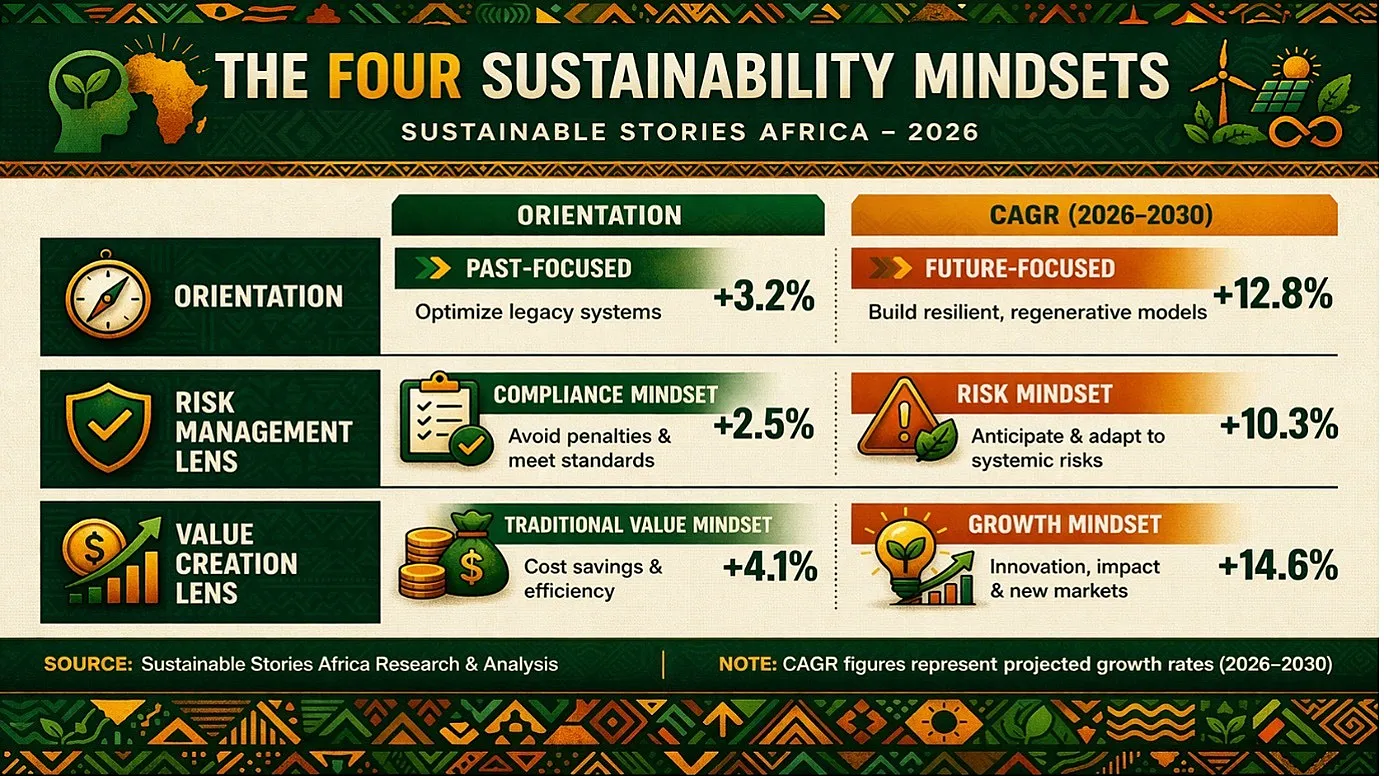
What is happening now is a migration; firms are moving diagonally across this matrix, from past-oriented compliance toward future-oriented growth strategies.
For African economies, this transition is particularly consequential. It determines whether sustainability becomes a cost centre or a catalyst for industrialisation, innovation, and resilience.
Breaking Down the Four Sustainability Mindsets
- Compliance Mindset (Past + Risk Management)
This is the starting point for most organisations.
Here, sustainability is treated primarily as a regulatory obligation. Companies focus on meeting environmental standards, avoiding penalties, and maintaining a licence to operate.
ESG disclosures, where present, are often backwards-looking and minimal.
African context:
- Many firms align with basic reporting frameworks (e.g., GRI or local regulations)
- ESG teams operate separately from core strategy
- Investment decisions rarely incorporate climate or social risk modelling
While necessary, this mindset limits strategic value.
- Traditional Value Mindset (Past + Value Creation)
In this phase, firms begin to see sustainability to enhance operational efficiency.
The emphasis shifts to cost savings, energy efficiency, waste reduction, and resource optimisation.
Key characteristics:
- Eco-efficiency initiatives (e.g., reduced energy intensity)
- Incremental productivity gains
- Sustainability framed as “doing more with less”
Example sectors:
- Manufacturing firms are reducing energy consumption
- Banks digitising operations to lower carbon footprints
However, this mindset still relies on existing business models rather than transforming them.
- Risk Mindset (Future + Risk Management)
This is where sustainability becomes strategic.
Companies begin to recognise ESG issues as material financial risks, including:
- Climate transition risks (carbon pricing, policy changes)
- Physical risks (flooding, drought, extreme weather)
- Social risks (labour, community relations)
African relevance:
- Agriculture and energy sectors are highly climate-exposed
- Financial institutions increasingly integrate climate risk into lending decisions
- Regulators are pushing toward IFRS S1 and S2 adoption
This mindset introduces forward-looking tools such as scenario analysis and stress testing, aligning sustainability with enterprise risk management.
- Growth Mindset (Future + Value Creation)
At the most advanced stage, sustainability becomes a core driver of innovation and growth.
Companies shift from managing risk to creating new markets and revenue streams.
Strategic focus:
- Green products and services
- Renewable energy investments
- Circular economy models
- Climate-aligned infrastructure
Emerging African signals:
- Solar mini-grid expansion across rural markets
- Fintech solutions targeting climate finance inclusion
- Green bonds and sustainability-linked financing
This mindset positions sustainability as a competitive advantage, not just a compliance requirement.
The Opportunity Landscape for Africa
If African firms successfully transition toward the growth mindset, the upside is significant.
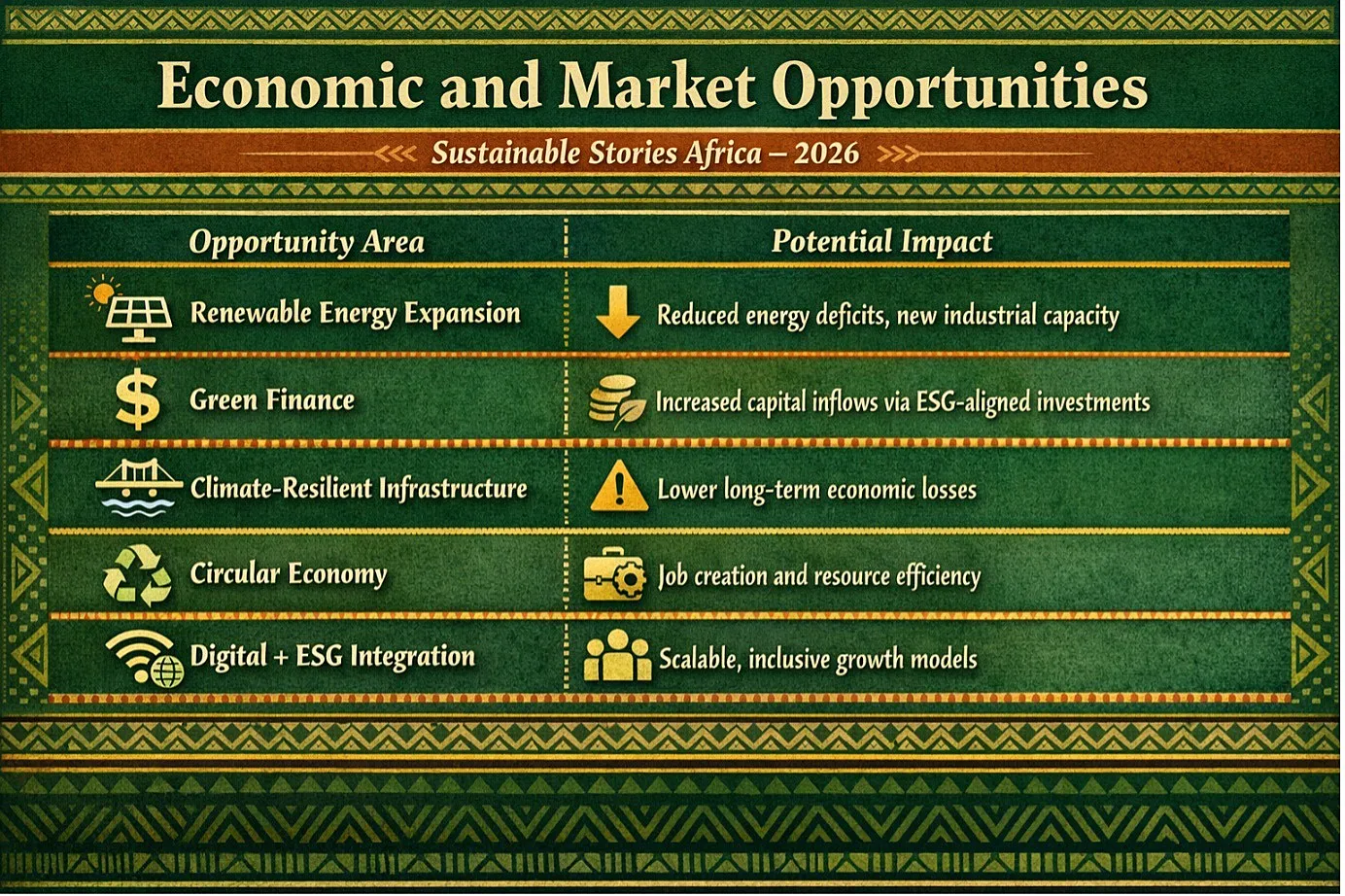
Economic and Market Opportunities
Opportunity Area | Potential Impact |
|---|---|
Renewable Energy Expansion | Reduced energy deficits, new industrial capacity |
Green Finance | Increased capital inflows via ESG-aligned investments |
Climate-Resilient Infrastructure | Lower long-term economic losses |
Circular Economy | Job creation and resource efficiency |
Digital + ESG Integration | Scalable, inclusive growth models |
The African Development Bank estimates that climate adaptation alone could require $50 billion annually by 2030, presenting both a challenge and an investment opportunity.
What Is at Stake
- Capital access: Investors are increasingly favouring ESG-aligned firms
- Trade competitiveness: Carbon border taxes could penalise non-compliant exporters
- Resilience: Climate shocks threaten GDP growth across multiple African economies
In short, remaining in compliance or traditional value mindsets risks falling structurally behind.
What Needs to Change Now
To move toward the growth mindset, coordinated action is required across stakeholders:
- Corporate Leadership and Boards
- Integrate sustainability into core strategy and capital allocation
- Link ESG metrics to executive compensation and performance
- Conduct double materiality assessments (impact + financial risk)
- Regulators and Policymakers
- Accelerate adoption of IFRS S1 and S2 standards
- Provide clear taxonomy frameworks for green investments
- Align national policies with global ESG expectations
- Financial Institutions
- Embed climate risk into credit and investment decisions
- Expand green financing instruments (bonds, loans)
- Support SMEs in ESG transition
- Businesses and Industry
- Invest in innovation-driven sustainability solutions
- Build data systems for ESG reporting and analytics
- Collaborate across value chains for systemic impact
- Citizens and Consumers
- Demand accountability and transparency
- Support sustainable products and services
Path Forward – From Risk to Resilience
Africa’s sustainability journey is no longer about catching up; it is about leapfrogging into a growth-driven, climate-aligned future.
The transition from compliance to a growth mindset will define which firms attract capital, scale innovation, and remain competitive in a rapidly evolving global economy.