
Across African boardrooms, a new question is reshaping finance: can ESG move from box-ticking cost to value-creating strategy for CFOs?
A “Green CFO Checklist” reframes sustainability as both debit and credit on the balance sheet, challenging finance leaders to cut energy costs, unlock cheaper capital, and protect brands while still meeting demanding climate and regulatory targets.
Green finance lens, balance-sheet stakes
For years, many African finance teams have treated ESG as a compliance burden – an annual sprint to file sustainability reports, tick regulatory boxes, and avoid penalties.
The “Green CFO Checklist” popularised by global sustainability expert Dr Edward Mungai reframes the mindset, putting value creation and risk management at the heart of ESG decisions.
It asks a simple but disruptive question: what if sustainability shows up as both debit and credit on the balance sheet?
The framework draws a sharp line down the CFO’s ledger. On one side sit traditional obligations: robust ESG data capture, internal governance audits, legal risk management, and meeting science-based climate targets.
On the other side is a less familiar but fast-growing agenda: cutting operating costs through energy efficiency, influencing ESG ratings to access cheaper capital, stress-testing supply chains for climate risks, and turning trust into tangible brand equity.
This shift is significant for African and other emerging markets where volatile currencies, climate shocks, and tight fiscal space leave little room for capital waste.
As financiers reprice carbon, climate, and governance risks, companies that remain stuck in a tick-box approach risk paying more for capital, losing export markets, or watching assets become stranded long before the end of their useful life.
The Green CFO, by contrast, treats ESG as a core financial strategy, not a side report.
From reporting cost to value engine
For CFOs, ESG decisions now carry a dual financial impact, functioning as both compliance costs and value drivers.
On one side are obligations such as building data systems, strengthening governance, managing regulatory risks, and meeting climate targets.
On the other side, strategic gains include cost efficiency, access to sustainable finance, risk mitigation, and enhanced brand value.
In practice, ESG data can unlock operational benefits. Emissions inventories can inform energy efficiency improvements, while climate-risk analysis helps avoid stranded assets.
Strong ESG reporting also positions firms to access green financing instruments, reinforcing the shift from compliance burden to strategic opportunity.
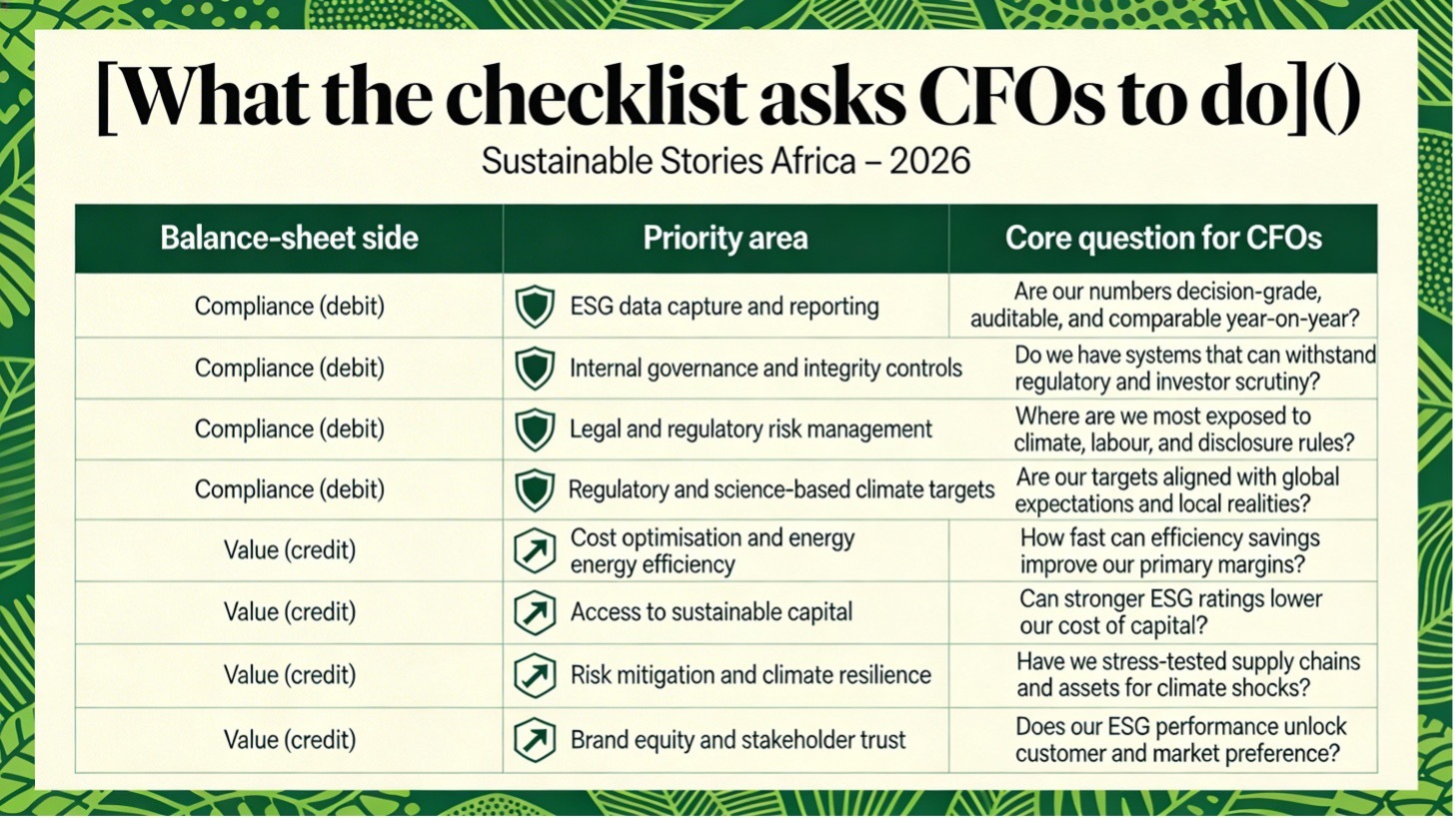
What the checklist asks CFOs to do
At its core, the Green CFO Checklist maps eight priority moves across two sides of the balance sheet:
| Balance-sheet side | Priority area | Core question for CFOs |
|---|---|---|
| Compliance (debit) | ESG data capture and reporting | Are our numbers decision-grade, auditable, and comparable year-on-year? |
| Compliance (debit) | Internal governance and integrity controls | Do we have systems that can withstand regulatory and investor scrutiny? |
| Compliance (debit) | Legal and regulatory risk management | Where are we most exposed to climate, labour, and disclosure rules? |
| Compliance (debit) | Regulatory and science-based climate targets | Are our targets aligned with global expectations and local realities? |
| Value (credit) | Cost optimisation and energy efficiency | How fast can efficiency savings improve our primary margins? |
| Value (credit) | Access to sustainable capital | Can stronger ESG ratings lower our cost of capital? |
| Value (credit) | Risk mitigation and climate resilience | Have we stress-tested supply chains and assets for climate shocks? |
| Value (credit) | Brand equity and stakeholder trust | Does our ESG performance unlock customer and market preference? |
For African firms facing rising energy costs and unreliable grids, cost optimisation is a priority.
Green CFOs can integrate energy data, fuel usage, and maintenance records to identify inefficiencies and evaluate investments in efficiency or renewables.
Many of these upgrades deliver payback within three to five years while strengthening operating margins.
On capital access, ESG ratings are becoming financial tools rather than reputational markers. Strong ratings can reduce borrowing costs, unlock sustainability-linked loans, and improve access to green or concessional finance.
This is particularly important for capital-intensive sectors where financing conditions directly affect investment and employment.
Risk mitigation connects climate realities to financial outcomes. By embedding climate stress tests into planning, firms can anticipate disruptions, manage exposure, and build resilience against increasingly frequent environmental shocks affecting operations, revenues, and long-term asset values.
Why Green CFOs can win on multiple fronts
Treating ESG as a strategy enables CFOs to deliver multiple benefits simultaneously. Efficiency initiatives reduce energy costs and emissions, stronger governance lowers fraud risk and builds investor confidence, and climate-resilient operations protect long-term revenues.
For listed firms, this integrated approach can enhance valuations as markets increasingly reward resilience and forward-looking risk management.
A practical example is a mid-sized African manufacturer investing in energy-efficient systems and rooftop solar.
Such investments can significantly lower energy costs, stabilise production amid grid instability, and improve margins.
Over time, these gains can support access to sustainability-linked financing and strengthen export competitiveness as global buyers demand lower emissions.
For communities, these decisions translate into tangible benefits. Cleaner environments, more reliable jobs, and inclusive value chains help reduce social and environmental risks while rebuilding trust between businesses, governments, and citizens.
Turning the checklist into a 12‑month finance agenda
To move from theory to practice, the Green CFO Checklist can be converted into a 12‑month action plan anchored in measurable milestones. At a minimum, finance teams can commit to four concrete shifts:
- Upgrade ESG data to decision-grade quality.
- Integrate sustainability metrics into core finance systems rather than standalone spreadsheets.
- Define a short list of key indicators, including emissions, energy use, water, waste, safety, and diversity, with clear baselines and assurance processes.
- Embed ESG in capital planning and investor dialogue.
- Map upcoming capex projects against cost-optimisation and climate-resilience outcomes.
- Engage lenders and investors early about sustainability-linked instruments and disclosure expectations.
- Run climate and integrity stress tests.
- Model how extreme weather, carbon pricing, or supply chain disruptions could affect revenue, margins, and asset values.
- Review internal controls around procurement, reporting, and third-party
- relationships to close integrity gaps.
- Translate ESG performance into brand and stakeholder value.
- Communicate clearly with employees, customers, regulators, and communities about both progress and gaps.
- Use sustainability reports and integrated reports as strategic tools, not only compliance documents, highlighting how ESG choices are improving financial resilience.
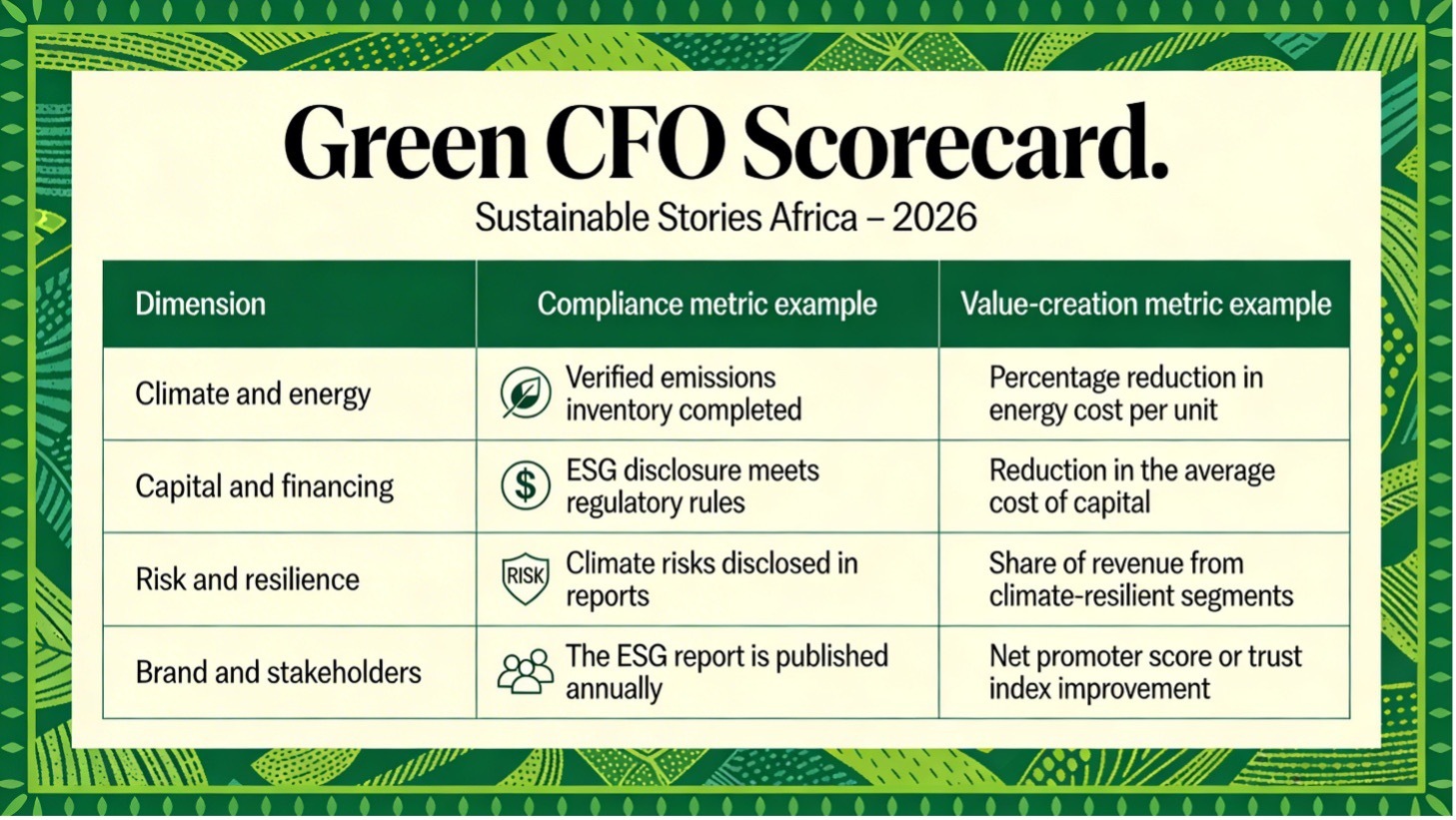
A simple way to track progress is to build a “Green CFO Scorecard” that pairs compliance indicators with value-creation metrics:
| Dimension | Compliance metric example | Value-creation metric example |
|---|---|---|
| Climate and energy | Verified emissions inventory completed | Percentage reduction in energy cost per unit |
| Capital and financing | ESG disclosure meets regulatory rules | Reduction in the average cost of capital |
| Risk and resilience | Climate risks disclosed in reports | Share of revenue from climate-resilient segments |
| Brand and stakeholders | The ESG report is published annually | Net promoter score or trust index improvement |
Path Forward – Green CFOs as system shapers
Forward-looking African CFOs are shifting ESG from compliance to financial strategy, using structured frameworks to link regulatory demands with cost savings, capital access, and resilience.
By embedding sustainability metrics into financial systems, they can strengthen margins and secure competitiveness in global markets.
The priority is clear: finance leaders must take ownership of ESG, build robust data systems, and align investment decisions with climate realities.
Executed properly, this position firms to drive inclusive, low-carbon growth while enhancing long-term economic resilience.