As climate disclosure requirements increase and buyers ask harder questions, companies are discovering that not all carbon metrics are interchangeable.
The differences among Life Cycle Assessment (LCA), Carbon Footprint (CF) and Product Carbon Footprint (PCF) now matter for cost, compliance, credibility and market access, especially for African producers entering stricter global value chains.
Three metrics, three strategic choices
The climate-data conversation is becoming more precise. What once looked like one broad reporting task is now splitting into distinct measurement tools, each built for a different decision.
That is the central insight behind the “Difference Between LCA, CF & PCF” visual: companies need to know whether they are measuring the environmental performance of an entire product system, in greenhouse gas emissions of an organisation, or the carbon footprint of a specific product.
For African and other emerging-market businesses, that distinction is no longer towards a report of technical housekeeping.
It affects export readiness, investor conversations, procurement credibility, and the quality of decarbonisation decisions inside their factories, farms, logistics chains and construction sites.
Choosing the Right Tools For Credible Climate Measurement
A product may appear environmentally friendly; however, it may fail rigorous climate scrutiny if the wrong measurement tool is applied. The key issue is selecting appropriate frameworks for specific sustainability questions as reporting shifts toward verifiable standards.
Life Cycle Assessment (LCA), defined under ISO 14040, provides the broadest evaluation by analysing environmental impacts across a product’s full life cycle, from raw materials to disposal. It captures overall environmental burden beyond emissions alone.
Carbon Footprint, guided by ISO 14064, focuses specifically on greenhouse gas emissions at the organisational level, enabling companies to measure, report, and verify emissions systematically.
Product Carbon Footprint (PCF), under ISO 14067, narrows this to emissions linked to individual products.
These distinctions are increasingly important as regulators, investors, and supply chains demand precise, product-level climate data.
Distinct Climate Tools Answer Different Sustainability Questions
The three tools differ based on the questions they answer.
- Life Cycle Assessment (LCA) examines environmental impacts across a product’s full life cycle, while organisational carbon footprint measures total greenhouse gas emissions within defined company boundaries.
- Product Carbon Footprint (PCF) focuses specifically on the climate impact of an individual product across selected or full life-cycle stages.
These tools are complementary, not interchangeable. PCF builds on LCA principles but narrows the scope to climate change impacts expressed in CO₂e. Organisational carbon footprint frameworks, such as ISO 14064, support company-level emissions accounting and verification, making them essential for structured reporting.
For African businesses, confusion often arises when “footprint” is used loosely. Different use cases, ranging from compliance and market access to operational decisions, require distinct tools to deliver accurate, decision-relevant insights.
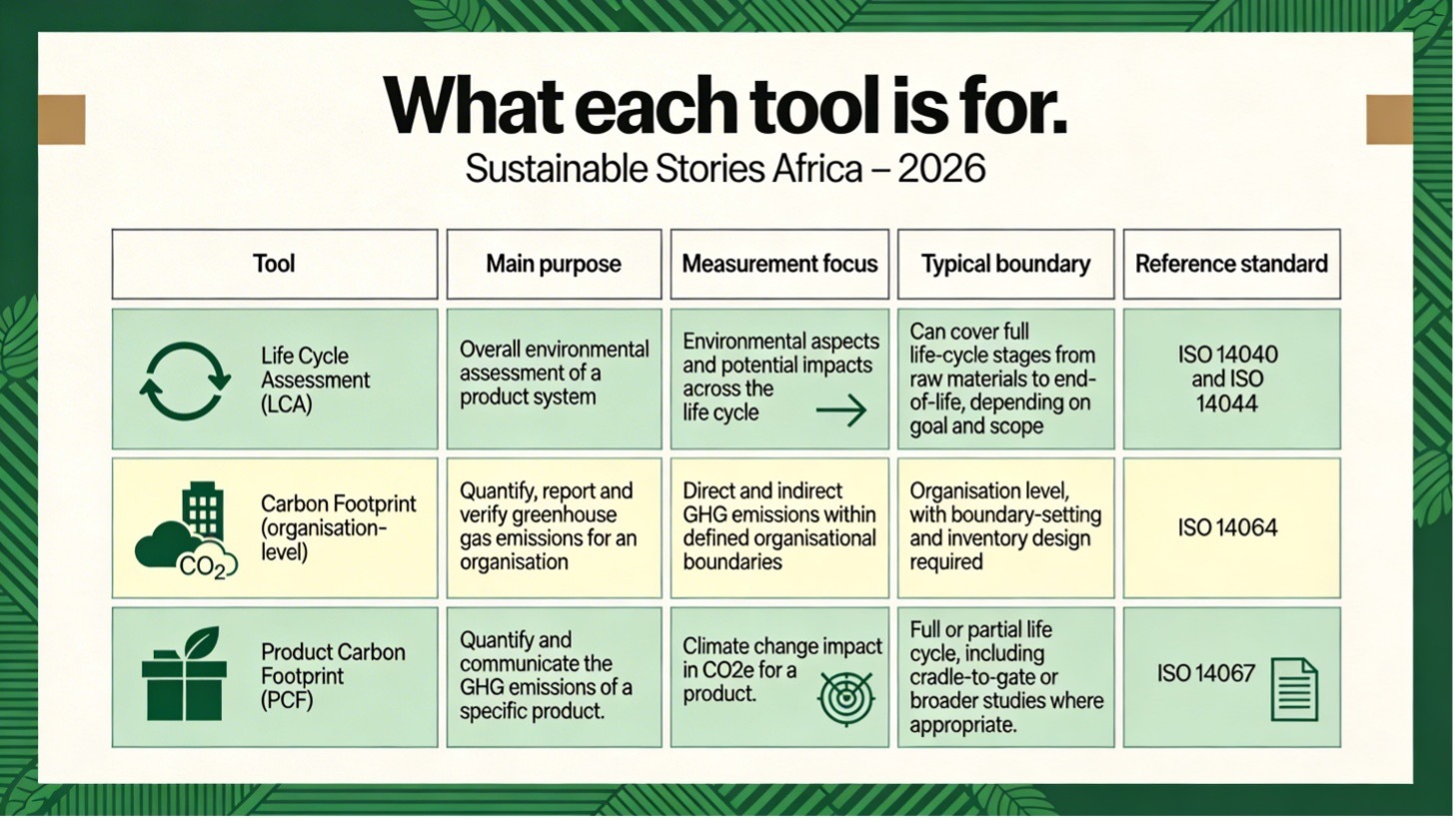
What each tool is for
| Tool | Main purpose | Measurement focus | Typical boundary | Reference standard |
|---|---|---|---|---|
| Life Cycle Assessment (LCA) | Overall environmental assessment of a product system | Environmental aspects and potential impacts across the life cycle | Can cover full life-cycle stages from raw materials to end-of-life, depending on goal and scope | ISO 14040 and ISO 14044 |
| Carbon Footprint (organisation-level) | Quantify, report and verify greenhouse gas emissions for an organisation | Direct and indirect GHG emissions within defined organisational boundaries | Organisation level, with boundary-setting and inventory design required | ISO 14064 |
| Product Carbon Footprint (PCF) | Quantify and communicate the GHG emissions of a specific product | Climate change impact in CO2e for a product | Full or partial life cycle, including cradle-to-gate or broader studies where appropriate | ISO 14067 |
Poor measurement leads to a flawed strategy. Relying solely on organisational footprints or PCF can obscure critical impacts, while weak methods risk unverifiable claims, undermining credibility with investors, auditors, and trade partners in increasingly scrutiny-driven markets.
Climate Measurement Tools Enable Strategic Business Decisions
When applied effectively, climate measurement tools extend beyond disclosure to support operational and strategic decision-making.
They help firms identify emissions hotspots, improve procurement, compare design options, and communicate performance with credibility.
ISO 14064 enables structured organisational decarbonisation planning, while ISO 14067 provides consistent product-level emissions data for increasingly evidence-driven markets.
For African industries, these tools create practical value. Manufacturers can combine organisational footprints, product carbon footprints, and Life Cycle Assessments to manage emissions, support product declarations, and evaluate trade-offs across materials, energy use, and supply chains.
The broader benefit is strategic clarity. Understanding which tool answers which question transforms climate reporting from a compliance exercise into a business enabler. This strengthens decision-making at the board level, improves engagement with investors and buyers, and equips sustainability teams with reliable, actionable insights.
Match Climate Metrics To Business Decisions
Companies need to shift from asking which climate metric is “best” to identifying which business problem they are solving.
Organisation-level accounting under ISO 14064 suits enterprise-wide emissions management, while Product Carbon Footprint under ISO 14067 supports customer disclosures and product comparisons.
Life Cycle Assessment remains essential for evaluating broader environmental impacts across value chains.
A practical approach involves four steps.
- First, define the decision objective clearly, whether compliance, decarbonisation, product reporting, or market access.
- Second, establish credible boundaries and prioritise primary data for material impacts.
- Third, align assessments with recognised standards to ensure consistency and verifiability.
- Fourth, integrate findings into investment, supplier, and product decisions.
Public institutions also play a role. Governments and industry bodies can provide clearer guidance, strengthen technical capacity, and develop verification systems to make climate measurement more accessible.
Path Forward – Better Metrics Build Credible Climate Action
The clearest message from the LCA, CF and PCF debate is that better climate action begins with better measurement choices.
LCA provides a broader environmental picture, organisational carbon footprints manage company-wide emissions, and PCFs reveal the climate profile of specific products.
What is being advocated now is precision: use the right metric for the right decision, build credible data systems, and turn measurement into action on design, operations and market strategy. That is how African businesses move from carbon confusion to climate credibility.