
Global ESG ratings, once seen as the backbone of sustainable finance, are facing a credibility crisis driven by inconsistency, opacity, and fragmentation.
The International Capital Market Association (ICMA) is now pushing reforms to restore trust, raising a critical question: Can ESG ratings evolve fast enough to remain relevant?
Fixing ESG’s Credibility Gap
The global ESG ecosystem is entering a phase of recalibration, as scrutiny intensifies around the reliability and comparability of ESG ratings. Once the definitive benchmarks for sustainability performance, ESG scores are now being questioned for methodological inconsistencies and lack of transparency.
The International Capital Market Association (ICMA), a key player in sustainable finance standards, is leading efforts to address these concerns.
Through its guidance on ESG ratings and data products, ICMA is advocating for clearer methodologies, improved disclosures, and stronger governance across rating providers.
For African and emerging markets, the implications are significant. ESG ratings increasingly influence capital flows, investment decisions, and sovereign risk perception.
However, the current system often underrepresents local realities, raising concerns about fairness, accuracy, and alignment on development.
A Crisis of Confidence in ESG Ratings
At the heart of the ESG debate lies a stark reality: two leading ESG rating agencies can assign dramatically different scores to the same company.
This divergence, sometimes exceeding 50% variance, has raised fundamental questions about the credibility of ESG ratings as decision-making tools.
ICMA’s intervention reflects growing global concern. As highlighted in its framework, the lack of transparency in methodologies, inconsistent weighting of ESG factors, and limited disclosure of assumptions are undermining market confidence.
For investors, this creates uncertainty. For issuers, it creates unpredictability. For emerging markets, it risks mispricing sustainability performance altogether.
Why ESG Ratings Are Fragmented
The ICMA insights point to three structural issues driving the ESG ratings challenge:
- Methodological Divergence – Unlike credit ratings, ESG ratings lack a universally accepted methodology. Different providers prioritise different indicators; some focus on environmental impact, others on governance, and others on risk exposure.
This leads to inconsistent outcomes and limits comparability across markets.
- Data Limitations and Bias – Many ESG ratings rely heavily on publicly available disclosures. In African markets, where reporting is still evolving, this creates structural bias:
- Companies with limited disclosures may receive lower ratings
- Informal sector contributions are often excluded
- Local sustainability practices may be underreported
As noted in the ICMA guidance, ESG ratings often reflect “data availability rather than actual performance,” creating distortions in emerging markets.
- Lack of Transparency – A key concern raised is the opacity of rating methodologies. Investors and issuers often lack visibility into:
- How scores are calculated
- Which indicators are weighted most heavily
- How qualitative judgments are applied
This opacity reduces trust and limits the usability of ESG ratings in financial decision-making.
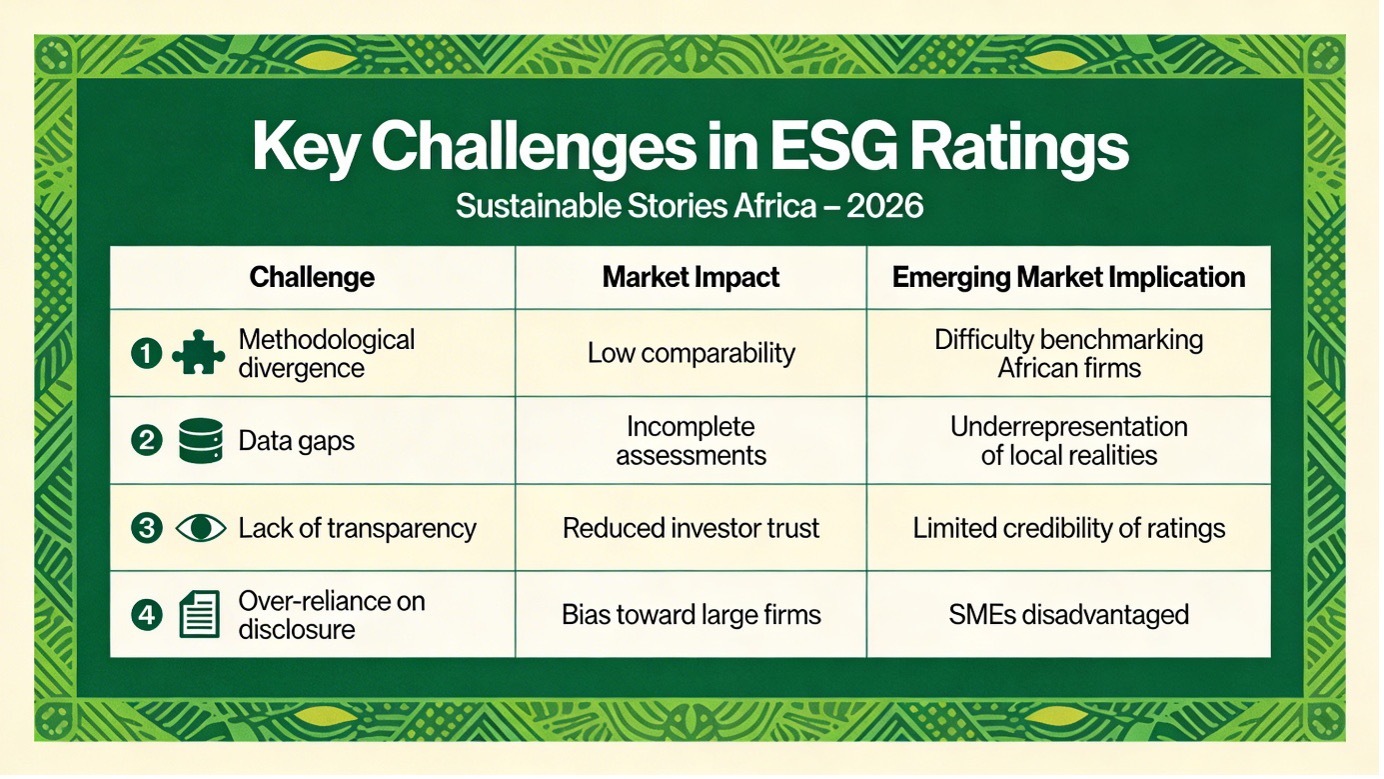
Key Challenges in ESG Ratings
Challenge | Market Impact | Emerging Market Implication |
|---|---|---|
Methodological divergence | Low comparability | Difficulty benchmarking African firms |
Data gaps | Incomplete assessments | Underrepresentation of local realities |
Lack of transparency | Reduced investor trust | Limited credibility of ratings |
Over-reliance on disclosure | Bias toward large firms | SMEs disadvantaged |
Rebuilding ESG Ratings for Market Integrity
Despite the challenges, ICMA’s framework outlines a pathway toward more credible and effective ESG ratings.
- Standardisation and Comparability – By encouraging alignment in methodologies and disclosure practices, ESG ratings can become more consistent and comparable, enhancing their usefulness for investors.
- Improved Transparency – ICMA advocates for clear disclosure of methodologies, data sources, and assumptions. This allows investors to interpret ratings and make informed decisions.
- Inclusion of Emerging Market Contexts – A more nuanced approach to ESG assessment can better capture:
- Informal sector contributions
- Local sustainability practices
- Developmental priorities
This ensures that ESG ratings reflect real impact, not just reporting capacity.
- Strengthened Governance – The introduction of governance standards for ESG rating providers, like those in credit rating agencies, can enhance accountability and reduce conflicts of interest.
If implemented effectively, these reforms could transform ESG ratings from imperfect signals into reliable decision-making tools.
What Stakeholders Must Do Now
The ICMA framework signals that responsibility for reform is shared across the ecosystem:
- Regulators: Establish Oversight Frameworks – Authorities must establish regulatory oversight to guide ESG rating providers, to ensure transparency, accountability, and consistency.
- Rating Agencies: Disclose and Standardise – Providers must:
- Clearly explain methodologies
- Standardise key indicators
- Improve data validation processes
- Companies: Improve ESG Disclosure – African corporates must strengthen sustainability reporting to align with global frameworks, including IFRS S1/S2 and GRI.
This includes investing in data systems, internal controls, and assurance processes.
- Investors: Use Ratings Critically – Investors must move beyond reliance on single ESG scores, combining ratings with qualitative analysis and local market insights.
- Development Institutions: Support Capacity Building – Multilateral institutions and industry bodies must support:
- ESG data infrastructure
- Training and capacity development
- Standard-setting initiatives
The ICMA guidance emphasises collaboration as critical to building a “robust and credible ESG ratings ecosystem.”
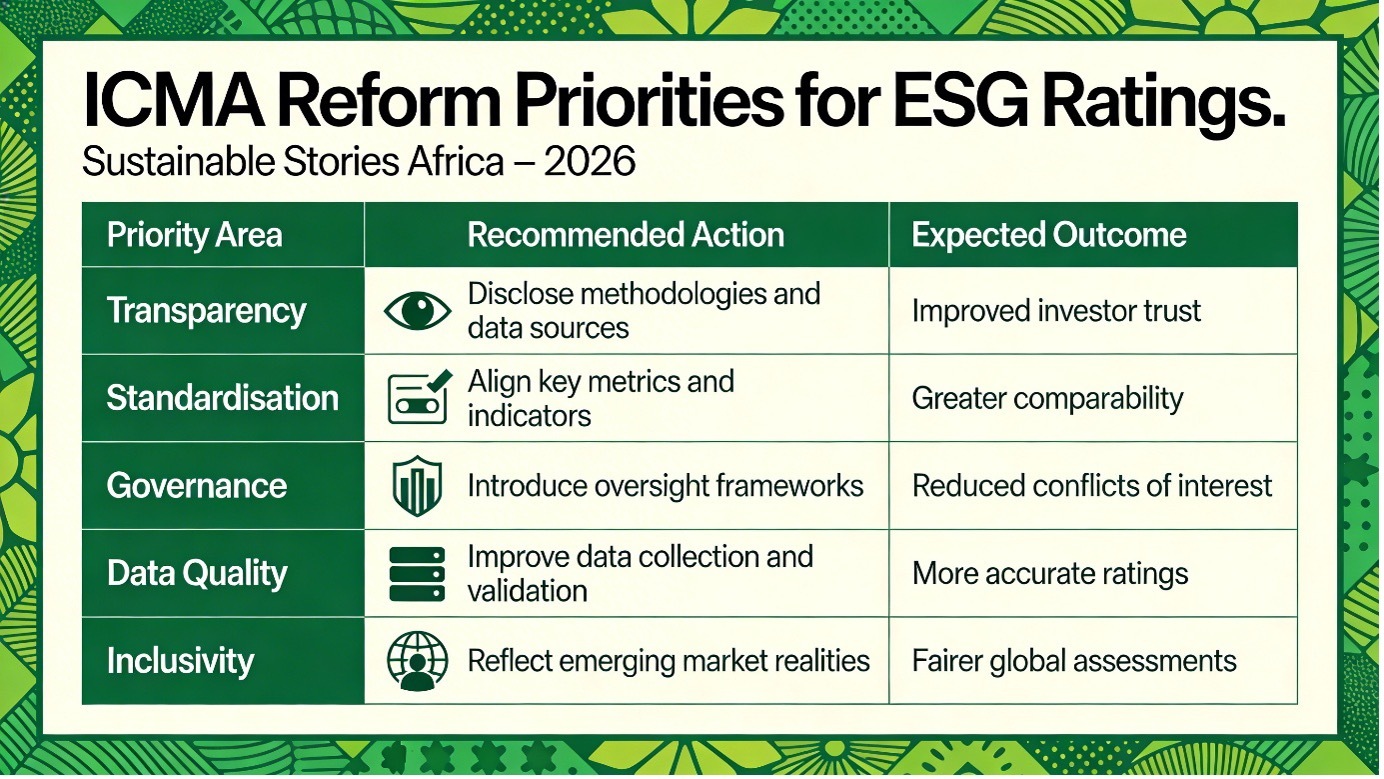
ICMA Reform Priorities for ESG Ratings
Priority Area | Recommended Action | Expected Outcome |
|---|---|---|
Transparency | Disclose methodologies and data sources | Improved investor trust |
Standardisation | Align key metrics and indicators | Greater comparability |
Governance | Introduce oversight frameworks | Reduced conflicts of interest |
Data Quality | Improve data collection and validation | More accurate ratings |
Inclusivity | Reflect emerging market realities | Fairer global assessments |
Path Forward – Restoring Trust in ESG Metrics
From Fragmentation to Alignment
ESG ratings must evolve from fragmented, opaque systems into transparent, standardised frameworks that investors can trust and use effectively.
Building a More Inclusive ESG Ecosystem
For Africa, the opportunity lies in shaping ESG ratings that reflect local realities while aligning with global standards, ensuring that sustainability performance is measured fairly, accurately, and meaningfully.