Africa’s climate finance gap is no longer just about funding; it is about systems. As billions remain underutilised, a deeper structural issue is emerging: weak institutional capacity.
This raises a critical question: Can climate finance scale without rethinking how countries build, retain, and deploy expertise across governance systems?
From Skills to Systems Transformation
Across African and Global South markets, the conversation on climate finance is undergoing a structural reset.
While funding commitments have increased, the ability to access, deploy, and sustain climate finance remains uneven, constrained not by scarcity of capital but by institutional readiness.
At the centre of this shift is a growing consensus: capacity development must move beyond training individuals to strengthening entire systems.
The traditional model, workshops, technical courses, and short-term advisory, has delivered awareness, but not always durable outcomes.
Insights from the 31st Green Climate Fund (GCF) Insight report highlight a core disconnect: knowledge acquisition does not consistently translate into institutional performance.
In African markets, where climate vulnerability intersects with development priorities, this disconnect is not theoretical; it directly shapes access to billions in climate finance.
The $ Gap Behind the Funding Gap
“Financial resources alone cannot deliver climate outcomes without competent institutions.”
That premise is now defining the next phase of climate finance architecture. Multilateral institutions, including the Green Climate Fund, increasingly recognise that weak governance systems, fragmented coordination, and limited execution capacity, not just funding shortages, are the primary bottlenecks.
Despite significant commitments, only a fraction of available climate finance is effectively deployed. The GCF’s readiness programme alone has approved hundreds of grants across more than 140 countries, yet outcomes remain uneven due to systemic constraints.
In practical terms, countries may secure training, attend workshops, and develop strategies; however, they still struggle to design bankable projects, meet accreditation standards, or coordinate across ministries.
Why Capacity Is Failing to Scale
The underlying issue lies in how capacity has been historically defined and delivered.
According to the GCF insight report, capacity development operates across three interdependent levels:
- Individual capacity (skills and knowledge)
- Institutional capacity (systems, governance, processes)
- Systemic capacity (policy coherence, enabling environment)
However, most interventions have focused disproportionately on individuals, training professionals without strengthening the systems within which they operate.
Key Structural Gaps Identified
Capacity Layer | Current Weakness | Impact on Climate Finance |
|---|---|---|
Individual | High training participation but low retention | Skills not applied |
Institutional | Weak governance, unclear mandates | Poor project execution |
Systemic | Policy fragmentation, coordination gaps | Limited scale and access |
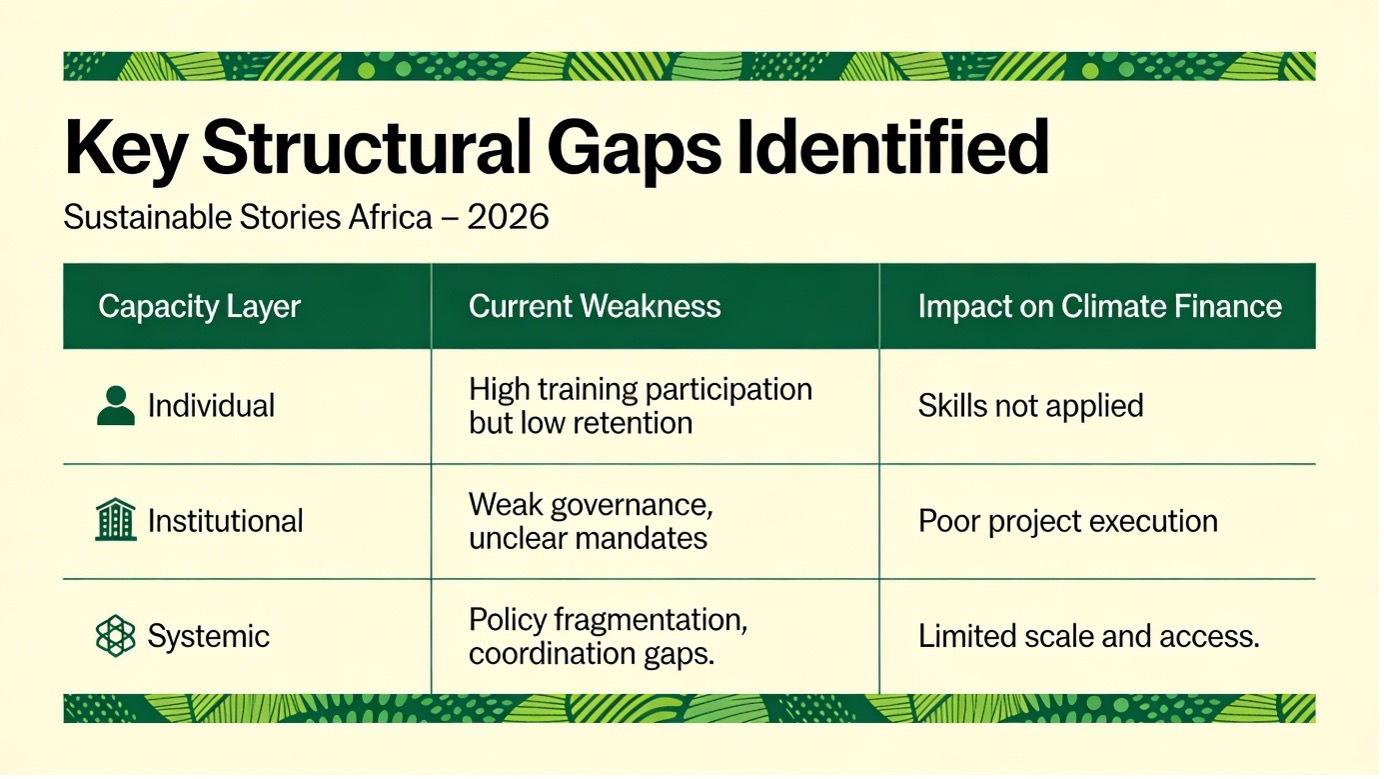
This imbalance creates what practitioners describe as a “capacity paradox”, trained individuals operating within constrained institutions.
One stakeholder insight captures the challenge succinctly:
“You can’t absorb all this money; you need all the players who have capacity.”
This reflects a broader ecosystem issue; governments cannot deliver climate outcomes without engaging private-sector actors, civil society, and regional institutions.
What a Functional Capacity System Unlocks
When capacity is treated as a system, rather than a skill set, the implications are transformative.
A well-designed capacity ecosystem enables:
- Stronger project pipelines, improving access to global climate funds
- Higher-quality investments, attracting private capital alongside public finance
- Faster implementation cycles, reducing delays in adaptation and mitigation projects
- Institutional continuity, ensuring knowledge survives personnel turnover
The GCF’s evolving strategy reflects this shift from output-based metrics (e.g. number of trainings) to outcome-based metrics (successful project implementation and pipeline development).
- Emerging Model: Embedded Capacity – A notable innovation is the deployment of embedded experts within national institutions to support accreditation, project design, and financial oversight from within the system.
This model addresses a critical failure point: capacity must be institutionalised, rather than outsourced.
What Must Change Now
The path forward requires a coordinated reset across governments, financiers, and development institutions.
Priority Actions for Stakeholders
- Governments and Regulators
- Institutionalise climate finance units within ministries
- Strengthen policy coherence across sectors (energy, finance, environment)
- Build retention frameworks for skilled professionals
- Multilateral Institutions (e.g., GCF, World Bank)
- Shift funding from training-heavy models to system-building interventions
- Expand embedded technical support within national systems
- Increase focus on pipeline development and execution capability
- Private Sector and Financial Institutions
- Engage earlier in project design to improve bankability
- Build internal ESG and climate finance expertise
- Partner with governments to co-develop scalable solutions
- Civil Society and Academia
- Bridge knowledge gaps through applied research
- Support localised capacity ecosystems
- Strengthen accountability and transparency frameworks
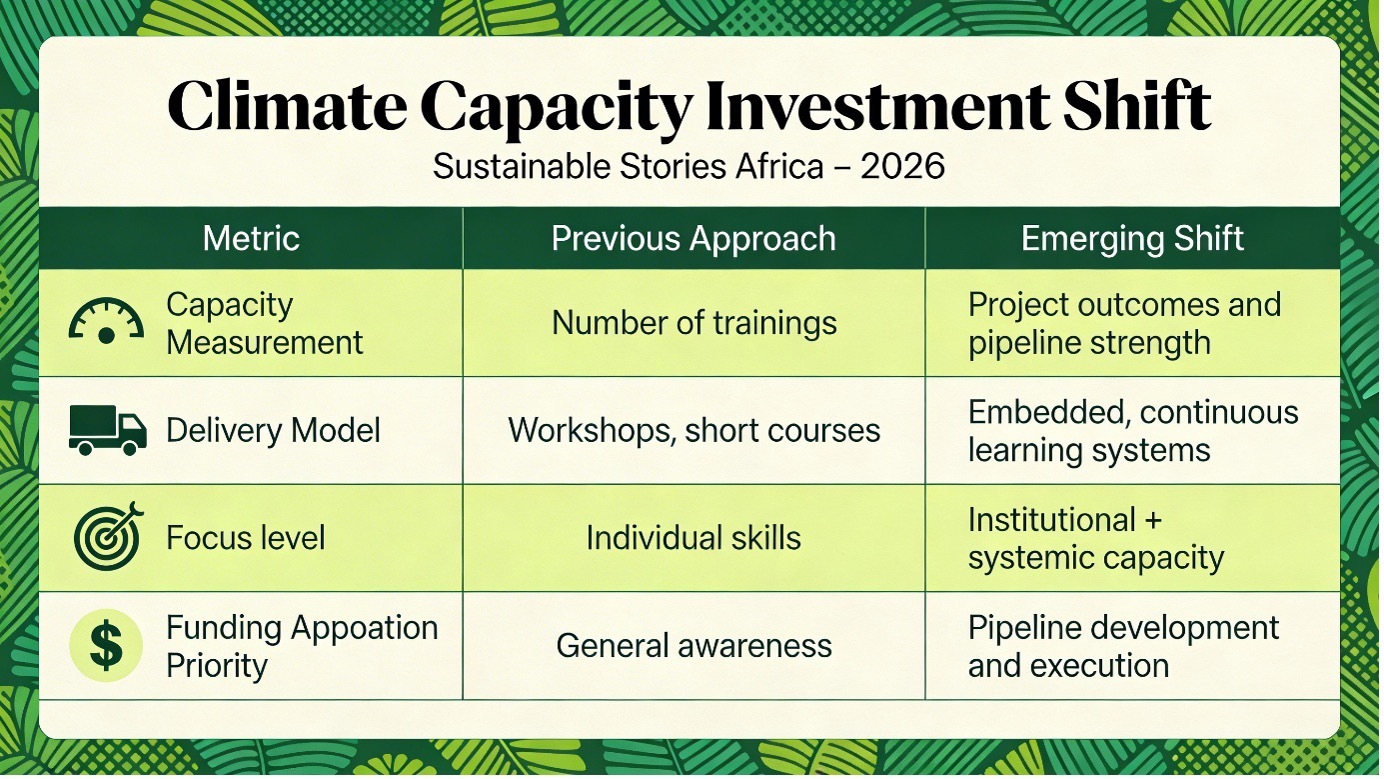
Climate Capacity Investment Shift
Metric | Previous Approach | Emerging Shift |
|---|---|---|
Capacity Measurement | Number of trainings | Project outcomes and pipeline strength |
Delivery Model | Workshops, short courses | Embedded, continuous learning systems |
Focus Level | Individual skills | Institutional + systemic capacity |
Funding Allocation Priority | General awareness | Pipeline development and execution |
Path Forward – Systems Before Scale
Africa’s climate finance challenge is no longer defined by access alone, but by readiness.
Building institutions capable of designing, absorbing, and deploying capital at scale is now the central task.
The shift is clear: from training individuals to strengthening systems. Without this transition, capital will continue to flow, but impact will remain constrained.