
Nigeria’s financial system is undergoing a structural shift as sustainability reporting moves from voluntary signalling to regulatory expectation.
At the centre is the Central Bank of Nigeria’s revised Sustainable Banking Principles, raising a critical question: can compliance unlock capital, credibility, and long-term resilience?
Regulation Meets Market Reality
Nigeria’s banking sector is entering a new phase of regulatory maturity, where sustainability is no longer a peripheral narrative but a supervisory requirement.
The Central Bank of Nigeria (CBN), through its revised Sustainable Banking Principles (SBPs), is redefining how financial institutions measure risk, allocate capital, and report performance.
Originally introduced in 2012 and updated in 2023, the SBPs establish a nine-principle framework spanning environmental, social, and governance (ESG) considerations.
These principles apply across commercial banks, merchant banks, development finance institutions, and non-interest banks, embedding sustainability directly into credit decisions and operational processes.
What is changing now is not the framework, but the intensity of enforcement, the depth of disclosure, and the expectations from global capital markets.
For Nigerian institutions, ESG is no longer about narrative positioning; it is about measurable, auditable performance.
A Regulatory Shift With Capital Implications
A quiet but consequential transformation is underway: sustainability reporting in Nigeria’s banking sector has moved from compliance to competitiveness.
The CBN’s Sustainable Banking Principles require financial institutions to integrate ESG risks into lending decisions, disclose portfolio exposure by risk tiers, and report operational footprints, including energy use, carbon emissions, and waste.
This shift matters because global capital is increasingly ESG-sensitive. Banks that fail to demonstrate credible sustainability practices risk exclusion from international funding pools, development finance pipelines, and institutional investor portfolios.
In effect, ESG compliance is becoming a proxy for financial credibility.
Inside the Framework Driving Change
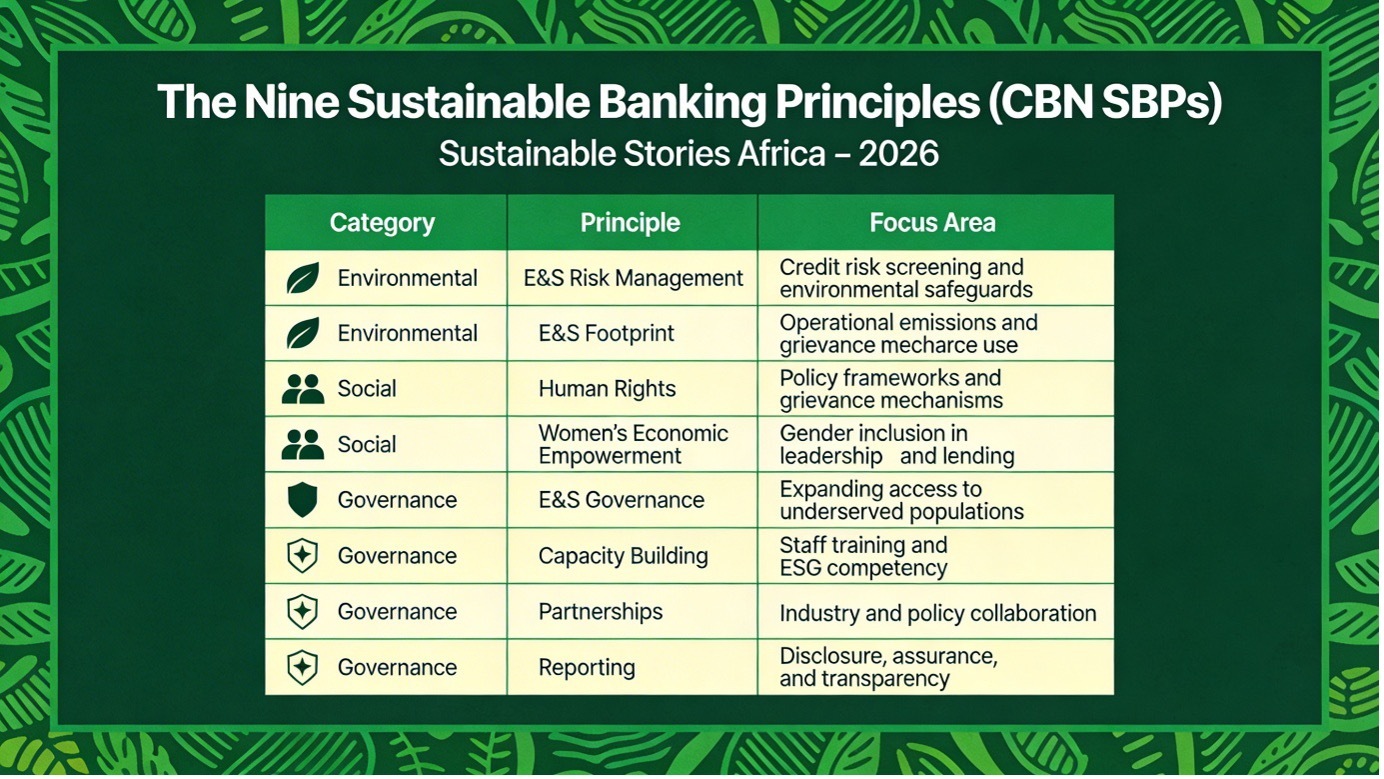
At its core, the SBP framework is structured around nine principles spanning environmental risk, social inclusion, and governance systems.
These include environmental and social risk management, human rights, women’s economic empowerment, financial inclusion, governance structures, and reporting obligations.
The Nine Sustainable Banking Principles (CBN SBPs)
Category | Principle | Focus Area |
|---|---|---|
Environmental | E&S Risk Management | Credit risk screening and environmental safeguards |
Environmental | E&S Footprint | Operational emissions and resource use |
Social | Human Rights | Policy frameworks and grievance mechanisms |
Social | Women’s Economic Empowerment | Gender inclusion in leadership and lending |
Social | Financial Inclusion | Expanding access to underserved populations |
Governance | E&S Governance | Board oversight and ESG integration |
Governance | Capacity Building | Staff training and ESG competency |
Governance | Partnerships | Industry and policy collaboration |
Governance | Reporting | Disclosure, assurance, and transparency |
The reporting scope is equally rigorous. Institutions must disclose:
- Portfolio exposure by ESG risk tier (high, medium, low)
- Sector-specific risk policies and screening criteria
- Operational metrics such as energy, water, and emissions
- Financial inclusion indicators and gender metrics
Beyond disclosure, the process itself is structured. Banks are required to establish baselines, align with CBN templates, obtain third-party assurance, secure board sign-off, and submit reports within three months of the financial year-end.
The Five-Step SBP Reporting Process
Step | Action | Strategic Purpose |
|---|---|---|
1 | Establish Baseline | Identify ESG data gaps and measurement systems |
2 | Use CBN Template | Standardise reporting and align with global frameworks |
3 | Seek Assurance | Enhance credibility through third-party verification |
4 | Board Sign-Off | Embed accountability at the governance level |
5 | Disclose & Submit | Ensure transparency and regulatory compliance |
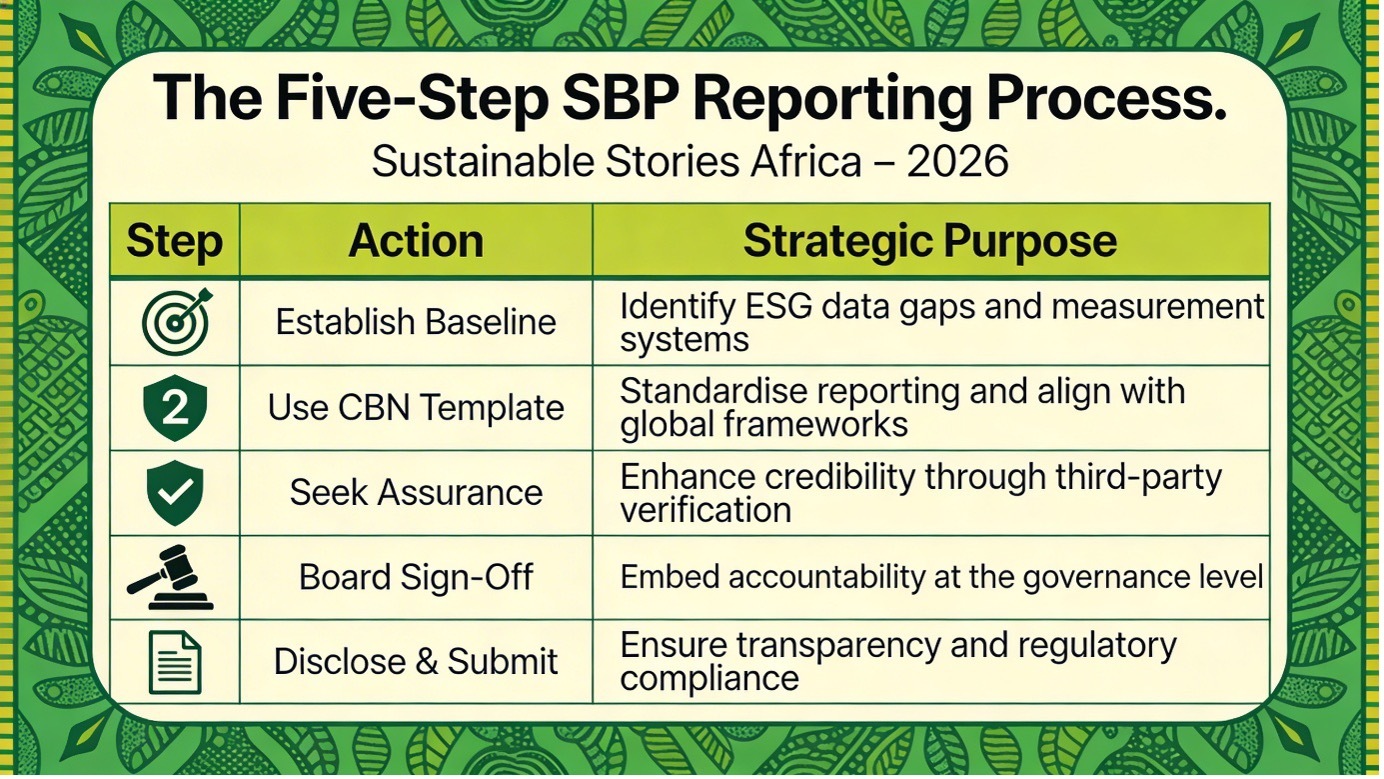
This structured approach signals a move toward institutionalising ESG within banking operations, not treating it as an add-on.
The Upside – Capital, Credibility, and Resilience
If implemented effectively, the SBPs offer more than regulatory compliance; they unlock strategic advantages.
- First, access to global capital. ESG-aligned banks are better positioned to attract funding from development finance institutions, climate funds, and sustainability-linked investors.
- Second, enhanced risk management. Integrating ESG into credit decisions reduces exposure to stranded assets, environmental liabilities, and social conflicts, particularly relevant in sectors such as oil and gas, agriculture, and infrastructure.
- Third, market differentiation. As ESG reporting becomes standardised, early adopters gain reputational advantages, positioning themselves as credible, forward-looking institutions.
The guide underscores that sustainability reporting “builds credibility with international lenders and ESG-focused investors” while demonstrating accountability to stakeholders.
However, the opportunity is matched by risk. Banks that delay implementation face:
- Higher cost of capital
- Increased regulatory scrutiny
- Reputational exposure, particularly around greenwashing
In this context, ESG becomes both a defensive necessity and an offensive strategy.
What Must Happen Next
To translate policy into practice, Nigerian financial institutions must move decisively across five priority areas:
- Embed ESG into Core Strategy – Sustainability must be integrated into corporate planning, not treated as a reporting function. This includes aligning ESG metrics with business objectives and risk frameworks.
- Strengthen Governance Structures – Boards must take ownership of ESG oversight, with dedicated sustainability committees and executive accountability tied to performance metrics.
- Invest in Data and Technology – A recurring challenge is data inconsistency. Institutions need integrated ESG data systems, with clear ownership and verification protocols.
- Build Internal Capacity – Training remains a critical gap. Banks must invest in upskilling credit officers, risk teams, and leadership to understand ESG implications.
- Align With Global Standards – To remain competitive, Nigerian banks must align with frameworks such as IFRS S1/S2, GRI, and TCFD, ensuring comparability with global peers.
The guide highlights practical solutions, including third-party assurance, ESG-linked executive incentives, and partnerships with institutions like UNEP FI and CIBN.
In essence, implementation requires a shift from policy awareness to operational execution.
Path Forward – From Reporting to Strategic Value
Turning Compliance Into Competitive Edge
Nigeria’s banking sector must move beyond compliance to embed ESG into decision-making, governance, and capital allocation.
This means aligning reporting with global standards, investing in data systems, and strengthening board-level accountability.
Building Trust, Unlocking Capital
If executed effectively, the SBPs can position Nigerian banks as credible players in global sustainable finance, unlocking investment, reducing risk, and building long-term resilience across the financial system.