The Sustainable Development Goals are often read as 17 separate promises. However, the real story is how governance, society, the economy and environment rise or fall together.
A visual explainer on SDG understanding captures that logic clearly, at a time when global progress is slipping, and African markets face rising pressure to deliver jobs, resilience and public trust.
Why the SDGs still matter
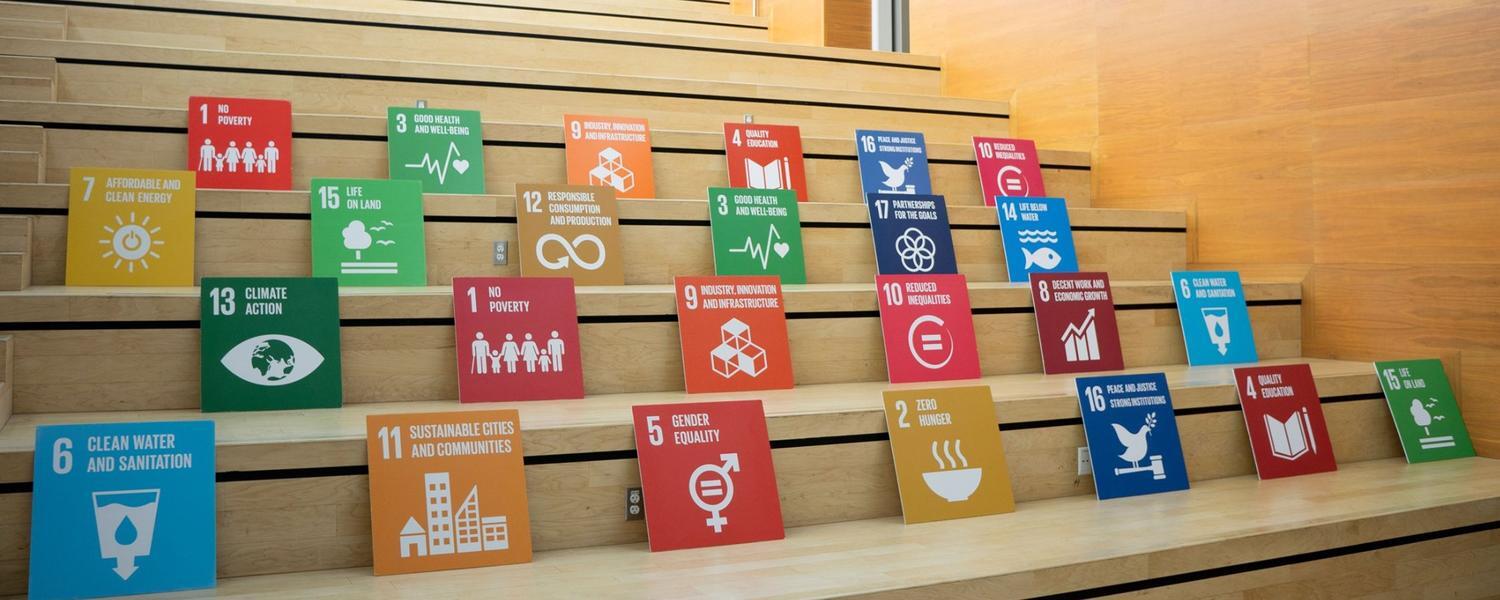
The image titled “SDG understanding” does something many policy papers fail to do: it makes the Sustainable Development Goals feel connected, practical and alive. Rather than presenting the 17 goals as a flat list, it stacks them into a development system, linking governance at the top, society above the economy, and the environment as the base that sustains them all.
That framing lands at a crucial moment. The United Nations highlights that only 17% of SDG targets are currently on track, with nearly half showing only minimal or moderate progress and more than one-third stalled or regressing.
The broader Sustainable Development Report finds that only 16% of targets are on track globally and that progress has largely stagnated since 2020.
For Africa and other emerging markets, this is not an abstract global scorecard. It is a reality that countries can expand jobs, improve public services, strengthen institutions and protect ecosystems, while trading one objective against another.
SDGs Falter Without Coherent Development Architecture
The urgency is clear: the Sustainable Development Goals (SDGs) are under strain, but the bigger risk lies in misinterpreting their purpose. Since 2020, global progress has stalled, with critical goals, including hunger, sustainable cities, life below water, life on land, and peace and justice, significantly off track. This matters because the SDGs were never designed as isolated priorities, but as an integrated development architecture.
A widely shared visual by Vishal Pagar illustrates this structure with clarity. Governance, anchored in peace, institutions, and partnerships, sits at the top, shaping outcomes across society, the economy, and the environment.
This hierarchy reflects a practical reality, particularly in African contexts: weak institutions undermine inclusive growth, while environmental decline erodes economic gains.
Failures in power, water, or public trust translate directly into inflation, reduced productivity, weaker investor confidence, and mounting fiscal pressure.
SDGs Demand Circular Systems, Not Linear Thinking
The central insight is that development is circular, rather than linear. The image reinforces its significance by explaining terms such as “resources,” “nutrients,” “make,” “use,” and “cycle,” echoing circular economy principles.
It highlights a critical point: extraction without regeneration is not growth, but depletion. This framing is increasingly relevant across African contexts, including food waste and plastics, to e-waste, water reuse, and industrial efficiency.
The urgency is underscored significantly by financing gaps. The UN Economic Commission for Africa estimates that $170 billion is required annually to close infrastructure deficits, while UNDP Africa estimates climate financing needs range from $118.2 billion to $145.5 billion annually.
These figures illustrate why siloed policymaking consistently fails. Disconnected efforts across climate, transport, and corporate sustainability cannot deliver results without aligned financing, governance capacity, and social systems, reinforcing the need for integrated SDG implementation.
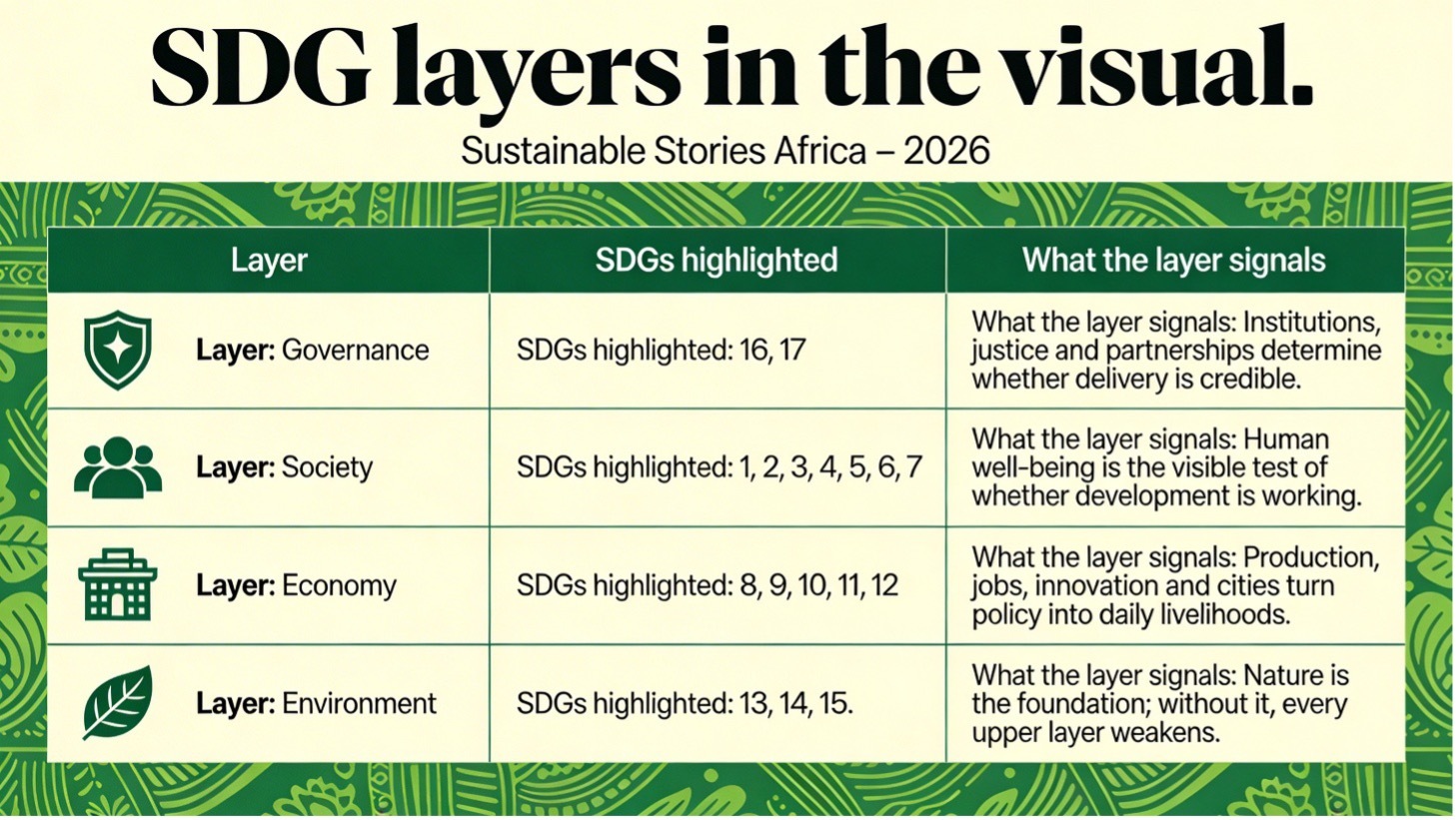
SDG layers in the visual
| Layer | SDGs highlighted | What the layer signals |
|---|---|---|
| Governance | 16, 17 | Institutions, justice and partnerships determine whether delivery is credible. |
| Society | 1, 2, 3, 4, 5, 6, 7 | Human well-being is the visible test of whether development is working. |
| Economy | 8, 9, 10, 11, 12 | Production, jobs, innovation and cities turn policy into daily livelihoods. |
| Environment | 13, 14, 15 | Nature is the foundation; without it, every upper layer weakens. |
Viewed sustainably, SDG 7 drives energy access, competitiveness, health, and resilience; SDG 6 shapes agriculture, urban planning and gender equity; and SDG 16 underpins institutional trust, contract certainty and credible public delivery across African markets and everyday community outcomes today.
Integrated Systems Unlock Compounding SDG Progress
A systems-based approach shows that development gains can compound when interventions target multiple SDGs simultaneously.
For example, resilient mini-grids can expand access to clean energy, reduce diesel-related health risks, boost local productivity, and lower emissions, delivering social, economic, and environmental returns.
This perspective is visible in the opportunities created by the circular economy. A UN estimate suggests the transition could create 11 million jobs across Africa, linking employment, innovation, sustainable consumption, and climate action.
However, financing remains critical. With the global SDG funding gap at $4 trillion annually, coordinated, integrated investment pipelines are essential to attract capital and accelerate implementation.
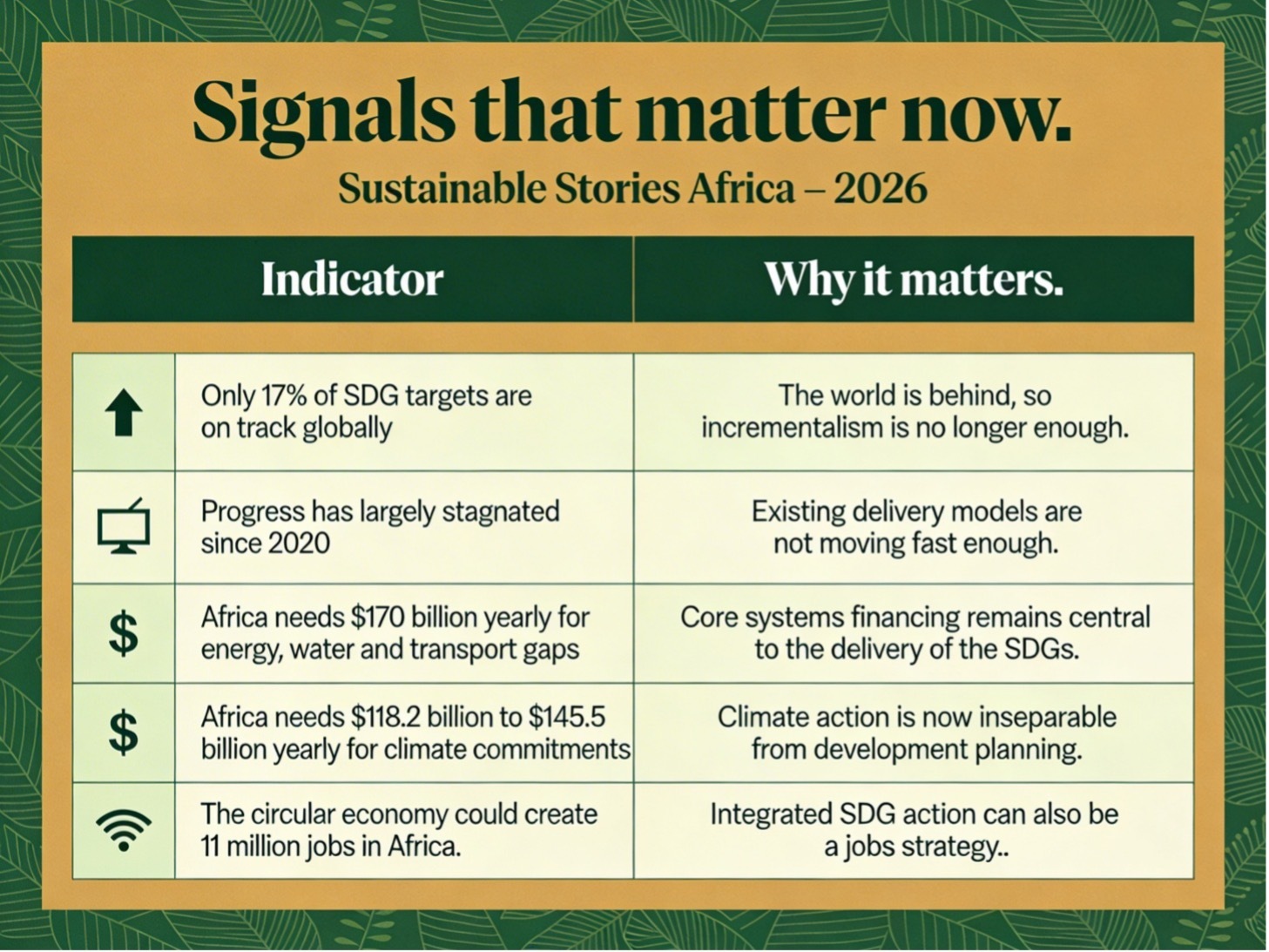
Signals that matter now
| Indicator | Why it matters |
|---|---|
| Only 17% of SDG targets are on track globally | The world is behind, so incrementalism is no longer enough. |
| Progress has largely stagnated since 2020 | Existing delivery models are not moving fast enough. |
| Africa needs $170 billion yearly for energy, water and transport gaps | Core systems financing remains central to the delivery of the SDGs. |
| Africa needs $118.2 billion to $145.5 billion yearly for climate commitments | Climate action is now inseparable from development planning. |
| The circular economy could create 11 million jobs in Africa | Integrated SDG action can also be a jobs strategy. |
SDGs Require Systems Thinking Across Stakeholders
For policymakers, the priority is to shift from viewing the SDGs as symbolic goals to using them as practical planning tools.
Public budgeting, regulation, and infrastructure investment must focus on cross-cutting outcomes such as jobs, resilience, inclusion, and environmental impact, rather than operating within rigid ministry silos.
For businesses and financiers, aligning sustainability strategies with local development needs improves effectiveness.
Investments in energy access, water, circular supply chains, and employment deliver stronger system-wide value than isolated initiatives.
For citizens and civil society, the key question remains: who benefits from development, and at what ecological cost over time?
Path Forward
The clearest lesson from this SDG explainer is that Africa does not need more fragmented ambition; it needs integrated execution.
With progress off track globally and financing gaps still large, leaders must align governance reform, social delivery, productive economies and ecological protection with their development logic.
What is advocated is simple but demanding: stronger institutions, smarter capital allocation, circular production systems and measurable delivery that treats the SDGs as an interdependent framework.