Feeding 10 billion people by 2050 is no longer just a question of land or yield; it is fundamentally about water.
A new World Bank report argues that without a systemic rethink of how water is allocated, managed, and valued, current agricultural systems can barely sustain a third of future demand.
Rethinking Water for Food Systems
The global food system is approaching a structural limit, and water is at the centre of the constraint.
By 2050, the world will need to feed nearly 10 billion people; however, current agricultural water management systems can sustainably support only about 3.4 billion people.
This stark mismatch, outlined in the World Bank’s Nourish and Flourish report, reframes the global food security debate.
The challenge is no longer simply increasing production; it is about fundamentally redesigning how water is used across food systems.
For Africa and other emerging markets, the stakes are especially high. Agriculture remains the backbone of livelihoods, yet water variability, inefficient irrigation, and fragmented policy frameworks continue to constrain productivity.
The report makes a clear case: solving food security is, in essence, a water governance challenge.
A System Feeding Billions, Failing Billions More
The most striking insight from the report is not about scarcity, but inefficiency.
Today’s agricultural water management (AWM) systems are misaligned, leading to both overuse and underuse of water resources.
In many regions, water is applied inefficiently to low-value crops, while in others, rainfed agriculture suffers from insufficient investments in irrigation systems.
The result is a system that wastes water where it is abundant and fails to deliver it where it is needed most.
This imbalance is not just an environmental issue; it is an economic one. A 10% increase in agricultural productivity can reduce poverty rates by approximately 3%.
For policymakers, the message is urgent: water mismanagement is quietly undermining both food security and economic development.
The Water – Food Nexus and Africa’s Strategic Position
The World Bank introduces a new analytical framework that categorises countries based on two variables:
- Water availability (water-secure vs water-stressed)
- Food trade position (net importers vs exporters)
This framework enables more targeted policy responses, recognising that solutions must reflect local realities rather than global averages.
Four Water – Food System Contexts
Category | Characteristics | Strategic Priority |
|---|---|---|
Water-secure importers | Adequate water, food deficits | Expand irrigation sustainably |
Water-secure exporters | Strong water and export base | Optimise productivity, maintain output |
Water-stressed exporters | Limited water, export reliance | Improve efficiency, reduce water footprint |
Water-stressed importers | Scarce water, food dependence | Reallocate water, prioritise resilience |
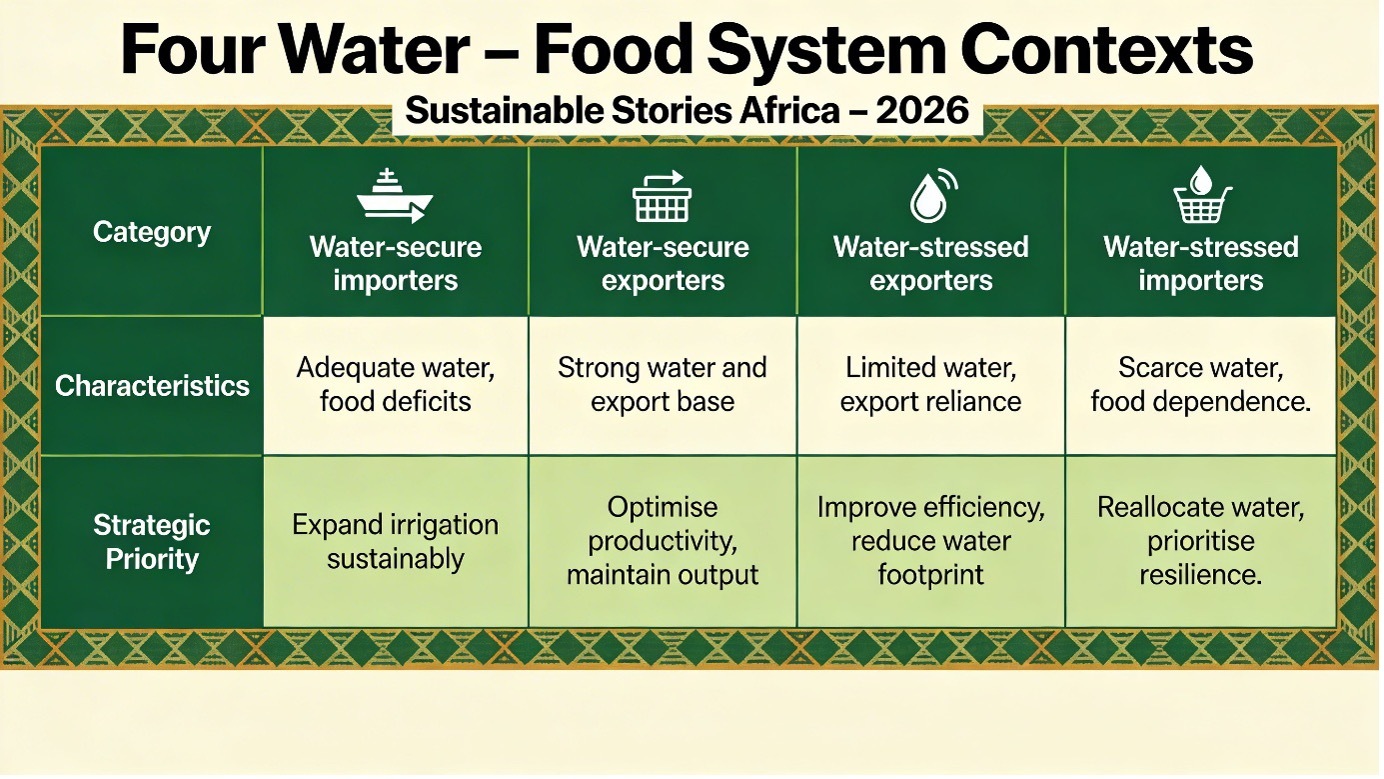
This typology is particularly relevant for Africa, where countries span all four categories, from water-abundant regions in Central Africa to highly water-stressed economies in the Sahel.
The report also highlights a major opportunity: converting rainfed agriculture to irrigation, within sustainable limits, could generate up to 245 million jobs globally, with about 218 million in sub-Saharan Africa alone.
This positions water infrastructure not just as an agricultural investment, but as a labour market and development strategy.
Unlocking a Water-Smart Agricultural Future
If implemented effectively, water-smart agricultural systems could transform economies.
Improved irrigation, better allocation, and increased water productivity can:
- Boost crop yields without expanding land use
- Reduce pressure on ecosystems and downstream water users
- Strengthen resilience to climate shocks
- Enable diversification into higher-value crops
Crucially, the report emphasises that water efficiency does not require sacrificing production. In fact, better management can increase output while reducing environmental impact.
For Africa, this represents a pathway to:
- Scale Agro-processing industries
- Reduce food imports
- Enhance rural incomes
- Build climate-resilient food systems
The opportunity is not hypothetical; it is already being demonstrated in pockets where irrigation, data systems, and policy incentives align.
From Policy Reform to System Redesign
The report outlines a set of practical, system-level interventions.
Priority Actions for Water-Smart Food Systems
Policy Lever | Key Action | Expected Impact |
|---|---|---|
Water Allocation | Implement data-driven water zoning systems | Reduce waste, improve efficiency |
Irrigation Systems | Modernise and expand irrigation infrastructure | Increase productivity |
Energy Transition | Promote renewable-powered irrigation | Lower costs, reduce emissions |
Market Incentives | Shift water use to higher-value crops | Maximise economic returns |
Consumer Awareness | Promote water-smart diets | Reduce system-wide water demand |
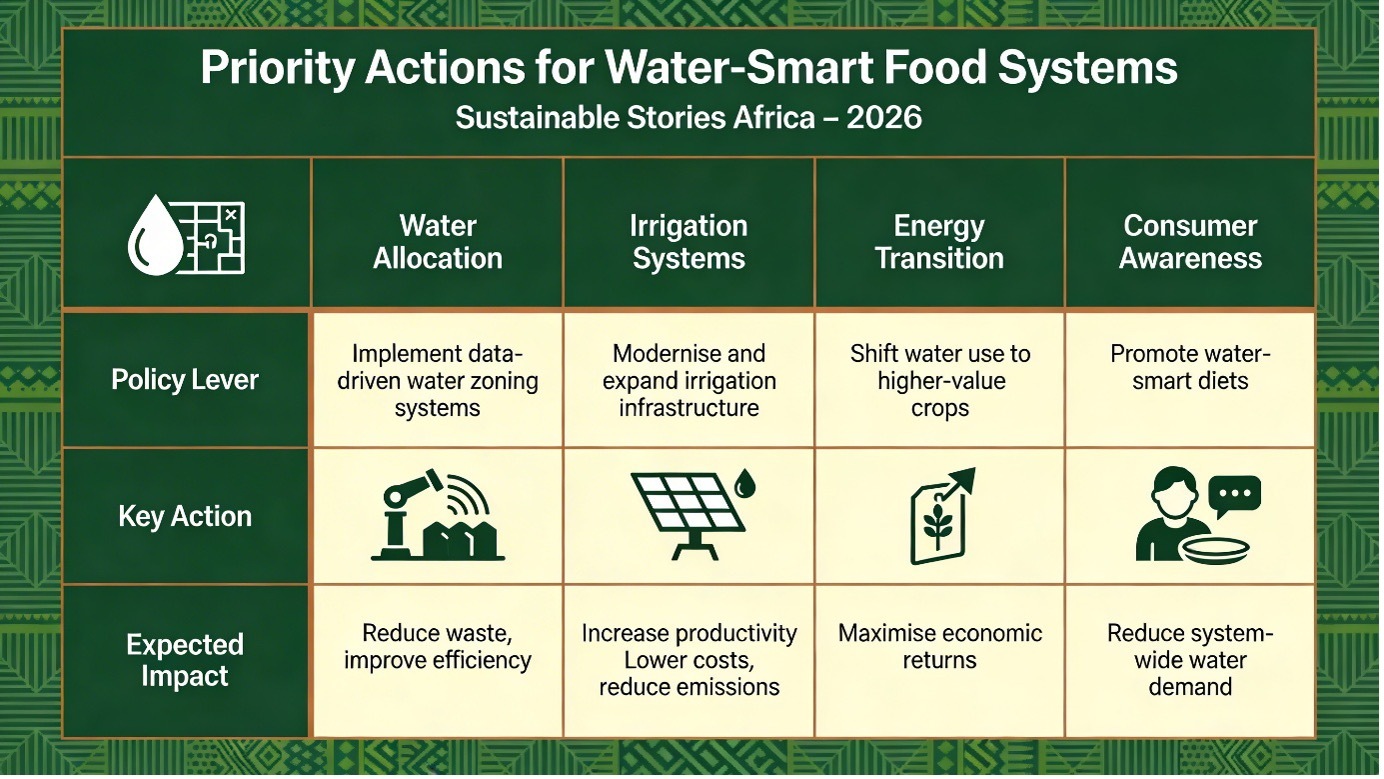
One of the most critical recommendations is the use of data-based water allocation systems to ensure water is directed toward the most productive and sustainable uses.
The report also calls for integrating renewable energy into irrigation systems, particularly for smallholder farmers, unlocking both cost savings and climate finance opportunities.
Importantly, financing is not the primary constraint. The report notes that required investments in water management are lower than current global agricultural subsidies, suggesting that the issue is one of reallocation, rather than scarcity of capital.
Path Forward – Align Water, Food, and Growth
Feeding 10 billion people requires more than expanding agriculture; it demands redesigning water systems to match economic, environmental, and social realities.
For Africa, the priority is clear: invest in irrigation, strengthen governance, and align water use with value creation. Done right, water can shift from a constraint to a catalyst, powering food security, job creation, and sustainable growth.