South Africa’s 2026 Budget is not branded as a “green budget”, but its sustainability signal runs deeper.
A new SAICA Sustainability Snapshot shows how fiscal discipline, infrastructure investment, and social protection are being aligned to create a more bankable and credible transition pathway.
Fiscal Credibility Meets Transition Ambition
South Africa’s 2026 Budget is being reframed, not as a climate manifesto, but as a structural reset of the country’s sustainability architecture.
At the centre of this shift is a simple but powerful idea: sustainability begins with fiscal credibility. Without a stable macroeconomic foundation, the state cannot finance infrastructure, protect vulnerable populations, or crowd in private capital.
The SAICA Sustainability Snapshot – February 2026 (Issue 7) argues that the Budget’s deeper significance lies in strengthening the operating conditions for a “more bankable and socially defensible transition.”
For investors, policymakers, and development institutions, this signals a transition strategy grounded less in rhetoric and more in execution—where infrastructure, governance, and capital allocation define outcomes.
Sustainability Is Now a Fiscal Policy Question
The most consequential insight from the Snapshot is clear: fiscal sustainability is sustainability policy.
South Africa projects its consolidated deficit narrowing from 4.5% of GDP in 2025/26, with gross debt stabilising at 78.9% of GDP before easing over time.
This matters because rising debt service costs have historically crowded out infrastructure spending and social investment, two pillars of a just transition.
The Budget responds by repositioning public finance as a tool for governance. It links fiscal discipline directly to the ability to fund infrastructure, sustain social protection, and maintain investor confidence.
In practical terms, this is a shift from sustainability as a reporting exercise to sustainability as a capital allocation framework.
Infrastructure, Water, and Carbon Signals Align
The Budget’s sustainability logic becomes clearer when viewed through three interconnected systems: infrastructure, water, and carbon pricing.
Core Sustainability Signals in South Africa’s 2026 Budget
Pillar | Key Investment/Policy | Strategic Significance |
|---|---|---|
Infrastructure | R1.07 trillion public investment (MTEF) | Growth, jobs, service delivery |
Water Systems | R185.2 billion allocation | Economic productivity and resilience |
Carbon Pricing | Tax increased to R308/tCO₂e | Transition finance signal |
Social Wage | 60% of non-interest spending | Equity and social stability |
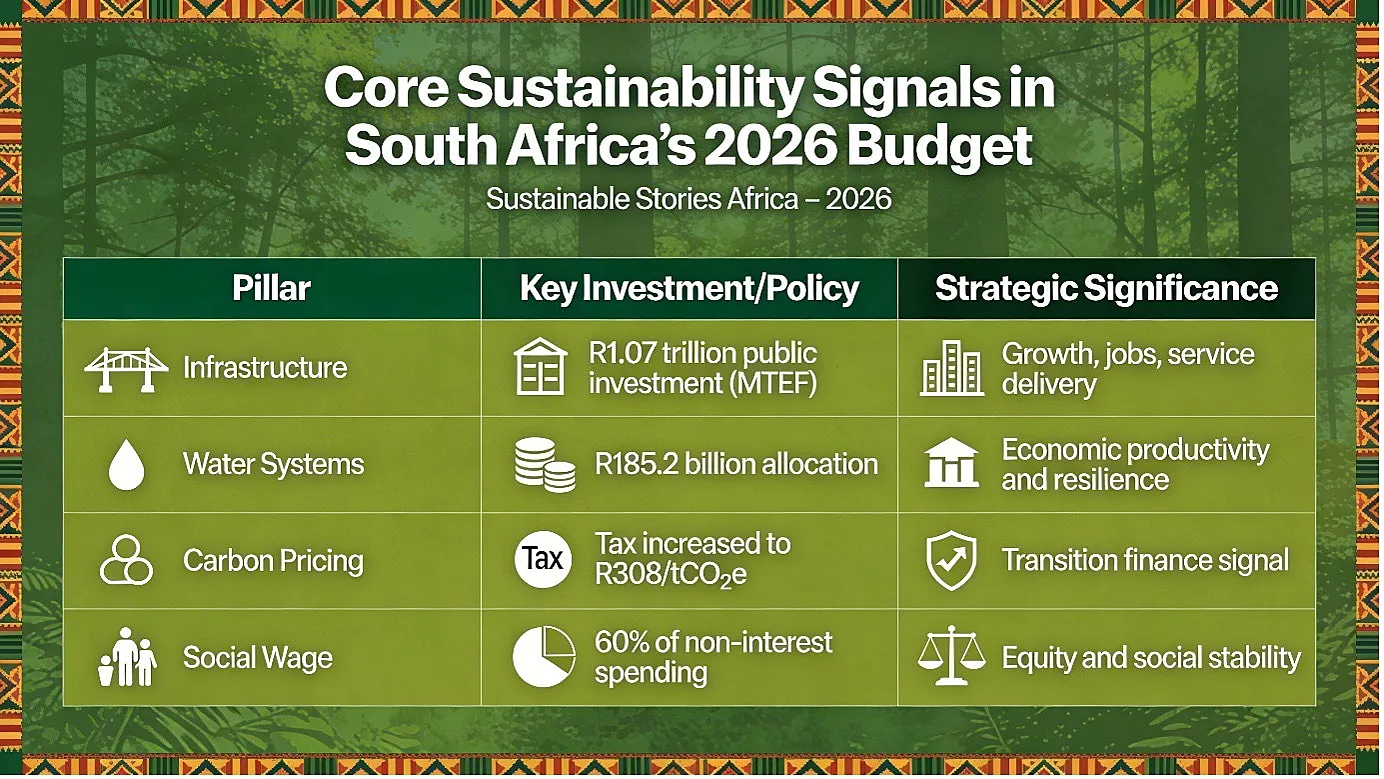
Public-sector infrastructure spending of R1.07 trillion prioritises transport, energy, water, and social services, sectors that underpin long-term productivity.
Water is elevated from a service issue to a core economic infrastructure priority, with R185.2 billion allocated to water and sanitation projects.
As highlighted in the section on page 3, investments in bulk water augmentation and infrastructure rehabilitation are designed to support industrial expansion, agriculture, and household resilience simultaneously.
At the same time, carbon pricing provides a directional signal. The carbon tax increase, from R236 to R308 per tonne of CO₂e, aligns fiscal policy with South Africa’s emissions targets under its Nationally Determined Contributions (NDCs).
Together, these measures create a layered sustainability framework:
- Infrastructure builds capacity
- Water ensures resilience
- Carbon pricing guides long-term behaviour
A Development-First Transition Model Emerges
If executed effectively, the Budget outlines a distinctive model: a development-first transition.
Rather than prioritising rapid decarbonisation at the expense of economic stability, South Africa is sequencing its transition:
- Stabilise fiscal conditions
- Invest in enabling infrastructure
- Protect households and vulnerable populations
- Introduce carbon signals gradually
This approach has several advantages:
- Investor confidence: Credible fiscal anchors reduce sovereign risk and cost of capital
- Social legitimacy: Expanded grants and social spending maintain public support
- Private sector mobilisation: Instruments like the Credit Guarantee Vehicle (CGV) de-risk infrastructure investment
Notably, social spending remains a cornerstone. Around 60% of non-interest expenditure is allocated to the social wage, supporting education, healthcare, and grants for over 26 million beneficiaries.
This reinforces a critical insight: sustainability is not only about emissions; it is about equity, inclusion, and institutional credibility.
Closing the Execution and Governance Gap
Despite its strengths, the Snapshot identifies key gaps that must be addressed.
Priority Actions to Strengthen Sustainability Outcomes
Area | Required Action | Risk if Ignored |
|---|---|---|
Carbon Framework | Integrate tax, revenues, and transition metrics | Fragmented climate policy |
Infrastructure Delivery | Strengthen project appraisal and governance | Inefficient capital allocation |
Municipal Reform | Improve financial and service delivery systems | Infrastructure underperformance |
SME Support | Translate tax relief into growth and formalisation | Limited economic inclusion |
Data & Reporting | Build transparent sustainability dashboards | Weak investor confidence |
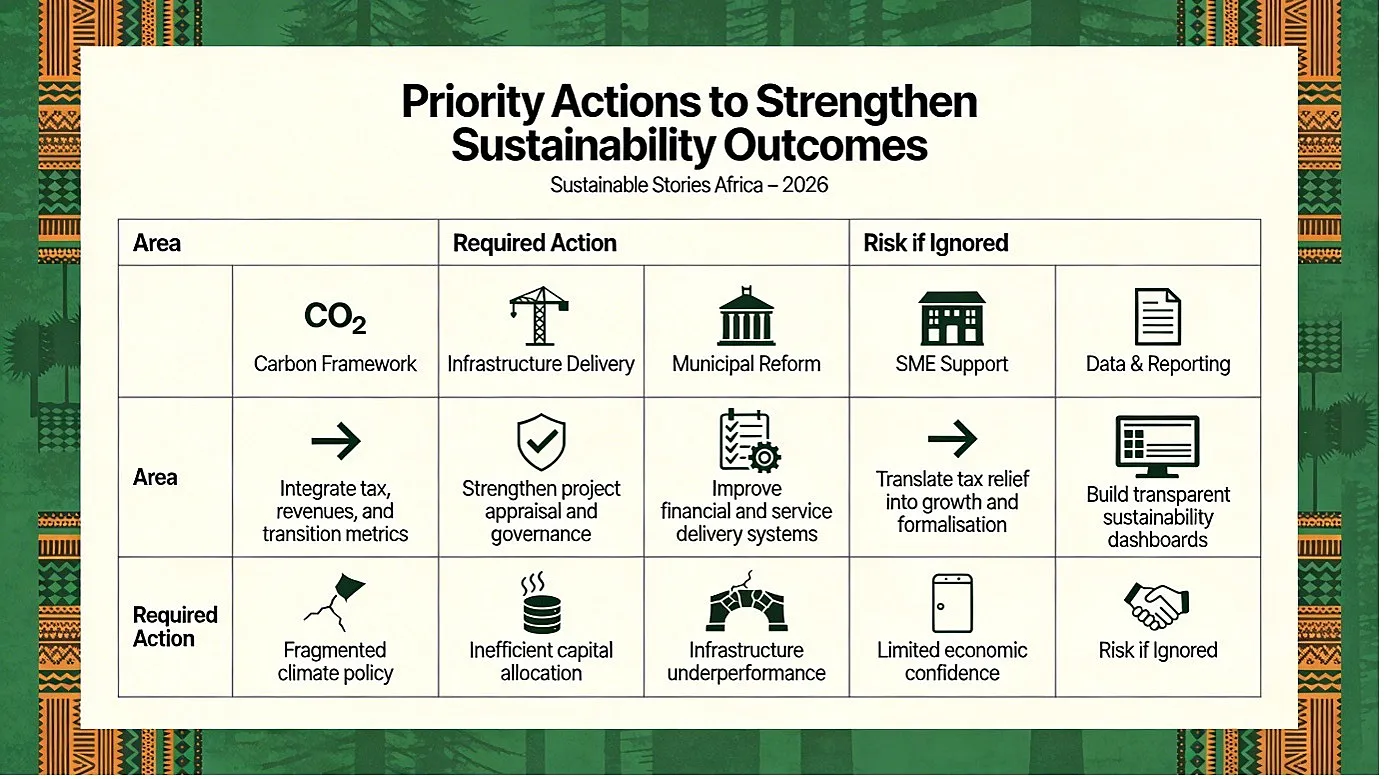
One of the most significant concerns is the lack of an integrated transition narrative.
While carbon pricing, infrastructure investment, and industrial policy exist, they are not yet presented within a unified framework that links:
- Carbon revenues
- Infrastructure spending
- Emissions outcomes
- Industrial transformation
This fragmentation risks diluting the effectiveness of otherwise strong policy signals.
Similarly, execution risk remains high. The success of the Budget will depend on:
- The governance of guarantee structures like the CGV
- The performance of infrastructure projects funded through the Budget Facility for Infrastructure (BFI)
- The credibility of social spending systems
In essence, sustainability has moved into the domain of measurement, governance, and assurance, core areas of institutional capacity.
Path Forward – Execution Defines Africa’s Transition Credibility
South Africa’s sustainability strategy now hinges on delivery, rather than design. Fiscal discipline, infrastructure investment, and social protection must translate into measurable outcomes, backed by transparent governance and data systems.
For African markets, the lesson is clear: credible transitions are built on financial architecture, not declarations.
Aligning capital, policy, and execution will determine whether sustainability becomes a growth driver, or remains an ambition.