New financial guarantee facilities are gaining traction as a powerful tool to unlock private investment in infrastructure.
By reducing risk for investors, these instruments are helping channel capital into projects that would otherwise struggle to attract financing.
For emerging markets, particularly across Africa, guarantees could play a crucial role in bridging the infrastructure financing gap and accelerating sustainable development.
Risk Guarantees Emerging As Infrastructure Investment Catalyst
Africa’s infrastructure deficit is one of the most significant barriers to economic growth, but a new financing tool is rapidly gaining attention as a solution.
Guarantee facilities, financial mechanisms that reduce investors risks, are increasingly used to unlock private capital for infrastructure projects across emerging markets.
Development institutions and multilateral lenders, including the World Bank and the African Development Bank, have highlighted guarantees as a critical instrument for mobilising private sector investment.
By protecting investors against specific risks, such as political instability, currency volatility, or payment defaults, guarantee mechanisms can make infrastructure projects far more attractive to institutional capital.
For regions with significant infrastructure needs but limited public financing capacity, the approach is gaining urgency.
Bridging Africa’s Infrastructure Financing Gap
Africa’s infrastructure needs are vast.
Estimates suggest the continent requires between $130 billion and $170 billion annually to build and maintain essential infrastructure, including power generation, transport systems, water networks, and digital connectivity.
However, financing remains constrained.
Private investors often perceive infrastructure projects in emerging markets as too risky due to regulatory uncertainty, political instability, or currency fluctuations.
Guarantee facilities are designed to address exactly those concerns.
How Guarantee Facilities Work
Mechanism | Function | Investor Impact |
|---|---|---|
Credit guarantees | Cover loan repayment risks | Encourages lenders to finance projects |
Political risk guarantees | Protect investors from political instability or policy changes | Reduces sovereign risk exposure |
Partial risk guarantees | Cover specific contractual risks | Improves the bankability of projects |
Blended finance guarantees | Combine public and private capital | Leverages institutional investment |
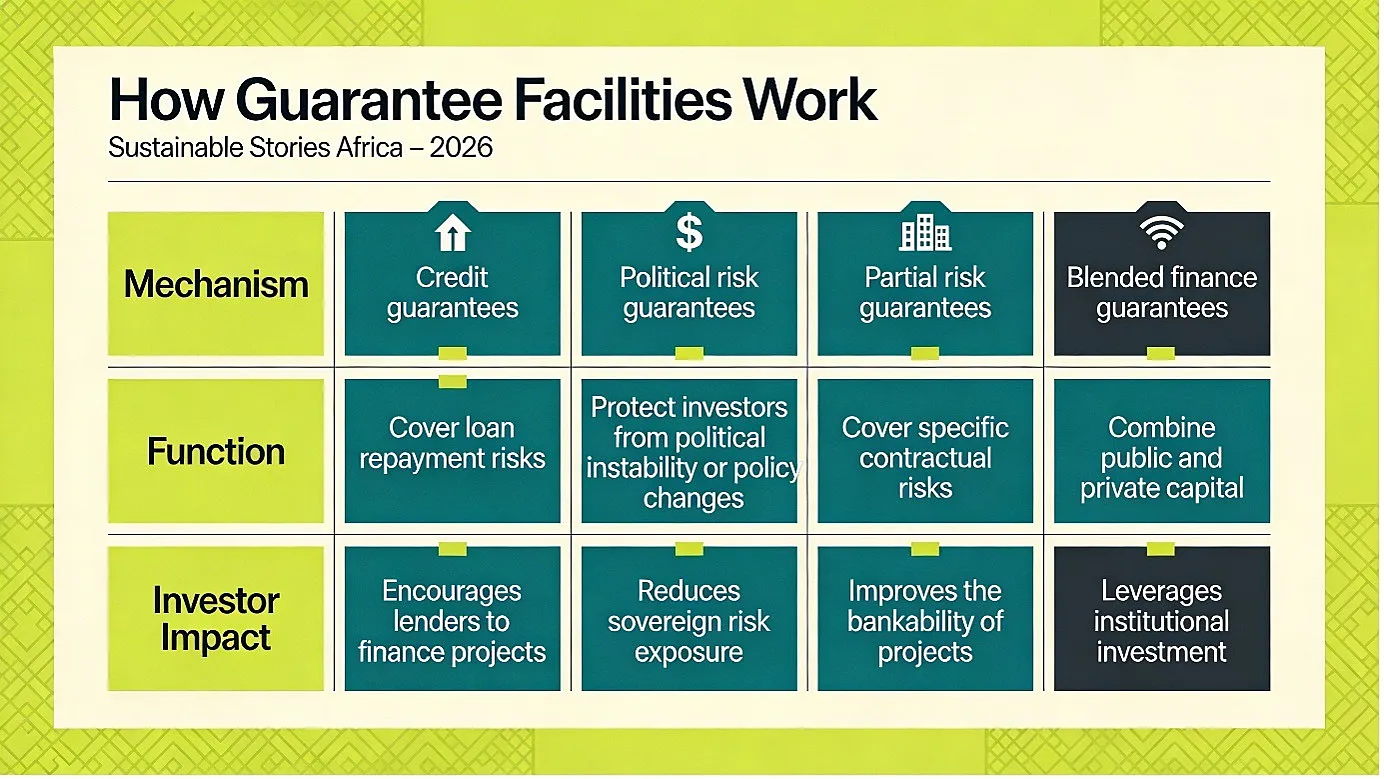
These tools allow governments and development institutions to use relatively small amounts of capital to mobilise significantly larger pools of private investment.
Infrastructure Financing Gap Snapshot
Indicator | Estimate |
|---|---|
Africa’s annual infrastructure financing needs | $130 billion – $170 billion |
Current annual infrastructure investment | $80 billion – $90 billion |
Estimated financing gap | $40billion – $80 billion |
Potential leverage from guarantee instruments | Up to 5 – 10x investment mobilisation |
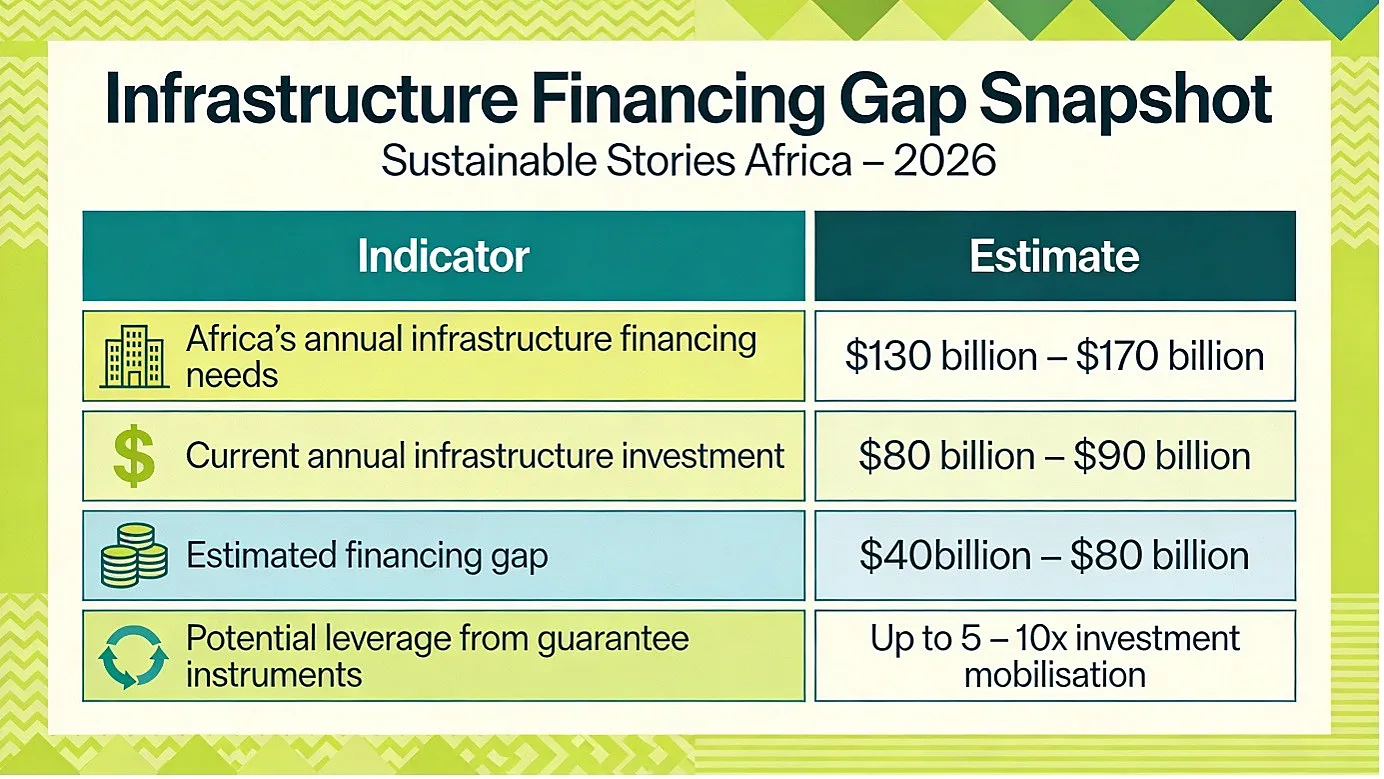
The ability to leverage public funds is one of the most attractive aspects of a guarantee mechanism.
Instead of financing entire projects directly, development institutions can use guarantees to catalyse private capital at scale.
Unlocking New Capital For Development
The growing interest in guarantee facilities reflects a broader shift in development finance.
Public budgets alone cannot meet the massive investment required to modernise infrastructure across emerging economies.
Guarantee instruments offer a practical way to de-risk projects while mobilising institutional capital, including pension funds, insurance companies, and sovereign wealth funds.
For Africa, this approach could transform investment flows.
Infrastructure sectors such as renewable energy, transportation networks, and water systems often offer strong long-term returns, but require stable financing structures to attract global investors.
Guarantee-backed projects can provide that stability.
For citizens, the benefits are tangible.
Improved infrastructure can boost economic productivity, expand energy access, improve trade logistics, and strengthen climate resilience.
Building Stronger Guarantee Ecosystems
However, experts caution that guarantee facilities alone will not solve the infrastructure financing challenge.
To maximise their effectiveness, countries must also strengthen policy and regulatory frameworks that support private investment.
Key priorities include:
- Transparent infrastructure procurement processes
- Stable regulatory environments for investors
- Clear project pipelines and feasibility studies
- Strong partnerships between governments and development institutions
Financial innovation must also continue.
Blended finance models, combining guarantees with concessional loans, grants, and private capital, are increasingly seen as essential for scaling infrastructure investment.
As global demand for sustainable infrastructure grows, guarantee facilities could become one of the most powerful tools for mobilising capital in emerging markets.
Path Forward – Risk Sharing To Unlock Infrastructure Capital
Guarantee facilities are rapidly emerging as a cornerstone of modern development finance.
By reducing risk and attracting private investors, these mechanisms can help bridge Africa’s infrastructure financing gap while accelerating sustainable growth and economic transformation.
Culled From: Guarantee facilities to unlock private infrastructure capital