The energy transition is no longer just about adding wind turbines and solar panels; it is about whether power systems can flex fast enough to keep the lights on at a reasonable price.
A New IRENA analysis shows that by 2050, the world's grids may need up to ten times more flexibility than in 2019 to manage daily swings in demand and variable renewables, turning flexibility from a technical afterthought into the backbone of secure, affordable decarbonisation.
From African interconnectors and batteries to consumer-led demand response in Europe, the emerging story is clear: countries that treat flexibility as critical infrastructure, and plan it alongside renewables and grids, will define the winners and losers of the clean power race.
When Flexibility Becomes The Fuel
The global power system is being reshaped in real time, and flexibility is emerging as the decisive factor for a stable, affordable, and low-carbon energy future.
As renewables scale rapidly and electricity becomes the dominant energy carrier, the central challenge is no longer capacity alone, but the ability to absorb, shift, and store volatile power flows across hours, days, and seasons.
A new IRENA report warns that under a 1.5°C pathway, daily flexibility needs will be ten times higher by 2050, with weekly and monthly demands rising sixfold. Even under less ambitious policies, requirements will more than double.
For Africa and other emerging markets, flexibility is not optional. It is the enabling layer that determines whether solar and wind can deliver energy security, affordability, and climate resilience at scale.
Flexibility Crunch In A Warming World
At the heart of IRENA's latest report is a clear warning: the pace of global decarbonisation is outstripping the policies and investments needed to keep power systems flexible.
Under a 1.5°C pathway, solar and wind could supply 46% of global electricity by 2030 and 70% by 2050, up from just 9% in 2019. This shift fundamentally changes how grids must balance supply and demand.
To capture the impact, IRENA measures the energy required to manage fluctuations between net load and its daily, weekly, or monthly averages.
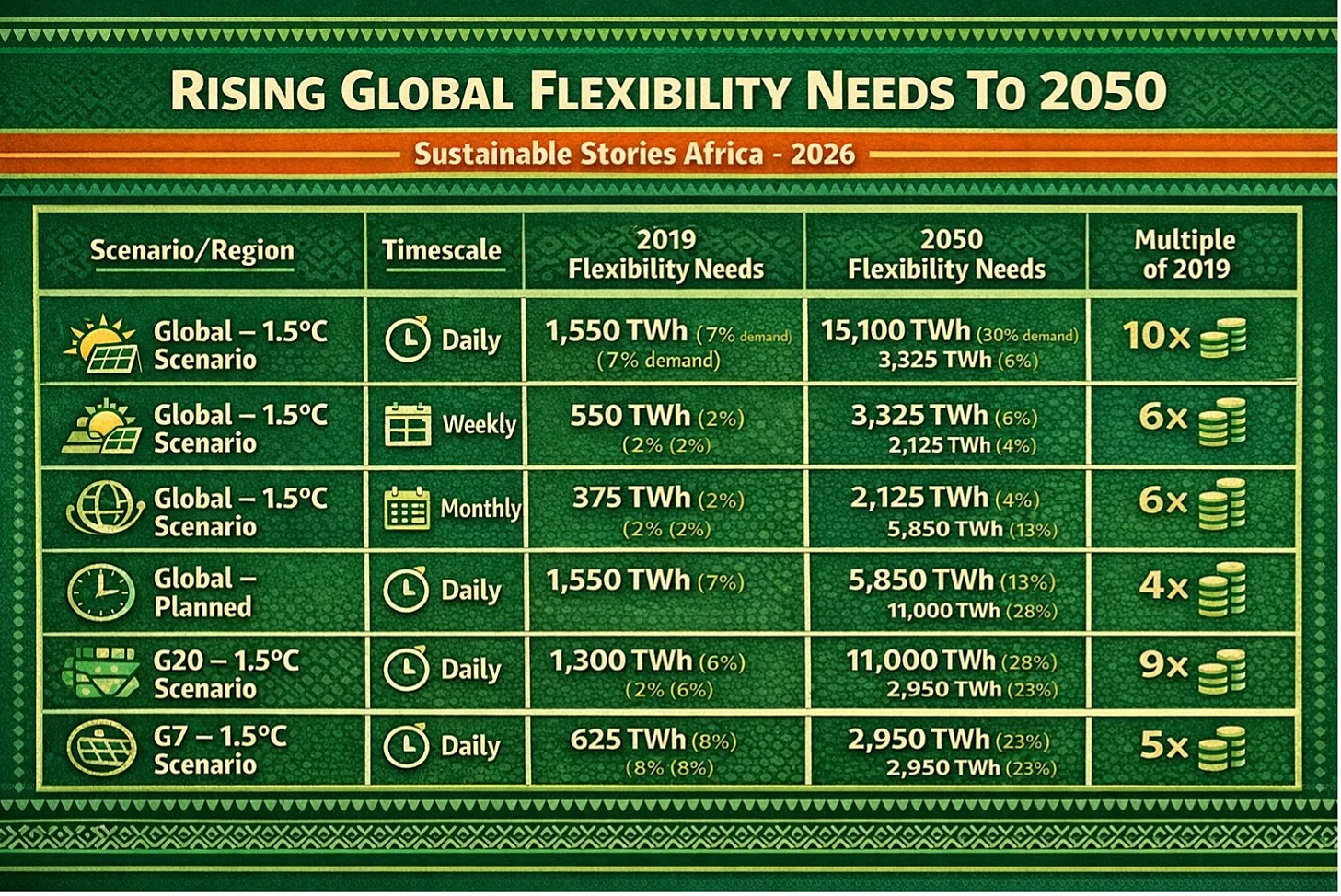
By 2050, daily flexibility needs could reach about 30% of annual electricity demand, up from 7% in 2019, while weekly and monthly needs also rise sharply.
In G20 and G7 economies, flexibility is no longer marginal. It is becoming the core operating condition of modern power systems.
Rising Global Flexibility Needs To 2050
| Scenario/Region | Timescale | 2019 flexibility needs | 2050 flexibility need | Multiple of 2019 |
|---|---|---|---|---|
| Global – 1.5°C Scenario | Daily | 1,550 TWh (7% demand) | 100 TWh (30% demand) | 10× |
| Global – 1.5°C Scenario | Weekly | 550 TWh (2%) | 325 TWh (6%) | 6× |
| Global – 1.5°C Scenario | Monthly | 375 TWh (2%) | 125 TWh (4%) | 6× |
| Global – Planned | Daily | 1,550 TWh (7%) | 850 TWh (13%) | 4× |
| Global – Planned | Weekly | 1,550 TWh (7%) | 1,850 TWh (13%) | 4× |
| G20 – 1.5°C Scenario | Daily | 1,300 TWh (6%) | 11,000 TWh (28%) | 9× |
| G7 – 1.5°C Scenario | Daily | 625 TWh (8%) | 2,950 TWh (23%) | 5× |
Why Grids Need Flexibility Everywhere, Always
Flexibility needs are surging not just because there is more renewable power on the grid, but because solar and wind behave differently from traditional plants, rising and falling with the weather and seasons.
As transport, buildings, industry and data centres electrify, demand patterns are also shifting across the day, week, month and year.
IRENA shows that systems must respond across multiple timescales: from instant frequency corrections after a fault, to managing the daily "duck curve", to riding out week-long wind lulls or seasonal extremes.
Flexibility itself is not a single gadget but a system capability, built from portfolios of tools including hydropower, flexible gas, batteries, long-duration storage, demand response, interconnectors and smarter market operations, which still fall behind renewable rollout in many emerging economies.
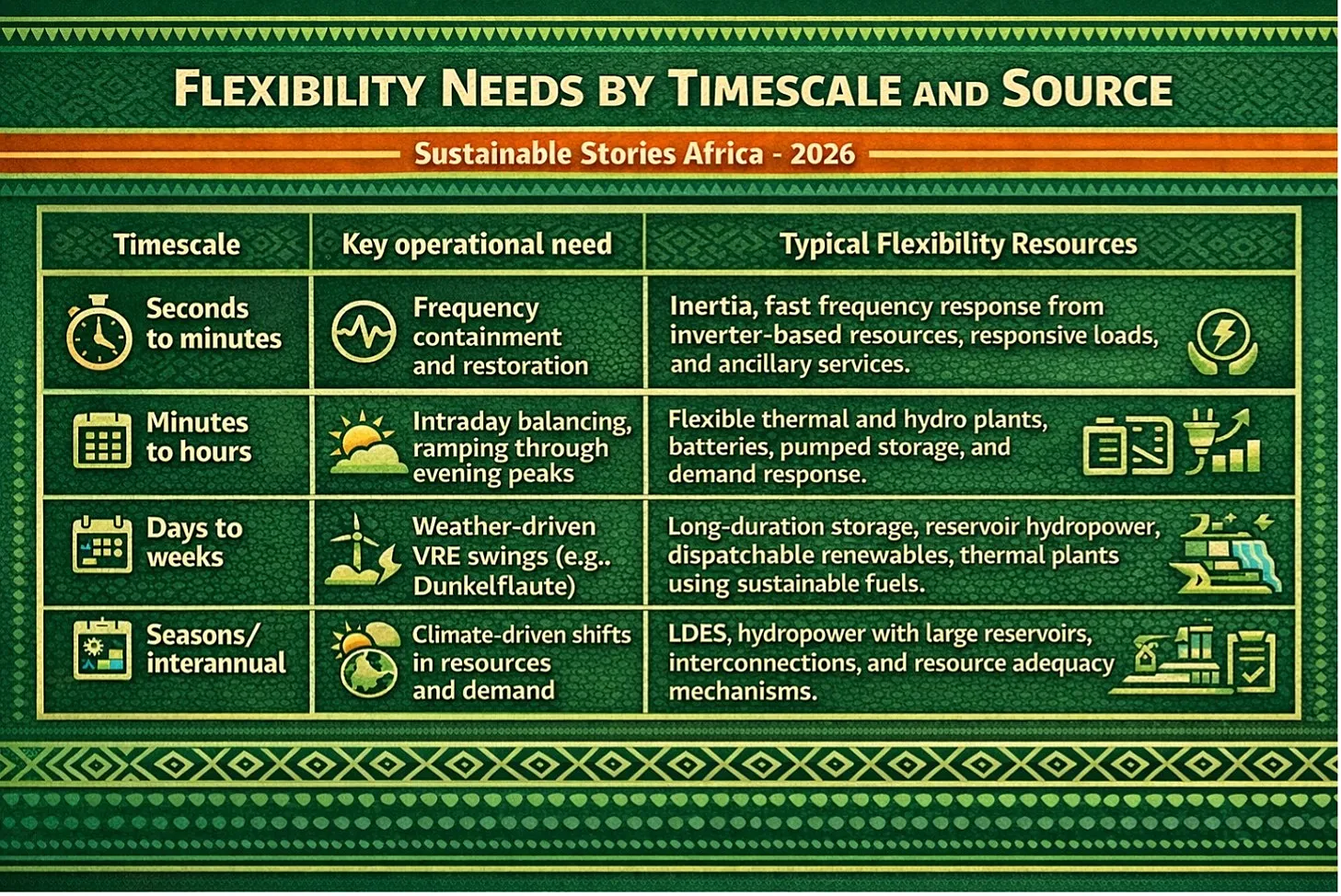
Flexibility Needs By Timescale And Source
| Timescale | Key operational need | Typical flexibility resources |
|---|---|---|
| Seconds to minutes | Frequency containment and restoration | Inertia, fast frequency response from inverter-based resources, responsive loads, and ancillary services. |
| Minutes to hours | Intraday balancing, ramping through evening peaks | Flexible thermal and hydro plants, batteries, pumped storage, and demand response. |
| Days to weeks | Weather-driven VRE swings (e.g., Dunkelflaute) | Long-duration storage, reservoir hydropower, dispatchable renewables, thermal plants using sustainable fuels. |
| Seasons/interannual | Climate-driven shifts in resources and demand | LDES, hydropower with large reservoirs, interconnections, and resource adequacy mechanisms. |
Flexibility Portfolios As Just Energy Policy
The first phase of the energy transition proved that renewables can beat fossil fuels on cost; the next must show that flexible systems can deliver that clean power reliably and fairly.
IRENA's modelling for Africa highlights how batteries, long-duration storage and interconnectors can slash the energy "swing" grids need to manage, reducing curtailment and blackout risks while enabling power trade across diverse weather patterns.
Demand-side measures add a powerful, people-centred layer. Shifting just 10% of peak demand from evening to midday can ease daily balancing needs, and consumer programmes that reward households and businesses for shifting use turn flexibility into both a resilience and equity tool.
At heart, the task is scaling flexibility in step with every new gigawatt of solar and wind.
Planning For Megaflex, Not Just Megawatts
The report's quiet provocation is that no country can meet its climate and energy security goals by focusing on capacity targets alone.
IRENA calls for flexibility to be fully integrated into power system planning, with explicit quantification of needs under different decarbonisation scenarios and climate conditions, and with tools like its FlexTool used to identify system-specific gaps and portfolios.
Practically, this means regulators and planners must stop treating flexibility as a residual service and instead set clear, technology-neutral frameworks that value fast response, duration and locational benefits across timescales.
Examples already exist: the European Union has adopted a common methodology for assessing flexibility needs and expects member states to define national flexibility targets by 2027, while the United Kingdom is introducing a cap-and-floor mechanism to unlock long-duration storage projects backed by detailed system studies.
For emerging markets, especially in Africa, Asia and Latin America, the report points to three immediate policy levers.
- Integrate flexibility into renewable tenders and grid codes, rewarding projects that bundle storage, demand response or hybrid configurations rather than pure megawatt additions.
- Prioritise regional interconnection and market coupling that allow countries to share flexibility resources and smooth variability, instead of overbuilding isolated national reserves.
- Use concessional and blended finance to de-risk early investment in storage, digitalisation and demand-side platforms, recognising flexibility as a good public enabler of affordable electrification.
The next phase of the transition is not about chasing one "hero" solution but assembling tailored flexibility portfolios that match each country's climate, load shape and development goals.
Solar-led systems may prioritise daily storage and demand response, wind-heavy grids deeper interconnection and seasonal buffers, while hydropower economies modernise dams as living batteries.
What ultimately ties these choices together is politics, not physics: flexibility must be funded, regulated and reported with the same urgency and visibility as new solar parks and offshore wind zones if clean power is to be both reliable and fair.
Path Forward – Flexibility First In Power Planning
Across every scenario, the signal is the same: flexibility must be measured, planned and financed with the same intent as new renewables and grid lines if power systems are to stay secure, affordable and low carbon.
Countries that bake storage, demand response, interconnection and smart operations into core energy strategies now will cope better with rising electrification and harsher climate shocks.
For African and other emerging systems, early, regionally coordinated investment in flexibility, from consumer-led demand shifting and digital grids to storage and strategic interconnectors, can lift renewable shares without trading away reliability or fairness.
Done well, the shift from megawatts to "megaflex" turns today's variability risk into tomorrow's competitive advantage