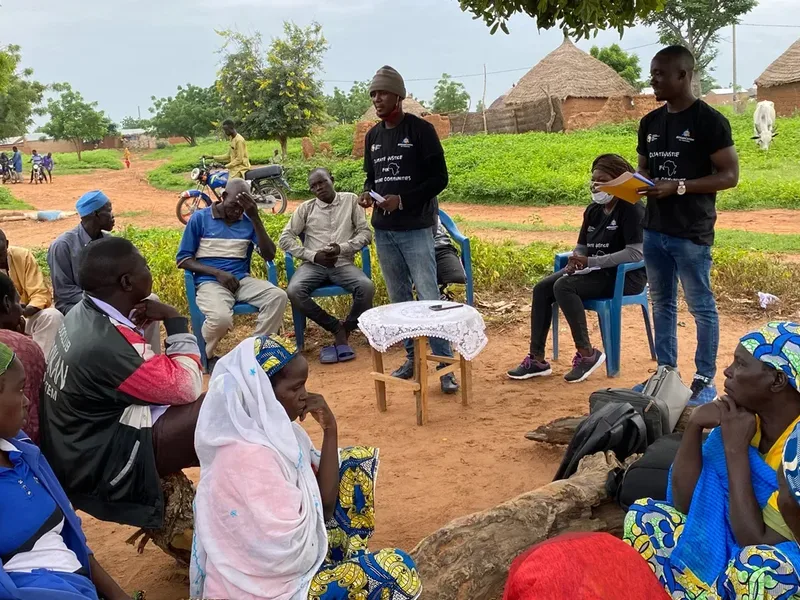
Artificial intelligence will not fail Africa due to its algorithms. It will fail or succeed because of institutions.
The UNDP's warning is clear: AI's benefits will cluster where governance, skills, and infrastructure already exist.
For Africa, the risk is not technological irrelevance. It is unequal integration into a system designed elsewhere.
Africa's AI Test: Inclusion Or Inequality
Part 2 of The Next Great Divergence? makes a sober observation: AI will shape human development through three intertwined channels: people, economy, and governance. Its aggregate gains may be positive. Its distribution will not be automatic.
Although the report focuses on the Asia-Pacific, its structural diagnosis applies powerfully to Africa. The continent is also diverse in readiness, infrastructure, institutional capacity, and digital inclusion.
In both regions, high-capacity systems are well enabled to capture early dividends; lower-capacity settings face dependency risks, accuracy gaps, and slower diffusion.
Part 2 reads not as a forecast, but as a governance test.
If AI becomes Africa's next essential infrastructure, like roads, schools, or electricity, then the continent must decide now whether that infrastructure will be inclusive by design or unequal by default.
Africa's Real AI Risk Is Institutional
The UNDP report frames AI as a human development multiplier, one that can expand freedoms, accelerate services, and strengthen resilience. However, it is equally clear: without guardrails, AI may deepen exclusion, erode trust, and widen divides.
Africa's risk is not simply that it lacks compute.
0AI systems may be deployed in fragile governance contexts where:
- Data protection frameworks remain uneven
- Public registries are incomplete
- Digital literacy is low
- Gender access gaps persist
- Vendor dependence is high
The report warns that high-capacity systems capture gains first while others remain dependent on imported models.
That is not merely a technical issue. It is a question of sovereignty.
Three Fault Lines Africa Cannot Ignore
People: Capability Expansion or Digital Exclusion?
Part 2 highlights the transformative potentials of AI in education, health care, disaster management, and social protection.
The promise is real:
- AI tutoring systems in Bhutan
- TB screening models
- Micro-credit expansion through AI scoring
- Disaster prediction tools
However, the report also identifies exclusion risks: Women in South Asia are 40% less likely to own smartphones. Data invisibility excludes minorities and rural populations. Biased systems deny benefits.
Africa mirrors these dynamics.
In many African economies:
- Rural broadband access is often half that of urban areas
- Women remain underrepresented in STEM and digital roles
- Informal workers lack digital identity trails
If AI relies on incomplete data, those without digital footprints risk being excluded by algorithms.
As a Kenyan social enterprise founder recently put it: "If you're not in the data, you don't exist in the system." That is not an exaggeration. It is a warning.
Economy: Dividends and Displacement
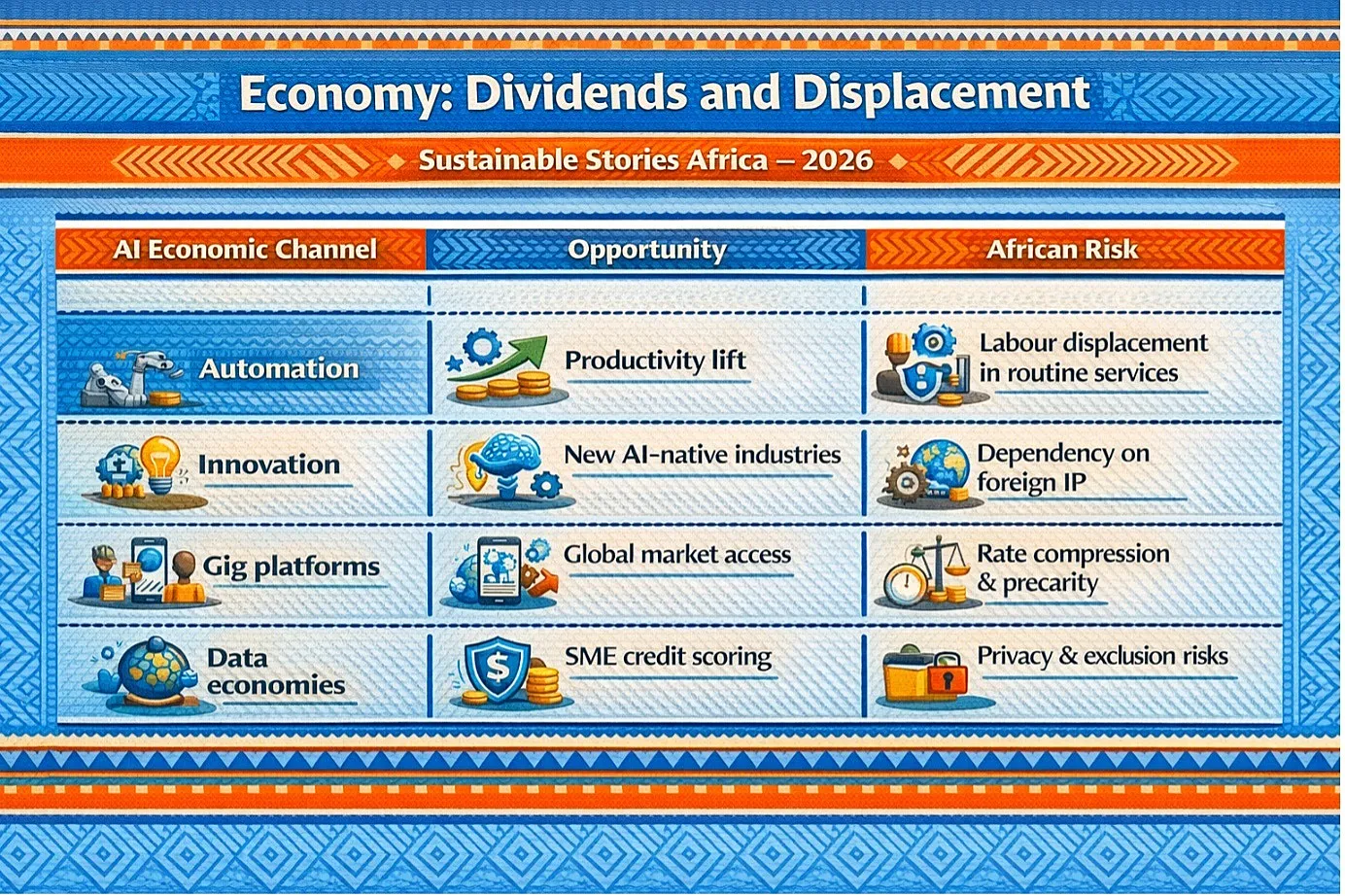
The report estimates AI-driven productivity gains ranging from 0.5% to 3.4% annually, with some projections exceeding 2% in certain economies. However, distribution remains uneven:
| AI Economic Channel | Opportunity | African Risk |
|---|---|---|
| Automation | Productivity lift | Labour displacement in routine services |
| Innovation | New AI-native industries | Dependency on foreign IP |
| Gig platforms | Global market access | Rate compression & precarity |
| Data economies | SME credit scoring | Privacy & exclusion risks |
The report notes that 25% of firms expect job losses alongside the creation of new roles.
Africa's informal sector, which often employs up to 60% of the workforce, cannot absorb rapid automation shocks without the redesign of social protection.
The question is not whether AI boosts GDP. It is whether Africa captures value or exports it.
Governance: Trust as the Hinge Variable
Part 2 is unequivocal: AI can make governance anticipatory, agile, and data-driven, but only where accountability mechanisms exist.
Chatbots reduce service resolution times in Singapore. Flood simulations enhance urban planning in Beijing.
But the report warns:
- Many AI systems operate as opaque "black boxes"
- Few countries have comprehensive AI regulation
- By 2027, over 40% of AI data breaches may stem from misuse across borders
In Africa, digital ID systems are expanding. Fintech ecosystems are scaling. E-government platforms are growing. However, transparency lags deployment.
If citizens cannot contest automated decisions in credit scoring, welfare eligibility, or law enforcement, AI will erode trust faster than it builds efficiency. And trust is development capital.
What an Inclusive AI Future Could Look Like
I do not believe Africa is destined for digital marginalization.
Imagine instead:
- AI-powered crop advisory systems in the Sahel are reducing climate vulnerability
- Local-language education bots narrowing literacy gaps
- AI-assisted diagnostics expanding rural healthcare access
- SME scoring models unlocking women-led enterprise financing
- Predictive public finance tools improving budget transparency
The UNDP principles are clear: start with a people-first approach, followed by responsible governance of innovations, and build future-ready systems, which are not abstract.
They are institutional levers.
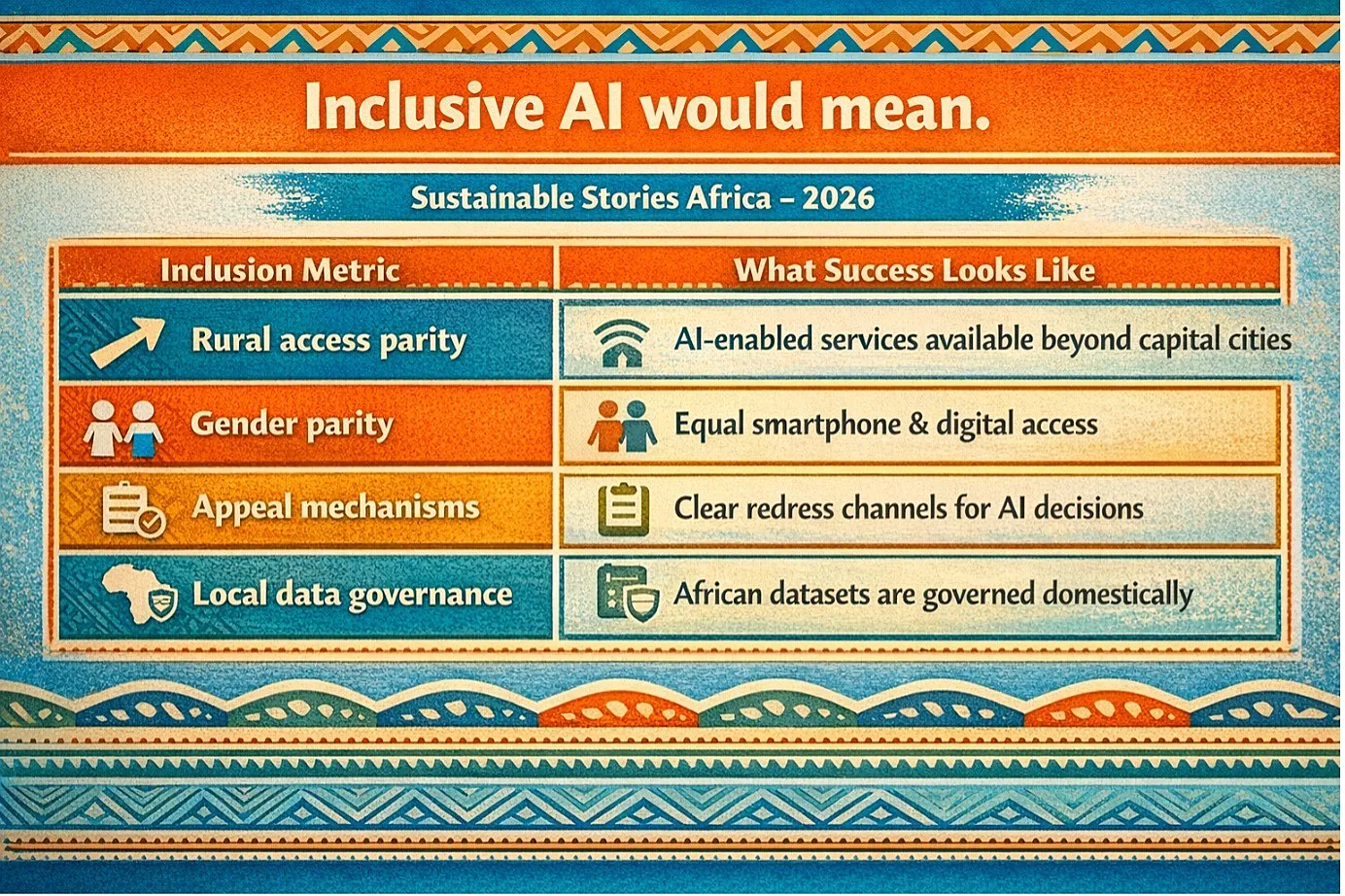
Inclusive AI would mean:
| Inclusion Metric | What Success Looks Like |
|---|---|
| Rural access parity | AI-enabled services available beyond capital cities |
| Gender parity | Equal smartphone & digital access |
| Appeal mechanisms | Clear redress channels for AI decisions |
| Local data governance | African datasets are governed domestically |
That is what convergence would look like.
Five Decisions African Leaders Must Make
AI diffusion will not wait for regulatory perfection. But institutional passivity is not an option.
- Treat AI as Public Infrastructure – Embed AI strategy within national development plans, not as a tech add-on.
- Synchronise Hard and Soft Levers – Connectivity and compute must align with skills and regulatory capacity.
- Mandate Transparency for High-Stakes AI – Welfare, justice, health, and credit decisions must remain explainable and appealable.
- Build Regional AI Sovereignty - African Union-level procurement standards can reduce vendor lock-in and regulatory fragmentation.
- Measure Inclusion, Not Adoption – Track outcome gaps, not chatbot launches.
The report emphasises sequencing actions over time and tailoring roadmaps by capacity level. Africa should adopt a similar differentiated roadmap:
- Lower-capacity states: prioritise connectivity, affordability, essential services
- Transitional economies: scale data governance, workforce transition
- Higher-capacity economies: lead regional standards and green AI
This is not about copying Asia. It is about learning from structural analysis.
PATH FORWARD – Build Trust Before Scale Accelerates
AI will accelerate. Institutions must keep pace. Africa's AI moment will not be defined by model size or the number/value of venture funding. It will be defined by whether governance, inclusion, and accountability are embedded from the start.
If trust anchors deployment, AI can compress development gaps. If opacity governs deployment, divergence will deepen. The next great divergence is not technological inevitability. It is an institutional choice.