La Niña-fuelled storms have triggered catastrophic flooding across parts of Southern Africa, displacing communities and damaging infrastructure.
Scientists say the climate pattern intensified rainfall across already vulnerable regions, exposing structural weaknesses in drainage systems, housing and disaster preparedness.
The floods underscore a widening adaptation gap: climate risk is accelerating faster than the readiness of institutions.
Climate Pattern Amplifies Regional Fragility
Severe flooding across Southern Africa has been linked to a La Niña weather pattern that intensified rainfall across multiple countries, overwhelming river basins and urban drainage systems.
The resulting destruction has affected thousands of households, disrupted agriculture and strained national emergency responses.
Scientists cited in recent assessments indicate that La Niña is characterised by cooler Pacific Ocean temperatures, altered atmospheric circulation patterns, and increasing moisture flows toward Southern Africa.
The outcome: extreme precipitation layered onto already saturated soils.
For governments navigating fiscal constraints and infrastructure backlogs, the floods represent more than a weather event. They signal systemic climate exposure.
What Happened And Why
Meteorological agencies observed above-average rainfall across parts of Zambia, Zimbabwe, Mozambique and South Africa. River systems breached capacity, informal settlements were submerged, and transport corridors were temporarily shut down.
Climate scientists note that while La Niña is a natural cyclical phenomenon, rising global temperatures increase the atmosphere’s moisture-holding capacity, amplifying rainfall intensity.
In short, natural variability is colliding with anthropogenic warming.
Structural Risk Snapshot
Factor | Current Condition | System Weakness |
|---|---|---|
Rainfall Intensity | Above the historical average | Drainage capacity exceeded |
Urban Expansion | Rapid informal growth | Inadequate zoning enforcement |
Agriculture Exposure | Floodplain cultivation | Crop vulnerability |
Disaster Funding | Limited adaptation budgets | Slow emergency mobilisation |
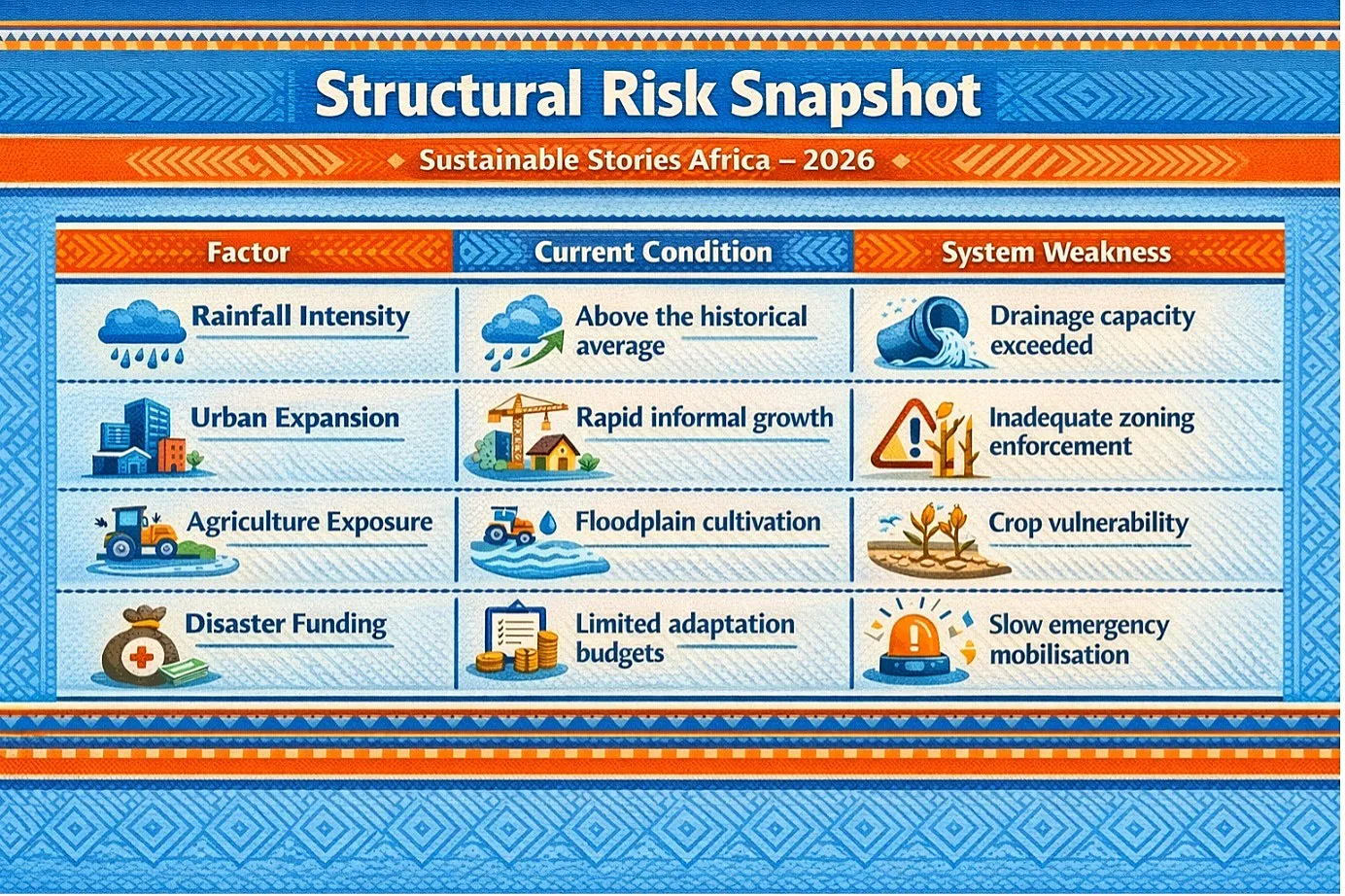
Floodplains that historically absorbed seasonal overflow are increasingly populated. Urbanisation without parallel stormwater infrastructure magnifies loss exposure.
Development finance institutions have repeatedly flagged Southern Africa’s adaptation financing gap. However, implementation is falling behind.
Who Is Most Affected?
- Low-income households in informal settlements
- Smallholder farmers reliant on rain-fed agriculture
- Municipal governments with limited fiscal buffers
- Regional supply chains dependent on road corridors
The economic spillover extends beyond immediate flood zones. Agricultural disruption raises food price pressures. Damaged infrastructure slows trade flows.
Adaptation as Economic Stabiliser
If climate adaptation is accelerated, three outcomes improve:
- Reduced disaster mortality and displacement
- Lower fiscal shock absorption costs
- Improved investor perception of resilience
If ignored, the costs compound:
- Rising insurance premiums
- Sovereign credit pressure
- Reduced agricultural productivity
- Infrastructure repair cycles that outpace budgets
Climate adaptation is no longer an environmental add-on. It is macroeconomic risk management.
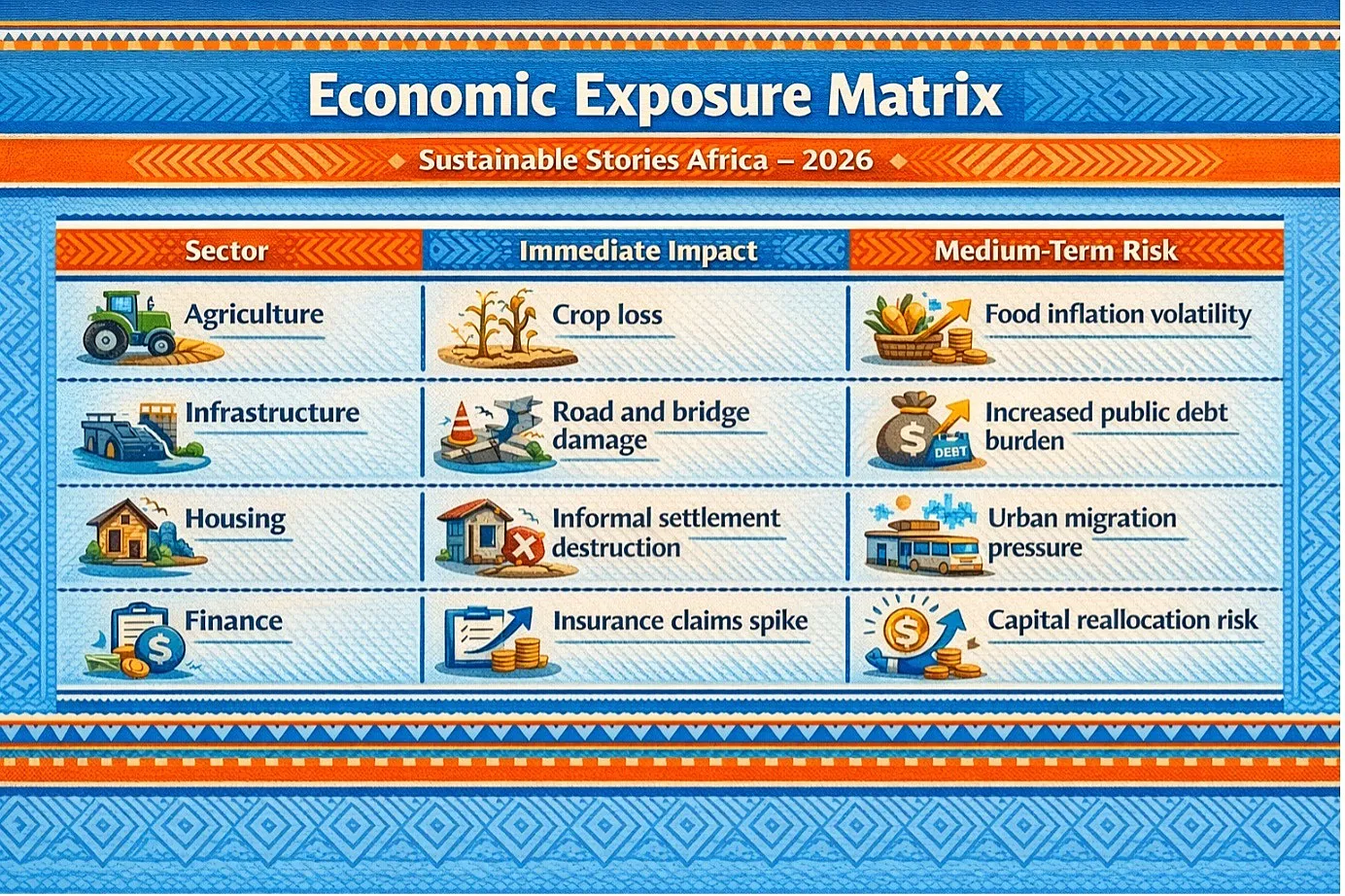
Economic Exposure Matrix
Sector | Immediate Impact | Medium-Term Risk |
|---|---|---|
Agriculture | Crop loss | Food inflation volatility |
Infrastructure | Road and bridge damage | Increased public debt burden |
Housing | Informal settlement destruction | Urban migration pressure |
Finance | Insurance claims spike | Capital reallocation risk |
The floods expose a fundamental imbalance: hazard frequency is accelerating faster than the deployment of adaptation capital.
Closing the Adaptation Execution Gap
Policymakers must:
- Ring-fence climate adaptation budgets
- Enforce floodplain zoning regulations
- Integrate climate modelling into urban planning
- Expand early-warning systems
Development banks and climate funds must prioritise infrastructure resilience over reactive relief financing.
Boards and institutional investors should integrate physical climate risk assessments into capital allocation decisions, particularly in agriculture and infrastructure portfolios.
Disclosure without implementation will not reduce flood risk. Execution will.
PATH FORWARD – Resilience Requires Institutional Acceleration
Southern Africa’s floods highlight a widening gap between climate science and infrastructure preparedness.
Closing that gap demands coordinated fiscal planning, urban reform and scaled adaptation finance to protect economic stability in an era of intensifying climate volatility.
Climate variability is cyclical. Vulnerability is structural.