The world is improving in its ability to survive storms, but not everywhere and not for every hazard. A new analysis of nearly four decades of disaster deaths shows Asia quietly saving hundreds of thousands of lives, while Africa and Europe confront deadlier flood and heat extremes shaped by population growth and climate change.
When Climate Hazards Kill, Patterns Shift
Floods, storms, and extreme temperatures have claimed nearly one million lives in major climate-related disasters between 1988 and 2024. However, the trajectory of risk is shifting in uneven ways. A new Geophysical Research Letters study analyses almost 2,000 of the deadliest climate events to confront a critical policy question: are societies becoming more effective at preventing fatalities when extreme weather strikes?
Drawing on a non-stationary model of the EM-DAT database, University of Chicago researcher B.B. Cael finds diverging regional patterns. In Asia, storms and floods are becoming less deadly and less frequent despite population growth and heavier rainfall. In Africa, flood fatalities are rising with increased exposure, while in Europe, intensifying heatwaves are driving higher mortality as cold extremes recede.
The study estimates that Asia's development gains have saved approximately 350,000 lives since 1988, a 40% reduction in mortality. However, 2023's Storm Daniel in Libya illustrates how infrastructure fragility and governance lapses can reverse decades of resilience in a single event.
Asia Saves Lives, Others Face Rising Peril
Climate risk is no longer defined solely by frequency, but by preparedness. By applying a generalised Pareto distribution to mortality data from extreme temperatures, floods and storms, Cael's study isolates the fatal "tail" of disasters. These are events which caused at least 30 deaths, revealing regional patterns often obscured by volatility.
Across 1,974 disasters since 1988, Asia stands out: storm and flood mortality and frequency have declined despite rising populations and heavier rainfall, with statistical tests highlighting reduced vulnerability as the driver.
By contrast, deadly African floods are increasing, while European heatwaves are becoming more lethal. In the Americas, mortality trends remain statistically indistinct, a reminder of data fragility.
Disaster Data Reveals Unequal Risk Trajectories
The study draws from EM-DAT's 26,000-event archive, narrowing to 1,974 major climate hazards, including floods, storms and extreme temperatures that killed at least 30 people between 1988 and 2024, representing 95% of recorded fatalities. Grouped by continent to minimise distortion, the dataset captures 300 temperature extremes, 1,088 floods and 586 storms, which were responsible for 940,895 deaths.
Focusing on the upper mortality tail through a generalised Pareto model, the analysis identifies only four significant shifts among 30 regional combinations: the decline in frequency and deadliness of Asian floods and storms; rising frequency of African floods; and increased deadliness of European extreme temperatures.
A further layer separates climate from exposure and vulnerability. In Asia, heavier rainfall persists, indicating gains, stronger infrastructure and response systems are reducing deaths.
In Africa, rising fatalities reflect expanding exposure, as population growth places more communities in flood-prone zones.
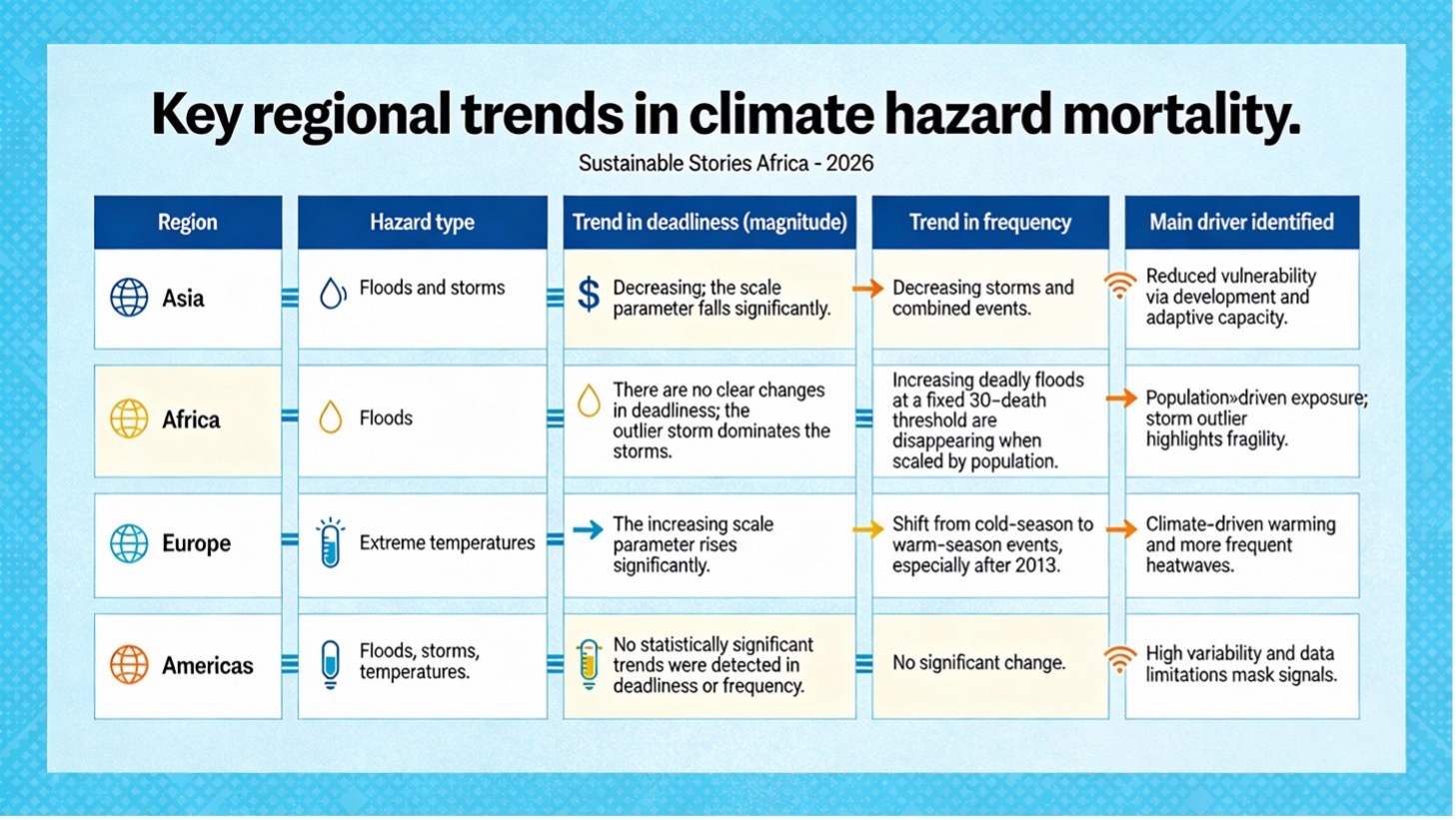
Key regional trends in climate hazard mortality
| Region | Hazard type | Trend in deadliness (magnitude) | Trend in frequency | Main driver identified |
|---|---|---|---|---|
| Asia | Floods and storms | Decreasing; the scale parameter falls significantly. | Decreasing | Reduced vulnerability via development and adaptive capacity. |
| Africa | Floods | There are no clear changes in deadliness; the outlier storm dominates the storms. | Increasing deadly floods at a fixed 30‑death threshold are disappearing when scaled by population. | Population‑driven exposure; storm outlier highlights fragility. |
| Europe | Extreme temperatures | The increasing scale parameter rises significantly. | Shift from cold‑season to warm‑season events, especially after 2013. | Climate‑driven warming and more frequent heatwaves. |
| Americas | Floods, storms, temperatures | No statistically significant trends were detected in deadliness or frequency. | No significant change. | High variability and data limitations mask signals. |
Quantifying Lives Saved And Lost Futures
The study's most consequential finding comes from Asia, where rising exposure and intensifying rainfall coincide with declining mortality, offering rare, measurable evidence of resilience at scale.
Modelling a counterfactual in which vulnerability remained at 1988 levels, Cael estimates that adaptation and development saved roughly 350,000 lives between 1988 and 2024, with a 95% confidence range of 220,000 to 560,000.
This equates to about a 40% reduction in deaths from major Asian floods and storms. Investments in forecasting, embankments, early-warning systems and evacuation capacity are quietly preventing tens of thousands of fatalities each decade.
By contrast, Libya's 2023 Storm Daniel, which killed an estimated 13,200, illustrates how infrastructure failure and governance gaps can transform extreme weather into a systemic catastrophe.
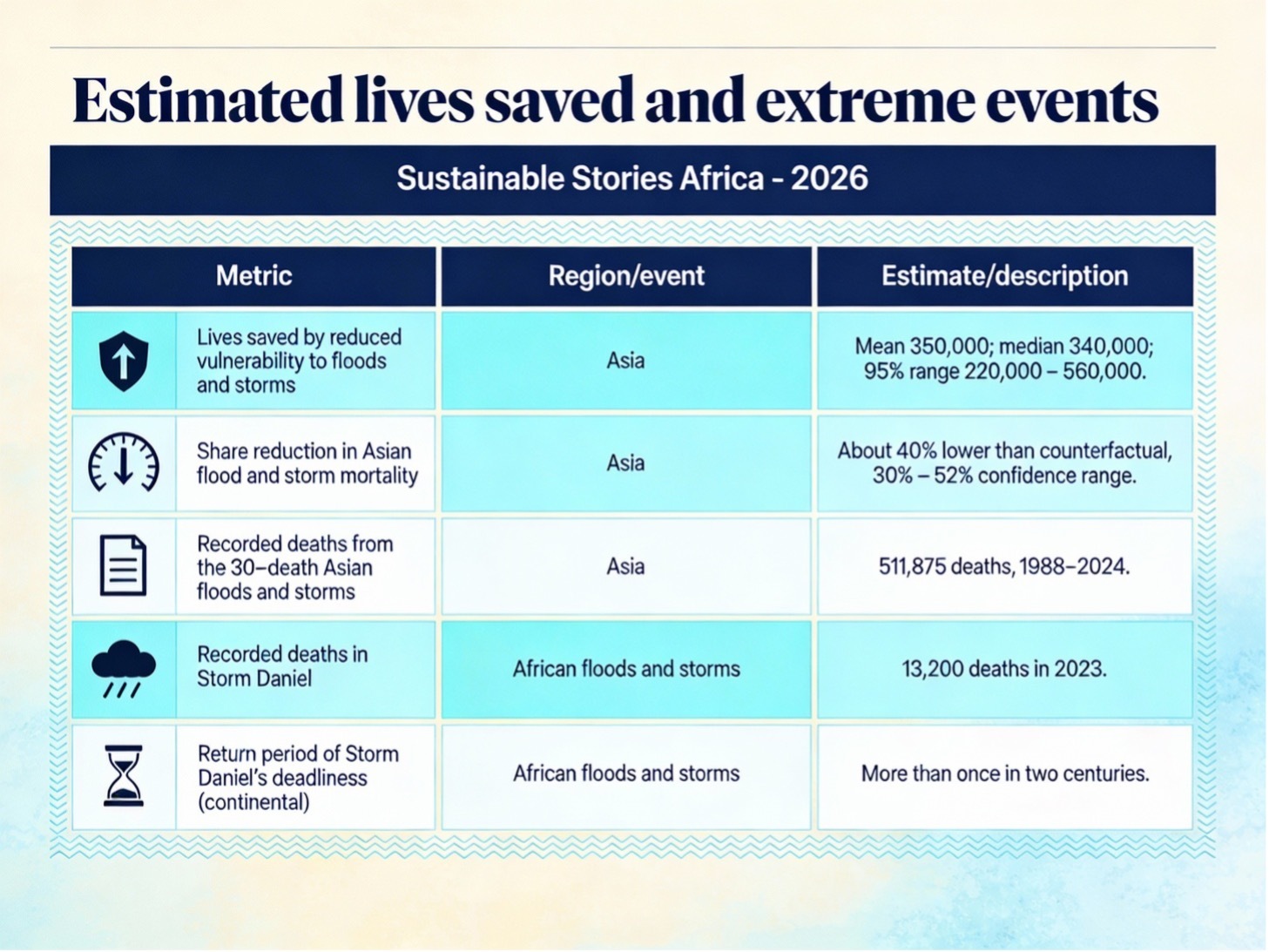
Estimated lives saved and extreme events
| Metric | Region/event | Estimate/description |
|---|---|---|
| Lives saved by reduced vulnerability to floods and storms | Asia | Mean 350,000; median 340,000; 95% range 220,000 – 560,000. |
| Share reduction in Asian flood and storm mortality | Asia | About 40% lower than counterfactual, 30% – 52% confidence range. |
| Recorded deaths from the 30‑death Asian floods and storms | Asia | 511,875 deaths, 1988–2024. |
| Recorded deaths in Storm Daniel | African floods and storms | 13,200 deaths in 2023. |
| Return period of Storm Daniel's deadliness (continental) | African floods and storms | More than once in two centuries. |
The lesson for policymakers is clear: adaptive investment saves lives, while weak institutions magnify risk.
For rapidly urbanising African cities and heat-exposed Europe, Asia offers a measurable benchmark for resilience.
Turn Mortality Data Into Preparedness Mandates
Cael's analysis reinforces a critical point: disaster mortality is not an inevitable consequence of warming, but a function of governance, planning and infrastructure performance.
Sustaining these insights, however, depends on continued investment in transparent, standardised databases such as EM-DAT, whose long-term funding remains uncertain.
Path Forward – From Counting Losses To Preventing Deaths
Across regions, the findings converge on a clear operational agenda: replicate Asia's sustained investments in early-warning systems, climate-resilient infrastructure and coordinated emergency response, while deliberately focusing on rapidly urbanising, high-exposure populations where risk is compounding fastest. Resilience must be scaled with demographic reality, not after disaster strikes.
At the same time, governments and funders must protect and modernise disaster data architecture. Robust, standardised and well-financed databases are essential for early detection of mortality trends, capital allocation, shaping regulation and enabling community-level adaptation, before the next century storm tests institutional readiness.