
ESG reform in Africa is not just about regulation. It is about leadership.
Dr Kola Adesina argues that global sustainability rules must align with local realities and that lasting corporate integrity begins with disciplined decision-making.
From boardrooms to regulators, he insists Africa must move from passive compliance to structured leadership, embedding governance, accountability and long-term thinking at the core of institutional transformation.

Structured Leadership Anchors Africa's ESG Future – Discipline Before Disclosure, Integrity Before Scale
Africa's ESG debate is entering a more deliberate phase. Less rhetorical, more structural. At a time when global sustainability regulations are accelerating, Dr Kola Adesina is reframing the conversation. Compliance alone, he argues, will not secure Africa's long-term competitiveness. Leadership design will.
In a recent interview on Asharami Radio with Cynthia Ade-Martins, Dr Adesina delivered a consistent message: integrity is non-negotiable, but implementation must reflect context. "We must not become passive rule-takers," he said. "If ESG frameworks ignore local realities, they risk becoming burdens rather than enablers."
His argument connects two powerful ideas: ESG reform and leadership discipline. Both, he insists, begin with decision-making, accountability and structured execution. "Transformation begins with responsibility," Adesina noted. "And responsibility begins with a decision."
Africa's next chapter in sustainability may depend less on new policies and more on how leaders design systems to implement them.
ESG Reform Meets Leadership Design
The reality is clear. African corporations are facing growing pressure to adopt ISSB-aligned disclosures, climate reporting standards and governance reforms.
However, data systems remain fragmented, enforcement is uneven, and institutional capacity is still maturing.
Adesina cautions against reflexive regulatory mimicry. "We must not reject global standards, but neither should we accept them uncritically," he said.
The implication is profound. ESG compliance without leadership discipline risks becoming symbolic. Leadership without governance systems risks becoming unstable. Africa, he argues, must align both.
At stake is capital access, investor confidence and long-term economic credibility.
The Architecture Behind Integrity
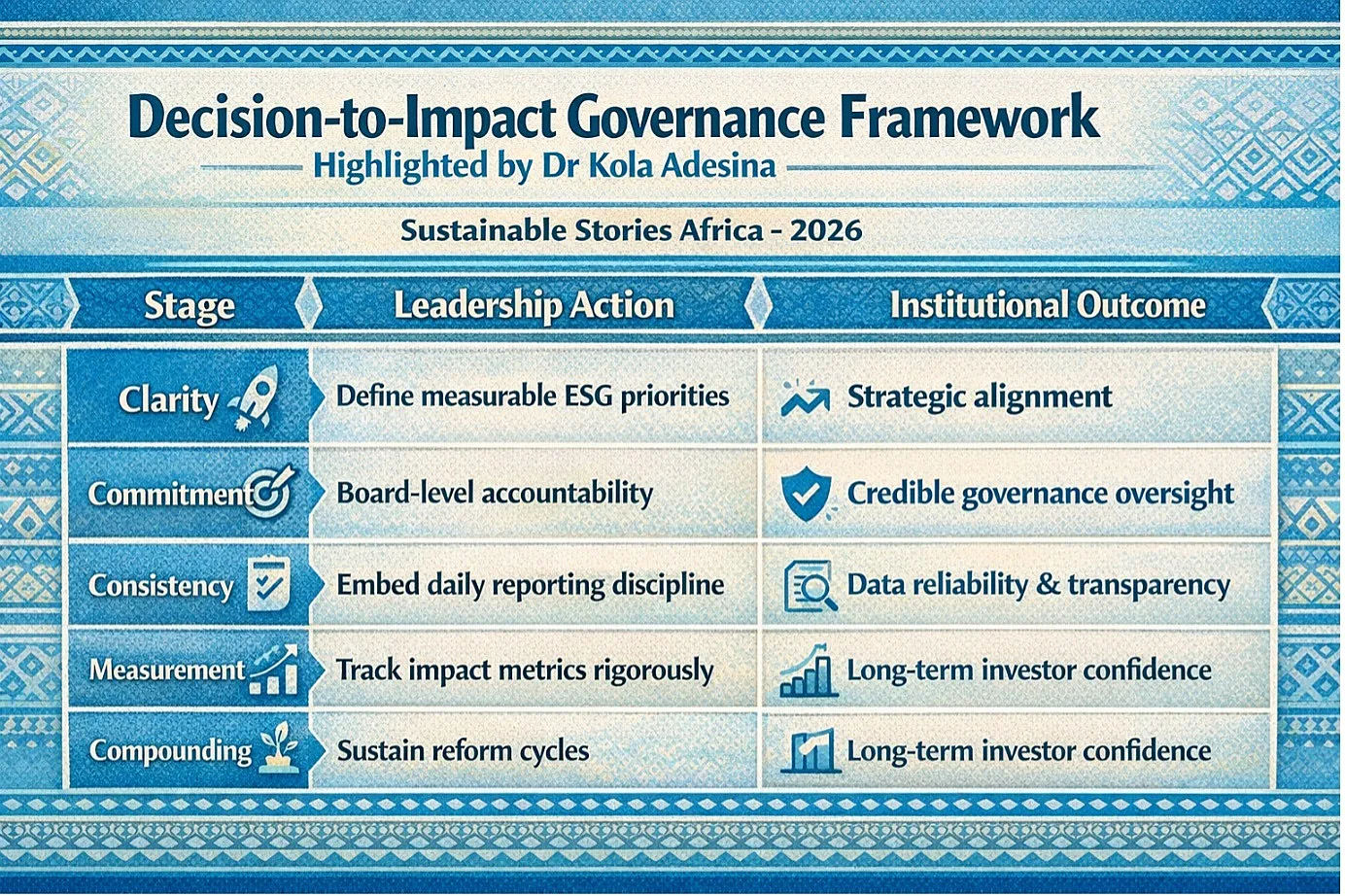
Dr Adesina outlined a repeatable progression for sustainable leadership and institutional reform:
Decision-to-Impact Governance Framework
| Stage | Leadership Action | Institutional Outcome |
|---|---|---|
| Clarity | Define measurable ESG priorities | Strategic alignment |
| Commitment | Board-level accountability | Credible governance oversight |
| Consistency | Embed daily reporting discipline | Data reliability |
| Measurement | Track impact metrics rigorously | Transparency |
| Compounding | Sustain reform cycles | Long-term investor confidence |
"Vision without discipline is hallucination," Dr Adesina said.
This framing moves ESG away from abstract sustainability language toward operational governance.
Whether in emissions disclosure, anti-corruption oversight or board independence, systems, not slogans, determine outcomes.
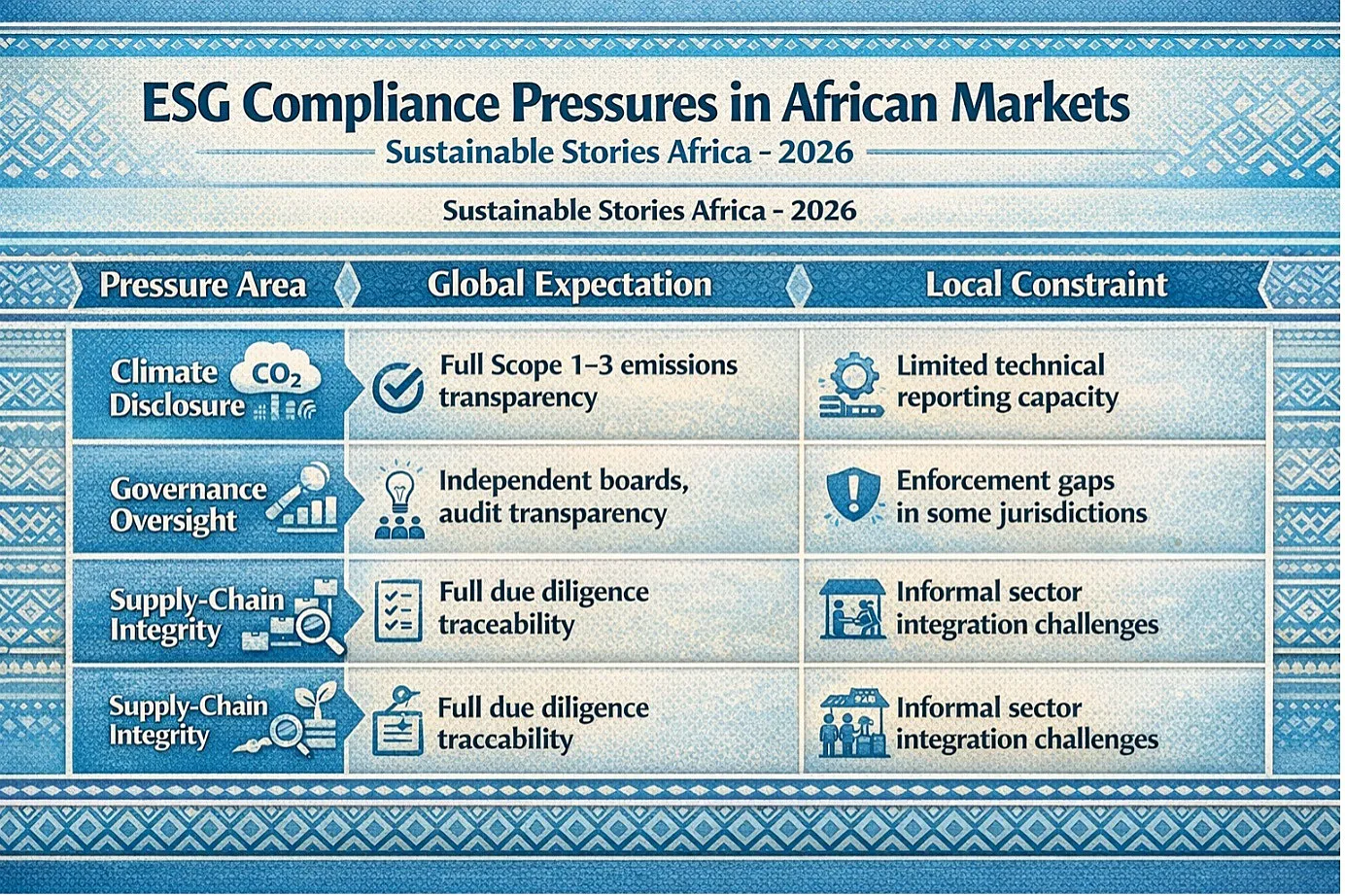
The discussions during the interview on ESG reform reinforced three structural pressures confronting African markets:
ESG Compliance Pressures in African Markets
| Pressure Area | Global Expectation | Local Constraint |
|---|---|---|
| Climate Disclosure | Full Scope 1–3 emissions transparency | Limited technical reporting capacity |
| Governance Oversight | Independent boards, audit transparency | Enforcement gaps in some jurisdictions |
| Supply-Chain Integrity | Full due diligence traceability | Informal sector integration challenges |
Dr Adesina's argument does not dismiss global standards. Instead, it emphasises sequencing. Starting with capacity building, strengthening institutions and designing implementation pathways.
"Compliance should not be cosmetic," he said. "It must be embedded in executive accountability."
Discipline as Competitive Advantage
Where the conversations converge most powerfully is on opportunity. "When discipline becomes culture, performance becomes predictable," Adesina stated.
Applied to ESG, this principle transforms reform from obligation to advantage. Transparent governance lowers risk premiums. Reliable disclosures attract institutional capital. Structured oversight reduces volatility.
Adesina describes this as a multiplier effect: disciplined systems create compounding trust.
Africa's demographic expansion, renewable energy potential and growing capital markets position it strategically. However, credibility will determine capital flows. Investors are increasingly assessing governance resilience as closely as growth projections.
The shift required is cultural. Leaders must first govern themselves, make decisions, allocate time and priorities, before governing institutions.
"Stop waiting for perfect conditions," he urged. "Make the decision, build the structure, and let consistency carry you."
From Compliance to Structured Transformation
Adesina's prescription is deliberate and layered:
- Boards must institutionalise ESG oversight, not delegate it symbolically.
- Regulators must phase implementation to reflect economic maturity.
- Corporations must invest in data systems and governance education.
- Investors must reward credible progress, not cosmetic alignment.
Above all, Africa must participate in shaping global standards rather than merely importing them.
Leadership by design. Governance by structure. Reform by execution.
Path Forward – Structured Discipline Drives Sustainable Credibility
Africa's ESG evolution will depend on embedding disciplined leadership into governance systems. The priority is phased reform, board-level accountability and measurable transparency.
By aligning global standards with local realities and converting vision into structured execution, African institutions can transform ESG from a compliance burden to a competitive advantage, unlocking sustainable capital and long-term credibility.