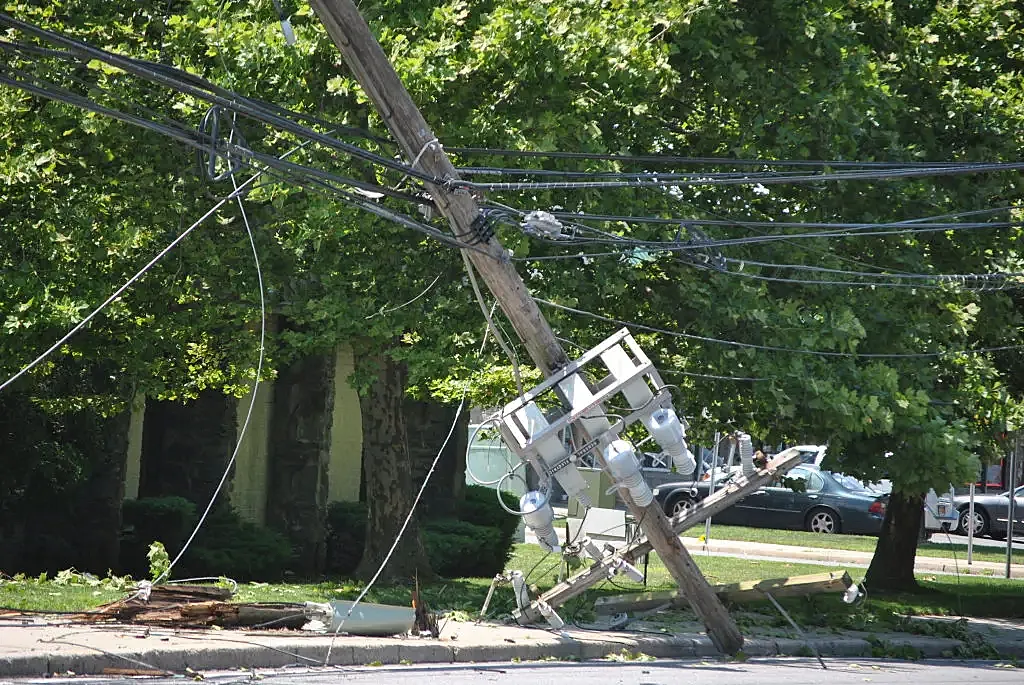
Climate shocks are no longer distant projections; they are balance-sheet risks.
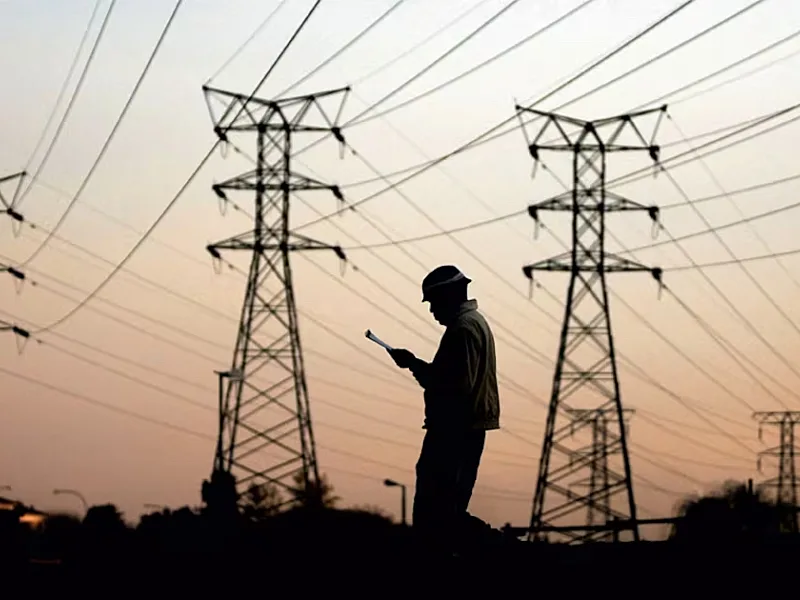
IRENA's 2025 report warns that power systems worldwide are dangerously exposed to extreme weather, with outages now cascading across economies and supply chains.
As electricity's share of final energy demand is set to more than double by mid-century, climate-proofing grids is no longer optional.
It is a strategic imperative for energy security, economic stability and sustainable growth.
Climate-Proofing Grids in an Era of Extremes
Across continents, the evidence is mounting that power systems for yesterday's climate are struggling to withstand today's extremes. The International Renewable Energy Agency's (IRENA's) Enhancing Resilience: Climate-Proofing Power Infrastructure presents a stark conclusion: without proactive adaptation, grids will increasingly fail under the weight of storms, floods, heatwaves and droughts.
Extreme weather events have quadrupled since the 1970s, with economic losses increasing sevenfold. In 2024 alone, the ten most costly climate events caused more than $228 billion in damages. Meanwhile, IRENA projects that by 2050, electricity will account for over 52% of total final energy consumption, up from 23% in 2022, a structural shift that deepens reliance on resilient grids.
The implication is clear: climate adaptation must move from policy rhetoric to infrastructure reality.
When Grids Become Economic Fault Lines
Hurricane Helene's $55 billion impact in 2024 left 4.7 million people without power. Winter Storm Uri in Texas caused losses estimated at up to $130 billion. Cyclone Idai left 1.8 million people in Mozambique without electricity.
These are not isolated disasters. They represent a pattern IRENA describes as "high-impact, low-probability" (HILP) events, climate shocks that grids were never designed to absorb.
The report reveals a clear upward trend in global natural disasters between 1970 and 2024. The trendline is not subtle. It is structural.
Power outages are no longer technical inconveniences; they are macroeconomic disruptions.
Mapping Vulnerability Across the Value Chain
IRENA's analysis dissects vulnerability along the grid value chain, fuel supply, generation, transmission, distribution and end-use.
A failure in one segment cascades downstream. Fuel disruptions disable generation; generation outages weaken transmission; transmission failures darken entire regions.
Between 1992 and 2010, 78% of major disruptions to U.S. distribution services were weather-related. Transmission and distribution (T&D) infrastructure remains the most exposed component, with restoration often taking weeks.
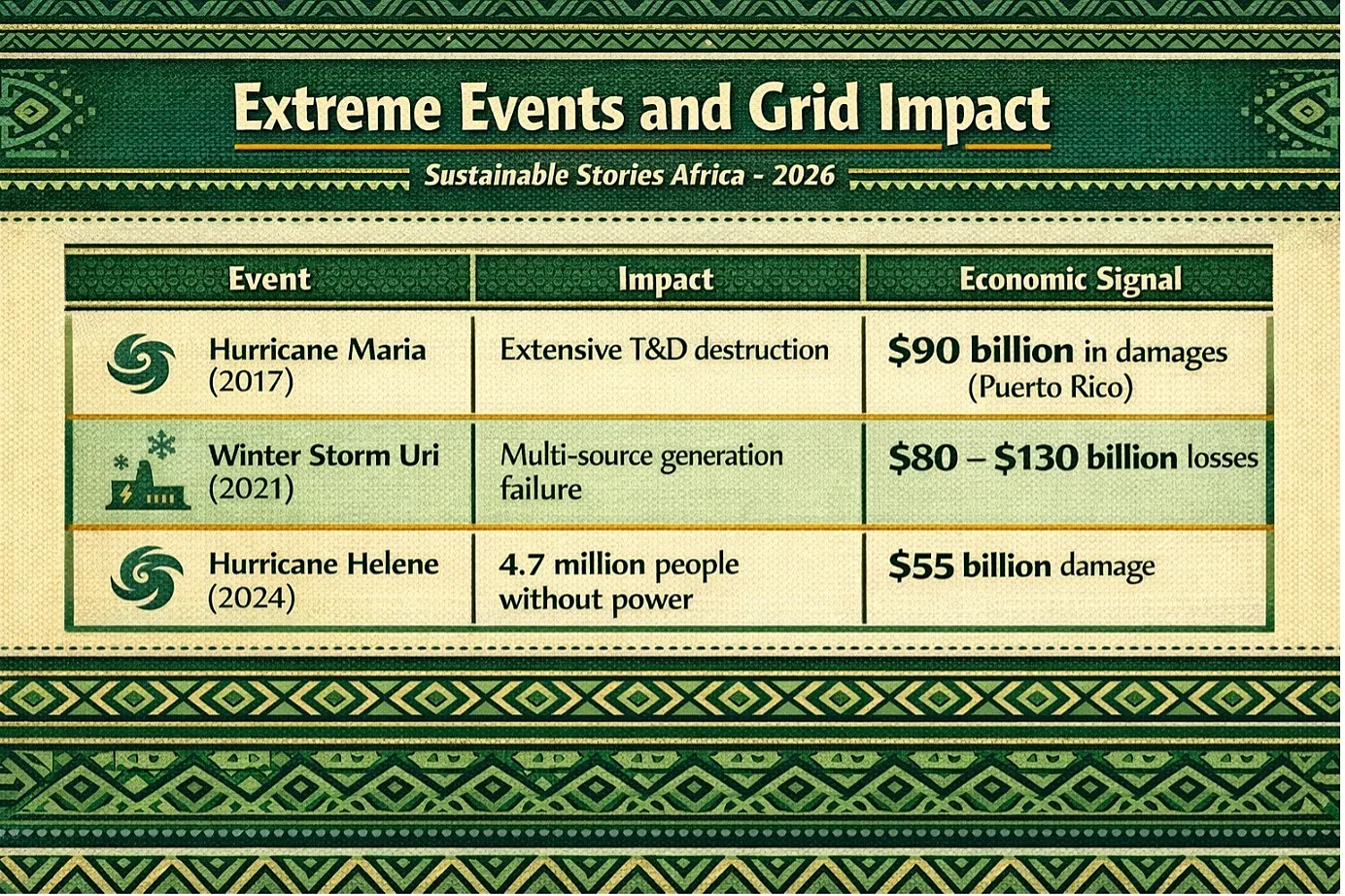
Extreme Events and Grid Impact
| Event | Impact | Economic Signal |
|---|---|---|
| Hurricane Maria (2017) | Extensive T&D destruction | $90 billion in damages (Puerto Rico) |
| Winter Storm Uri (2021) | Multi-source generation failure | $80 – $130 billion losses |
| Hurricane Helene (2024) | 4.7 million people without power | $55 billion damage |
The vulnerability extends beyond wires and substations. Climate-driven temperature extremes are increasing peak demand for cooling and heating, stressing grids that are already weakened by ageing infrastructure.
Meanwhile, renewable-heavy systems face new exposure: hydropower suffers during droughts; solar and wind output fluctuate under extreme conditions.
Resilience is no longer about backup generators. It is about systemic redesign.
Ten Actions to Climate-Proof Power Infrastructure
At the heart of the report is a 10-point action agenda. The recommendations move beyond reactive repairs toward proactive adaptation.
They include:
- Mapping systemic vulnerabilities through advanced climate modelling.
- Conducting cost-benefit analyses to prioritise resilience investments.
- Hardening infrastructure against floods, storms and heat.
- Scaling distributed energy resources (DERs) and storage.
- Integrating grid-forming renewables to maintain stability during disruption.
- Deploying smart grid technologies for predictive response.
- Unlocking innovative finance mechanisms for resilience upgrades.
Energy storage emerges as a cornerstone solution. Modular battery systems can provide black-start capability, restore critical services and stabilise grids during outages.
Smart grids add a second layer of protection. By integrating climate and weather data into planning, such as PG&E's wildfire risk modelling in California, utilities can anticipate, not react to, disruption.
For emerging economies and climate-vulnerable regions, this approach offers more than resilience. It offers development security.
From Policy Intent to Investment Discipline
The report is explicit: adaptation must be embedded in national climate frameworks, including updates of NDC 3.0 and National Adaptation Plans.
Policy reform is central. Traditional regulatory models often fail to adequately price resilience risk. Incentive-based frameworks, such as Italy's distribution resilience reforms, demonstrate how regulators can align utility investment with climate risk mitigation.
Financing mechanisms must evolve. IRENA highlights grant building, concessional finance, public-private partnerships and resilience-themed debt instruments as viable tools.
For African grids, where electrification rates are rising, and climate exposure remains high, the message is particularly urgent. Investment today in resilient infrastructure reduces tomorrow's reconstruction costs.
The alternative, "fix it when it breaks", is economically unsustainable.
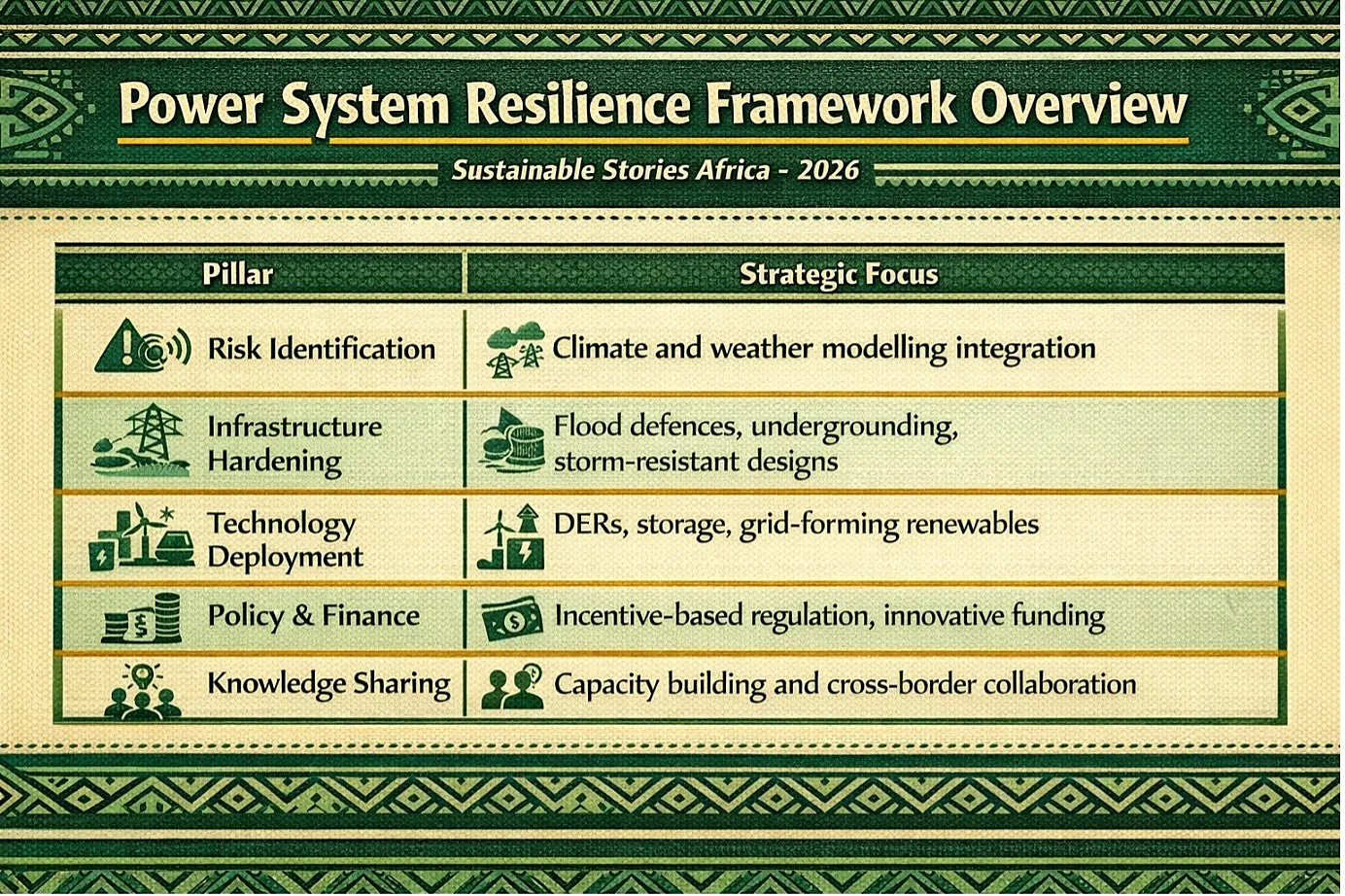
Power System Resilience Framework Overview
| Pillar | Strategic Focus |
|---|---|
| Risk Identification | Climate and weather modelling integration |
| Infrastructure Hardening | Flood defences, undergrounding, storm-resistant designs |
| Technology Deployment | DERs, storage, grid-forming renewables |
| Policy & Finance | Incentive-based regulation, innovative funding |
| Knowledge Sharing | Capacity building and cross-border collaboration |
Path Forward: Embedding Climate Resilience into Energy Planning
Power system resilience must shift from emergency response to strategic design. Governments are being urged to integrate climate modelling, reform regulatory incentives and unlock blended finance for grid upgrades.
The next phase is implementation: hardening infrastructure, scaling distributed renewables and embedding resilience metrics into planning cycles. Climate-proofing grids is no longer about survival; it is about safeguarding economic continuity in an electrified world.